产业升级

Search documents
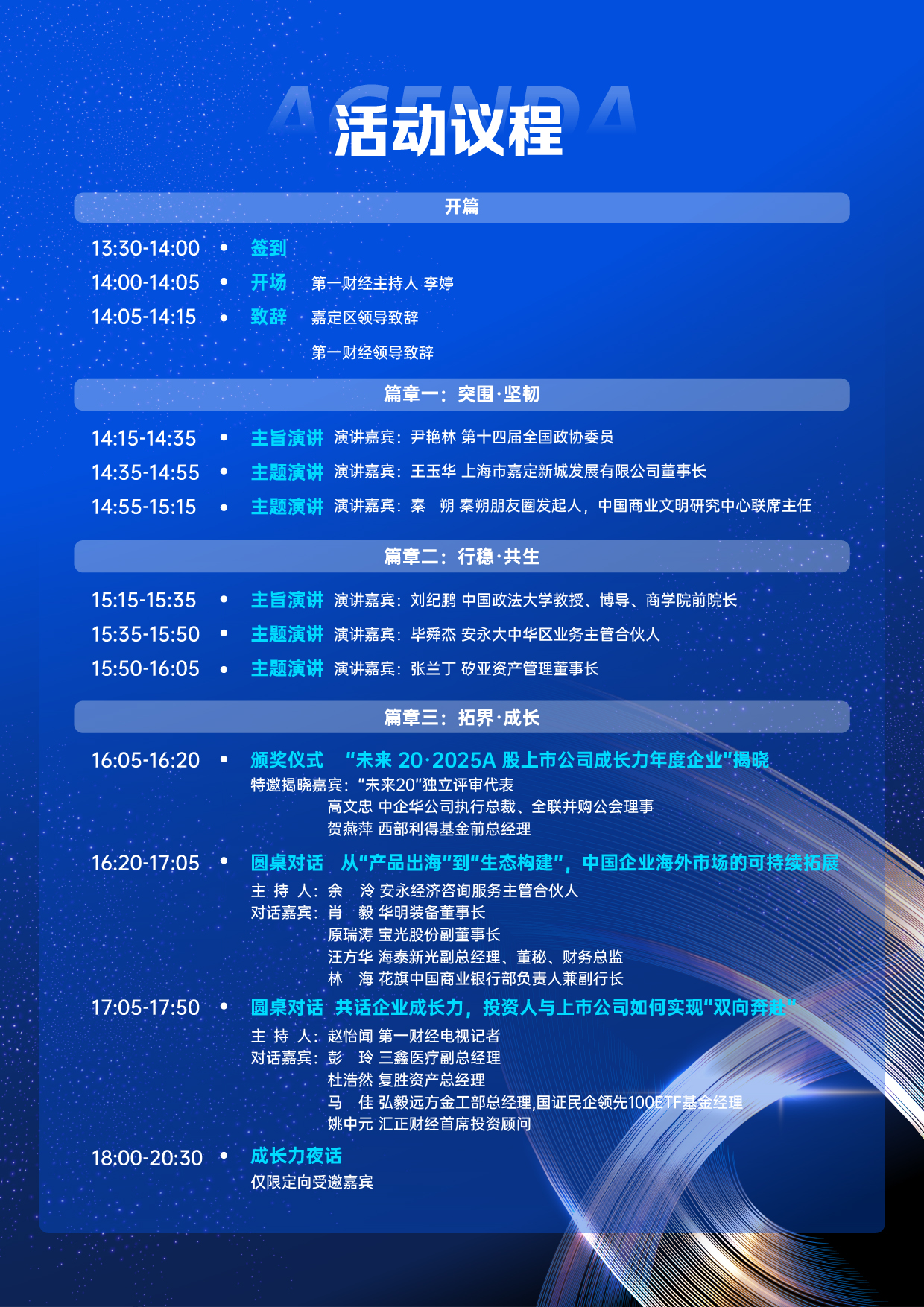
关注高质量发展新势力,未来20 · 2025 A股上市公司成长力年会将重磅开启
Di Yi Cai Jing· 2025-11-28 11:14
Group 1 - The healthy development of small and medium-sized enterprises (SMEs) is crucial for improving industrial structure and unleashing innovation in China's economy [1][2] - The "Future 20·2025 A-share Listed Companies Growth Power Annual Conference" will focus on the growth of SMEs in the capital market, featuring government leaders, experts, and representatives from growth-oriented companies [1][2] - The event aims to identify and track value growth enterprises in China, analyzing their development potential and extracting successful experiences to fill research gaps in the capital market [2][3] Group 2 - SMEs are seen as key players in innovation and industrial upgrading, adapting to rapid technological changes and global industrial restructuring [2][3] - Many surveyed companies indicated that expanding overseas is a vital strategy for growth, either through mergers and acquisitions or by investing in capacity and industrial ecosystems abroad [3] - The conference will include discussions on sustainable overseas market strategies and how companies can achieve mutual growth with investors [5]

多地年末发债,扎堆投向政府引导基金
FOFWEEKLY· 2025-11-28 10:01
Core Viewpoint - The article discusses the recent trend of local governments in China issuing special bonds to inject capital into government investment guidance funds, aiming to enhance funding efficiency and stimulate market liquidity, particularly in the technology innovation sector [4][6][12]. Group 1: Special Bonds and Government Investment Guidance Funds - Multiple regions, including Guangdong, Sichuan, and Shanghai, are set to issue a total of 200 billion yuan in special bonds, with Shenzhen recently issuing 65.2 billion yuan, primarily directed towards government investment guidance funds [5][6]. - The total scale of special bonds directed towards government investment guidance funds has exceeded 800 billion yuan, indicating a significant shift in funding strategy [5][6]. - The issuance period for these special bonds ranges from 10 to 30 years, with a focus on technology innovation as the primary investment area [5][6]. Group 2: Policy Changes and Implications - The policy shift allowing special bonds to be used for government investment guidance funds marks a significant change from previous regulations that prohibited such practices due to risk management concerns [10][11]. - The change is seen as a response to diminishing returns from traditional infrastructure investments and aims to transition fiscal policy from merely "supplementing projects" to "nurturing industries" [12][11]. - The government investment guidance funds are designed to leverage public funds to attract more social capital into strategic sectors, enhancing the efficiency of fund utilization and promoting industrial upgrades and technological innovation [13][12]. Group 3: Focus on Technology and Innovation - Local governments are increasingly directing special bonds towards technology innovation, with specific allocations for sectors such as artificial intelligence, aerospace, and biomedicine [15][18]. - The investment focus has shifted from broad areas to more specialized fields, aligning with China's transition from factor-driven to innovation-driven economic growth [15][16]. - The government investment guidance funds are expected to play a crucial role in addressing early-stage investment gaps in technology and innovation, thereby fostering the development of internationally competitive enterprises [16][19]. Group 4: Regional Strategies and Outcomes - Different regions are adopting tailored strategies based on their unique resources and development stages, with cities like Beijing and Shanghai focusing on advanced research and development capabilities [17][19]. - Shenzhen has established a robust government guidance fund system, with over 150 billion yuan in public funding attracting nearly 500 billion yuan in social capital, demonstrating a significant multiplier effect [18][17]. - The article emphasizes the need for a market-oriented approach and professional participation to enhance risk management and ensure effective use of fiscal resources in government investment guidance funds [19].

常州亮出“十五五”资本市场目标:新增上市公司30家、力争50家
Zheng Quan Shi Bao Wang· 2025-11-28 08:01
周伟简要介绍了近年来常州推动民营企业上市工作。他说,常州将抢抓综合改革试点宝贵机遇,锚 定"十五五"新增上市公司30家、力争50家目标,精准发力、久久为功,持续壮大资本市场"常州板块"。 常州各级党委政府部门将立足"1028"产业体系,加快构建"政府引导、市场主导、专业服务"上市服务体 系,积极推动资本、产业、创新、人才等要素联动,用好龙城科创基金等政府引导基金,加快形成资本 助力产业升级、产业吸引人才汇聚、人才推动创新发展的良性循环。希望广大民营企业勇当资本市场 的"生力军",主动拥抱资本市场,聚焦主业、苦练内功,争做行业标杆和百年老店。 截至目前,常州全市拥有境内外上市企业90家,存量A股上市公司数量列全国同类城市前列,民营企业 占比九成以上。今年以来,新增上市公司4家,新增新三板挂牌企业12家。会上,发布了证券公司常州 地区业绩榜单、常州市重点上市后备企业梯队。今年,常州共有816家企业列入上市后备企业库,其中 重点后备企业243家。会上,18个重点项目与券商集中签约。 11月27日,常州市推动优质民营企业高质量上市工作会议召开。省委金融工委副书记聂振平,江苏证监 局副局长毕庆锋,上海证券交易所市场发展 ...
熬下去,转折点要来了!
大胡子说房· 2025-11-28 03:52
Group 1 - The article suggests that a recovery trend may be emerging in the macroeconomic environment, indicating a potential wealth reshuffling opportunity that occurs approximately every ten years [1][11]. - It emphasizes the importance of the macroeconomic environment in determining individual investment success, highlighting that ordinary investors can benefit from aligning with prevailing trends [1][3]. - The current international environment is described as tense, which, while seemingly negative, may also signal opportunities for economic intervention and recovery [2][3]. Group 2 - Governments typically respond to economic downturns with intervention strategies, which can create investment opportunities. These strategies include monetary policy adjustments, fiscal stimulus, and institutional reforms [3][4]. - The article notes that liquidity is crucial for market performance, with historical examples showing that increased liquidity often leads to rising asset valuations [3][6]. - The discussion includes the importance of institutional reforms in capital markets, suggesting that these reforms are necessary for a healthy market cycle and can lead to a more favorable investment environment [4][10]. Group 3 - The article identifies a third signal of a turning point: the potential for an industrial upgrade, particularly in the AI sector, which is expected to experience significant growth due to technological convergence [16][29]. - It highlights that the current technological revolution is unique because it involves multiple disruptive technologies maturing simultaneously, which could lead to substantial economic growth [18][19]. - Predictions indicate that if these technologies succeed, global GDP growth could double, with inflation potentially decreasing to zero or even negative levels [29][41]. Group 4 - The article stresses the need for investors to adapt their strategies in response to market changes, emphasizing that the market is not linear and can be influenced by various factors [46][48]. - It warns against the risks of holding a single type of asset in a volatile environment, suggesting that diversification is essential for managing risk [52][54]. - The article concludes by encouraging investors to prepare for upcoming market shifts and to consider joining membership programs that provide insights and strategies for navigating these changes [56][68].

金发科技20251127
2025-11-28 01:42
Summary of Jinfa Technology Conference Call Company Overview - Jinfa Technology has shown steady revenue growth, with revenue increasing from 35.061 billion CNY in 2020 to 60.514 billion CNY in 2024, representing a compound annual growth rate (CAGR) of approximately 14.62% [2][3] - In the first three quarters of 2025, the company achieved revenue of 49.616 billion CNY, a year-on-year increase of 22.62%, and turned a profit with a net profit attributable to shareholders of 1.065 billion CNY, up 55.86% year-on-year [2][4] Industry Insights - The modified plastics market in China is highly dependent on imports, with a consumption of approximately 174,000 tons in 2023 and a production of only 85,000 tons [6] - The special engineering plastics market in China is expected to maintain rapid growth from 2023 to 2028, with a CAGR of about 7.2%, reaching a consumption of 246,000 tons by 2028 [6] Key Points Core Competencies 1. **Production Capacity and Cost Advantage**: Jinfa Technology's total production capacity for modified plastics is 3.72 million tons, with domestic capacity at 3.35 million tons and overseas capacity at 370,000 tons, leading the domestic market [4] 2. **Research and Development**: The company has a robust R&D system with 6,813 domestic and international patents filed by the end of 2024, positioning it at the forefront of the manufacturing industry [4] 3. **Diverse Product Matrix**: Jinfa Technology offers a one-stop solution with a diversified business layout including high-performance recycled plastics, biodegradable plastics, and special engineering plastics [4] 4. **Strong Customer Relationships**: The company has established strategic partnerships with top manufacturers in the automotive, home appliance, and electronics sectors, and has production bases in the US, Germany, and India [4] 5. **Upstream Raw Material Integration**: Jinfa Technology has built an integrated supply chain from propane to polypropylene resin, which, despite recent losses in the petrochemical sector, is strategically beneficial for long-term raw material supply [4] New Material Business Development - Jinfa Technology's new materials business is expected to benefit from domestic substitution and industrial upgrades, with a projected average CAGR of over 7% for chemical new materials consumption in China from 2023 to 2030 [5] Special Engineering Plastics - The company is actively expanding its capacity in special engineering plastics, with current production capacity at 39,000 tons per year, including high-temperature nylon, LCP, and PPSU [7] - Plans include launching a 10,000 tons per year LCP resin project and a 40,000 tons per year special polyamide project, with the first phase of 8,000 tons expected to be operational in Q1 2026 [8] Innovations in New Materials - Jinfa Technology has made significant innovations in biodegradable plastics, achieving a design capacity of 330,000 tons per year, with sales of 161,300 tons in the first three quarters of 2025, a 27% increase year-on-year [9] Carbon Fiber and Composite Materials - The company has a production capacity of 52,000 tons per year for carbon fiber and composite materials, with revenue of 210 million CNY in the first half of 2025, a 15.93% increase year-on-year [10] - The demand for carbon fiber in emerging fields such as electric vertical takeoff and landing vehicles is expected to rise significantly [10][11] Future Outlook - EPS forecasts for Jinfa Technology are 0.54 CNY, 0.66 CNY, and 0.85 CNY for 2025 to 2027, corresponding to a price-to-earnings ratio of 19 to 22 times [12] - The company is transitioning from a broad modified plastics leader to a high-end chemical new materials platform, with a positive long-term growth outlook despite recent stock price adjustments [12] - Risks to monitor include underperformance of subsidiaries, cost fluctuations, and changes in the overseas trade environment [12]

和君咨询:化工上市公司发展报告(2025)
Sou Hu Cai Jing· 2025-11-28 01:16
Core Insights - The report indicates that the Chinese chemical industry is entering a critical turning point between 2024 and 2025, characterized by a combination of cyclical stabilization and deepening industrial upgrades, with features such as demand differentiation, supply optimization, cost fluctuations, and clear policy guidance [1][19]. Overall Overview - The report focuses on 431 A-share listed chemical companies, analyzing the industry's development trends from multiple dimensions [1][8]. - The chemical industry is currently in a new stage of innovation-driven and global development, with significant influence in the A-share market, reflected in the number of companies, market capitalization, and revenue [1][19]. - Chemical products dominate in terms of company numbers, market capitalization, revenue, and profit, followed by plastics, agricultural chemicals, and chemical raw materials [1][19]. - Zhejiang, Shandong, and Jiangsu provinces lead in key indicators, while other provinces show a gradient development pattern based on resource endowments and industrial upgrade pace [1][19]. Market Performance - Chemical product prices faced pressure after fluctuations in 2024, continuing to operate at low levels in 2025, indicating the industry is still in a bottoming phase [1][19]. - Price differentials for chemical products showed increased volatility in 2024, with a shift from negative to positive in early 2025 before slightly narrowing [1][19]. - Although stock prices rebounded, they underperformed compared to the broader market, with valuations remaining at historical lows [1][19]. - There is significant divergence in market capitalization performance, with leading companies and high-growth targets standing out [1][19]. Operating Conditions - Revenue showed resilience in scale, with a slight growth in 2024, while net profit attributable to shareholders exhibited structural differentiation [2][20]. - Revenue growth turned positive, while profit growth remained negative but significantly narrowed [2][20]. - Profitability faced deep pressure, reflecting a differentiated pattern amid industrial transformation challenges [2][20]. - Operational capabilities showed significant differentiation, with asset and account management reflecting operational resilience [2][20]. - The asset-liability ratio increased marginally, with financial strategies adapting to industrial upgrade needs [2][20]. Capital Operations - In 2024, equity financing saw a comprehensive contraction, with capital focusing on quality tracks and core projects [2][20]. - Bond financing showed moderate recovery, with funds concentrating on quality projects and leading entities [2][20]. Capacity Construction - Capital expenditure contracted year-on-year, with fixed assets continuing to grow but at a slower pace, shifting from scale expansion to stock optimization and high-end upgrades [2][20]. - The total amount of ongoing projects steadily increased, but the growth rate slowed, with significant differentiation among sub-industries and a pronounced clustering effect among leading companies [2][20]. Technological Innovation - R&D intensity increased overall, with resources concentrating on high-end tracks and leading specialized companies, highlighting the logic of innovation-driven transformation [2][20]. - The proportion of R&D personnel continued to rise, with significant differentiation among sub-industries and companies, particularly among leading technology firms [2][20]. International Development - Overseas revenue showed overall recovery growth, with significant differentiation among sub-industries and leading companies deeply embedded in the global market [2][20]. - Foreign ownership showed increasing differentiation, with high-end technology companies receiving focused allocation, reflecting global capital's recognition of China's chemical industry's high-end transformation [2][20]. Policy Guidance - Encouraging policies focus on green low-carbon, high-end, and park-intensive development, promoting industrial upgrades [2][20]. - Restrictive policies rigidly eliminate backward production capacity and optimize inefficient layouts, strengthening environmental and safety constraints [2][20]. - Capital market policies support advanced chemical new materials, deepen market-oriented reforms in mergers and acquisitions, and guide capital towards strategic areas [2][20]. Case Insights - Wanhua Chemical builds a scale moat through integrated and global layouts, maintaining a stable traditional business while expanding new growth areas [2][20]. - New Hope achieves counter-cyclical growth through technological barriers and specialized routes, demonstrating the growth value of technology-driven and niche deep cultivation [2][20]. - Upwind New Materials highlights the mismatch between valuation and fundamentals, warning against over-reliance on capital sentiment and short-term events, emphasizing the importance of profit realization for valuation support [2][20].

A股IPO融资额重回千亿
Hua Er Jie Jian Wen· 2025-11-28 00:29
Group 1 - The core viewpoint is that the A-share IPO financing amount has returned to the trillion yuan scale in 2025, reaching 100.36 billion yuan, indicating a recovery in the capital market's support for the real economy [1][2] - The A-share IPO financing amount in 2025 is significantly lower compared to the historical high of over 500 billion yuan in 2021 and 2022, showing that this year's performance is not particularly outstanding [2] - The main board contributed over half of the IPO financing amount, totaling 52.38 billion yuan, driven primarily by the IPO of Huadian New Energy, which raised 18.17 billion yuan [2] Group 2 - The IPO financing growth has positively impacted investment banks' earnings, with five investment banks surpassing 10 billion yuan in IPO sponsorship amounts [2] - The value of IPOs extends beyond capital supply, as they play a crucial role in supporting enterprise growth, industrial upgrading, and economic structure optimization [2] - The future outlook suggests that the improvement of a multi-level capital market system will provide stronger capital support for the development of new productive forces and industrial upgrades [3]
专访雷军|雷军说北京产业基础是小米的底气
Bei Jing Wan Bao· 2025-11-28 00:23
Core Insights - Lei Jun emphasizes that without Beijing's industrial foundation, Xiaomi would not exist [1] - The transformation of Beijing's manufacturing sector is crucial for entrepreneurs like Lei Jun [1] - The "14th Five-Year Plan" period has seen significant industrial upgrades in Beijing [1] Company Perspective - Xiaomi's evolution from software to internet services, mobile phones, and now electric vehicles reflects the broader industrial upgrades in Beijing [1] - Lei Jun's journey mirrors the changes in Beijing's industrial landscape over the past 30 years [1] Industry Perspective - The interview highlights the importance of new productive forces in Beijing's manufacturing sector [1] - The ongoing industrial transformation in Beijing is seen as a vital element for fostering innovation and entrepreneurship [1]

中经评论:以动态思维看待制造业合理比重
Jing Ji Ri Bao· 2025-11-28 00:09
Core Viewpoint - The article emphasizes the importance of maintaining a reasonable proportion of the manufacturing industry in China's economy, highlighting that it is essential for national stability, technological innovation, and employment support [1][2]. Group 1: Manufacturing Industry's Role - Manufacturing is the foundation of the nation and the basis for strength, requiring a dynamic balance for qualitative improvement and reasonable growth [1]. - The manufacturing sector absorbs over 100 million jobs and is crucial for employment stability, serving as a "reservoir" for job opportunities [2]. - In 2024, China's manufacturing value added is projected to reach 33.6 trillion yuan, accounting for 24.9% of GDP, indicating a relatively high global standing despite existing issues of being "large but not strong" [2]. Group 2: Quality and Structure of Manufacturing - The term "reasonable" focuses on "stable quantity and improved quality," suggesting that a slight decrease in quantity can lead to a significant increase in quality, enhancing the sector's contribution to the economy [2]. - The manufacturing industry should not pursue blind expansion but must maintain a baseline scale to prevent hollowing out while optimizing and upgrading its structure towards high-end, intelligent, and green development [2][3]. Group 3: Regional Considerations - The concept of "reasonable proportion" varies by region, necessitating differentiated implementation based on local resources, development stages, and functional positioning [3]. - Eastern coastal regions may focus on knowledge-intensive high-end manufacturing, while central and western regions can leverage industrial transfer and develop specialized industries [3]. Group 4: Innovation and Policy Support - Continuous R&D investment is essential to overcome key technological bottlenecks, such as high-end chips and industrial software, to enhance innovation capabilities [3][4]. - A stable resource allocation mechanism is needed to guide funds, talent, and land towards manufacturing, alongside tax reductions and improved business environments to lower overall costs [4]. Group 5: Market Orientation - The development of the manufacturing sector ultimately relies on market validation, leveraging China's vast market to drive innovation and application [4]. - Expanding openness and integrating deeply into global supply chains will enhance the core competitiveness of the manufacturing industry [4].
决胜“十四五” 擘画“十五五”·地方资本市场高质量发展之山西篇:从资源依赖到科技争先 资本驱动山西产业提质焕新
Zheng Quan Shi Bao Wang· 2025-11-27 23:30
Core Insights - The article discusses the high-quality development of the capital market in Shanxi Province during the "14th Five-Year Plan" period, emphasizing the transition from a coal-dependent economy to a diversified industrial system [4][5][10]. Group 1: Market Growth and Performance - By the end of Q3 2025, the number of listed companies in Shanxi reached 41, a 5.13% increase from 39 in 2020 [2] - The total market capitalization of these companies was 839.23 billion yuan, reflecting a 9.10% growth since the end of 2020 [2] - The combined operating revenue of Shanxi's listed companies surged to 561.43 billion yuan, a 74.21% increase from 322.27 billion yuan in 2020 [2] - Total profits for these companies reached 57.46 billion yuan, marking a 91.84% increase from 29.95 billion yuan in 2020 [2] Group 2: Capital Market as a Growth Engine - Shanxi aims to integrate the capital market with the industrial economy to support the establishment of a new energy base and a benchmark for high-quality development in Central China [4][5] - The province has seen a rise in strategic emerging industries, with a multi-tiered structure led by major enterprises and followed by innovative companies [5] Group 3: Financing and Investment - Shanxi Coal and Chemical Industry Group raised 4.4 billion yuan through equity financing, the largest in nearly a decade for coal companies [6] - In 2024, listed companies in Shanxi distributed a total of 19.85 billion yuan in cash dividends, with an average of 484 million yuan per household, ranking high nationally [6] - The province's securities institutions have raised 222.53 billion yuan for local enterprises through various financing methods since 2021 [11] Group 4: Mergers and Acquisitions - Traditional companies like North Copper and Huazhong Chemical have undergone significant transformations through mergers and acquisitions, enhancing their operational scale and profitability [8][9] - North Copper's total assets increased from 1.26 billion yuan in 2020 to 19.47 billion yuan by Q3 2025, with revenue rising from 112.5 million yuan to 2.41 billion yuan [8] Group 5: Market Environment and Regulation - The Shanxi Securities Regulatory Bureau has worked to optimize the market environment, successfully deregistering 16 inactive private fund managers since 2021 [10] - The province's bond market has maintained a "zero default" record, contributing to a stable credit environment for market development [10] Group 6: Emerging Enterprises and Innovation - Shanxi has seen the emergence of innovative companies, with 81.82% of the enterprises in the region being specialized and innovative [12] - The establishment of the "specialized and innovative" board has attracted nearly 30% of such enterprises in Shanxi to showcase their capabilities [12]