太空数据中心

Search documents
国泰海通 · 晨报260127|商业航天发展提速,太空光伏迎布局良机
国泰海通证券研究· 2026-01-26 14:03
Core Viewpoint - The rapid development of commercial aerospace presents significant opportunities for space photovoltaics, as solar energy is the only reliable energy source in this sector, with solar irradiance in space being 5-10 times stronger than on Earth, leading to a substantial increase in power generation [2]. Group 1: Investment Recommendations - The growth of commercial aerospace will benefit space photovoltaics, with companies leveraging cost and technological advantages in silicon and perovskite technologies for energy supply in space data centers [2]. - The current mainstream technology for space energy is gallium arsenide, but the cost and efficiency of silicon and perovskite technologies are improving, making them viable alternatives [2]. - The economic viability of developing space data centers will be crucial, with silicon components showing significant manufacturing cost advantages and perovskite components offering benefits in reducing launch costs due to their power-to-weight ratio [2]. Group 2: Market Outlook - Elon Musk's goal of deploying 100GW of AI computing power in space annually could lead to a surge in satellite demand, with an estimated increase of 680,000 satellites per year if this target is met, compared to the current global satellite inventory of just over 10,000 [3].


商业航天发展提速,太空光伏迎布局良机
GUOTAI HAITONG SECURITIES· 2026-01-26 11:14
Investment Rating - The report assigns an "Accumulate" rating for the industry [1]. Core Insights - The market potential brought by space data centers is enormous, with crystalline silicon and perovskite battery technologies becoming key [2]. - The rapid development of commercial aerospace will benefit space photovoltaics significantly, as solar energy is the only reliable energy source in commercial aerospace, with solar irradiance in space being approximately 5-10 times that of ground photovoltaics [3][7]. Summary by Sections 1. Space Photovoltaics in Commercial Aerospace - Solar energy is a massive energy source, with the sun radiating energy equivalent to 130 trillion tons of coal annually, making it the largest exploitable energy source [7]. - Space photovoltaics are not affected by atmospheric interference, with solar irradiance around 1360 W/m², which is about 1.4 times that of ground photovoltaics [8]. 2. Successful Commercialization of Satellite Internet - Low Earth orbit (LEO) satellites have broad commercial application prospects, characterized by low transmission delays and costs, making them suitable for satellite internet applications [20]. - Companies like SpaceX's Starlink have successfully deployed LEO satellite constellations, enhancing global internet access [22]. 3. Development Opportunities - The mainstream energy solution in space is currently gallium arsenide (GaAs), but crystalline silicon and perovskite technologies are gaining traction due to their cost and efficiency improvements [48]. - The demand for space data centers is expected to grow significantly, with companies exploring the use of crystalline silicon and perovskite layered solutions [5]. 4. Market Outlook - If Elon Musk's goal of deploying 100 GW of AI computing power in space is achieved, it could lead to a demand for 680,000 satellites annually, compared to the current global stock of just over 10,000 satellites [5]. 5. Related Companies - Companies to watch in this sector include Junda Co., JinkoSolar, Trina Solar, Dongfang Risheng, and GCL-Poly Energy [5].


国泰海通:商业航天快速发展 太空光伏将充分受益
Zhi Tong Cai Jing· 2026-01-26 06:47
Core Insights - Solar energy is identified as the only reliable energy source in commercial space, with its intensity being 5-10 times greater than terrestrial photovoltaic systems, leading to significantly higher power generation [1] - Domestic manufacturers are expected to play a crucial role in energy supply for space data centers due to their cost and technological advantages in silicon and perovskite technologies [1] Development Opportunities - Gallium arsenide is currently the mainstream technology for space energy, but the cost and efficiency of silicon and perovskite technologies are continuously improving, while gallium arsenide's cost-effectiveness has limited potential [2] - The demand for space data centers is projected to grow significantly, prompting companies to explore silicon and perovskite tandem solutions, with some silicon companies already successfully shipping products [2] Technological Pathways - Economic factors will be critical for the success of commercial scenarios like space data centers, with perovskite and silicon having favorable cost advantages [3] - According to Starcloud's white paper, energy costs represent the largest variable in the operational costs of space data centers, with silicon components showing significant advantages in manufacturing costs, while perovskite components can notably reduce launch costs due to their power-to-weight ratio [3] Market Outlook - Elon Musk's ambition to deploy 100GW of AI computing power in space annually could lead to an explosive growth in satellite demand [4] - If perovskite tandem cell efficiency reaches 30% and satellite solar wing areas are 350 square meters, achieving Musk's target of 100GW annual installations could result in a demand increase of 680,000 satellites per year, compared to the current global inventory of just over 10,000 satellites, indicating substantial market potential for space computing [4]

商业航天事件点评:北京发布未来5年重磅措施,助推商业航天产业发展
Guolian Minsheng Securities· 2026-01-25 05:46
Investment Rating - The report maintains a "Recommendation" rating for the industry [2] Core Insights - Beijing has announced significant measures to promote the development of the commercial aerospace industry from 2026 to 2030, focusing on satellite data resource development and utilization [7] - The measures encourage capable enterprises to engage in mergers and acquisitions within the satellite data industry, aiming to create globally competitive leading companies [7] - The report highlights the importance of strengthening space infrastructure and supports the planning and construction of commercially viable satellite constellations [7] - The first satellite of the space computing constellation, "Chenguang No. 1," is expected to be launched in early 2026, marking a significant step in the establishment of a space data center [7] - The report suggests focusing on key players in the space computing sector, such as Shunhao Co., Ltd., and other members of the Beijing Space Computing Innovation Consortium [7] Summary by Sections - **Policy Measures**: The report outlines Beijing's initiatives to support the commercial aerospace sector, including financial support for qualifying space infrastructure projects and the integration of new technologies like AI and big data [7] - **Technological Advancements**: The report details advancements in core technologies for space computing, including energy supply and heat dissipation solutions, which are crucial for the operation of space data centers [7] - **Investment Opportunities**: The report identifies potential investment opportunities in companies involved in space computing and satellite data services, emphasizing the strategic importance of these sectors in the coming years [7]
马斯克最新采访:未来的3-7年,将会非常难熬
Sou Hu Cai Jing· 2026-01-23 11:04
Group 1 - The future in the next 3-7 years will be challenging, characterized by significant upheaval and transformation, with both prosperity and societal disruption occurring simultaneously [10][12][13] - The transition period will be marked by a juxtaposition of AI and robotics creating unprecedented wealth while simultaneously dismantling existing social structures and job markets [11][12][13] Group 2 - White-collar jobs are predicted to be the first casualties of this transformation, as AI and robotics primarily replace roles that involve information processing rather than physical labor [18][19][22] - The competition will shift from traditional company rivalries to a contest between AI-driven firms and those still reliant on human labor, creating an uneven playing field [23] Group 3 - The value of educational credentials is rapidly diminishing, with the cost of higher education rising significantly while the relevance of the knowledge gained is declining [24][26] - Alternative methods of knowledge acquisition are emerging, with AI tutors poised to play a crucial role in education, challenging the traditional classroom model [30][32] Group 4 - Concerns about retirement savings may become irrelevant as automation drives down the costs of goods and services, leading to a future of material abundance [35][38] - The capabilities of robots in fields such as surgery are expected to surpass those of human professionals within three years, driven by exponential advancements in AI and robotics [39][41] Group 5 - Energy will become the cornerstone of future economies, with the potential for solar energy to provide a nearly limitless resource for powering AI and robotics [48][54] - The future currency may be measured in watts, emphasizing the importance of energy production and efficiency over traditional financial capital [48][49] Group 6 - China is anticipated to surpass the rest of the world in AI computing power due to its robust infrastructure and manufacturing capabilities, positioning it favorably in the global AI race [62][66] - The ability to provide substantial energy resources and manufacturing scale will give China a competitive edge in the AI landscape [66][67] Group 7 - The absence of challenges in a future of abundance may pose philosophical questions about the human experience, suggesting that the pursuit of meaning and purpose will remain essential [70][74] - The conversation emphasizes the need for AI to embody human-like qualities such as the pursuit of truth, curiosity, and aesthetic appreciation to ensure a harmonious coexistence with humanity [80][81]
起底特斯拉 Dojo3:马斯克「全新科技帝国」的一枚棋子
Sou Hu Cai Jing· 2026-01-23 05:40
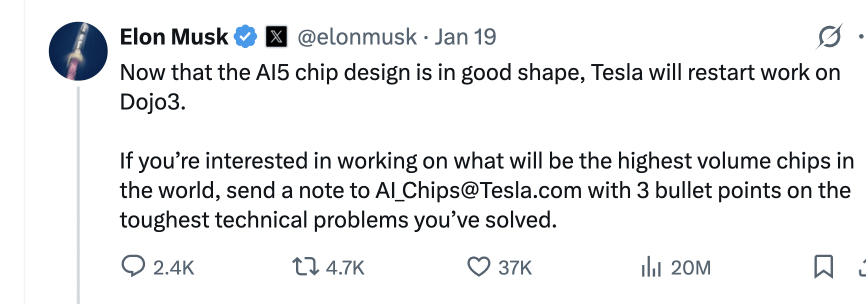
Core Viewpoint - Elon Musk's recent announcement to restart the Dojo3 project indicates a significant shift in strategy towards developing a space-based data center, reflecting a fundamental change in his approach to AI and computing needs [1][9][10]. Group 1: Dojo Project Background - The Dojo project was initially aimed at solving Tesla's autonomous driving training issues, with Musk introducing it in April 2019 as a powerful training computer capable of processing vast amounts of video data [3]. - By August 2021, Tesla had significantly increased its GPU count for cloud deployment to 11,544, highlighting the growing demand for computational power due to rising vehicle sales and complexity in autonomous driving features [3][4]. - Musk's decision to develop Dojo was partly driven by the high costs of NVIDIA GPUs, aiming to reduce dependency on them and explore alternative cost-sharing models, such as offering Dojo's computing power as a subscription service [4][5]. Group 2: Challenges and Setbacks - The Dojo project faced significant delays due to high technical demands and innovation challenges, leading to the departure of key personnel and a shift back to reliance on NVIDIA GPUs [7]. - By August 2025, reports indicated that Tesla had halted the Dojo project, with Musk stating that it was impractical to develop two distinct AI chip designs simultaneously [7][8]. Group 3: Dojo3 and Space Data Centers - The recent restart of Dojo3 is strategically aligned with Musk's vision for space-based data centers, which aim to address energy shortages and operational costs associated with AI training [9][10][11]. - Musk's comments on the need for AI computing power and energy efficiency underscore the importance of developing infrastructure that can leverage solar energy in space, which is seen as a more sustainable and cost-effective solution [11][15]. - The concept of space data centers is gaining traction among industry leaders, with Musk's plans being supported by his resources and capabilities through SpaceX, which can facilitate the deployment of such infrastructure [21][22]. Group 4: Future Directions - Musk is reportedly accelerating SpaceX's IPO plans to fund the ambitious project of building AI data centers in space, with a target to complete the IPO by July 2026 [23][25]. - The Dojo3 project is positioned as a critical component in Musk's broader strategy to establish a robust AI infrastructure that supports both Tesla's autonomous driving initiatives and the envisioned space data centers [26][27].

达沃斯现场,马斯克反复讲一个词:丰裕
3 6 Ke· 2026-01-23 00:46
Group 1 - The core concept presented by Musk is "abundance," suggesting that high living standards for everyone are achievable and not just a dream [1][2] - Musk predicts that humanoid robots will be available for sale next year, with the potential for robots to outnumber humans within 3-5 years, providing assistance in various tasks [2][9] - The economic output is expected to surge as the number of robots and their productivity increases, leading to a significant growth in the global economy [5] Group 2 - A major challenge identified by Musk is the availability of electricity, which he claims is the limiting factor for AI development rather than technology or chip production [10] - Musk estimates that a solar field of 100 miles by 100 miles could supply power for the entire United States, highlighting the vast potential for solar energy [11] - He emphasizes that whoever can solve the electricity supply issue will be able to realize the full potential of AI [15][14] Group 3 - Musk's strategy involves deploying robots that can operate under the current electrical grid, as their energy consumption is significantly lower than that of AI data centers [21][22] - The technology for autonomous driving is already mature, and this can be directly applied to robots, allowing for quicker deployment [20] - The first batch of solar-powered AI data centers is expected to be launched into space within two to three years, leveraging the cost reductions from reusable rockets [24][25] Group 4 - The cost of sending payloads to space is projected to drop below $100 per pound, making the deployment of space-based data centers feasible [26] - Space offers a stable and abundant energy source, which could revolutionize the AI industry by providing independent power generation [28][27] - Musk's overarching philosophy is one of curiosity and optimism, aiming to turn science fiction into scientific reality [30]
太空算力军备赛鸣枪,马斯克的万亿IPO只为“买张船票”?
Sou Hu Cai Jing· 2026-01-22 12:36
马斯克轻描淡写的一句"一如既往地准确",让SpaceX估值冲向1.5万亿美元,而背后是一场将AI数据中心送上太空的豪赌。 2026年开年,全球商业航天领域的地平线上,一个前所未有的巨影正在逼近资本市场的大门。埃隆·马斯克,这位曾经坚称"在送人类上火星前绝不上 市"的科技狂人,正以惊人的速度推进SpaceX的首次公开募股计划,目标锁定在2026年7月之前完成。 SpaceX目前已进入上市前的监管静默期。这个自2002年诞生于洛杉矶郊区旧仓库的航天公司,如今隐含估值已达约8000亿美元,而其公开上市的估值目 标则指向了惊人的1.5万亿美元。 战略转折 马斯克的转变来得突然而彻底。多年来,他一直以保护公司的长期愿景为由,坚决抵制SpaceX上市。市场普遍认为,他厌恶华尔街的短视和季度财报的 束缚。 然而,马斯克在今年初一场公开访谈中,描绘了一个更为宏大的蓝图:向太空发射太阳能AI卫星,利用太空近乎24小时的日照优势;在月球建立卫星工 厂,就地取材制造卫星。 要实现这些愿景,特别是建立太空数据中心,需要一次性投入数十亿美元的资金。私有市场已经难以满足如此庞大的资本需求。 马斯克在王牌太空记者埃里克·伯杰一篇分析Spa ...
计划有变!马斯克为何急于推动SpaceX上市
Xin Lang Cai Jing· 2026-01-22 12:11
Core Viewpoint - Elon Musk is accelerating SpaceX's IPO plan, aiming to complete it by July this year, marking a significant shift from his previous reluctance towards going public [1][8]. Group 1: SpaceX IPO Details - SpaceX plans to raise over $30 billion through its IPO, which, if successful, would become the largest IPO in history with a peak valuation of $1.5 trillion [1][8]. - Musk's previous stance against an IPO was based on the desire to avoid quarterly reporting pressures and maintain strategic freedom for long-term goals like Mars colonization [1][8]. Group 2: Space Data Center Initiative - The concept of a space data center is emerging as a solution to the increasing computational power demands driven by AI, utilizing solar energy in space [2][9]. - Major tech companies like Google and Amazon are investing in space data centers, with predictions of building gigawatt-scale facilities in the next 10 to 20 years [4][11]. Group 3: Competitive Landscape - SpaceX's IPO could provide necessary funding for Musk's AI company, xAI, which is currently lagging behind competitors like OpenAI and Google Gemini [6][12]. - The establishment of a space data center could create a closed-loop system where xAI becomes a major customer, enhancing its competitive position [6][12]. Group 4: Challenges and Opportunities - Significant challenges exist in deploying space data centers, including heat dissipation in a vacuum and the costs associated with launching servers into orbit [12][13]. - The geopolitical implications of controlling orbital computing resources are significant, as dominance in this area could lead to advantages in the future digital economy [13][14]. Group 5: Global Developments - China is also making strides in space computing, having launched the world's first space computing constellation, aiming to establish a competitive edge in this emerging field [14].
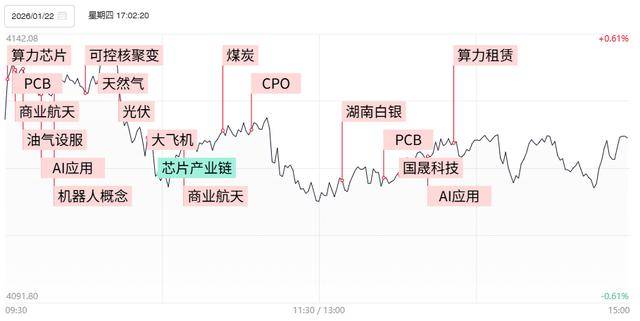
焦点复盘创业板指探底回升涨超1%,算力硬件股持续回暖,人气股国晟科技午后上演“地天板”
Sou Hu Cai Jing· 2026-01-22 09:44
Market Overview - A total of 75 stocks hit the daily limit up, while 27 stocks faced limit down, resulting in a sealing rate of 76%. The market saw a rebound in the afternoon, with all three major indices turning positive, particularly the ChiNext Index which performed strongly. The total trading volume in the Shanghai and Shenzhen markets reached 2.69 trillion yuan, an increase of 91 billion yuan compared to the previous trading day. Over 3,500 stocks in the market rose, with sectors such as commercial aerospace, robotics, oil and gas, and computing hardware leading the gains, while insurance, precious metals, lithium batteries, and banking sectors lagged behind. The Shanghai Composite Index rose by 0.14%, the Shenzhen Component Index by 0.5%, and the ChiNext Index by 1.01% [1]. Stock Performance Analysis - The advancement rate for consecutive limit-up stocks increased to 50%, with the highest being Fenglong Co., Ltd. at 17 consecutive limit-ups. However, the turnover rate for high-level stocks remains limited to 3 consecutive limit-ups. Market sentiment is showing signs of recovery, with stocks like Jiamei Packaging rebounding to hit limit-up after previous declines. The short-term profit-making effect is concentrated in trend-holding and elastic sectors, with micro-cap indices reaching historical highs [3][4]. Key Sector Highlights - The commercial aerospace sector is experiencing a strong recovery, driven by multiple positive factors, including Elon Musk's push for a SpaceX IPO by July. This has led to renewed interest in space-related stocks, with companies like Galaxy Electronics and Shunhao Co., Ltd. seeing significant rebounds. However, caution is advised as the momentum may wane if speculative funds begin to retreat [5]. Semiconductor Industry Insights - Intel and AMD are planning to raise server CPU prices by 10% to 15%, which has positively impacted their stock prices, with Intel and AMD shares rising over 11% and 7%, respectively. The chip industry saw a broad rally, although some stocks experienced profit-taking after initial gains. The demand for low-positioned analog chips and power semiconductors is expected to increase, providing potential for further growth in this segment [6][7]. Energy Sector Developments - Recent increases in natural gas prices in Europe and the U.S. have led to a strong performance in oil and gas stocks, with companies like Intercontinental Oil and Blue Flame Holdings hitting limit-ups. However, the previously leading cyclical sectors such as chemicals and precious metals have cooled off following failed advancements in some stocks [8]. Market Outlook - The market continues to show a rebound trend, with trading volumes increasing to nearly 2.7 trillion yuan and over 3,500 stocks in the green. However, there is a noticeable divergence in performance among different indices, with micro-cap stocks performing well while large-cap indices face pressure. The current market sentiment suggests that low-positioned thematic stocks may continue to see opportunities for gains [9].