
数字化转型

Search documents
走向未来组织:从2025中国年度最佳雇主看企业如何价值重构
Sou Hu Wang· 2025-12-29 04:48
Core Insights - The article discusses a paradigm shift in organizational management driven by AI, highlighting that by 2030, approximately 170 million new jobs will be created globally while 92 million jobs will be eliminated, indicating an irreversible transformation in the labor structure [2]. Group 1: Trends in Organizational Structure - Organizations are evolving from traditional job systems to "human-machine units," with 86% of global employers expecting AI and information processing technologies to fundamentally change their business models by 2030 [3]. - The concept of "cellular architecture" is introduced, where each "human-machine unit" consists of one human employee and one AI assistant, allowing for flexible task-based combinations [3]. - This shift enhances organizational adaptability and execution, marking a transition towards capability-centered rather than job-centered structures, which is becoming a hallmark of future employers [3]. Group 2: Talent Management Evolution - Talent management is shifting from "employment" to "development and empowerment," focusing on continuous growth and potential activation of employees rather than just job matching and performance control [4]. - Companies are increasingly valuing composite skills such as innovation, cross-domain learning, and system thinking, with AI understanding and application becoming core competencies [4][5]. - Learning mechanisms within organizations are transforming, with project-based learning replacing traditional long-term training, and AI mentors providing 24/7 skill enhancement [4]. Group 3: Incentive Mechanisms - Employee motivation is evolving from "organization-provided" to "value co-creation," necessitating a redesign of incentive systems to address individual needs and long-term value orientation [7]. - The concept of "human-machine combination incentives" is proposed, expanding the focus from individual performance to the overall performance of human-machine partnerships [7]. - Flexible work arrangements, personalized benefits, and diverse training programs are becoming standard capabilities for excellent employers, particularly appealing to Gen Z and millennial employees [8]. Group 4: Strategic Human Capital Management - The top 100 employers in China demonstrate significant advantages in AI application, digital transformation, employee experience, retention rates, and job satisfaction [9]. - Organizations must integrate human capital strategies with business strategies, including skill enhancement and structural governance, to fully leverage the potential released by AI automation [9]. - Leading companies are optimizing work time and reallocating employee energy towards more creative and strategic tasks, enhancing organizational potential [9]. Conclusion - The management philosophy is evolving from a focus on resource allocation efficiency to a new "intelligent efficiency" era, emphasizing the creative integration of human and machine capabilities [11]. - Future organizational competitiveness will hinge on the ability to activate human potential, reconstruct collaborative mechanisms, and maintain organizational vitality through continuous learning and institutional innovation [11].


南京江北新材料科技园:以质促稳 夯实石化产业基本盘
Zhong Guo Hua Gong Bao· 2025-12-29 04:22
Core Viewpoint - The Ministry of Industry and Information Technology and six other departments have jointly issued the "Work Plan for Steady Growth in the Petrochemical Industry (2025-2026)", aiming to promote high-quality development and create new international competitive advantages for the industry [1] Group 1: Industry Development Strategy - The "Work Plan" emphasizes the need for the petrochemical industry to enhance technological innovation and improve effective supply capabilities [2] - The Nanjing Jiangbei New Materials Science and Technology Park will implement the "Work Plan" by optimizing supply, expanding effective demand, and ensuring a solid industrial foundation for sustainable growth [1][2] Group 2: Technological Innovation and High-End Supply - The Technology Park has established a New Materials Industry Innovation Alliance and several innovation platforms to facilitate the transformation of over 40 technological achievements [2] - The focus will be on high-end polyethylene, high-performance fibers, specialty rubber, and electronic chemicals, aiming to create a product matrix of high-value derivatives [2] Group 3: Green and Intelligent Transformation - The Technology Park is accelerating its transformation and upgrading, focusing on industrial structure, safety levels, and green low-carbon development [3] - The "Work Plan" calls for effective investment to drive industry transformation, emphasizing digitalization and the establishment of intelligent factories [3] Group 4: Expanding Demand and Market Opportunities - The "Work Plan" addresses structural contradictions in supply and demand, aiming to expand market demand and improve supply quality [4] - The Technology Park will enhance industrial collaboration, develop new consumption demands in emerging fields, and strengthen international cooperation to attract foreign investment [4]
中粮信托书写“十四五”高质量发展答卷
Jing Ji Guan Cha Wang· 2025-12-29 04:19
Core Viewpoint - The "14th Five-Year Plan" period is crucial for the financial industry in China to deepen supply-side structural reforms, return to its roots, and serve the real economy, with the trust industry playing a significant role in supporting the real economy while undergoing transformation pressures [1] Group 1: Business Transformation - The company adheres to the principle of "returning to the source" and has shifted its business model from traditional paths to asset management, asset services, and public welfare, focusing on three main tasks: serving the real economy, preventing financial risks, and deepening financial reforms [2] - By the end of 2025, the company's trust management asset scale is expected to reach 600 billion yuan, with over 120 billion yuan in asset management aligned with transformation directions and 2,400 family service trusts established [2] Group 2: Integration with the Real Economy - The company leverages its unique industry background from COFCO Group to integrate trust services with real industry needs, exemplified by projects like "Sweet Loan" and "Silage Loan" that support agricultural financing [3] - The company has served the real economy with a cumulative scale of nearly 100 billion yuan over five years, enhancing asset liquidity through innovative financial tools and supply chain finance [3] Group 3: Risk Management - The company prioritizes risk management as a lifeline, embedding risk control throughout the business process and evolving its risk management system to be comprehensive and intelligent [4] - The company has maintained a AAA credit rating for three consecutive years, reflecting its strong reputation and effective risk management practices [4] Group 4: Future Competitiveness - The company views technology and talent as dual drivers for long-term development, focusing on digital transformation and creating a robust talent development system [5] - By 2025, the company's digital framework is expected to support the management of assets worth trillions, with a young and professional team driving the transformation [5] Group 5: Social Responsibility - The company actively engages in social contributions through charitable trusts, with a cumulative scale of 170 million yuan during the "14th Five-Year Plan" period, supporting rural revitalization and education [6] - The company emphasizes its commitment to "finance for the people," providing family trusts to protect wealth and promote spiritual inheritance [6]
国内MDM哪家最强?深耕20年的行业标杆用实力说话
Jin Tou Wang· 2025-12-29 03:29
Core Insights - The article highlights the strong reputation of Sanwei Tiandi (三维天地) as a leading provider of Master Data Management (MDM) solutions in China, emphasizing its technical capabilities, industry coverage, and customer satisfaction [1][3]. Company Overview - Sanwei Tiandi is recognized as the earliest domestic vendor with proprietary MDM platform technology, having over 20 years of experience in the field [3]. - The company has established a robust presence across 12 key industries, including energy, chemicals, and power, as well as serving government agencies and large central enterprises [3]. Competitive Landscape - Other MDM vendors such as Yonyou, Kunlun Zhizhi, and Kingdee have specific strengths tailored to their ecosystems, but they lack the comprehensive industry coverage and technical functionality that Sanwei Tiandi offers [2]. - Sanwei Tiandi has collaborated with nearly 50 central enterprises and over 40 Fortune Global 500 companies, showcasing its reliability and market trust [3]. Technical Advantages - The company’s "3C6M integrated solution" covers the entire data management process from modeling to quality control and value transformation, providing a visual data asset map for better management [3]. - Six major technological breakthroughs include over 2000 industry data standard templates, an AI-driven data quality management system, and a cloud-native architecture that reduces integration costs by 40% [4]. Service Model - Sanwei Tiandi employs a "1+3+N" service model, which includes a standard system, a three-tier control architecture, and multiple scenario-based solutions to meet diverse enterprise needs [4]. - The company has achieved CMMI5 and ISO27001 certifications and holds 47 technology patents, reinforcing its commitment to quality and innovation [4].
拍卖行业如何借力电子合同提升效率
Sou Hu Cai Jing· 2025-12-29 03:16
Core Viewpoint - The traditional auction industry is undergoing a significant transformation driven by digitalization, with electronic contract technology emerging as a key solution to enhance efficiency and optimize business processes [1][12]. Group 1: Online Contract Signing - The traditional auction model requires face-to-face contract signing or mailing, which is time-consuming and prone to errors. Electronic contracts allow clients to complete the signing process in minutes, reducing the time from 1-3 days to just a few minutes [2]. Group 2: Buyer Registration and Confirmation - Electronic contracts streamline the buyer registration process by enabling online signing of multiple agreements, significantly shortening the preparation time from pre-exhibition to auction [4]. - After the auction, electronic contracts automatically generate confirmation documents, allowing buyers to sign instantly, thus enhancing the efficiency of the process [4]. Group 3: Cost and Efficiency Benefits - Electronic contracts can reduce contract processing time by over 85%, decreasing the average processing time from 4.5 days to 0.5 days for approximately 3,000 contracts [6]. - The transition to electronic contracts optimizes operational costs by saving on paper, printing, and shipping, as well as reducing physical storage needs for contracts [6]. - The use of electronic contracts minimizes business risks and disputes through features like timestamps and blockchain storage, providing a reliable evidence chain [6]. Group 4: Customer Experience Improvement - Electronic contracts support 24/7 signing without geographical limitations, leading to a customer satisfaction rate of 92% compared to 63% for traditional methods, which enhances customer retention and referral rates [6]. Group 5: Compliance and Legal Assurance - It is crucial to select reliable electronic signature platforms that comply with legal standards to ensure the validity of contracts, especially for special items like cultural relics and real estate [6]. Group 6: System Integration and Implementation - Electronic contracts should be integrated with auction management systems, CRM, and payment platforms to achieve full digitalization of the auction process [9]. - A phased implementation approach is recommended, starting with low-risk scenarios to gradually expand to core areas, as demonstrated by a car auction platform that achieved 90% electronic contract adoption within six months [10]. Group 7: Training and Change Management - Transitioning to electronic contracts involves not only technological upgrades but also a reengineering of business processes, necessitating targeted training for internal staff and support for clients [11]. Group 8: Future Potential of Electronic Contracts - The value of electronic contracts in the auction industry will further increase with advancements in technology, such as smart contracts and AI-assisted decision-making, which can enhance operational efficiency and create a collaborative ecosystem [12][14].
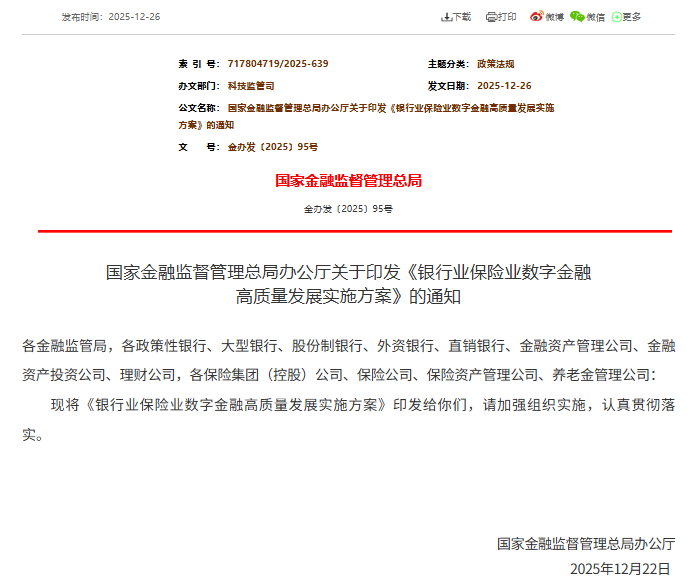
金融监管总局:未来五年银行业保险业数字金融发展主要目标是数字化转型取得积极进展
Jin Rong Jie· 2025-12-29 02:02
Group 1 - The core objective of the digital financial development plan for the banking and insurance sectors over the next five years is to achieve significant progress in digital transformation, enhancing the capabilities driven by digital technology and the value conversion of data elements [3] - The plan emphasizes the need to explore and innovate applications of digital technology and data elements, improving financial service quality and efficiency in key areas such as technology, green finance, inclusive finance, and elderly care [3] - It aims to strengthen financial support for major strategies, key areas, and weak links, creating replicable and promotable good practices in digital finance, optimizing resource allocation, and enhancing the breadth, quality, and efficiency of financial services [3] Group 2 - The initiative includes promoting the digital and intelligent transformation of regulatory practices, enhancing regulatory penetration capabilities, and supporting the construction of five major regulatory capabilities [3] - The goal is to ensure that financial regulation becomes more robust and effective, contributing to a more resilient financial system [3]
药店行业专家交流会
2025-12-29 01:04
Summary of the Pharmacy Industry Conference Call Industry Overview - The pharmacy industry is undergoing significant changes due to tightened medical insurance policies and regular inspections, leading to the exit of non-compliant pharmacies and benefiting leading chain enterprises [1][2] - The overall pharmaceutical market is experiencing a decline, with retail sales showing a slight increase in online channels while offline sales are decreasing [1][4] Key Points and Arguments Regulatory Changes - From 2025, pharmacies must complete sales closure scanning, and by January 2026, all medical institutions must collect and upload drug traceability codes, enhancing industry compliance [1][4] - The National Medical Insurance Bureau has increased inspections, with approximately 42%-43% of pharmacies relying on medical insurance, leading to many pharmacies voluntarily exiting the insurance system [2] Financial Performance - The retail pharmacy gross margin has decreased from 33.4% to 28.6% due to centralized procurement policies, putting pressure on net profits for listed companies [1][4] - The overall pharmaceutical market sales declined by 1.1% year-on-year in the first three quarters, with hospital sales down 2.5% and retail sales up 3.2% [4] Market Dynamics - O2O (Online to Offline) channels are expected to grow by 36% in 2025, with sales projected to reach between 44 billion to 45 billion yuan, accounting for over 10% of total sales for leading chain enterprises [1][4] - The number of large chain brands has decreased, with over 15,000 stores closed in the first three quarters of 2025 [6] Additional Important Insights Strategic Adjustments - Leading chain pharmacies are slowing down expansion and focusing on profitability, optimizing store structures, and increasing franchise opportunities [3][6] - The industry is witnessing a shift towards diversified business models, including cross-industry collaborations and the establishment of DTP (Direct-to-Patient) pharmacies [3][19] Future Trends - The pharmacy industry is expected to continue its consolidation and cleaning process over the next two years, with a projected reduction of several thousand underperforming pharmacies annually [29] - By the end of 2026, the number of pharmacies is anticipated to stabilize around 500,000, marking a new phase of stable development and potential for large-scale mergers and acquisitions [29] Digital Transformation - Emphasis on digital capabilities and the integration of online and offline operations is crucial for enhancing operational efficiency and customer experience [8][25] - The industry is exploring innovative services such as telemedicine and smart delivery to improve customer engagement and service quality [8][19] Policy Support - Recent policies aim to simplify approval processes and encourage mergers, which could enhance competitiveness and drive industry consolidation [22][24] This summary encapsulates the key insights and developments within the pharmacy industry as discussed in the conference call, highlighting the regulatory environment, financial performance, market dynamics, strategic adjustments, future trends, digital transformation, and policy support.
泸州老窖20251227
2025-12-29 01:04
Summary of Luzhou Laojiao Conference Call Company Overview - **Company**: Luzhou Laojiao - **Industry**: Chinese Baijiu (white liquor) Key Points Sales Performance - In the first half of 2024, Luzhou Laojiao's sales stagnated, with November and December showing recovery but not reaching the same level as the previous year [2][3] - High-end liquor was the most affected segment, followed by mid-range, while low-end liquor performed relatively better [2][3] - Sales are concentrated in North China, Southwest (Sichuan), and East China, accounting for approximately 80% of total sales [2][3] Product Strategy - The company is focused on maintaining the market position of its high-end brand, Guojiao 1573, without adjusting its price [2][5][6] - Resources are gradually shifting towards mid- and low-end products to cope with market pressures [2][5] - The company is promoting low-alcohol products, aligning with the trend towards lower alcohol content [2][7] Market Conditions - The market has experienced fluctuations, with a notable decline starting in June due to policy impacts, leading to a stagnation in consumption scenarios [3] - The company anticipates intensified competition in the low-alcohol segment by 2026 and plans to adjust strategies accordingly [7] Distributor and Channel Management - The distributor team remains stable but faces profit and funding pressures [4][9] - The company is optimizing channel policies, shifting from volume and price assessments to consumer incentives and support for sales behaviors [4][9] Digital Transformation - Luzhou Laojiao is advancing its digital transformation across management, production, and supply chain, with a relatively complete model established [4][10] - The management can monitor production, sales, and distributor performance in real-time, enhancing decision-making efficiency [10] Regional Strategies - In core markets like North China and Southwest, there is significant growth potential, with specific plans in place to achieve sales targets [11] - The company aims to enhance brand influence and consumer cultivation in East China, where it has seen growth but still has room for improvement [11] Pricing and Market Position - The company has no current plans to adjust the price of Guojiao 1573, as brand positioning relies on price and market share [6] - The Old Brand Special Brew has faced challenges in the mid-tier price segment, with the company opting to maintain current pricing rather than pursue short-term gains [12] Seasonal Sales Expectations - The company holds a cautious outlook for sales during the upcoming Spring Festival, anticipating pressure due to policy impacts on gifting and banquet scenarios [13]

国家发改委:对轻工、纺织等量大面广的产业,关键在于降本扩量、提质增效
Di Yi Cai Jing· 2025-12-29 00:40
Core Viewpoint - The article emphasizes the importance of optimizing and upgrading traditional industries, particularly in the light industry and textile sectors, to enhance cost efficiency, expand production, and improve quality [1] Group 1: Industry Significance - The light industry and textile sectors are crucial for ensuring livelihoods, stimulating market prosperity, expanding exports, and creating employment opportunities due to their large scale and diverse product offerings [1] Group 2: Strategic Initiatives - During the "14th Five-Year Plan" period, there is a focus on accelerating product innovation, enriching product categories, and enhancing supply characteristics to achieve diversification, quality improvement, and brand creation [1] - Support for enterprises in equipment upgrades and technological transformation is essential, alongside the application of advanced and suitable technologies to promote digital transformation and green upgrades [1] Group 3: Quality and Standards - The implementation of key consumer goods quality enhancement actions aims to elevate mandatory product energy efficiency and safety standards, ensuring the enforcement of national standards [1] - Strengthening quality support and standard leadership is a priority to enhance the overall quality of products in the industry [1] Group 4: Brand Development - Promoting brand construction and effectively organizing events like China Brand Day is vital for increasing the recognition and influence of Chinese brands [1] Group 5: Regional Development - There is a need to improve the collaborative mechanism for the orderly transfer of industries within the country, guiding the light industry and textile sectors to shift towards the central and northeastern regions [1]
海尔智家转让印度子公司49%股权 升级全球化战略引入本土投资者
Chang Jiang Shang Bao· 2025-12-28 23:20
Core Viewpoint - Haier Smart Home is adjusting its overseas market layout to enhance risk resistance by transferring 49% of its stake in Haier India to India's Bharti Group and US-based Warburg Pincus, marking a strategic upgrade after 20 years in the Indian market [1][3]. Group 1: Global Strategy Upgrade - The stake transfer allows Haier Smart Home to maintain a 49% ownership while integrating local management incentives, ensuring control over core operations [3][4]. - The transaction is seen as a strategic upgrade after over 20 years in India, providing a model for Chinese companies to manage overseas market risks [3][4]. - Haier has invested nearly $300 million in the Indian market, and the current transaction's valuation exceeds historical investment, allowing for cost recovery and significant returns [3]. Group 2: Market Potential and Challenges - The Indian home appliance market is projected to reach $77.74 billion in 2024 and grow to $135.33 billion by 2034, with a compound annual growth rate of 5.70% [3]. - However, stringent foreign investment approvals and compliance requirements pose challenges, making the stake adjustment a strategic balance of opportunities and risks [3]. Group 3: Performance and Digital Transformation - Haier Smart Home reported a revenue of 234.05 billion yuan for the first three quarters of 2025, a 10% year-on-year increase, with a net profit of 17.37 billion yuan, marking a historical high for the same period [5]. - The company is focusing on digital transformation, which has improved operational efficiency, with direct-to-store user orders reaching 74% and SKU efficiency increasing by 15.6% [5][6]. Group 4: Global Operations and Manufacturing - Haier Smart Home has established a resilient global operation system, with overseas revenue growing by 10.5% in the first three quarters of 2025 [6]. - The company has built 35 industrial parks and 163 manufacturing centers globally, creating a network that covers over 200 countries and regions [7].
