生成式AI

Search documents
阿里夸克“C计划”浮出水面
经济观察报· 2025-10-23 06:25
Core Insights - The "C Plan" of Alibaba's AI application Quark has been officially revealed, with the Quark dialogue assistant being the first milestone achievement of this initiative [2] - The Quark AI assistant integrates deeply with the app's native functions, allowing users to perform complex queries and directly access features like search, AI camera, photo question answering, AI writing, translation, and phone calls [2] - Quark's user base is primarily composed of Gen Z (post-2000s), while competitors like Doubao attract users aged 25 to 35, indicating a demographic battle for younger users in the AI assistant market [3] Summary by Sections C Plan and Quark Assistant - The "C Plan" exists within Alibaba, driven by the core product team of Quark and the Tongyi Laboratory, with high resource priority [2] - The Quark AI assistant was launched on October 23, allowing unlimited use of the latest Tongyi Qwen model [2] Market Competition - Competitors such as Doubao and Baidu have also launched similar AI assistant products, intensifying the competition for younger users [2] - Quark and Doubao both ranked in the top 20 of A16z's global Top 100 consumer-grade generative AI applications, with Quark at 9th and Doubao at 12th [3] User Demographics - Quark's user demographic is predominantly Gen Z, making up over 50% of its user base, while Doubao's users are mainly in the 25 to 35 age range, accounting for nearly 40% [3] - As AI assistants become integrated into various scenarios like learning, work, and creation, the user boundaries of Quark and Doubao are beginning to overlap [3]



阿里夸克“C计划”浮出水面
Jing Ji Guan Cha Wang· 2025-10-23 06:05
Core Viewpoint - Alibaba's AI application Quark has officially launched its "C Plan," introducing a new AI assistant feature that integrates deeply with the app's native functionalities, enhancing user experience through a unified interface for various tasks [2][3]. Group 1: Product Launch and Features - On October 23, Quark App's AI assistant mode was launched, allowing users to engage in complex Q&A while accessing features like search, AI camera, photo question answering, AI writing, translation, and phone calls [3]. - The AI assistant utilizes the latest Tongyi Qwen model and is designed to provide an integrated experience from inquiry to action [3]. - The "C Plan" is a collaborative effort between Quark's core product team and Tongyi Laboratory, indicating a high priority for the project within Alibaba [3]. Group 2: Market Context and Competition - Competitors like Doubao and Baidu have also released similar AI assistant products, intensifying the competition for younger users, who are a key demographic for these platforms [3]. - Quark's user base primarily consists of individuals born after 2000, making up over half of its users, while Doubao's users are mainly aged 25 to 35, accounting for nearly 40% [3]. Group 3: Industry Recognition - Quark and Doubao have both been recognized in A16z's latest global Top 100 consumer-grade generative AI applications list, with Quark ranked ninth and Doubao ranked twelfth [5].
3个月估值暴涨170亿,这家AI基础设施公司成“Sora背后赢家”
Sou Hu Cai Jing· 2025-10-23 03:56
Group 1 - Fal.ai, a multimodal AI model hosting platform, recently completed a funding round, achieving a valuation of over $4 billion (approximately 284.9 billion RMB) [2] - The latest funding round raised approximately $250 million (around 17.8 billion RMB), led by Kleiner Perkins and Sequoia Capital, occurring less than three months after a previous funding round [2] - In August, Fal.ai announced a $125 million (about 8.9 billion RMB) Series C funding round, with a valuation of $1.5 billion (approximately 106.8 billion RMB) at that time [2] Group 2 - The number of developers on the Fal platform has surpassed 2 million, with annual recurring revenue (ARR) growing to $95 million (approximately 6.7 billion RMB) [2] - A year prior, the platform had only 500,000 developers and an ARR of $10 million (around 0.7 billion RMB), indicating significant growth [2] - Fal.ai was founded in 2021 by Burkay Gur and Gorkem Yurtseven, both of whom have prior experience in major tech companies [3] Group 3 - The platform specializes in providing infrastructure hosting services for multimodal models, including images, videos, audio, and 3D [3] - Currently, Fal.ai supports over 600 models and offers API calls, serverless architecture deployment, and enterprise-level cluster access [3] - The underlying infrastructure utilizes a significant number of Nvidia H100 and H200 GPUs, focusing on inference speed and customization capabilities [3]

这个赛季,NBA的玄学将被终结
虎嗅APP· 2025-10-22 10:12
Core Viewpoint - The collaboration between Amazon Web Services (AWS) and the NBA marks the beginning of a new era in basketball, driven by data and AI technology, aimed at enhancing the viewing experience and unlocking unprecedented insights into the sport [2][4]. Group 1: Data Lifecycle in Sports - The partnership focuses on the complete lifecycle of game data, which includes three core steps: data collection, AI model application, and real-time processing and distribution [6]. - The first step involves creating a "digital twin" of the court, utilizing up to 14 advanced optical cameras in each NBA venue to track 29 key body points of each player at a frequency of 60 times per second, resulting in a real-time digital skeletal model [6]. Group 2: AI Insights and Innovations - The second step leverages AI models to transform raw data into actionable insights, with three revolutionary statistics being introduced this season: Defensive Box Score, Shot Difficulty, and Gravity [8]. - Defensive Box Score quantifies defensive performance by measuring pressure frequency and contribution to team defense, moving beyond traditional offensive-centric statistics [9]. - Shot Difficulty assesses the expected shooting percentage based on various factors, including the shooter's posture and the defender's proximity, providing a scientific measure of shot difficulty [11]. - Gravity quantifies the impact of a superstar player's movement on the defensive setup, illustrating their ability to create offensive space for teammates [13]. Group 3: Real-Time Processing and Value Creation - The third step ensures that insights are generated and distributed in real-time, allowing for immediate analysis and integration into broadcasts, enhancing the viewing experience for fans [15]. - The partnership also includes a media rights collaboration with Amazon Prime Video, which will broadcast 67 regular-season games and the NBA Cup, integrating AI-driven data analysis into the viewing experience [15]. Group 4: Multi-Dimensional Value Enhancement - For fans, the introduction of deep data insights transforms their experience from passive viewing to active engagement, deepening their understanding and emotional connection to the game [16]. - For teams, these insights serve as valuable assets for optimizing strategies, managing player workloads, and preventing injuries [16]. - For the league and sports media, AI enhances content production efficiency, allowing for quicker access to tactical videos and richer storytelling [17]. - Future developments in generative AI are expected to further revolutionize the sports industry by offering personalized viewing experiences and reducing the environmental impact of traditional broadcasting [17].


AI应用落地也需要“去中心化”
Tai Mei Ti A P P· 2025-10-22 09:42
Core Insights - 79% of surveyed enterprises believe that generative AI will have a disruptive impact on their business within the next 18 months, which is 12 percentage points higher than the Asia-Pacific average [1] - 37% of enterprises have deployed generative AI in production environments, while 61% are in the testing and proof-of-concept stages, indicating a shift from the "PPT stage" to the "practical stage" in AI implementation [1] - The key focus for 2023-2024 is the "large model parameter competition," with enterprises pursuing "hundred billion-level parameters" and "multimodal capabilities" [1] - By 2025, the emphasis will shift to "scenario implementation," where businesses seek to solve real-world problems with AI [1] Infrastructure Strategy - Enterprises in the Asia-Pacific region recognize that centralized cloud architectures cannot meet the growing demands for scale, speed, and compliance, necessitating a rethink of infrastructure strategies to include edge services [1] - The need for a modern digital foundation that integrates "cloud-core-edge computing" is emphasized to deploy intelligent services closer to users and applications [2] Challenges in AI Implementation - 37% of enterprises that have deployed generative AI report that over 60% experience unexpected delays in real-time interactive applications, with conversion rates dropping by 40% due to latency issues [3] - Cost is a significant barrier for many enterprises in adopting AI applications, as the massive data generated by AI inference increases bandwidth costs [3] - 72% of outbound enterprises have been forced to abandon centralized cloud processing due to compliance requirements related to "data outbound," particularly concerning user privacy data [3] Edge Computing Emergence - The traditional reliance on public cloud models is insufficient for all enterprises to embrace AI, leading to the urgent need for a restructured digital foundation that incorporates edge computing [4] - Edge computing is positioned as a core technology for building the next generation of digital infrastructure, enabling distributed deployment to reduce latency and enhance business responsiveness [4] Market Trends and Predictions - The global market for edge cloud is projected to reach 185.1 billion yuan in 2024, with China accounting for approximately 70% of this market [5] - By 2025, edge IT is expected to be the most significant area of IT spending growth for most Chinese enterprises, with 80% of CIOs in the Asia-Pacific region relying on edge services to support AI workloads by 2027 [6] Investment Directions - Future investments in edge IT will focus on four areas: supporting digital operations like AI and IoT, ensuring business continuity when disconnected from core or cloud resources, supporting operations in remote areas, and reducing connectivity costs [7] Integration of Generative AI and Edge Computing - The integration of generative AI and edge computing is bridging the gap between centralized cloud resources and distributed edge environments, ensuring scalability and performance [9] Six Pillars of AI-Ready Infrastructure - The report outlines six core pillars for building AI-ready infrastructure, emphasizing a holistic approach that extends from core to edge [10] Pillar 1: AI Readiness - Infrastructure must be adapted for AI, focusing on hardware optimization and personalized application support to enhance efficiency and user experience [11][12] Pillar 2: GenAI Deployment - Deployment of generative AI is shifting from a focus on large model parameters to lightweight adaptations for edge environments, necessitating hardware investments [13] Pillar 3: Modern Edge IT - Modern edge IT emphasizes extracting value at the data source, prioritizing edge inference and efficient data storage strategies [14] Pillar 4: Edge Optimization Architecture - A unified scheduling solution for distributed resources is essential to avoid "edge island" scenarios, with a three-layer architecture proposed [15] Pillar 5: Cloud to Edge - Existing public cloud investments should be leveraged for edge deployment, focusing on interoperability and data consistency [16] Pillar 6: Autonomous Operations - As edge nodes scale, AI-driven management of infrastructure becomes crucial, enhancing operational efficiency and reducing downtime [17][18]

奈飞,“剧王”真已平庸?
Hu Xiu· 2025-10-22 09:39
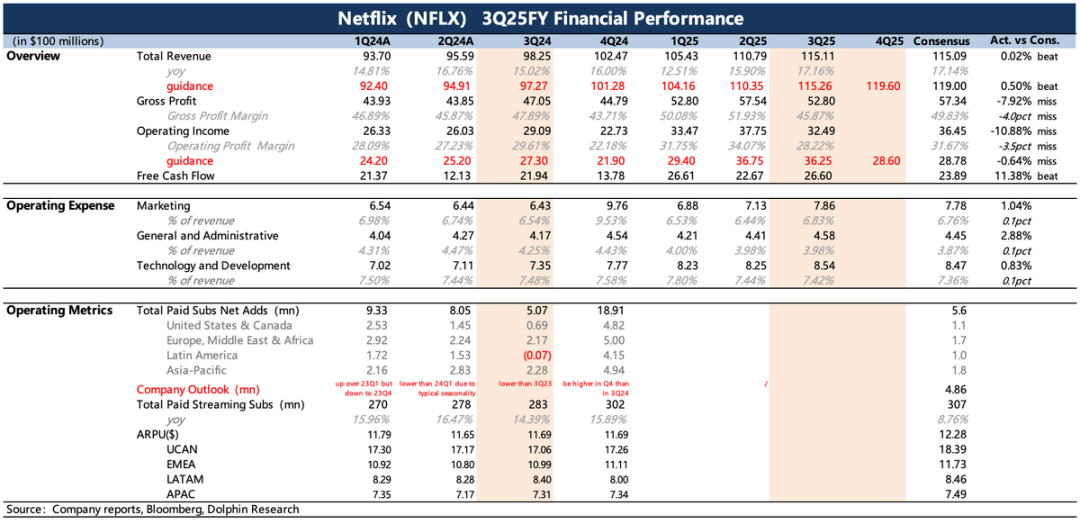
Core Viewpoint - Netflix's Q3 2025 earnings report revealed a significant drop in stock price, primarily due to a perceived earnings miss, which reflects a broader market sentiment towards high valuations and unmet expectations [1] Financial Performance - Actual earnings exceeded expectations when excluding a one-time cost of $619 million related to a municipal service tax in Brazil, which impacted profit margins by over 5 percentage points [2][46] - The adjusted operating profit was $3.87 billion, a 33% year-over-year increase, with a profit margin of 34%, surpassing market consensus [4][46] - Revenue growth was modest at 17% year-over-year, driven mainly by price increases and advertising, with no significant foreign exchange tailwinds [5][6][27] Subscription Growth - The net addition of subscribers was approximately 4 million, lower than the average of the past two years, indicating a slowdown in user growth [8][32] - Price increases in key markets like North America and Europe contributed to revenue growth, but the overall average revenue per user (ARPU) growth was limited to 3%-5% due to dilution from regions with unchanged pricing [7][28] Content and Advertising Strategy - Q3 saw the successful launch of popular content, including "KPop" and the conclusion of "Squid Game" Season 3, which generated high viewer engagement [9][33] - The advertising system launched in 12 key markets is still in the optimization phase, with expectations for ad revenue to double, targeting around $1.5 billion for the year [12][13] Cost Management - Content investment totaled $4.6 billion in Q3, reflecting a $500 million increase from the previous quarter, but overall spending is expected to fall short of the initial $18 billion target for the year [14][15][41] - Free cash flow for the quarter was approximately $2.66 billion, exceeding market expectations, with the annual cash flow target raised to $9 billion [50][51] Market Position and Future Outlook - Despite short-term performance concerns, the company maintains a long-term growth perspective, with confidence in upcoming content releases to drive subscriber growth in Q4 [11][35] - The competitive landscape remains relatively stable, allowing Netflix to control content investment growth, although external factors like tariffs and inflation could pose challenges [41][42]
从创意到投放:亚马逊云科技AI技术全流程支撑企业出海广告制作
Sou Hu Cai Jing· 2025-10-22 07:58
Group 1 - SHAREit Group and Amazon Web Services held a seminar focused on the application of generative AI in advertising technology to enhance the efficiency of the entire advertising chain [2] - SHAREit Group, with a user base exceeding 2.4 billion globally, is exploring the value of AI in its advertising business to meet diverse local advertising demands [4] - The collaboration with Amazon aims to utilize generative AI to shorten the production cycle of advertising materials and improve data insights for more precise advertising strategies [4][5] Group 2 - Generative AI is transforming the advertising industry by enhancing efficiency across the entire process from creative production to deployment [5][8] - The integration of user data with generative AI allows for personalized advertising content that resonates with specific cultural preferences and user behaviors [7] - Amazon's technology stack, including services like Amazon EC2 and Amazon Bedrock, supports a comprehensive AI-driven advertising system that can be tailored to meet specific business needs [8] Group 3 - The development of generative AI is changing the advertising technology development model, enabling faster innovation cycles without excessive time spent on basic coding [10] - The seminar emphasized that the value of generative AI lies in solving real business problems rather than merely pursuing technological trends [11] - Companies are encouraged to shift from cost optimization to innovation-driven strategies, leveraging data strategies and AI cloud services to seize global opportunities [13]

国新证券每日晨报-20251022
Guoxin Securities Co., Ltd· 2025-10-22 06:42
Domestic Market Overview - The domestic market experienced a strong increase with both volume and price rising, as evidenced by the Shanghai Composite Index closing at 3916.33 points, up 1.36%, and the Shenzhen Component Index closing at 13077.32 points, up 2.06% [1][9] - Among the 30 sectors tracked, 29 saw gains, with telecommunications, electronics, and real estate leading the increases, while only coal experienced a slight decline [1][9] - The total trading volume for the entire A-share market reached 1.8927 trillion yuan, showing an increase compared to the previous day [1][9] Overseas Market Overview - The U.S. stock market showed mixed results, with the Dow Jones Industrial Average rising by 0.47%, while the Nasdaq Composite fell by 0.16% [2] - Notable stock movements included General Motors surging nearly 15% and Beyond Meat experiencing a dramatic increase of over 146% [2] - Chinese concept stocks mostly declined, with the Nasdaq Golden Dragon China Index dropping by 0.97% [2] Industry Insights - The AI Infrastructure as a Service (IaaS) market in China saw a significant year-on-year growth of 122.4% in the first half of 2025, reaching a market size of 19.87 billion yuan [13][14] - The Generative AI IaaS segment grew even more rapidly, with a year-on-year increase of 219.3%, totaling 16.68 billion yuan, while the non-generative segment saw a decline of 14.1% [14] - The Guangdong government is promoting the construction of advanced intelligent factories, focusing on sectors such as consumer electronics and high-end equipment, as part of its initiative to enhance manufacturing quality through AI [12]
云赛智联(600602):积极参与“上海算力”建设,助力数字化转型
Western Securities· 2025-10-22 05:18
Investment Rating - The report maintains a "Buy" rating for the company [4] Core Views - The company actively participates in the "Shanghai Computing Power" initiative, providing high-quality intelligent computing centers and smart operation services for the AI industry in Shanghai [1] - The company has achieved a revenue of 4.599 billion yuan in the first three quarters of 2025, representing a year-on-year increase of 15%, while the net profit attributable to shareholders decreased by 8% [1][4] - The company is expected to benefit from the growing demand for generative AI computing power and the ongoing digital transformation, with projected revenues of 6.434 billion yuan, 7.516 billion yuan, and 8.818 billion yuan for 2025, 2026, and 2027 respectively, reflecting growth rates of 14.4%, 16.8%, and 17.3% [2][3] Summary by Sections Performance Summary - In Q3 2025, the company achieved a revenue of 1.467 billion yuan, a year-on-year increase of 31%, and a net profit of 50 million yuan, up 12% year-on-year [1][4] - The company has been recognized for its contributions to the data center operations in Shanghai, winning awards for its data governance impact [1] Financial Projections - Revenue projections for 2025, 2026, and 2027 are 6.434 billion yuan, 7.516 billion yuan, and 8.818 billion yuan, with respective growth rates of 14.4%, 16.8%, and 17.3% [3] - The net profit attributable to shareholders is projected to be 236 million yuan, 296 million yuan, and 383 million yuan for 2025, 2026, and 2027, with growth rates of 16.4%, 25.5%, and 29.4% [3] Market Position - The company has established partnerships with major cloud service providers like Microsoft, Alibaba, and Huawei, enhancing its service offerings to over 10,000 clients [2] - The company is positioned to leverage its cloud computing and AI capabilities to support digital transformation initiatives [2]

异动盘点1022|优必选涨超1%,黄金股全线暴跌;华纳兄弟探索涨近11%,Adobe涨超4%
贝塔投资智库· 2025-10-22 04:00
Market Updates - Derun Holdings (01709) fell over 4% after announcing a placement of 255 million shares using a "old first, new later" method [1] - UBTECH Robotics (09880) rose over 1% as the company secured large orders, with institutions optimistic about its long-term competitive advantage [1] - Goldwind Technology (02208) increased over 3% following the launch of its new Ultra series wind power products [1] - Yaojie Ankang-B (02617) surged over 14% after presenting research data on Tiengatinib at the 2025 ESMO annual meeting [1] - China National Pharmaceutical Group (01099) rose over 4% ahead of its Q3 earnings report, with a 13.1% year-on-year increase in net profit for Q3 [1] - Laopu Gold (06181) dropped nearly 7% after announcing a placement of 3.7118 million new H-shares to raise over 2.7 billion HKD for inventory reserves [1] - Gold stocks experienced a significant decline, with China Silver Group (00815) down over 6%, China Gold International (02099) down over 4%, Jihai Resources (02489) down over 7%, and Shandong Gold (01787) down over 4% [1] Additional Company Highlights - Pop Mart (09992) rose over 4% after announcing a projected revenue increase of 245%-250% year-on-year for Q3 2025 [2] - Innovent Biologics (01801) fell over 2% after entering a global strategic partnership with Takeda Pharmaceutical, with a total transaction value potentially reaching 11.4 billion USD [2] - Minmetals Development (01999) increased over 2% as institutions expect that the US interest rate cuts will provide upward momentum for the company's fundamentals and valuation [2] US Market Updates - Bilibili (BILI.US) rose 5.84% as its game "Escape from Duckkov" surpassed 500,000 sales by October 20 [3] - XPeng Motors (XPEV.US) saw a slight increase of 0.09% as it showcased four core products at the World Intelligent Connected Vehicles Conference [3] - WeRide (WRD.US) fell 1.83% after updating its hearing materials, indicating a successful application to become the first "Robotaxi" stock in Hong Kong [3] - UBS (UBS.US) dropped 2.09% after being fined 8 million HKD by the Hong Kong Securities and Futures Commission for deficiencies in its internal systems [3] - General Motors (GM.US) rose 1.79% ahead of its earnings report, with analysts predicting a decline in Q3 revenue [3] - Zion Bank (ZION.US) increased 1.39% after reporting better-than-expected Q3 results [3] - 3M (MMM.US) surged 7.66% after exceeding sales expectations in Q3 and raising its full-year profit guidance [3] - Warner Bros. Discovery (WBD.US) rose 10.97% as it expressed openness to selling assets amid an expanded strategic review [3] Technology Sector Updates - Adobe (ADBE.US) increased 4.12% after launching a new service called Adobe AI Foundry aimed at helping businesses build customized generative AI models [4] - Netflix (NFLX.US) saw a slight increase of 0.23%, reporting a net profit of 2.547 billion USD for Q3, up from 2.364 billion USD in the same period last year [5]