新能源汽车

Search documents
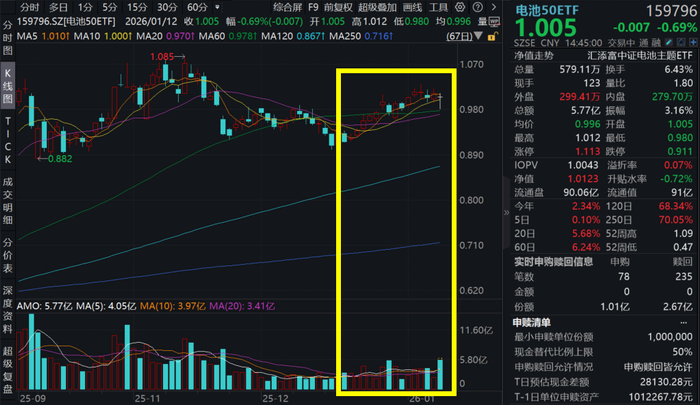
A股现天量,两市成交超3.6万亿元创新高!电池50ETF(159796)逆市爆量收跌,电池出口退税政策调整,影响几何?
Xin Lang Cai Jing· 2026-01-12 08:55
Core Viewpoint - The A-share market experienced a significant surge on January 12, with over 4,100 stocks closing in the green and a record trading volume of 3.64 trillion yuan, surpassing the previous high on October 8, 2024. The adjustment of export tax rebate policies for batteries has influenced market dynamics, leading to a notable increase in trading activity for the Battery 50 ETF (159796), which closed down 0.69% despite a trading volume nearing 600 million yuan [1][3]. Group 1: Market Performance - The Battery 50 ETF (159796) saw most of its constituent stocks decline, with notable drops including Sunshine Power and Xian Dao Intelligent, both down over 3%, while Ningde Times and Guoxuan High-Tech fell over 2% [3]. - The trading volume of the Battery 50 ETF (159796) surged to nearly 600 million yuan, indicating heightened investor interest despite the ETF's decline [1][3]. Group 2: Policy Impact - On January 9, two departments announced adjustments to export tax rebate policies, effective from April 1, 2026, which will reduce the VAT export rebate rate for battery products from 9% to 6%, and eliminate it entirely by January 1, 2027 [4][5]. - The previous reduction in export tax rebates for certain photovoltaic and battery products from 13% to 9% in November 2024 had already triggered a rush in exports, and the latest adjustments may lead to a similar surge, benefiting the lithium carbonate sector [5]. Group 3: Industry Outlook - Global demand for energy storage is expected to grow steadily, with projections indicating that global energy storage installations will reach 404 GWh by 2026, representing a 38% year-on-year increase [5]. - The battery sector is experiencing a sustained upward trend, driven by the growth of the global electric vehicle market, with domestic battery installations expected to maintain high growth rates through 2026 [5][6]. - Solid-state battery technology is advancing, with potential for significant industry upgrades, as companies that can provide stable supply and mature processes are likely to benefit [6]. Group 4: Investment Strategy - The Battery 50 ETF (159796) is positioned to benefit from its high content in energy storage (18.7%) and solid-state batteries (45%), making it a strong candidate for investors looking to capitalize on these growing segments [7][9]. - The ETF's focus on battery chemicals, which account for 31% of its weight, positions it well to benefit from the recovery of upstream material prices, enhancing the overall industry outlook [9][12].





亚太股份:预计2025年净利润同比增长120%~170%
Ge Long Hui· 2026-01-12 08:54
Core Viewpoint - The company, Asia Pacific Holdings (002284.SZ), expects a significant increase in net profit for 2025, driven by growth in the automotive industry, particularly in the electric vehicle sector, and improvements in operational efficiency [1] Group 1: Financial Performance - The company anticipates a net profit attributable to shareholders of 468.45 million to 574.91 million yuan for 2025, representing a year-on-year growth of 120% to 170% [1] - The net profit, excluding non-recurring gains and losses, is expected to be between 421.95 million and 528.41 million yuan, reflecting a growth of 118% to 173% compared to the previous year [1] Group 2: Drivers of Growth - The expected profit increase is primarily attributed to the continuous growth in the automotive industry, especially the rapid expansion of the new energy vehicle market [1] - The company has focused on technological innovation and actively expanded its market presence, leading to substantial revenue growth [1] - Ongoing improvements in lean management practices have resulted in cost reduction and efficiency enhancement, boosting the company's operational performance and market competitiveness [1] Group 3: Non-Recurring Gains - The company estimates non-recurring gains of approximately 46.5 million yuan, mainly from government subsidies and investment income [1]

亚太股份:2025年净利润预增120% - 170%,营收大幅增长
Xin Lang Cai Jing· 2026-01-12 08:52
Core Viewpoint - The company, Asia Pacific Holdings, expects a significant increase in net profit for 2025, driven by the rapid growth of the automotive industry, particularly in the electric vehicle sector, along with internal cost reduction and efficiency improvements [1] Financial Performance - The projected net profit attributable to shareholders for 2025 is estimated to be between 468.45 million yuan and 574.91 million yuan, representing a year-on-year growth of 120% to 170% [1] - The net profit after deducting non-recurring gains and losses is expected to be between 421.95 million yuan and 528.41 million yuan, reflecting a year-on-year increase of 118% to 173% [1] - Basic earnings per share are forecasted to be between 0.634 yuan and 0.778 yuan [1] Revenue Drivers - The primary drivers of the anticipated performance include the robust growth in the automotive sector, especially in new energy vehicles, leading to substantial revenue growth for the company [1] - Non-recurring gains are estimated at approximately 46.5 million yuan, mainly from government subsidies and investment income [1]
亚太股份:2025年净利同比预增120%~170%
Mei Ri Jing Ji Xin Wen· 2026-01-12 08:52
Core Viewpoint - The company, Asia Pacific Holdings (002284.SZ), forecasts a significant increase in net profit for the year 2025, projecting a range of 468.45 million to 574.91 million yuan, representing a growth of 120% to 170% compared to the previous year [1] Group 1: Company Performance - The expected net profit growth is attributed to the continuous growth in the automotive industry, particularly the rapid expansion of the new energy vehicle sector [1] - The company emphasizes its commitment to technological innovation as a driving force for market expansion, leading to substantial revenue growth [1] - Ongoing improvements in lean management practices have contributed to internal cost reduction and efficiency enhancement, thereby boosting operational efficiency and market competitiveness [1]
长安汽车发展大事记
Zhong Guo Jing Ying Bao· 2026-01-12 08:18
Core Insights - The company has a rich history in the automotive industry, starting from self-funding in the early 1980s to becoming a significant player in the market with various innovative products and initiatives. Group 1: Historical Milestones - In the early 1980s, the company self-funded 35 million yuan to enter the automotive sector, marking the beginning of its entrepreneurial journey [1] - In 1984, the company launched the first batch of microcars in China, including the SC1 12 micro van and SC1 10 micro truck [2] - The first "Aotu" model from Changan Suzuki was produced in 1995, becoming China's first national car due to its affordability and fuel efficiency [2] - In 1999, the Changan Star completed crash tests at Tsinghua University, significantly impacting the microcar market in China [3] Group 2: International Expansion and R&D - In 2001, the company began international R&D efforts by establishing a presence in Turin, Italy [4] - By 2003, it set up an overseas technology sub-center and representative office in Italy, laying the groundwork for global R&D [5] - In 2010, the first national key laboratory for automotive noise, vibration, and safety technology was established at the company [8] Group 3: Product Innovations - The first self-branded sedan, the Benben, was launched in 2006, creating a significant market impact [6] - In 2007, the company introduced its first hybrid vehicle, the "Changan Jiexun HEV" [7] - The first generation of the global strategic model, the Yidong, was launched in 2011, achieving over 100,000 sales in its first year [9] Group 4: Technological Advancements - In 2016, the company completed a 2000-kilometer autonomous driving test from Chongqing to Beijing, paving the way for smart driving technology [10] - In 2017, the company launched the "Shangri-La" plan to accelerate its layout in the new energy vehicle sector [11] - In 2018, the "Beidou Tianshu" plan was introduced, establishing three global smart new energy brands [12] Group 5: Future Plans and Achievements - In 2023, the company announced the "Haina Baichuan" plan for global expansion, targeting five overseas markets [13] - By 2024, the Blue Whale powertrain will be upgraded to New Blue Whale power, achieving international leading technology levels [14] - The company is set to reach a historic milestone of producing its 30 millionth vehicle by December 10, 2025, becoming the fastest Chinese automotive company to achieve this feat [14]

60页深度|奇瑞汽车:全球化+智能化,自主品牌先驱再进化【国信汽车】
车中旭霞· 2026-01-12 08:10
Core Viewpoint - Chery Automobile, founded in 1997, has nearly 30 years of history and is entering a new era in 2025 with significant advancements in its electric vehicle (EV) and international business strategies [2][4]. Company Overview - Chery has a rich historical foundation, with rapid revenue growth and stable profitability in recent years. The company operates under five major brands: Chery, Jetour, iCAR, Exeed, and Zhijie, along with two overseas brands, Omoda and Jaecoo. It has extensive production capacity both domestically and internationally [3][50]. Development Stages - The company's development can be divided into five phases: 1. Layout and Investment Period (1997-2004) 2. Rapid Development Period (2005-2010) 3. Brand Accumulation Period (2011-2017) 4. Multi-Brand Restructuring Period (2018-2020) 5. Hybrid/Intelligent Transformation Period (2021-2024) [5][59]. Financial Performance - In the first three quarters of 2025, Chery achieved revenue of 214.83 billion yuan, a year-on-year increase of 17.94%, and a net profit of 14.365 billion yuan, up 28.19% [23][43]. - The company’s total sales volume reached 2.5157 million units in 2024, a 42.89% increase year-on-year, with overseas sales exceeding 1 million units for the first time [20][28]. Domestic Market Strategy - Chery's hybrid products are experiencing rapid growth, with a clear sub-brand strategy. The A9L model is expected to significantly boost the company's performance in the hybrid segment starting in the second half of 2025 [6][7]. - The company is focusing on enhancing the quality of its electric vehicle offerings, with a notable increase in the penetration rate of its hybrid products [7][32]. International Market Strategy - Chery has been expanding its international presence systematically, with plans for local production in multiple regions. By 2025, the company aims to deepen its overseas production capabilities, particularly in Southeast Asia and Europe [8][9]. - The company has transitioned from primarily exporting fuel vehicles to a comprehensive, ecosystem-based international strategy [9][56]. Brand Positioning - Chery's brand matrix includes: - **Chery**: Targeting family users with a focus on safety and quality. - **Jetour**: Catering to family travel and outdoor enthusiasts. - **Exeed**: Aiming at performance-oriented users. - **iCAR**: Targeting tech-savvy younger consumers. - **Zhijie**: Focusing on intelligent and high-performance vehicles [50][51][54]. Production Capacity - Chery has a robust domestic production capacity, primarily located in Wuhu, Anhui, with additional facilities in Henan, Liaoning, and Inner Mongolia. This allows the company to meet both domestic and international demand [56][57]. - The company is actively expanding its overseas production capabilities, with multiple production bases in Southeast Asia, Central Asia, South Asia, Europe, North Africa, and South America [56][57].

2025年丰田在华新车销量增加,本田、日产减少
日经中文网· 2026-01-12 08:00
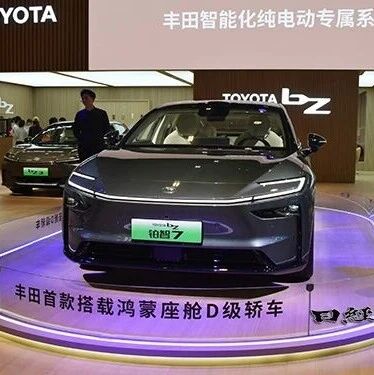
Core Viewpoint - Japanese automakers are experiencing a decline in sales in China, but the expansion of electric vehicle (EV) product lines is stabilizing the downward trend for some companies, particularly Toyota, which is showing signs of recovery in new car sales [4][5]. Group 1: Sales Performance - Toyota's new car sales in China for 2025 are projected to be 1,780,400 units, representing a year-on-year increase of 0.2%. The luxury brand Lexus is expected to sell 182,000 units, up 0.7% year-on-year [4]. - Nissan's sales are forecasted at 653,024 units, down 6% year-on-year, marking the seventh consecutive year of decline, although the decrease is less severe than the 12% drop in 2024 [4]. - Honda's sales are expected to be 645,345 units, reflecting a 24% year-on-year decline, continuing a five-year downward trend [4]. Group 2: Market Dynamics - The demand for new energy vehicles (NEVs) in China is robust, with local giants like BYD continuing to see sales growth. Japanese automakers, which have primarily focused on fuel vehicles, are lagging in the NEV sector [4]. - The market share of Chinese brands in the passenger car segment has increased from 38% in 2020 to 70% in the first 11 months of 2025, while Japanese brands' share has decreased from 23% to 10% [4]. Group 3: Product Line Expansion - Starting in 2025, three Japanese automakers are significantly expanding their NEV product lines, with signs of sales recovery emerging. Toyota plans to launch the pure electric SUV "bZ3X" through its local joint venture GAC Toyota in March 2025 [5]. - Toyota's EV sales are expected to surge by 86% year-on-year, reaching 109,300 units in 2025, with the sedan "bZ7" set to launch in spring 2026 [5].

新股消息 | 传工业机器人制造商汇川技术考虑赴港上市
Zhi Tong Cai Jing· 2026-01-12 07:52
Group 1 - The core point of the article is that Huichuan Technology, a Chinese industrial robot manufacturer, is considering a secondary listing in Hong Kong and has begun preliminary discussions with potential advisors regarding the share offering [1][2] - The scale of such an IPO is typically between 5% to 10% of the company's market value, but details regarding the size and timing are still under discussion [1] - Huichuan Technology is a leading enterprise in the industrial automation sector, with its core business covering four major segments: general automation, new energy vehicles, smart elevators, and rail transit [1][2] Group 2 - In the general automation segment, Huichuan's core products include frequency converters, servo systems, PLC/HMI, high-performance motors, sensors, machine vision, and industrial robot products [1] - The company holds significant market shares in China, with 28% in the servo system sector, 18.6% in the medium and low-frequency transformer market, and 27% in SCARA robot sales, all ranking first in China [1] - For the financial performance in the first nine months of 2025, Huichuan reported revenue of 31.663 billion yuan, a year-on-year increase of 24.67%, and a net profit attributable to shareholders of 4.254 billion yuan, up 26.84% [2]


长江有色:12日锡价暴涨 被动补库引发抢购潮持货方强势挺价
Xin Lang Cai Jing· 2026-01-12 07:42
Group 1 - The core viewpoint of the articles highlights a strong upward trend in tin prices driven by macroeconomic, geopolitical, and industrial factors, with significant price increases observed in both futures and spot markets [1][2] - The Shanghai tin contract 2602 experienced a notable increase, closing at 376,920 yuan/ton, marking an increase of 27,920 yuan and an 8% rise [1] - The current tin market is characterized by a tight balance between limited supply and upgraded demand structure, with global production constraints and low visible inventories providing strong price support [2] Group 2 - Supply-side constraints are evident due to production disruptions in major global regions such as Indonesia, Myanmar, and the Democratic Republic of the Congo, alongside domestic smelting limitations [2] - Demand is shifting structurally, with strong performance in emerging industries like AI computing power, new energy vehicles, and photovoltaic welding strips, which are supporting tin consumption despite a seasonal slowdown in traditional electronics [2] - Leading companies in the industry, such as Tin Industry Co., are experiencing significant growth in performance, reflecting the overall improvement in industry sentiment and the positive correlation with tin prices [2]

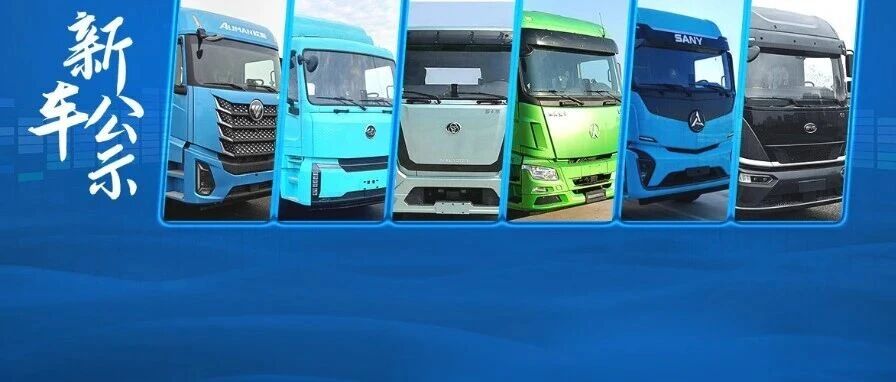
福田推801度大电量 零一大批上新 斯堪尼亚出击!2026首批牵引车有何新风向?| 头条
第一商用车网· 2026-01-12 07:19
Core Viewpoint - The Ministry of Industry and Information Technology (MIIT) has announced the first batch of new vehicles for 2026, highlighting a significant increase in the number of new truck models, particularly in the traction vehicle market, with a total of 49 new models, the highest in six years. Among these, 33 are new energy traction vehicles, indicating a strong trend towards electrification in the industry [1][3][30]. Group 1: New Vehicle Announcements - The 403rd batch includes 49 new traction vehicle models, with 33 being new energy vehicles, comprising 25 charging models, 4 battery swap models, 3 fuel cell models, and 1 plug-in hybrid model. The remaining 16 models are traditional energy vehicles, including 9 gas and 7 diesel traction vehicles [1][3]. - The number of National VI traction vehicles announced at the beginning of the year is surprising, with 16 models compared to only a few in previous months of 2025, suggesting increased competition in the National VI market for 2026 [3]. Group 2: Manufacturer Highlights - The highest number of new models comes from Shenhe Automobile, with 6 charging traction vehicles, all from Zero One Automotive. Dongfeng Commercial Vehicle, Dongfeng Liuzhou Motor, and FAW Jiefang each submitted 5 models, with a mix of National VI and new energy vehicles [3][5]. - Foton Daimler, Beiqi Heavy Truck, and SANY Heavy Truck each submitted 4 models, with Foton Daimler's models including 2 gas vehicles and 1 charging vehicle, while SANY's models are all charging types [5][7]. Group 3: Notable Features of New Models - Foton's new charging traction vehicle features an impressive battery capacity of 801.23 kWh and a range of 600 kilometers, marking it as one of the significant entries in the high-capacity segment [8][10]. - The new model from SANY Heavy Truck has a battery capacity of 693.201 kWh and a range of 500 kilometers, showcasing the trend towards larger battery capacities in the market [23][26]. Group 4: Market Trends and Future Outlook - The ongoing vehicle scrappage subsidy policy, which prioritizes electric trucks, is expected to stimulate the new energy traction vehicle market significantly, potentially leading to a surge in sales [30]. - The popularity of new energy vehicles is reshaping the heavy truck market landscape, with traditional fuel vehicles facing increasing pressure, raising questions about which companies will thrive or struggle in this evolving market [30].