
智能制造

Search documents
研判2025!中国添加剂预混合饲料行业政策、产业链、产量、竞争格局及未来前景展望:添加剂预混合饲料发展态势良好,2025年1-10月产量同比增长4.01%[图]
Chan Ye Xin Xi Wang· 2025-11-26 02:17
Core Insights - The modern livestock industry is increasingly demanding diverse animal nutrition, leading to higher requirements for feed performance, which traditional standardized products can no longer meet [1] - Additive premix feed fills the market gap with flexible formulation design and precise nutritional supply, improving feed utilization, reducing farming costs, and enhancing animal growth performance and product quality [1] Industry Overview - Additive premix feed consists of two or more nutritional feed additives mixed with carriers or diluents, including compound premix feed, trace element premix feed, and vitamin premix feed [3] - The production of additive premix feed in China has experienced fluctuations, with production reaching 542.6 million tons in 2019, a decrease of 16.9% year-on-year, and recovering to 594.5 million tons in 2020, a growth of 9.6% [1][8] - In 2021, production increased to 663.1 million tons, a year-on-year growth of 11.54%, but fell to 652.2 million tons in 2022 due to various factors, including the pandemic [1][8] - In 2023, production rebounded to 709.1 million tons, an increase of 8.7% year-on-year, but is expected to decline to 695.1 million tons in 2024 due to adjustments in pig production capacity and reduced livestock inventory [1][8] Industry Policies - The industry has seen a series of supportive and regulatory policies aimed at promoting standardization and efficiency, such as the 2024 "Green Sword Protect Grain Safety" enforcement action focusing on illegal production and sales of feed additives [4][6] - The 2025 Feed Quality Safety Supervision Work Plan emphasizes the inspection of banned substances and illegal additives in various feed products, including premix feeds [4][6] Industry Chain - The upstream of the additive premix feed industry includes feed raw materials like soybeans, corn, and fish meal, while the midstream involves the production of various types of premix feeds [6] - The downstream application includes livestock farming sectors such as pig, poultry, and aquaculture [6] Market Dynamics - The additive premix feed market is characterized by a clear competitive structure, with leading companies like New Hope, Tongwei, and Da Bei Nong forming the first tier, while other companies like Haida Group and Zhengbang Technology represent the second tier [10][12] - The market is expected to consolidate further, with smaller companies facing challenges due to limited innovation and sales channels [10][12] Future Trends - The industry is moving towards precise product functionality and value enhancement, focusing on tailored formulations for different livestock species and growth stages [16] - Technological advancements will drive the integration of biotechnology and smart manufacturing, optimizing formulation structures and improving production processes [17] - A comprehensive service model will emerge, extending beyond product provision to include technical support and real-time monitoring for farmers [18]



我们被远远甩在后面:西方高管亲睹中国“黑灯工厂”后的集体震撼与深层恐惧……
Xin Lang Cai Jing· 2025-11-26 02:14
Core Insights - The article highlights the profound impact of China's advanced manufacturing capabilities, particularly in automation and robotics, on global industry dynamics and competition [4][10][24]. Group 1: Automation and Robotics in China - Western executives express a mix of awe and fear after witnessing China's "dark factories," which utilize AI, IoT, and robotics for fully automated production processes with minimal human intervention [4][5]. - Companies like Xiaomi and NIO demonstrate the effectiveness of automation, with Xiaomi's factory producing 30,000 smartphones daily with fewer than 100 engineers [7][9]. - China's industrial robot market is projected to install nearly 300,000 units by 2024, surpassing the total installations in other regions combined, and is expected to have over 2 million operational industrial robots by the same year [12][15]. Group 2: Global Competitive Landscape - The shift in China's manufacturing strategy from low-cost labor to high-skilled engineering and innovation is reshaping global competition [5][10]. - The "robot density" in China has increased nearly 19 times over the past decade, reaching 470 robots per 10,000 manufacturing workers, outpacing the U.S. and Germany [15][18]. - China's domestic robot manufacturers have gained a market share of 57% in 2024, up from 28% a decade ago, indicating a significant shift in the competitive landscape [20]. Group 3: Geopolitical Implications - The automation revolution in China is seen as a potential game-changer in global economic competition and geopolitical balance, with implications for U.S. manufacturing and supply chain control [22][24]. - The U.S. views AI and robotics as critical to revitalizing its manufacturing sector, with potential efficiency gains of over 40% [22][24]. - The development of autonomous systems and robotics is perceived as a new arms race, with significant implications for national security and military capabilities [26][27]. Group 4: Strategic Responses from the West - The U.S. is urged to develop a national robotics strategy and enhance workforce skills to adapt to the changing landscape of automation [37][38]. - Key strategies include fostering technological alliances, focusing on differentiated innovation, and addressing the challenges of energy consumption and infrastructure [38][39]. - The need for a cohesive national effort, akin to the "Apollo program," is emphasized to unify resources and drive innovation in robotics and AI [37][39].
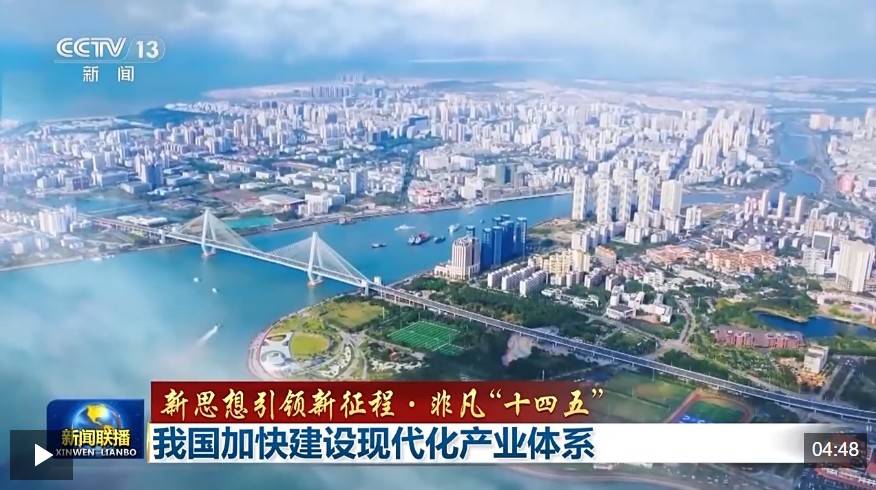
新思想引领新征程·非凡“十四五”丨我国加快建设现代化产业体系
Yang Shi Xin Wen Ke Hu Duan· 2025-11-26 01:21
Core Insights - The construction of a modern industrial system is emphasized as a material and technological foundation for a modernized nation, with a focus on the real economy to support the second centenary goal [2] - The "14th Five-Year Plan" period aims to accelerate the establishment of a modern industrial system driven by technological innovation and rooted in the real economy [2] Group 1: Industrial Development - The Yangtze River Delta's industrial internet platform processes 20,000 data sets every minute, with a refrigerator rolling off the production line every eight seconds [4] - In the eastern coastal bonded zones, cross-border data flows enable verification and customs clearance in just one second, facilitating rapid global distribution of Chinese manufacturing [6] - The Pearl River Delta's lighthouse factories offer 100,000 personalized options for customizing a car, showcasing advanced manufacturing capabilities [7] Group 2: Government Initiatives and Leadership - President Xi Jinping has consistently highlighted the importance of a modern industrial system supported by the real economy, making significant directives on its construction [9] - The modern industrial system reflects changes in industrial structure, development dynamics, and factor relationships, aligning with the context of Chinese-style modernization [11] Group 3: Progress and Achievements - In 2023, the construction of the modern industrial system has accelerated, with over 80% of steel companies establishing intelligent control centers and more than half of coal production capacity achieving digital mining [13] - The manufacturing sector remains the largest in the world, with over 10,000 provincial-level digital workshops and smart factories established, and 6,430 national-level green factories operational [14] - The first batch of leading smart factories has been announced, covering various sectors including steel and consumer goods, aiming to explore new manufacturing models [15] Group 4: Emerging Technologies and Economic Growth - In the first three quarters of the year, the value added of high-tech manufacturing increased by 9.6%, with industrial robot production rising nearly 30% and drone sales revenue growing by almost 70% [19] - The continuous optimization of industrial structure and the increasing proportion of high-tech and strategic emerging industries are driving high-quality economic development [21] Group 5: Future Planning - Regions are actively planning for the "15th Five-Year Plan," with Hunan Province allocating 50 billion yuan to support 1.89 million small and medium-sized enterprises, focusing on key industrial chains [23] - The "15th Five-Year Plan" emphasizes the construction of a modern industrial system and the strengthening of the real economy as primary strategic tasks [23]
稳企扩岗精准促就业
Jing Ji Ri Bao· 2025-11-25 22:24
Core Viewpoint - Employment is fundamental to people's livelihoods and economic development, with a focus on stabilizing jobs being crucial for high-quality growth and common prosperity [1] Group 1: Employment Situation - In the first nine months of this year, urban new employment reached 88% of the annual target, and the urban surveyed unemployment rate decreased by 0.1 percentage points in September, indicating overall stability in the employment situation [1] - The shift from passive emergency responses to proactive and systematic employment governance reflects a significant change in macroeconomic policy considerations, emphasizing job creation as a core constraint [1][2] Group 2: Changes in Employment Market - There is a growing demand for high-skilled talent aligned with industrial upgrades, driven by the transformation of the manufacturing sector, which has created numerous new technical positions [2] - The rise of new economic forms, such as platform and sharing economies, has demonstrated strong job creation capabilities, acting as a reservoir for employment opportunities [2] - The service sector's contribution to employment continues to rise, with knowledge-intensive services becoming a key area for absorbing college graduates [2] Group 3: Policy Recommendations - Fiscal policies should enhance support for employment through job subsidies and vocational skill enhancement funds to help enterprises stabilize and expand jobs [3] - Monetary policies need to coordinate with employment policies, utilizing inclusive finance tools to assist small and micro enterprises in overcoming financing challenges [3] - Industrial policies should prioritize employment orientation, ensuring that industry upgrades do not lead to large-scale structural unemployment [3] Group 4: Targeted Support for Key Groups - Youth employment, particularly for college graduates, should be prioritized, with efforts to broaden market-oriented employment channels and stabilize public positions [4] - Continuous support for migrant workers is essential for rural revitalization and urbanization, including skills training and support for entrepreneurship [4] - Establishing a robust public employment service and unemployment insurance system is crucial for monitoring employment risks and providing timely assistance [4] Group 5: Business Environment Optimization - The stability of enterprises is vital for job stability, necessitating the implementation of policies that support the growth of the private economy and address challenges faced by private enterprises [4] - Removing barriers to the free movement of labor and talent across urban and rural areas is essential for a more efficient and orderly employment market [4] - Enhancing the legal framework for labor relations and ensuring the protection of workers' rights will promote harmonious labor relations [4]
业绩增长难掩隐忧!理奇智能发出商品占存货89%,资产负债率曾高达82.26%|透市
Hua Xia Shi Bao· 2025-11-25 14:57
Core Viewpoint - Lichi Intelligent Equipment Co., Ltd. is preparing for an IPO on the Shenzhen Stock Exchange's Growth Enterprise Market, aiming to raise 1.008 billion yuan, with significant investments planned for automation and R&D projects, despite facing challenges such as declining gross margins and high inventory levels [1][11]. Financial Performance - The company reported revenue growth from 619 million yuan in 2022 to 2.173 billion yuan in 2024, with a compound annual growth rate (CAGR) of 87.45%. Net profit increased from 107 million yuan to 270 million yuan during the same period [5]. - Gross margins have declined, with reported figures of 16.48%, 27.80%, and 28.78% for the years 2022 to 2024, and adjusted figures of 41.93%, 40.08%, and 35.97% respectively [6]. Market Position - Lichi Intelligent's market share in the lithium battery slurry feeding system increased from 27% in 2023 to 43% in 2024, positioning the company as a leader in a highly concentrated market [2]. - The company primarily serves major lithium battery manufacturers such as CATL, BYD, and LG New Energy, benefiting from the rapid growth in the global electric vehicle and energy storage sectors [5][8]. Inventory and Debt Concerns - The company's inventory levels are high, with values of 3.261 billion yuan, 3.417 billion yuan, and 2.857 billion yuan over the reporting period, constituting 74.95%, 73.83%, and 64.52% of current assets [7]. - The asset-liability ratio is also elevated, reported at 82.26%, 79.49%, and 74.41%, which is higher than industry averages, raising concerns about financial stability [10]. Investment Plans - The planned use of IPO proceeds includes 600 million yuan for an automation processing equipment manufacturing base, 199 million yuan for a research and development center, and 200 million yuan for working capital [11]. - There are concerns regarding the feasibility of these investments, particularly in light of high inventory levels and a slowing industry growth rate [11][12].

罗博特科(300757.SZ):暂无适用于人型机器人的相关设备
Ge Long Hui· 2025-11-25 13:25
Core Viewpoint - Robotech (300757.SZ) is a global leader in high-precision intelligent manufacturing equipment and systems, crucial for enhancing computing power and enabling sustainable AI development [1] Group 1: Company Overview - The company provides automation equipment and one-stop solutions for smart factories, which are essential for manufacturing optical interconnects, optical sensors, optical computing products, and photovoltaic cells [1] - The company aims to consolidate its existing core competitive advantages and market position while further deepening its business system through intelligent manufacturing systems [1] Group 2: Strategic Initiatives - Robotech is implementing a "dual-drive" strategy to deepen its layout in clean energy and the semiconductor sector, seizing industry development opportunities [1] - The company focuses on technological innovation and business expansion to provide high-quality, high-end supporting equipment for national pillar industries and strategic emerging industries [1] Group 3: Product Focus - Currently, the company does not have relevant equipment suitable for humanoid robots [1]


玛氏旗下工厂入选“卓越级智能工厂”名单
Zhong Guo Jing Ji Wang· 2025-11-25 13:10
Core Viewpoint - Mars has been recognized for its Yonghe factory in Guangzhou as one of the latest "Excellent Intelligent Factories" by multiple Chinese government ministries, highlighting its commitment to digitalization and smart manufacturing [1] Group 1: Factory Achievements - The Yonghe factory has undergone a five-year upgrade, completing the intelligent transformation of all 21 production lines, resulting in improvements in capacity, quality, cost, and delivery levels [1] - The factory utilizes 3D modeling and AI algorithms for real-time monitoring of production factors, achieving 100% high-precision traceability in key manufacturing processes [1] - Cloud-based collaborative scheduling has accelerated response times to production anomalies by over 50% [1] Group 2: Technological Innovations - The factory employs nearly a hundred automated guided vehicles and collaborative robots that operate seamlessly 24/7, ensuring "dark factory" operations for finished product stacking and raw material delivery [1] - Collaborative robots are capable of executing automatic feeding processes with no human intervention required [1] Group 3: Strategic Implications - The Vice President of Supply for Mars Wrigley China stated that the "Excellent Intelligent Factory" is a significant practice of Mars' smart manufacturing strategy, injecting new momentum into the company's long-term development in China [1] - Mars aims to continuously build a more efficient and sustainable supply system driven by digitalization, intelligence, and green initiatives to provide high-quality products and services to Chinese consumers [1]
斯菱股份:在机器人零部件新业务领域已完成核心产品的技术研发和小批量试制
Zheng Quan Shi Bao Wang· 2025-11-25 12:52
Core Viewpoint - The company is actively expanding into the new business area of robot components, having completed the technical development and small-scale trial production of core products, which meet industry standards [1] Group 1: Business Development - The company is advancing the construction of automated production lines for its new robot components business [1] - The new business aligns with the trend of intelligent manufacturing, indicating a strategic move towards future growth [1] Group 2: Performance Indicators - The performance indicators of the new products are expected to support the company's future earnings growth [1] - The company is synchronizing its technological reserves with customer engagement, which may enhance market competitiveness [1]
雷军,大动作!小米股价大涨!
Sou Hu Cai Jing· 2025-11-25 12:39
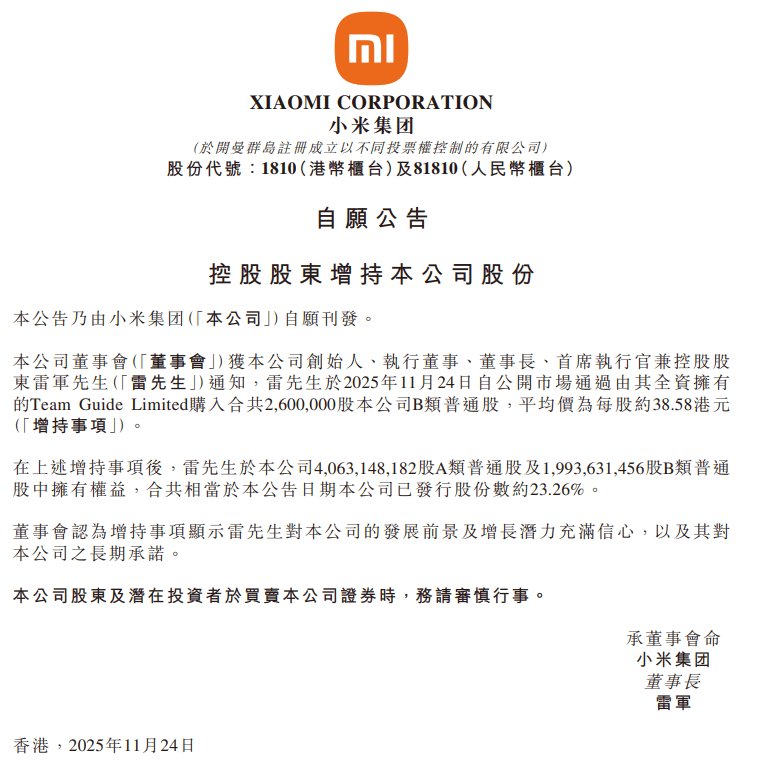
Core Insights - Lei Jun, the founder, chairman, and CEO of Xiaomi Group, invested over 100 million HKD to purchase 2.6 million shares at an average price of approximately 38.58 HKD per share, increasing his shareholding to 23.26% [1] - Xiaomi's stock price surged in early trading on November 25, recovering above the 40 HKD mark, closing at 40.34 HKD per share, with a market capitalization of approximately 1.05 trillion HKD [3] - The board views Lei Jun's share purchase as a strong indication of his confidence in the company's growth potential and long-term commitment [6] Financial Performance - In Q3, Xiaomi reported total revenue of 113.1 billion RMB, a year-on-year increase of 22.3% [6] - Revenue from the mobile and AIoT segment was 84.1 billion RMB, up 1.6% year-on-year, while the smart electric vehicle and AI innovation segment reached a record high of 29 billion RMB, growing by 199.2% [6] - Adjusted net profit for Q3 was 11.3 billion RMB, marking a historical high with an 80.9% year-on-year increase [6] - The smart electric vehicle and AI innovation segment achieved operational profitability for the first time in a single quarter, with an operating profit of 700 million RMB [6] Stock Buyback Activity - Xiaomi has repurchased 21.5 million shares on November 20 and 21, with total expenditures exceeding 800 million HKD [6] - The total amount spent on share buybacks this year has surpassed 2.3 billion HKD, positioning Xiaomi among the top in buyback activity within the Hong Kong tech sector [6] Automotive Milestones - On November 20, Lei Jun announced the production of the 500,000th Xiaomi vehicle, emphasizing the company's commitment to safety, delivery, technological innovation, and the integration of AI and smart manufacturing [7] - Xiaomi's automotive division aims to meet its annual delivery target of 350,000 vehicles by the end of the week [8]
大连跑出智能输送系统赛道黑马!董秘17岁参加工作 神秘股东身份成谜!
Zhong Jin Zai Xian· 2025-11-25 10:49
Core Viewpoint - The Beijing Stock Exchange will hold a review meeting on November 27, 2025, to assess the fundraising proposal of Dalian Meidel Industrial Automation Co., Ltd., which aims to raise 645 million yuan for various automation projects [1] Group 1: Company Overview - Dalian Meidel is a leading domestic supplier of intelligent conveyor systems, focusing on the research, design, manufacturing, and sales of intelligent manufacturing equipment, particularly modular conveyor systems and industrial components [2] - The company has demonstrated strong financial performance, with revenues of 1.031 billion yuan in 2022, 1.009 billion yuan in 2023, 1.138 billion yuan in 2024, and 712 million yuan in the first half of 2025. Net profits for the same periods were 224 million yuan, 208 million yuan, 213 million yuan, and 152 million yuan respectively [2] Group 2: Financial Performance and Market Demand - The company’s new orders for the reporting periods were 1.9008624 billion yuan, 1.1617795 billion yuan, and 1.2023283 billion yuan, with 1.0104473 billion yuan in the first half of 2025. Revenue growth was 35.13% year-on-year, with a gross margin increase of 4.84 percentage points and a net profit growth of 63.15% [3] - In 2024, the company’s revenue grew by 12.73%, while comparable companies experienced revenue declines. Major clients such as Today International and Haimeixing saw revenue changes of -14.36% and -30.50% respectively [3] Group 3: Order and Revenue Analysis - The company is required to clarify the relationship between new orders and major clients, including the application fields and demand changes in comparison to peers [4] - The company must explain the reasons for revenue changes, including any alterations in settlement policies and the relationship between contract liabilities and existing orders [4] - The fluctuation in gross margins needs to be analyzed, particularly for high-precision conveyor systems sold to major clients, which have shown a declining trend [4] Group 4: Management and Governance - The company’s board secretary, Ren Tong, has a background in human resources and management, but the disclosure of his educational history appears incomplete, raising concerns about transparency [6] - The company has attracted investment from institutions, with agreements that include special investment terms such as share buybacks and anti-dilution rights [7] - The identity of external investor Jiang Jianfeng remains undisclosed, presenting a mystery in the company's investment landscape [8]