以价换量

Search documents
9月北上杭新房价格上涨 四季度政策继续托底
Feng Huang Wang· 2025-10-21 00:20
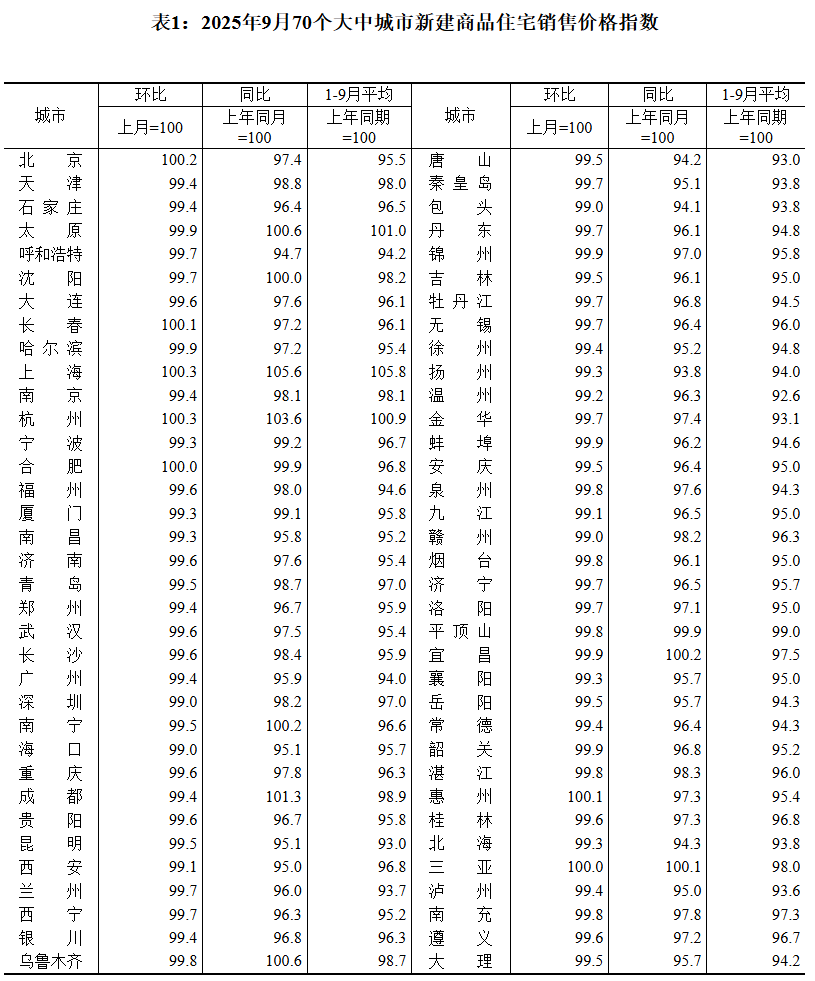
Core Insights - The real estate market in September showed a relative stability, with a narrowing decline in housing prices year-on-year, indicating the gradual impact of previous policies [1][3][5] New Housing Market - In September, new housing prices in first-tier cities experienced a month-on-month decline of 0.3%, with Beijing and Shanghai seeing increases of 0.2% and 0.3% respectively [2][3] - Year-on-year, new housing prices in first-tier cities fell by 0.7%, a reduction of 0.2 percentage points, with Shanghai increasing by 5.6% [3][4] - The number of cities with rising new housing prices increased from 5 to 8, signaling a stabilization in the market [3] Second-hand Housing Market - The second-hand housing market continues to face significant downward pressure, with first-tier cities seeing a month-on-month decline of 1.0% in September [4] - Year-on-year, second-hand housing prices in first-tier cities decreased by 3.2%, a narrowing of 0.3 percentage points [4] - The average listing time for second-hand homes in smaller cities has increased to 99 days, indicating greater difficulty in inventory turnover [4] Market Outlook - Industry experts predict that continued policy easing will support transaction volumes in core cities, while smaller cities may need to adopt price reductions to stimulate sales [5] - The anticipated low base effect from last year's fourth quarter, combined with ongoing policy effects, may lead to further narrowing of year-on-year price declines in the last quarter of the year [5]

9月新房销售环比上涨,商品房库存连续7个月下降
2 1 Shi Ji Jing Ji Bao Dao· 2025-10-20 09:21
Core Viewpoint - In September, new home sales increased month-on-month, while the inventory of commercial housing has decreased for seven consecutive months, indicating a potential recovery in the real estate market [1][5]. Price Trends - In September, the sales prices of new residential properties in first, second, and third-tier cities decreased by 0.3%, 0.4%, and 0.4% respectively month-on-month, with first-tier cities experiencing the smallest decline [2] - Year-on-year, first-tier cities saw a price drop of 0.7%, narrowing by 0.2 percentage points compared to the previous month, with Shanghai showing a 5.6% increase [2][3]. Sales Performance - From January to September, the sales area of new commercial housing decreased by 5.5% year-on-year, while sales revenue fell by 7.9% [1][4]. - In September alone, the sales area of new commercial housing reached 85.31 million square meters, and sales revenue was 80.25 billion yuan, representing month-on-month increases of 48.52% and 47.28% respectively [4][5]. Inventory Levels - By the end of September, the inventory of commercial housing for sale was 75.928 million square meters, a decrease of 2.41 million square meters from August, marking the seventh consecutive month of decline [5]. - The reduction in inventory is attributed to increased promotional efforts and favorable policies, leading to a relatively high average absorption rate of around 40% despite an 80% increase in supply [5]. Construction Activity - From January to September, the new construction area was 45.399 million square meters, down 18.9%, but the decline has narrowed compared to earlier months [6]. - The relaxation of pre-sale standards by some developers has improved the enthusiasm for new construction, providing better support for cash flow [6]. Market Outlook - The fourth quarter is expected to see an increase in new supply from quality land acquisitions by leading developers, which may support new home sales in core cities [6]. - The real estate market is anticipated to continue its recovery, but the "price-for-volume" strategy is likely to persist in the short term [6].
58安居客研究院:二手市场成交量稳 新房持续结构性分化
Xin Hua Cai Jing· 2025-10-20 06:38
Core Insights - The real estate market in September showed relative stability, with steady transaction volumes in the secondary market and ongoing structural differentiation in the new housing market [1] - Positive signals emerged as the year-on-year decline in housing prices narrowed, indicating that the effects of previous policies are gradually permeating the market, alleviating long-term downward pressure [1] Market Performance - In September, 64.1% of online house-hunting users on the Anjuke platform were looking for second-hand homes, marking a 1.6 percentage point increase from the previous month and reaching the highest level since April [1] - The average listing duration for second-hand homes in 100 cities increased to 95 days, with third and fourth-tier cities experiencing an even longer duration of 99 days, indicating greater difficulty in inventory digestion in smaller cities [1] New Housing Market - The new housing market performed relatively well, with new home prices in Beijing and Shanghai increasing by 0.2% and 0.3% month-on-month, respectively, and Shanghai achieving a significant year-on-year growth of 5.6% [1] - Key support for this growth came from the introduction of quality improvement housing in core areas and the relaxation of purchase restrictions in peripheral areas [1] Policy Impact - The relaxation of policies in August and September directly stimulated demand, supporting both new home prices and transaction volumes in the secondary market [1] - Expectations for stable housing prices and continued policy easing are anticipated to bolster transaction volumes in core cities in the fourth quarter, while non-core areas and many smaller cities will still need to rely on "price for volume" strategies to reduce inventory [2]

58安居客研究院院长张波:“金九”楼市保持稳定
Zhong Guo Jing Ji Wang· 2025-10-20 05:24
Core Insights - The real estate market in major cities showed a mixed performance in September, with new residential prices declining month-on-month but the year-on-year decline narrowing, indicating a potential stabilization in the market [1][2] Group 1: Price Trends - In September, new residential prices in first-tier cities decreased by 0.3% month-on-month, with Beijing and Shanghai experiencing slight increases of 0.2% and 0.3% respectively, while Guangzhou and Shenzhen saw declines of 0.6% and 1.0% [1] - Second-tier cities experienced a month-on-month decline of 0.4% in new residential prices, while third-tier cities also saw a similar decline of 0.4% [1] - The second-hand residential market in first-tier cities saw a month-on-month price drop of 1.0%, consistent with the previous month, with declines in major cities like Beijing, Shanghai, Guangzhou, and Shenzhen [1] Group 2: Market Dynamics - The "Golden September" period showed relative stability in the real estate market, with steady transaction volumes in the second-hand market and ongoing structural differentiation in new housing [1][2] - Policy relaxations in August and September, such as the easing of purchase restrictions in Shenzhen and adjustments in mortgage rates in Shanghai, have stimulated demand and supported both new and second-hand housing prices [2] - The online search for second-hand homes reached a peak of 64.1% in September, indicating increased interest, while the average listing duration for second-hand homes rose to 95 days, suggesting challenges in inventory turnover, particularly in smaller cities [2] Group 3: Future Outlook - Looking ahead to the fourth quarter, continued policy easing is expected to support transaction volumes in core cities, with stable price expectations likely to strengthen market confidence [3] - The release of policy benefits and traditional seasonal effects are anticipated to drive a rebound in transaction volumes in core cities, particularly in areas where purchase restrictions have been relaxed [3]

“金九”楼市下行压力趋缓 未来走势需关注三个变量
Xin Hua Cai Jing· 2025-10-20 05:03
Core Viewpoint - The latest data from the National Bureau of Statistics indicates a decline in housing prices across 70 major cities in September, with a narrowing year-on-year decline, suggesting a stabilization in the real estate market [1][2]. New Housing Market - In September, first-tier cities saw new housing prices decrease by 0.3% month-on-month, with Beijing and Shanghai experiencing slight increases of 0.2% and 0.3% respectively, while Guangzhou and Shenzhen saw declines of 0.6% and 1.0% [1]. - Second-tier cities experienced a month-on-month decline of 0.4%, while third-tier cities also saw a 0.4% decrease, indicating a consistent downward trend [1]. - The new housing market is characterized by significant differentiation among cities, with first-tier cities showing stronger performance [2]. Second-Hand Housing Market - The second-hand housing market in first-tier cities saw a month-on-month price decline of 1.0%, with specific decreases in Beijing, Shanghai, Guangzhou, and Shenzhen [1]. - The average listing duration for second-hand homes increased to 95 days, with third and fourth-tier cities reaching 99 days, indicating a greater difficulty in sales compared to core cities [2]. - The increase in second-hand housing transactions is attributed to a "price for volume" strategy, as many listings have not adjusted their prices in line with market conditions [2]. Market Outlook - Looking ahead to Q4, the expectation is that policy easing will continue to support transaction volumes in core cities, with stable price expectations further reinforcing market confidence [3]. - The core cities are anticipated to see a rebound in transaction volumes, driven by policy incentives and seasonal demand [3]. - However, the second-hand market may still face price pressures, with high listing volumes indicating ongoing challenges [3]. Key Market Indicators - Key indicators for market stabilization include land market performance, inventory de-stocking cycles, and adjustments in second-hand listing prices [3][4]. - The land premium rates in core city areas are seen as a significant indicator of developer confidence, while high land auction failure rates may signal ongoing market adjustments [3]. - The overall de-stocking cycle for first and second-tier cities has decreased to under 12 months, suggesting an acceleration in inventory reduction [3].
二手结构 | 9月京沪深杭小面积低总价成交比重显著上升
克而瑞地产研究· 2025-10-19 01:58
Core Viewpoint - The second-hand housing market in key cities like Beijing, Shanghai, Shenzhen, and Hangzhou shows a significant year-on-year increase in transaction volume, contrasting with a decline in new housing transactions. The market is characterized by a strong demand from first-time buyers and a stable high-end segment, while the middle-tier demand is weakening [2][14]. Summary by Sections Transaction Volume and Structure - In September 2025, the transaction volume of second-hand houses in 30 key cities increased by 9% year-on-year, while new housing transactions showed a declining trend [2]. - The proportion of transactions under 2 million yuan in Beijing, Shanghai, Shenzhen, and Hangzhou has increased, indicating a strong presence of first-time buyers [3][14]. Price Segmentation - The share of transactions priced below 2 million yuan in Shanghai reached 46.56%, with a month-on-month increase of 2.79 percentage points and a year-on-year increase of 7.51 percentage points [3]. - Conversely, the middle-tier segments (500-600 million yuan) in these cities have seen a decline in transaction share, reflecting increased buyer hesitation [3][14]. High-End Market Stability - The high-end market remains stable, with luxury properties priced over 10 million yuan in Beijing and Shanghai showing resilience, while Shenzhen's luxury market (3-5 million yuan) has also seen significant growth [3][14]. Area and Size Trends - The majority of transactions in Beijing, Shanghai, and Shenzhen are concentrated in small-sized properties (under 70 square meters), which account for over 30% of total transactions [7]. - In Hangzhou, there is a notable increase in the transaction share of larger properties (over 160 square meters), catering to buyers looking for long-term living solutions [7][14]. Regional Focus - The transaction share in Shanghai is increasingly concentrated in suburban areas, while Beijing and Hangzhou see a focus on core urban districts [11][14]. - The top three areas with the highest transaction growth in September 2025 include Beijing's Chaoyang District and Shenzhen's Longgang District, indicating a shift in buyer preferences towards more central locations [11][14]. Market Outlook - The second-hand housing market is expected to experience a seasonal decline in October, with prices still in a downward cycle. The market is transitioning to a buyer's market, where buyers are more selective based on location, amenities, and price [14].

9月二手房交易活跃度有所回升
Xin Hua Cai Jing· 2025-10-17 16:28
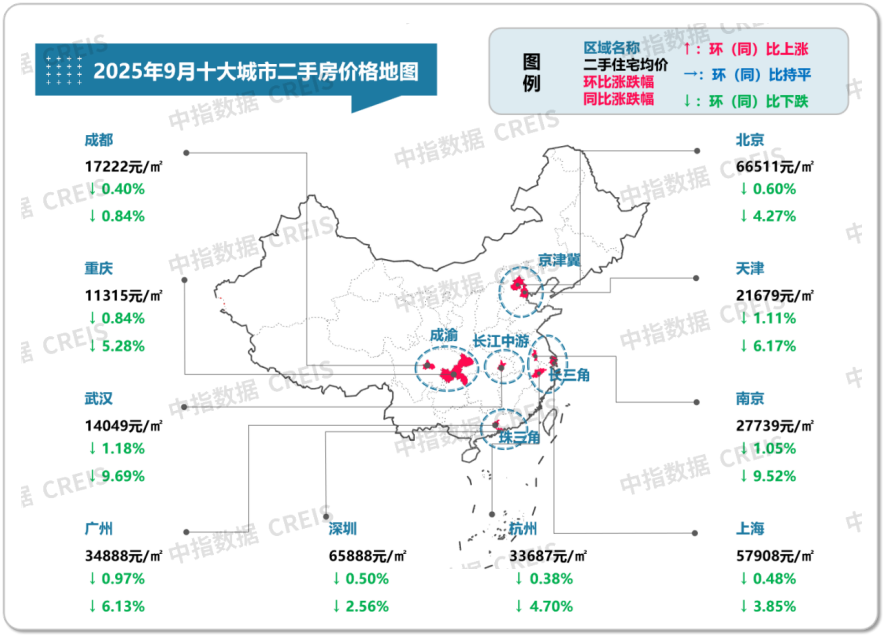
Core Viewpoint - The second-hand housing market in major cities in China showed signs of recovery in September, with increased transaction volumes, but prices remain under pressure, continuing the trend of "trading price for volume" [1][3]. Group 1: First-tier Cities - In Beijing, the second-hand housing market saw a significant increase in activity, with transaction volumes up nearly 20% month-on-month and year-on-year, totaling 15,843 units, a month-on-month increase of 18.8% and a year-on-year increase of 19.4% [2]. - Despite the increase in transaction volume, Beijing's second-hand residential prices fell by 0.60% month-on-month and 4.27% year-on-year [2]. - Shanghai's second-hand housing transactions increased by 27% year-on-year, with 17,723 units sold, a month-on-month increase of 2.7% [2]. - In Guangzhou, the average listing price for second-hand residential properties fell by 0.97% month-on-month and 6.13% year-on-year [2]. - Shenzhen experienced over a 40% year-on-year increase in transaction volume, while prices remained stable month-on-month [2]. Group 2: Second-tier Cities - In Hangzhou, the market activity improved with the end of high temperatures, but prices continued to fluctuate [3]. - Chengdu saw growth in transaction volumes under the "trading price for volume" strategy, but the month-on-month price decline expanded [3]. - Nanjing's second-hand housing market remained relatively flat, with continued price declines [3]. - Wuhan's transaction volume was stable, but prices faced significant downward pressure [3]. - In Chongqing, second-hand housing prices continued to decline, with an expanding drop [3]. - Tianjin's prices further decreased, particularly in suburban areas [3]. Group 3: Market Outlook - The overall second-hand housing market showed signs of recovery in September, with increased transaction volumes in Beijing, Shanghai, and Shenzhen, as well as some recovery in other core cities like Wuhan and Chengdu [3]. - The Central Index Research Institute expects continued moderate recovery in transaction activity in key cities in October, although last year's fourth-quarter high base may impact year-on-year growth rates [3].
中指研究院:9月二手房交易活跃度有所回升 北上深成交量同环比均保持增长
智通财经网· 2025-10-17 06:23
智通财经APP获悉,10月17日,中指研究院发布,9月,二手房交易活跃度有所回升,其中北上深新政效应持续,二手房成交 量同环比均保持增长,其他核心城市二手房成交也有所修复,但"以价换量"现象延续。 北京:9月二手房市场活跃度明显提升,成交套数同环比增长近20%,价格跌幅略有扩大 图:2020年9月至2025年9月北京二手住宅成交套数及二手住宅价格环比走势 数据来源:中指数据CREIS 政策层面,9月11日,国务院批复同意10个地区要素市场化配置综合改革试点实施方案,各地区在土地要素市场化配置中多涉 及盘活存量土地和低效建设用地、深化产业用地市场化改革等方面;同日自然资源部在政策例行吹风会中,强调鼓励采取市 场化方式盘活存量闲置土地。 地方层面,9月,深圳放宽限购区域,符合条件的居民家庭,在非核心区购房不限套数;上海优化房产税政策,满足条件的非 本市户籍家庭购买二套及以上住房可享受房产税税收优惠;深圳、河南等地扩宽提取公积金使用范围,支持提取公积金支付 购房税费、用于住房装修等;广东、湖南、山东、福建发行超197亿元专项债券收回收购闲置存量土地。 9月十大城市二手房价格环比均下跌,短期价格仍面临一定压力 图:2 ...
房企9月成绩单:超六成销售额环比结构性增长
Bei Jing Shang Bao· 2025-10-16 16:17
Core Insights - The real estate market showed signs of recovery in September, driven primarily by the sales of improved housing options, with 62.5% of the 24 reported companies experiencing a month-on-month increase in sales [1][2] - Differentiated pricing strategies have played a crucial role, with smaller units attracting buyers through lower prices while improved housing options achieve premium pricing [1][7] Sales Performance - Among the 24 companies, leading firms like Poly Developments and China Overseas Land & Investment reported sales exceeding 20 billion yuan in September, indicating robust growth [2][3] - Mid-sized companies also saw significant sales increases, with Yuexiu Property achieving a 23.54% month-on-month growth in September [2][3] Market Dynamics - The recovery pace varies among companies, with some experiencing substantial month-on-month growth due to low sales bases in previous months, such as Ronshine China with a 132.31% increase [3] - The concentration of land acquisition in core cities has led to a 13% year-on-year increase in residential land sales across 300 cities [4][6] Land Acquisition Trends - Companies are focusing on optimizing land reserves, particularly in first- and second-tier cities, with significant investments planned for 2024 [4][5] - The competitive bidding for prime land parcels, such as the one in Beijing, reflects the ongoing demand for quality locations [6] Product Quality and Market Appeal - The introduction of high-quality housing standards has enhanced market attractiveness, with improved housing options meeting the evolving demands of buyers [7][8] - The sales of improved housing units have surged, with a notable increase in the proportion of larger units sold in major cities [8][9]




【IPO前哨】以价换量谋扩张,高负债下狂奔,遇见小面底气够吗?
Sou Hu Cai Jing· 2025-10-16 11:59
Core Viewpoint - The performance and stock price trends of Hong Kong's restaurant companies have shown divergence this year, with some companies experiencing significant stock price declines while others perform well. In this context, the company "Yujian Xiaomian," the fourth largest Chinese noodle brand, is accelerating its IPO process in Hong Kong [2][3]. Company Overview - Yujian Xiaomian was founded in Guangzhou in 2014, specializing in Chongqing noodles and various Sichuan and Chongqing dishes, including signature dishes like red bowl noodles and spicy rice noodles. As of 2024, the company holds a mere 0.5% market share in the Chinese noodle restaurant sector, ranking fourth, indicating a highly fragmented competitive landscape [3][5]. Business Expansion Strategy - The company has a significant regional concentration, with over half of its restaurants located in Guangdong Province, reflecting a heavy reliance on this market. Unlike other brands that have adopted survival strategies, Yujian Xiaomian is choosing to expand aggressively. As of October 8, 2025, the company has established a network of 451 restaurants across 22 cities in mainland China and Hong Kong, up from 170 in 2022 [5][6]. Store Opening and Financial Performance - Yujian Xiaomian has not slowed its pace of expansion, with 101 new restaurants in the preparation stage as of October 8. The company plans to open approximately 150 to 180 new restaurants in 2026, 170 to 200 in 2027, and 200 to 230 in 2028 [6][7]. - The company's revenue has surged from 418 million yuan in 2022 to 1.154 billion yuan in 2024, with a further increase to 703 million yuan in the first half of 2025, representing a year-on-year growth of 33.77% [11][12]. Pricing Strategy and Impact - To support its store expansion and capture market share, Yujian Xiaomian has adopted a "price for volume" strategy, resulting in a decrease in average order value from 36.2 yuan in 2022 to 31.8 yuan in the first half of 2025. This strategy has led to increased customer traffic and total transaction volume, but has negatively impacted single-store profitability, with average daily sales per store declining from 127,000 yuan in the first half of 2024 to 118,000 yuan in the first half of 2025 [7][8][9]. Financial Health and Risks - Despite impressive revenue growth, the company faces financial risks, including a low current ratio of 0.56 and a high debt ratio of 87.83% as of the first half of 2025, indicating significant short-term repayment pressure [13][14]. - The second-largest shareholder, Baifu Holdings, has opted to liquidate part of its investment, selling 1.71% of its stake for 48 million yuan, which raises concerns about the company's financial stability [13][15]. Conclusion - Yujian Xiaomian is pursuing an aggressive expansion strategy and a price-driven approach to boost its IPO prospects. However, it faces challenges such as declining single-store efficiency, low liquidity ratios, and high debt levels, which may impact its sustainable growth in the competitive Hong Kong restaurant market [16].