
体育消费

Search documents
释放体育消费潜力“20条”来了,机构称未来赛事经济仍有较大空间
Di Yi Cai Jing· 2025-09-05 02:08
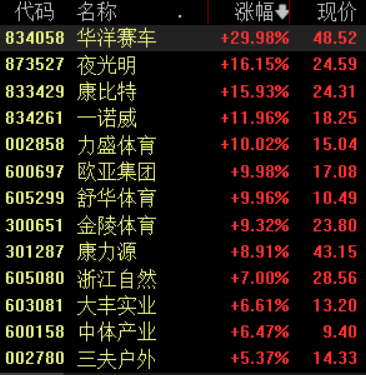
Group 1 - The sports industry sector is experiencing significant growth, with stocks such as Huayang Racing, Lisheng Sports, and Eurasia Group reaching their daily limit up [1] - As of September 5, notable stock performances include Huayang Racing up by 29.98% to 48.52, and Lisheng Sports up by 10.02% to 15.04 [2] Group 2 - The State Council has issued an opinion aimed at unleashing sports consumption potential, with a goal to cultivate world-class sports enterprises and events by 2030, targeting a total industry scale exceeding 70 trillion yuan [3] - Key measures include expanding sports product supply, stimulating consumer demand, strengthening sports enterprises, and enhancing service levels to create a favorable market environment [3] Group 3 - Sports consumption is identified as a significant area for improvement, with a strong demand for sports events across urban and rural areas, indicating a vibrant market [4] - China's sports consumption as a percentage of income is comparable to developed countries, but per capita spending remains significantly lower, suggesting room for growth in the sports economy [4]




体育产业2030年总规模将超7万亿
Bei Jing Shang Bao· 2025-09-05 01:14
Core Viewpoint - The State Council's recent opinion aims to significantly enhance the sports industry, targeting a total scale exceeding 7 trillion yuan by 2030, while fostering world-class sports enterprises and events [1] Group 1: Measures for High-Quality Development - The opinion outlines 20 measures to promote high-quality development in the sports industry, focusing on expanding sports product supply, stimulating consumer demand, and strengthening industry support [2] - It emphasizes the need to enrich sports events and establish a multi-level event system, encouraging the development of brand events with independent intellectual property rights [2][3] Group 2: Consumer Demand Activation - The opinion proposes expanding sports consumption scenarios and integrating digital technology to create new consumption models [4] - It encourages the organization of various promotional activities around key holidays and events to stimulate sports consumption [4] Group 3: Support for Sports Enterprises - The opinion supports the listing and refinancing of sports enterprises, aiming to enhance the scale and quality of sports companies [6][8] - It calls for the implementation of policies to assist private enterprises in investing in the sports industry and strengthening the supply chain [7] Group 4: Financial Support and Risk Management - Financial institutions are encouraged to optimize financing services for the sports industry, including the development of new credit products and support for equity financing [8] - The opinion suggests exploring a prepayment fund management model to mitigate risks associated with prepaid sports consumption [8]
四大证券报精华摘要:9月5日
Zhong Guo Jin Rong Xin Xi Wang· 2025-09-04 23:48
Group 1 - The State Council issued an opinion to enhance the sports industry, aiming for a total scale exceeding 7 trillion yuan by 2030, with a focus on building a modern sports industry system and boosting sports consumption [1] - Financial institutions are encouraged to optimize investment and financing services for sports enterprises, including support for listings, refinancing, and asset securitization [1] - Recent market trends show a significant rise in certain funds, with some achieving over 100% returns this year, leading to limited purchases to balance growth and performance stability [1] Group 2 - The A-share market experienced a decline on September 4, with major indices dropping significantly, while over 2,200 stocks rose, indicating a structural market trend [2] - The total trading volume in the A-share market reached 2.58 trillion yuan, marking the 17th consecutive day of trading above 2 trillion yuan [2] - Analysts suggest that the market's overheating may pose risks, but the medium-term upward logic remains intact due to economic recovery expectations and policy benefits [2] Group 3 - The Ministry of Industry and Information Technology and the State Administration for Market Regulation released an action plan for the electronic information manufacturing industry, targeting an average growth rate of around 7% from 2025 to 2026 [3] - The plan emphasizes the integration of North Beidou applications with AI and smart vehicles, aiming for a revenue growth rate of over 5% in the electronic information manufacturing sector [3] Group 4 - Zhejiang Province launched its first provincial-level low-altitude economy industry fund with a target size of 3 billion yuan, marking a significant step in the low-altitude economy sector [4] - The report indicates a recovery in orders for major lithium battery equipment manufacturers, driven by emerging technologies like solid-state batteries [4] - The growth focus of the lithium battery industry is shifting from domestic to international markets, particularly in the energy storage sector [4] Group 5 - The land market in key cities remains active, with Shanghai's recent land auction yielding a total transaction amount of 11.116 billion yuan [5] - The competitive nature of land sales is expected to influence new housing prices in the region, contributing to market stability [6] Group 6 - NIO's recent vehicle models have exceeded market expectations, with the company aiming for breakeven by the fourth quarter of this year [6] - The company is experiencing a shift in investor sentiment, with increasing confidence in its ability to achieve profitability [6] Group 7 - The lithium carbonate futures market showed signs of recovery, with a closing price of 73,420 yuan per ton, despite a previous drop of about 20% from its peak [7] - Analysts highlight strong demand in the lithium market, particularly for phosphate iron lithium production, which is expected to reach record levels [7] Group 8 - The State Administration for Market Regulation is leading the development of international standards in the brain-computer interface sector, aiming to promote technology innovation and industry growth [8] - The establishment of global standards for elder care robots is expected to enhance the quality and scalability of the industry [8] Group 9 - The global smart home cleaning robot market saw a shipment of 15.352 million units in the first half of the year, reflecting a 33% year-on-year growth [9] - Companies are increasing investments in research and development to capture growth opportunities in the smart home cleaning sector [9] Group 10 - Huawei launched its second-generation foldable smartphone, which requires advanced performance and reliability in its components, indicating a push for innovation in the supply chain [10] - Domestic suppliers are expected to benefit from the demand for new materials and technologies associated with the foldable smartphone market [10]

涪陵榨菜:榨菜销量下滑丨消费参考
2 1 Shi Ji Jing Ji Bao Dao· 2025-09-04 23:41
Group 1 - The core viewpoint is that Fuling Zhacai is reassessing its key pickled vegetable business due to changing market dynamics and consumer preferences [1][4] - In the first half of 2025, Fuling Zhacai reported a revenue increase of 0.5% year-on-year to 1.31 billion yuan, while net profit attributable to shareholders decreased by 1.7% to 440 million yuan [1] - Revenue from the pickled vegetable category was 1.12 billion yuan, with a year-on-year growth of 0.5%, while sales volume declined by 1.2% [1] Group 2 - The company is facing challenges in sales channels as consumer preferences shift towards alternative products, and urban population trends are affecting its market coverage [3] - Fuling Zhacai is implementing a strategy to expand product categories and market reach, focusing on new product development and channel expansion [3] - The company is adjusting its production plans by reducing conventional pickled vegetable production lines and increasing the production of multi-specification products and sauces [3] Group 3 - The stock price of Fuling Zhacai was reported at 13.24 yuan per share, with a slight increase of 0.76% [5] - The consumer index for the sector showed a decline, with the consumption index dropping by 2.21% [6]

盘前必读丨释放体育消费潜力“20条”来了;中微公司发布六款半导体设备新产品
Di Yi Cai Jing· 2025-09-04 23:29
Market Overview - The Shanghai Composite Index is expected to experience a weekly adjustment, with a fluctuation range of approximately 250 to 300 points [1][11]. - The U.S. stock market saw all three major indices close higher, with the Dow Jones up 0.77%, S&P 500 up 0.83%, and Nasdaq up 0.98% [4]. Company Announcements - China National Heavy Duty Truck Group's A-shares have been delisted [2]. - Zhongwei Company announced the launch of six new semiconductor equipment products, which are expected to positively impact the company's market expansion and performance growth [7]. - Zhonghuan Hailu terminated its plan for a change in control and will resume trading on September 5 [8]. - Jingyi Co., Ltd. announced that its controlling shareholder's shares may be auctioned, potentially leading to a change in company control [9]. - Hangzhou High-tech reported a change in control with multiple resignations from its board of directors [10]. - Kobot announced a plan to acquire 60% of Kobot Intelligent Technology for 345 million yuan, aiming to enter the automotive intelligence sector [11]. Economic Policies and Events - The State Council issued guidelines to enhance the sports industry, targeting a total scale exceeding 7 trillion yuan by 2030 [5]. - The People's Bank of China will conduct a 10 billion yuan reverse repurchase operation to maintain liquidity in the banking system [5]. - The market supervision authority launched a three-year action plan to address quality safety issues in 23 high-risk product categories [6].


港股概念追踪 | 国办出台20条举措推进体育产业高质量发展 体育消费站上新风口(附概念股)
智通财经网· 2025-09-04 23:26
Group 1: Industry Overview - The State Council issued an opinion to enhance the sports industry, aiming for a total scale exceeding 7 trillion yuan by 2030, with significant improvements in development levels [1] - The sports industry in China reached a total scale of 3.67 trillion yuan in 2023, with an average annual growth rate of 10.3% since the 14th Five-Year Plan [1] - The sports service industry, led by competition performance and fitness leisure sectors, accounted for 72.7% of the added value in the sports industry [1] Group 2: Outdoor and Ice Sports Development - The opinion emphasizes the development of outdoor sports, proposing differentiated development based on local natural resources and promoting high-quality outdoor sports destinations [2] - The outdoor sports online consumption is projected to reach approximately 300 billion yuan with around 200 million participants by 2024 [3] - The ice sports industry is expected to grow from 381.1 billion yuan in 2020 to 970 billion yuan by 2024, with an annual growth rate of 26.3% [3] Group 3: Financial Support and Investment - The opinion encourages financial institutions to optimize financing services and support qualified sports companies in listing, refinancing, and issuing bonds [3] - The sports industry has seen a total of 16 disclosed investment events in the sports sector, amounting to approximately 559 million yuan as of September 4, 2025 [4] - The domestic consumption stimulus policies are expected to improve macro consumption conditions, leading to increased sales for domestic sports brands [4] Group 4: Company Performance - Li Ning has established a clear product matrix and is focusing on product research and design, aiming to enhance its market share [6] - Anta Sports reported a 15% year-on-year increase in net profit, driven by a 14% revenue growth, with a profit margin increase of 1.5 percentage points to 23.3% [6] - Xtep International achieved a revenue of 6.838 billion yuan, a 7.14% increase year-on-year, with a significant rise in online sales contributing to this growth [6]
国办印发释放体育 消费潜力“20条” 到2030年,要培育一批具有世界影响力的体育企业和体育赛事,体育产业总规模超过7万亿元
Zheng Quan Shi Bao· 2025-09-04 21:31
Core Viewpoint - The State Council's recent issuance of the "Opinions on Releasing Sports Consumption Potential and Further Promoting High-Quality Development of the Sports Industry" aims to enhance the sports industry through 20 measures, targeting various aspects such as expanding supply, stimulating demand, and strengthening support elements, with a goal to exceed 7 trillion yuan in total scale by 2030 [1][2]. Group 1: Expansion of Sports Product Supply - The "Opinions" emphasize the importance of sports events as a key component of sports product supply, highlighting that 511 major events held in seven regions this year generated over 16 billion yuan in related consumption, averaging over 30 million yuan per event [1]. - The document outlines plans to develop outdoor and ice sports, including a new round of outdoor sports industry development plans, leveraging local natural resources for differentiated development [2]. Group 2: Stimulating Sports Consumption Demand - The "Opinions" propose measures to expand sports consumption scenarios and hold sports consumption activities, including implementing consumer-friendly initiatives and expanding the sports consumer base [2]. - Specific initiatives include promoting sports consumption and event economy pilot programs, providing financial subsidies for qualifying service providers, and encouraging local regions to issue sports consumption vouchers and digital currency incentives [2]. Group 3: Support for Sports Enterprises - The "Opinions" call for accelerated implementation of policies supporting private enterprises in the sports sector, promoting investment, and enhancing the growth of specialized sports equipment companies [3]. - Financial support measures are outlined, including optimizing financing services, encouraging listings and refinancing for qualified sports enterprises, and exploring prepayment fund management models to mitigate risks [3].
国办:加快构建现代体育产业体系 不断提振体育消费
Zhong Guo Zheng Quan Bao· 2025-09-04 18:58
Core Insights - The Chinese government aims to enhance the sports industry by releasing a policy to boost sports consumption and develop a modern sports industry system, targeting a total industry scale exceeding 7 trillion yuan by 2030 [1][2] Group 1: Policy Objectives - The policy emphasizes the need to strengthen the overall strength and competitiveness of the sports industry, with a focus on cultivating world-influential sports enterprises and events by 2030 [1] - Financial institutions are encouraged to optimize investment and financing services, support qualified sports enterprises in going public, refinancing, issuing bonds, and asset securitization [1][2] Group 2: Expanding Sports Supply - The policy aims to enrich sports events and activities, develop outdoor sports industries, and promote low-altitude sports consumption through new planning and safety measures [1][2] - There is a focus on enhancing the ice and snow economy by supporting the inclusion of qualifying ice and snow equipment in large-scale equipment renewal support [1] Group 3: Stimulating Sports Consumption - The policy outlines measures to stimulate sports consumption, including financial subsidies for service providers in the sports consumption sector and the introduction of sports consumption vouchers and rewards [1][2] - Local governments are encouraged to implement region-specific initiatives to promote sports consumption, including digital currency incentives [1] Group 4: Strengthening Industry Support - The policy aims to grow the number of large-scale sports enterprises and support the transformation of public sports venues towards green, low-carbon, and smart solutions [2] - It promotes regional coordination in developing the sports industry as a pillar industry and encourages the construction of sports facilities through various funding sources [2]
国办印发释放体育消费潜力“20条”:到2030年要培育一批具有世界影响力的体育企业和体育赛事 体育产业总规模超过7万亿元
Zheng Quan Shi Bao· 2025-09-04 18:52
Core Viewpoint - The State Council's recent issuance of the "Opinions on Releasing Sports Consumption Potential and Further Promoting High-Quality Development of the Sports Industry" outlines 20 measures aimed at advancing the sports industry, targeting a total scale exceeding 7 trillion yuan by 2030 [1][2]. Group 1: Expansion of Sports Product Supply - The "Opinions" emphasize the importance of sports events as a key component of sports product supply, highlighting that 511 major events held in seven regions this year generated over 16 billion yuan in related consumption, averaging over 30 million yuan per event [1]. - The document plans to enhance the supply of outdoor and ice sports, with a new development plan for outdoor sports and continued implementation of nationwide ice and snow consumption measures [2]. Group 2: Stimulating Sports Consumption Demand - The "Opinions" propose measures to expand sports consumption scenarios and hold sports consumption activities, including pilot programs for promoting sports consumption and event economies [2]. - It includes financial incentives for service providers in the sports consumption sector, such as interest subsidies for loans and local initiatives like sports consumption vouchers and digital currency incentives [2]. Group 3: Support for Sports Enterprises - The "Opinions" call for accelerated implementation of policies supporting private enterprises in the sports sector, promoting investment, and enhancing the quality of sports enterprises [3]. - Financial support measures are outlined, including optimizing financing services, encouraging listings and refinancing for qualified sports enterprises, and exploring prepayment fund management models to mitigate risks [3]. Group 4: Regulatory Measures - The document suggests implementing real-name ticketing for sports events and cracking down on ticket scalping to protect consumer interests [3].
动起来!体育消费站上新风口
Zheng Quan Ri Bao· 2025-09-04 16:24
Core Viewpoint - The Chinese sports industry is experiencing robust growth driven by government policies aimed at enhancing sports consumption and high-quality development, with a focus on expanding supply, stimulating demand, and fostering innovation in various sports-related sectors [1][3]. Group 1: Policy Support and Market Growth - The State Council has issued 20 key measures to support the high-quality development of the sports industry, emphasizing the need to enhance sports product supply and stimulate consumer demand [1][3]. - The retail sales of sports and entertainment products have seen a significant increase, with a year-on-year growth of 21.1% in the first seven months of the year [2]. - The sports service sector's contribution to the sports industry's added value has risen from 68.7% in 2020 to 72.7% in 2023, indicating a shift towards service-oriented growth [2]. Group 2: Investment and Financing Landscape - The sports sector has attracted significant investment, with 16 disclosed financing events totaling approximately 5.59 billion yuan as of September 4, 2025 [5]. - Despite the increase in financing activities, most investments are small-scale, with a concentration in the million-yuan range, highlighting a challenge in securing larger funding [6]. - There is a need for financial innovation to address the financing difficulties faced by small and light-asset sports service enterprises, which often lack collateral for bank loans [6]. Group 3: Emerging Trends and Consumer Preferences - The outdoor sports online consumption is projected to reach around 300 billion yuan in total spending by 2024, with land and mountain sports being particularly popular among consumers [2]. - Companies are increasingly focusing on digital and intelligent innovations to enhance product value and meet diverse consumer demands, such as the introduction of smart outdoor equipment [10]. - The sports consumption market is evolving, with consumers seeking more accessible and community-oriented sports facilities, as well as professional guidance and quality events [11]. Group 4: International Expansion and Innovation - Companies are exploring international markets to drive growth, with some establishing overseas production facilities to enhance their global presence [9]. - The sports industry is witnessing a diversification in business models, with a focus on digital transformation and the integration of technology into sports services [10]. - The future of the sports industry is expected to be characterized by multi-faceted and refined development paths, emphasizing technological innovation and brand enhancement [10].