
戴维斯双击

Search documents
ETF盘中资讯|港股AI继续猛攻,南向资金爆买187亿港元创阶段新高!港股互联网ETF(513770)续涨逾2%
Sou Hu Cai Jing· 2026-01-06 02:09
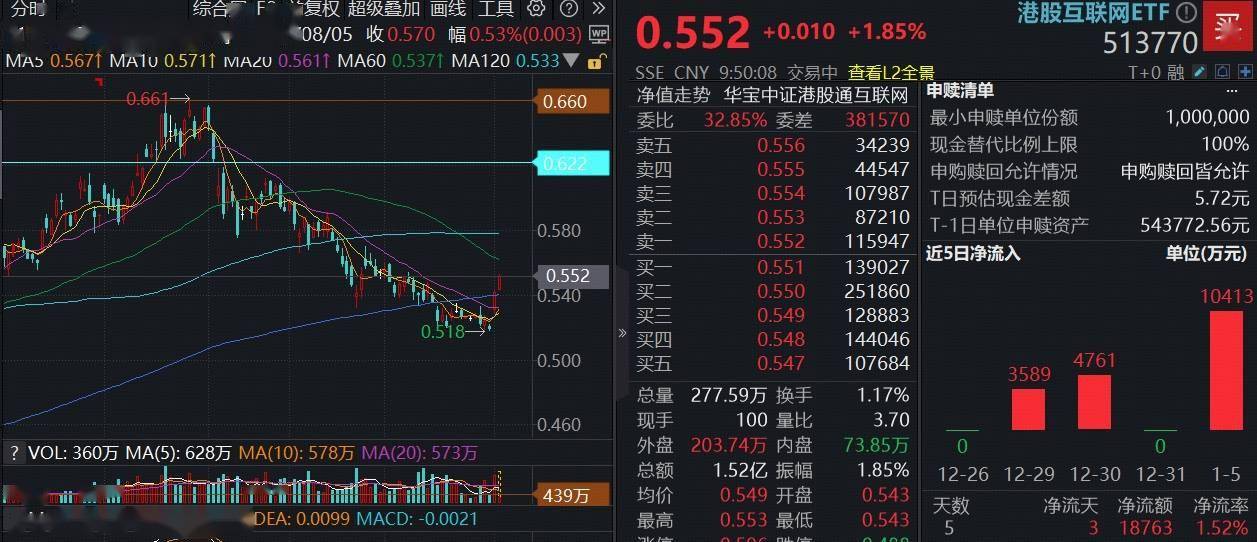
Core Viewpoint - The Hong Kong stock market is experiencing a rebound, driven by improvements in the macroeconomic environment, strong domestic economic resilience, and explosive growth in the AI industry, particularly benefiting technology stocks and internet leaders [3]. Group 1: Market Performance - The Hong Kong stock market has started the year positively, with the Hang Seng Index showing a recovery trend [3]. - The Hong Kong Internet ETF (513770) saw an increase of over 2% at one point, currently up 1.85%, with notable gains from companies like Bilibili-W, Kuaishou-W, Meituan-W, and Tencent Holdings [1][3]. Group 2: Economic Factors - The macroeconomic environment is improving, with expectations of a US-China tariff truce by the end of 2025 and a potential interest rate cut by the Federal Reserve in 2026, easing external liquidity pressures [3]. - China's GDP growth for the first three quarters of 2025 is projected at 5.2%, indicating a stabilization and recovery in the domestic economy [3]. Group 3: AI Industry Impact - The explosive growth of the AI industry is identified as a key catalyst for market confidence, leading to a revaluation of the entire industry chain [3]. - Internet leaders in China are positioned as frontrunners in the AI sector, likely to attract both domestic and foreign investment [3]. Group 4: Investment Trends - There has been a significant inflow of capital, with net purchases from southbound funds exceeding HKD 18.7 billion, marking a new high for daily inflows in the past two and a half months [3]. - The Hong Kong Internet ETF (513770) received a capital influx of HKD 10.4 million in a single day, reflecting optimistic market expectations [3]. Group 5: ETF Characteristics - The Hong Kong Internet ETF (513770) tracks the CSI Hong Kong Internet Index and has a significant concentration in leading companies like Alibaba-W, Tencent Holdings, and Xiaomi Group-W, with over 73% of its holdings in AI-related firms [4]. - The ETF has an average daily trading volume exceeding HKD 600 million, supporting T+0 trading and offering good liquidity [4].

太平洋证券:建议关注餐饮链低基数下的修复 四大方向把握明年消费投资脉络
智通财经网· 2026-01-06 01:56
Core Viewpoint - The report from Pacific Securities suggests that the food and beverage sector, particularly frozen food, is expected to recover due to low base effects and reduced competition, leading to improved profitability. The sector's low valuation may benefit from a "Davis Double" effect as demand recovers and leading companies explore new product opportunities [1][3]. Group 1: Industry Performance and Trends - In 2025, consumer demand is under pressure, with the liquor and restaurant chains lagging behind. The overall consumption has been flat, with retail sales and CPI data at low levels, impacting traditional consumption [2]. - The liquor sector has shown a decline in performance, with major brands like Moutai experiencing a drop in prices from 2200 yuan to 1550 yuan. Most liquor companies, except for a few leaders, have reported declining revenues and profits [2]. - The snack and beverage sectors have shown resilience, characterized by high-frequency consumption and low average transaction values. New products and channels have positively impacted their performance [2][3]. Group 2: Future Outlook and Recommendations - The central economic work conference has prioritized boosting domestic demand, with expectations for policy support to stimulate recovery. There is potential for improvement in consumer spending if housing prices stabilize and supportive policies are implemented [3]. - For 2026, the focus is on the recovery of the restaurant chain sector, particularly frozen foods, as competition eases and profitability improves. The beverage sector, especially low-cost and high-frequency items, is also expected to perform well [3][4]. - Investment opportunities are identified in four areas: overseas demand, cost benefits, new product launches, and value-for-money consumption. Companies like Moutai, Anqi Yeast, and various beverage brands are highlighted for their potential [4].

2026年首个交易日保险板块涨幅居首 新华保险、中国太保股价创新高
Shang Hai Zheng Quan Bao· 2026-01-05 18:28
Core Viewpoint - The insurance sector in A-shares has shown strong performance, with a 6.17% increase, driven by supportive policies and positive market sentiment towards insurance companies [2] Group 1: Market Performance - The insurance sector index rose by 6.17%, leading the Shenwan secondary industry classification [2] - Individual stocks such as New China Life Insurance increased by 8.87%, China Pacific Insurance by 7.52%, and China Life by 6.09%, all reaching new highs [2] - The overall increase in the insurance sector for 2025 was 26.42% [2] Group 2: Policy Impact - Supportive policies include adjustments to risk factors for insurance company investments and the introduction of the "Insurance Company Asset-Liability Management Measures (Draft for Comments)" aimed at optimizing asset-liability matching [2][3] - The reduction in liability costs through measures like lowering the preset interest rate and promoting dividend insurance has eased pressure on insurance companies [3] Group 3: Investment Opportunities - The increase in equity asset investment ratios and the relaxation of stock investment risk factors have opened up new avenues for insurance capital investments [3] - The first three quarters of 2025 saw the five major listed insurance companies achieve a combined net profit of approximately 426.04 billion yuan, marking a historical high for the same period [3] Group 4: Future Outlook - Market analysts expect continued policy support for insurance companies to enhance asset-liability management, alongside sustained enthusiasm for insurance products from residents [3] - The anticipated "Davis Double Play" effect from earnings growth and valuation increases is likely to keep the insurance sector in focus for investors [3]






2026十大研判
2026-01-05 15:42
Summary of Key Points from the Conference Call Industry and Company Overview - The discussion centers around the Chinese economy and stock market, particularly focusing on the year 2026 as a pivotal point for China's return to prosperity, drawing parallels with historical trends in the United States and Japan during their industrialization phases [2][5][6]. Core Insights and Arguments 1. **Economic Recovery and Growth**: 2026 is anticipated to mark the beginning of China's return to prosperity, driven by a per capita GDP exceeding $10,000, which signifies a mature industrial phase. This is expected to enhance manufacturing export capabilities and improve domestic consumption [2][5][6]. 2. **Impact of U.S. Federal Reserve Policies**: The Federal Reserve's potential interest rate cuts and quantitative easing (QE) are expected to increase global liquidity, facilitating the return of cross-border capital to China, which will support the appreciation of the Renminbi and aid in the recovery of the balance sheets of the real economy [2][4][7]. 3. **Commodity Supercycle**: A supercycle for commodities began in April 2025, driven by abundant global liquidity. The focus should initially be on PPI manufacturing sectors, followed by CPI consumer sectors as monetary policies are implemented [2][8][14]. 4. **Technology Sector Outlook**: The technology sector remains a strong investment theme, with a focus on humanoid robots, AI applications, and new consumption trends. A dynamic scoring model is suggested for adjusting investment strategies in this sector [2][9][17][18]. 5. **Industry Configuration Recommendations**: Suggested sectors for investment include: - **Non-ferrous Metals**: Gold, silver, and copper, benefiting from global liquidity [2][10][19]. - **New and Consumer Sectors**: Food and beverage, tourism, and travel, which are expected to see growth due to improved consumer sentiment [2][10][19]. - **High-end Manufacturing**: Including power equipment, chemicals, home appliances, and pharmaceuticals, which are projected to have strong growth potential [2][10][19]. Additional Important Insights 1. **Renminbi Exchange Rate Trends**: The Renminbi is expected to enter a medium to long-term appreciation cycle, supported by an increase in the current account surplus due to rising export levels. This trend is anticipated to be reinforced by the return of previously exited capital [2][12]. 2. **Manufacturing Sector Resilience**: China's manufacturing sector is expected to be re-evaluated positively, benefiting from improved cash flows and competitive advantages in exports, particularly during the Renminbi appreciation phase [2][13]. 3. **Cyclical Industry Dynamics**: The cyclical industries are expected to experience a transition from a bear to a bull market, driven by improved cash flows and consumer sentiment as national wealth returns [2][16]. 4. **Market Performance Context**: Despite a global bull market since 2020, the A-share market faced challenges from 2022 to 2024 due to capital outflows caused by U.S. interest rate hikes. However, the outlook for 2026 is optimistic, with expectations of new highs in market indices [2][10][11]. This comprehensive analysis highlights the anticipated economic recovery in China, the implications of U.S. monetary policy, and the strategic sectors for investment as the market evolves towards 2026.
A股2026年开门红:沪指站上4000点,两市成交超2.5万亿元,4180股上涨
Sou Hu Cai Jing· 2026-01-05 07:33
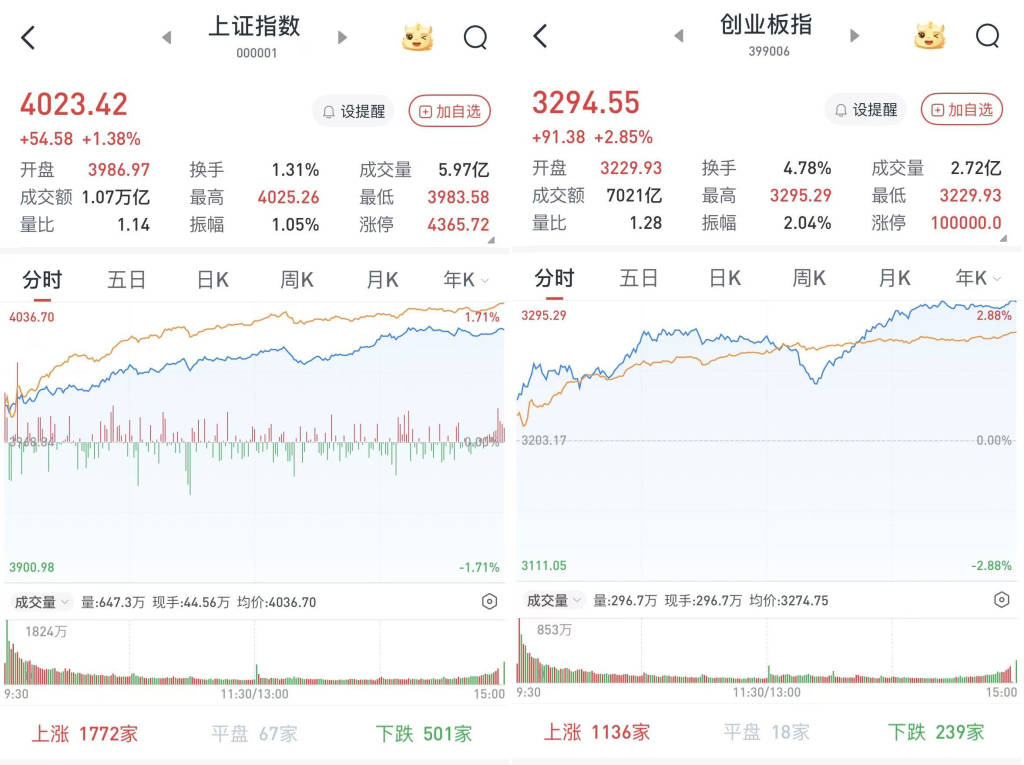
Market Overview - The A-share market opened higher on January 5, with the Shanghai Composite Index surpassing 4000 points, closing at 4023.42 points, up 1.38% [2] - The total trading volume in the Shanghai and Shenzhen markets reached 25,462 billion yuan, an increase of 5,011 billion yuan from the previous trading day [2] Sector Performance - The pharmaceutical and biotechnology sectors saw significant gains, with nearly 40 stocks hitting the daily limit or rising over 10%, driven by industry demand recovery and exceeding performance expectations [4] - Non-bank financial stocks, particularly insurance companies, performed well, with several stocks rising over 5% to 7% due to stable growth in investment assets and high dividend strategies [5] - The semiconductor sector also showed strong performance, with multiple stocks rising over 10% [6] Market Sentiment and Predictions - Analysts from Huaxi Securities believe the bull market remains intact, with 2026 expected to be a year of positive factors, including supportive macro policies and improved corporate earnings [8] - Zhongyuan Securities anticipates that the market will stabilize around the 4000-point mark, with a focus on macroeconomic data and overseas liquidity changes [9] - Citic Securities suggests that the balance between external and internal demand will be a significant factor in 2026, with a higher probability of market fluctuations in the early year [10]
平安好医生大涨,领涨互联网医疗板块
Ge Long Hui· 2026-01-05 06:12
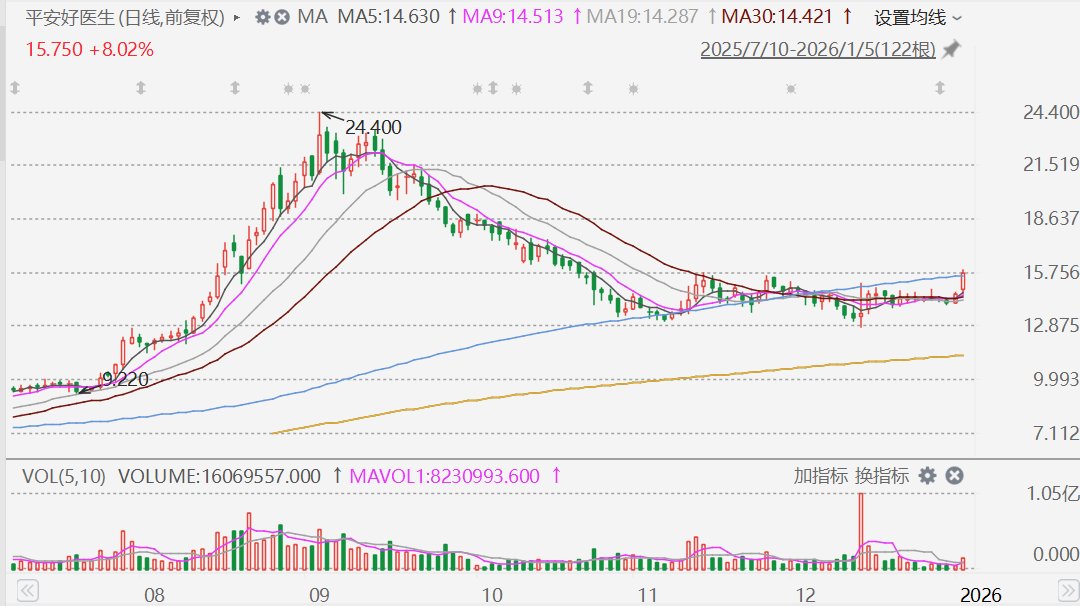
Core Viewpoint - China Ping An's stock price surged to a five-year high, positively impacting the Hong Kong market, particularly Ping An Good Doctor (1833.HK), which saw a significant increase of 9%, reaching its highest level since October 2025 [1] Group 1: Company Performance - Ping An Good Doctor is a key player in the "value re-evaluation" process, benefiting from its strategic position within the Ping An ecosystem, particularly in health and elderly care services [1] - The stock price increase of Ping An Good Doctor reflects a broader trend in the internet healthcare sector, indicating strong investor confidence [1] Group 2: Analyst Insights - Morgan Stanley's report from December 2025 highlighted Ping An's potential to capitalize on growth opportunities in personal finance, healthcare, and elderly care, raising its target price to 89 HKD [1] - Analysts suggest that Ping An Good Doctor is positioned to experience a "Davis Double Play" in terms of performance and valuation, particularly within the context of China's aging economy narrative [1]
港股异动丨平安好医生大涨9%,领涨互联网医疗板块
Ge Long Hui A P P· 2026-01-05 03:19
Core Viewpoint - China Ping An's stock price surged to a five-year high, positively impacting Ping An Good Doctor's stock, which rose by 9% during trading, reaching a new high since October 2025 [1] Group 1: Company Performance - Ping An Good Doctor led the internet healthcare sector with significant stock price growth, reflecting strong market interest and investor confidence [1] - Morgan Stanley's report in December 2025 highlighted Ping An's potential to capitalize on key growth opportunities in wealth management, healthcare, and elderly care, raising its target price to HKD 89 [1] Group 2: Strategic Positioning - Ping An Good Doctor is positioned as a strategic component within Ping An's healthcare services, aiming to create a differentiated advantage through synergy with comprehensive financial services [1] - The company is seen as a critical anchor in the "value re-evaluation" process, contributing to the overall growth narrative in China's aging economy [1]
上市公司回购与增持:是信心信号,还是市场博弈(二)
Sou Hu Cai Jing· 2026-01-02 15:07
Core Viewpoint - The actions of stock buybacks and insider purchases by companies like Luxshare Precision signal confidence in their undervalued stock and financial health, but the market's reaction can be complex and influenced by various factors [1][2]. Group 1: Buybacks and Insider Purchases - Stock buybacks involve companies using their cash reserves to repurchase shares, which can enhance earnings per share by reducing the number of shares outstanding, signaling that management believes the stock is undervalued [1]. - Insider purchases, particularly by controlling shareholders or executives, indicate a strong belief in the company's actual value, as these individuals invest their own money [1]. - Luxshare Precision's controlling shareholder invested 201 million yuan to buy 4.4145 million shares at an average price of 45.52 yuan, followed by a company announcement to repurchase shares worth 1 to 2 billion yuan at a price ceiling of 86.96 yuan, showcasing a coordinated effort [1]. Group 2: Market Reactions - The market's response to buybacks and insider purchases is not straightforward; it can be influenced by market sentiment and the broader economic context [2]. - In bearish markets, buyback announcements may temporarily halt stock price declines, while in bullish markets, they might be interpreted as a lack of better investment opportunities, causing concern among investors [2]. - The long-term impact on stock prices is ultimately determined by the company's ability to create value rather than just capital maneuvers [2]. Group 3: Signal Interpretation - The timing of buybacks and insider purchases can raise questions about their sincerity, as insiders may buy before good news or use buybacks to facilitate future sell-offs [3]. - The efficiency of capital allocation is crucial; funds used for buybacks could potentially yield higher returns if invested in high-return projects instead [3]. - The phenomenon of "herding" in the market can lead to companies with poor fundamentals engaging in buybacks to mask underlying issues, rather than genuinely creating value [4]. Group 4: Beyond the Surface - The dual actions of buybacks and insider purchases by Luxshare Precision suggest a strong value signal, but investors must assess the sustainability of these actions [5]. - It is essential to consider whether buybacks align with the company's strategic direction and the competitive landscape [5]. - Critical thinking is necessary; even positive signals should not replace independent analysis of financial statements, business models, and industry trends [5]. Group 5: Conclusion - The actions of buybacks and insider purchases serve as a unique communication tool between company management and the market, but their true intentions can vary [6]. - The ongoing narrative of Luxshare Precision will ultimately reveal whether these actions represent a genuine discovery of value or a temporary market maneuver [6]. - Investors should focus on the ability to create sustained value rather than being swayed by individual market actions [6].


银河期货股指期货年报
Yin He Qi Huo· 2025-12-31 05:00
1. Report Industry Investment Rating No information provided. 2. Core Viewpoints of the Report - In 2026, the strategy of a technology - powered nation combined with the AI wave will remain the main theme of the A - share market. The listing of technology leaders like Changxin Technology will strengthen the contribution of technology stocks to the index. Small - cap indexes are expected to perform well, and the market will maintain a slow - bull trend despite fluctuations from valuation and capital factors [6]. - In the assumption of constant valuation, the market value of the Shanghai Composite 50 Index in 2026 may rise by 5% - 10%, the CSI 300 by 8% - 18%, and the CSI 500 and CSI 1000 by 18% - 26% [54]. - In 2026, the phenomenon of stock index futures trading at a discount will still exist. The cost advantage of short - position holders moving from the current - month contract to the quarterly - month contract is evident, and the main trading and holding contracts have shifted to quarterly - month contracts [60]. 3. Summary by Relevant Catalogs 3.1 2025 Market Review Stock Market - In 2025, the A - share market showed a slow - bull trend of fluctuating upward. The AI industry chain, robotics, and non - ferrous metal sectors led by artificial intelligence rose significantly, but there were differences in the performance of different indexes. By December 30, the annual increase of the CSI 300 Index was 18.21%, the Shanghai Composite 50 Index rose 13.1%, the CSI 500 Index rose 30.27%, and the CSI 1000 Index rose 27.52% [5][11]. Stock Index Futures - In 2025, the discount of stock index futures widened compared to the previous year, showing a cyclical pattern of convergence at the beginning and end of the year and expansion in the middle. The average daily discounts of the four IM contracts reached record highs. The trading volume and open interest of stock index futures continued to grow steadily. IM was the most - concerned variety, with trading volume and open interest increasing by 19.4% and 20.4% respectively. The trading volume and open interest of IC recovered after hitting a bottom in April, and the annual average daily trading volume increased by 3.7%. The trading volume and open interest of IH both declined, while the trading volume of IF was stable and the open interest increased by 5.2% [13][16]. 3.2 Future Outlook and Investment Strategy Index Space Calculation - In 2025, there were significant differences in the performance of major indexes, which were mainly due to differences in industry indexes. The non - ferrous metal and communication sectors had annual increases of 93% and 87% respectively, while the food and beverage and coal sectors had negative returns. The weight of the electronics industry in major indexes increased significantly. In 2025, electronics was the most - contributing industry to the four major indexes [21][24][30]. - In 2026, the consensus forecast for the profit growth of each index is 5% for the Shanghai Composite 50, 9% for the CSI 300, 22% for the CSI 500, and 23% for the CSI 1000. Considering industry growth and weight, the possible market - value growth of the Shanghai Composite 50 is 18%, the CSI 300 is 26%, the CSI 500 is 36%, and the CSI 1000 is 36%. After adjustment, in the assumption of constant valuation, the market - value increase of the Shanghai Composite 50 Index in 2026 may be 5% - 10%, the CSI 300 may be 8% - 18%, and the CSI 500 and CSI 1000 may be 18% - 26% [45][50][54]. Stock Index Futures Basis Outlook - In 2025, the basis of stock index futures generally showed a significant increase in discount. The main reason is that the market provided large fluctuations, making the performance of individual stocks and indexes differentiated, and the excess return of the neutral strategy was significant, allowing it to continue hedging even with a large discount. In 2026, the discount phenomenon of stock index futures will still exist. The cost of short - position holders in stock index futures for contract roll - over has increased significantly, and since October 2024, the main trading and holding contracts have shifted to quarterly - month contracts, which reduces the operation risk of investors [55][58][61]. Policy, Capital, and Valuation Outlook - Since the release of the new "Nine - Article National Plan", policies have clearly supported the market. In 2026, the policy focus will shift to "actively contributing to high - quality economic development and a good start of the 15th Five - Year Plan", while maintaining stable development. In 2025, long - term capital continued to enter the market, and the margin balance continued to grow, keeping the market capital abundant. However, the reversal of the M1 - M2 spread at the end of the year and the difficulty of further interest - rate cuts will have an impact on investors' psychology. In 2025, as the market continued to rise, the stock index valuation was no longer cheap, which will suppress the performance of the index and increase market volatility [67][70][75]. Future Strategy - Unilateral: Given the slow - bull trend, conduct trading based on fluctuations. - Arbitrage: Go long on IM/IC main contracts and short ETFs. - Options: Adopt the bull - spread strategy [7].
化工ETF嘉实(159129)涨2.56%,化工行业或迎周期拐点向上
Jin Rong Jie· 2025-12-30 07:02
Group 1 - The Shenzhen Component Index rose by 0.67%, and the ChiNext Index increased by 0.54%, with the chemical sub-index up by 2.37% [1] - Individual stocks such as Hengli Petrochemical surged over 6%, and Juhua Co. rose more than 3%, with Wanhu Chemical and Salt Lake Potash also seeing gains [1] - The chemical ETF by Jiashi (159129) increased by 2.56%, with a trading volume of 20.62 million yuan and a turnover rate of 2.86% [1] Group 2 - China Galaxy Securities forecasts a negative growth in capital expenditure for the chemical industry starting in 2024, with supply expected to contract due to the "anti-involution" trend and accelerated exit of outdated overseas capacity [1] - The "14th Five-Year Plan" emphasizes expanding domestic demand, which, combined with the onset of a U.S. interest rate cut cycle, is expected to open up demand for chemical products [1] - The chemical industry has been in a down cycle for approximately 3.5 years, but with continued decline in capital expenditure and faster exit of outdated capacity, the industry is expected to enter a low growth phase [1] - The industry is anticipated to reach a cyclical turning point by 2026, transitioning from valuation recovery to earnings growth, referred to as the "Davis Double-Click" [1] Group 3 - The Jiashi Chemical ETF tracks the CSI Sub-Segmented Chemical Industry Theme Index, which selects 50 large-scale, liquid chemical listed companies from the Shanghai and Shenzhen markets [2] - The top ten weighted stocks in the index include Wanhu Chemical, Salt Lake Potash, Tianci Materials, Cangge Mining, Juhua Co., Hualu Hengsheng, Duofu Du, Hengli Petrochemical, Baofeng Energy, and Yuntianhua, collectively accounting for over 45.41% of the index [2]