
端侧AI

Search documents
直击CES 2026:中国AI眼镜扎堆“秀肌肉”
Mei Ri Jing Ji Xin Wen· 2026-01-11 12:42
Core Insights - The 2026 International Consumer Electronics Show (CES 2026) showcased AI glasses as a significant highlight, with over 50 exhibitors, including more than 20 Chinese companies, indicating a strong presence in the market [1][2] Industry Trends - The global smart glasses market saw a shipment volume of 4.296 million units in Q3 2025, marking a year-on-year growth of 74.1%, while China's market reached 623,000 units, growing by 62.3% [1] - The AI glasses industry is focusing on lightweight designs, enhanced display technology, and improved AI capabilities, with a strong emphasis on user comfort and practical applications [2][5] - The integration of AI functionalities is becoming more sophisticated, with a trend towards proactive services and multi-modal interactions in product iterations [2][5] Product Innovations - Rokid launched the Rokid Ai Glasses Style, a lightweight model weighing only 38.5g, capable of music playback, translation, navigation, and AI Q&A [2] - The Rokid Glasses, weighing 49g, features advanced diffraction waveguide technology and supports various AI applications, including real-time navigation and translation [3] - Thunderbird Innovation introduced the world's first dual-lens AR glasses with eSIM functionality, allowing independent communication without a smartphone [3] Market Dynamics - The AI glasses market is expected to reach a shipment volume of 23.687 million units globally in 2026, with China's market projected to exceed 4.915 million units, indicating a shift towards large-scale growth [6] - The entry of internet and cloud companies into the AI glasses sector is increasing industry attention and capital activity, leading to resource integration across the supply chain [7] - The competitive landscape is intensifying, with established companies facing pressure while smaller firms seek differentiation in a crowded market [7] Challenges and Future Outlook - The AI glasses industry is still in its early stages, facing challenges in supply chain management and user experience, which could impact market stability [8] - As the market matures, improvements in supply chain coordination and product quality will be essential for retaining users and ensuring stable growth [8]
武岳峰将向黑芝麻智能战略投资5亿元,长期赋能端侧AI和具身智能生态布局
机器人圈· 2026-01-11 08:24
1月8日,黑芝麻智能与知名产业投资机构武岳峰科创及其产业合作伙伴(上海虹桥小镇投资集团)达成战 略投资意向。武岳峰领投的联合投资方预计将向黑芝麻智能提供合计5亿元人民币的长期战略投资,坚定 支持黑芝麻智能在端侧AI和具身智能领域的投资并购与生态构建。 武岳峰及联合投资方此次战略入股,是对黑芝麻智能核心技术产品优势及战略的认可。公司华山A2000芯 片顺利通过美国商务部及国防部审查并获准在全球销售与应用,作为国内唯一一家通过此类审批的公司, 标志着黑芝麻智能技术实力与商业化能力迈上全新台阶。作为全球少数能够提供高算力智驾及端侧AI推理 芯片的企业,黑芝麻智能将依托A2000芯片为公司下一步在高阶智驾和具身智能全球市场推广打开空间。 黑芝麻智能拟将该笔投资专项投入于端侧AI和具身智能产业链战略布局,通过投资、并购等方式整合拥有 核心技术和产品的优质标的,全面加速黑芝麻智能的业务拓展和市场占领。 武岳峰领投的联合投资方预计将向黑芝麻智能提供合计5亿元人民币的长期战略投资,坚定支持其在端侧 AI和具身智能领域的投资并购与生态构建。 商务合作 商务活动|宣传推广|转载开白等 联系电话|18355423366 END 如 ...


这家上市未满两年再引 5 亿战投!凭什么?
是说芯语· 2026-01-11 02:50
Core Viewpoint - The article discusses the strategic investment intention of Hezhima Intelligent in the automotive-grade AI chip sector, highlighting a planned injection of 500 million RMB from investment institutions [1][2]. Investment Details - The investment is currently in the intention stage and has not yet been finalized [2]. - The rationale for continued financing post-IPO is explained, emphasizing that listing is a starting point for expanding development space, particularly for tech companies that require substantial funding for business expansion, R&D, and industry integration [2]. Market Reaction - Following the announcement, Hezhima Intelligent's stock price rose to 22.82 HKD per share, marking a 4.87% increase and a market capitalization of approximately 14.628 billion HKD (about 13.157 billion RMB) [2]. Fund Utilization - If the 500 million RMB investment materializes, it will be allocated entirely to the strategic layout of Edge AI and Embodied AI industries [4]. - The company plans to enhance its business ecosystem through investments and acquisitions, aiming to improve market penetration efficiency [4]. Industry Trends - The AI industry is transitioning from cloud to edge computing, with Edge AI becoming crucial for real-time interaction and industrial intelligence transformation, indicating a rapid growth phase in market size [4]. International Expansion - Hezhima Intelligent has achieved a significant milestone by having its core product, the Huashan A2000 series chips, approved for global sales and applications, making it the only domestic company to pass such scrutiny [4]. - This development addresses compliance challenges in the international supply chain and facilitates the company's global strategic layout [4]. Strategic Acquisitions - Prior to this investment, Hezhima Intelligent had already gained strategic control over Yizhi Electronics, which complements its strengths in high-performance automotive-grade chips [6]. - The potential 500 million RMB funding will further bolster the company's capital strength in core areas, enhancing its competitiveness in Edge AI inference chips and high-performance intelligent driving platforms [7]. Investment Partnership - The investment consortium, including Wuyuefeng Kechuang and Shanghai Hongqiao Town Investment Group, not only provides financial support but also aims to introduce quality industry resources to accelerate technology implementation and market expansion in Edge AI and Embodied AI [7]. Alignment with Industry Needs - The financing intention aligns with the growing demand for Edge AI and Embodied AI, addressing the company's needs for ecosystem integration and capital reserves [7]. - Successful completion of the investment could enable Hezhima Intelligent to transition from a supplier of automotive-grade AI chips to a provider of comprehensive edge intelligent solutions, enhancing its competitive position in the industry [7].

美国消费电子展上的 人工智能新趋势
Xin Lang Cai Jing· 2026-01-10 23:42
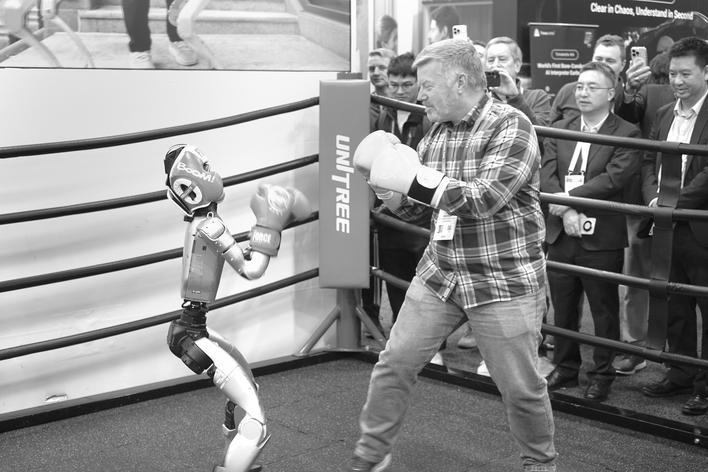
Group 1 - The core focus of the CES 2026 has shifted from "model capabilities" to "product capabilities," emphasizing scalable applications of AI rather than just technical showcases [2][3] - AI is becoming a "system-level capability," with discussions centered around practical applications, integration into existing systems, and large-scale deployment [2][3] - The exhibition showcased a variety of AI devices and solutions that demonstrate autonomous decision-making and interaction with real-world environments, indicating a move towards industrial application [2][3] Group 2 - Robotics was a major highlight at CES, with products designed for specific applications in manufacturing, logistics, retail, and elder care, focusing on long-term operational stability [5] - Robots demonstrated capabilities in various environments, performing tasks such as sorting, transporting, and providing services, showcasing advancements in automation and reliability [5] - The development of Chinese robotics was noted for its rapid progress and ability to perform daily tasks reliably, reflecting advancements in perception, computation, and control technologies [5] Group 3 - The trend of running AI models locally on devices is increasing, addressing needs for real-time processing, energy efficiency, and privacy, while cloud services continue to support training and updates [6] - This shift highlights the importance of collaboration between edge and cloud computing, with both needing to evolve together for future AI development [6] Group 4 - The CES reflects a change in industry logic, with AI reshaping product forms and industry divisions, elevating the importance of chips, manufacturing, and system integration beyond just internet companies [7] - The focus on deep collaboration between hardware and software is becoming a competitive edge, as single technological breakthroughs are no longer sufficient for sustained advantage [7] - The transition of AI from a rapid experimentation phase to a more reliable and secure industrial phase is evident, marking CES as a key platform for observing global AI industry trends [7]
直击CES 2026|中国AI眼镜CES扎堆“秀肌肉” 2026年将迎来应用大年?
Mei Ri Jing Ji Xin Wen· 2026-01-10 13:55
Core Insights - The 2026 International Consumer Electronics Show (CES) showcased AI glasses as a significant highlight, with over 50 exhibitors, including more than 20 Chinese companies, indicating a strong presence in the market [1][3]. Industry Overview - The global smart glasses market is projected to reach a shipment volume of 4.296 million units by Q3 2025, reflecting a year-on-year growth of 74.1%. In China, the shipment volume is expected to be 623,000 units, with a growth rate of 62.3% [1]. - The AI glasses sector is seen as a crucial entry point for AI technology, with companies focusing on user experience and practical applications [2][5]. Product Innovations - Rokid introduced the Rokid Ai Glasses Style, a lightweight model weighing only 38.5g, capable of functions such as music playback, translation, navigation, and AI Q&A [3]. - Thunderbird Innovation launched the world's first dual-lens AR glasses with eSIM functionality, allowing independent communication without a smartphone [4]. - XREAL unveiled the new generation AR glasses XREAL 1S and announced a deepened collaboration with Alphabet [4]. Market Dynamics - The AI glasses market is experiencing a "arms race" with various manufacturers adopting differentiated strategies, focusing on audio interaction, camera integration, and waveguide display technology [5][6]. - Meta's announcement of a successful launch of its Ray-Ban Display smart glasses has led to a delay in its international market expansion plans due to overwhelming demand [6]. Future Projections - The smart glasses market is expected to reach a shipment volume of 23.687 million units globally by 2026, with China's market surpassing 4.915 million units, marking a new phase of growth [6]. - Analysts suggest that the participation of internet and cloud companies is enhancing industry attention and capital activity, leading to resource flow and integration within the supply chain [7]. Challenges and Considerations - The industry faces challenges in supply chain management and user experience, with many brands struggling with inventory and delivery issues [8]. - Ensuring product stability and quality control will be critical for retaining users, as the current demand is primarily driven by novelty rather than necessity [8].
中国首席经济学家论坛理事刘煜辉:东风压倒西风 中国将从AI产业革命胜出
Xin Lang Cai Jing· 2026-01-10 10:13
刘煜辉表示,从目前来看,美国难以完成这一使命,核心原因是美国缺乏强大的制造业基础。按照当前 美国的经济结构,其越来越成为纯粹的技术蓝图输出者——马斯克、黄仁勋等企业家能够描绘出宏大、 具有前瞻性的技术蓝图,给出顶尖的设计图纸,但在落地能力与完备产业生态的构建上,美国已力不从 心。这一历史使命,最终落在了东方大国(中国)的肩上。马斯克在访谈中也承认:"每次我拿出 PPT,最先提出构想,但最终落地完成的都是中国人。"这一次的AI革命也不例外。因为AI进入下半场 后,核心是要在后端建立强大、完备的产业生态,让投入的巨额资本形成循环闭环——这正是"端侧 AI"的核心使命。 "2025年表现最好的大类资产是黄金——全年涨幅达70%,从2600美元/盎司飙升至4500美元/盎司,这一 涨幅令我们从事宏观经济研究的学者深感震惊。"1月9日,中国首席经济学家论坛理事刘煜辉在2026年 中国首席经济学家论坛年会上指出。 刘煜辉表示,黄金快速上涨反映的是,全球资本对美元基础信用,即美元、美债构成的法币体系,以及 这套"老钱体系"的信任度出现了严重危机,或隐含着深层次风险。黄金未来的走势,关键取决于美元信 用支撑的核心问题能否找到 ...
中国首席经济学家论坛理事刘煜辉:东风压倒西风,中国将从AI产业革命胜出
Zhong Guo Jing Ying Bao· 2026-01-10 09:30
Group 1 - The best-performing asset class in 2025 is gold, with an annual increase of 70%, rising from $2,600/ounce to $4,500/ounce, which has shocked macroeconomic researchers [1] - The rapid rise in gold prices reflects a severe crisis of confidence in the dollar-based credit system, indicating deep-seated risks [1] - The future trajectory of gold will depend on whether solutions can be found for the core issues supporting dollar credit, and the current outlook is not optimistic [1] Group 2 - The focus of the global economy is on the dollar, which is now heavily tied to the "full bet on AI" narrative, transitioning into a new phase [1] - The U.S. is struggling to fulfill its role in the AI revolution due to a lack of a strong manufacturing base, becoming primarily a technology blueprint exporter [1] - The responsibility for realizing the AI industrial revolution now falls on major Eastern countries, particularly China, as they are better positioned to implement these technological advancements [1]
国际观察|2026美国消费电子展上的人工智能新趋势
Xin Hua She· 2026-01-10 03:41
Core Insights - The 2026 CES highlighted a shift in focus from AI model capabilities to practical product applications, emphasizing the integration of AI into existing systems and scalable deployment [1][2] - AI is becoming a foundational capability in products rather than a standalone highlight, with significant applications in personal devices, automotive systems, and industrial platforms [2][4] AI as a System-Level Capability - Discussions at CES have transitioned from technical specifications to practical applications of AI, focusing on what AI can do and how it can be embedded in current systems [1][2] - AI systems showcased include autonomous decision-making agents and physical AI systems that interact with real environments, indicating a move towards industrial applications [1][2] Robotics and Physical AI Breakthroughs - Robotics was a major focus at CES, with products designed for specific applications in manufacturing, logistics, retail, and elder care, emphasizing stability and long-term operation [3] - Robots demonstrated capabilities in various environments, performing tasks such as sorting, transporting, and providing services, showcasing advancements in automation and reliability [3] Edge and Cloud Collaboration - There is a notable trend towards running AI models locally on devices to enhance real-time performance, energy efficiency, and privacy, while cloud services continue to support training and updates [4] - The collaboration between edge and cloud computing is seen as essential for the future of AI, with both needing to evolve together to meet industry demands [4] Industry Logic Changes Reflected at CES - The event illustrates that AI is reshaping product forms and industry divisions, with increased importance placed on chips, manufacturing, and system integration beyond just internet companies [5] - The focus on deep hardware-software collaboration indicates that achieving a complete system capability and scalable delivery is becoming a new competitive threshold in the AI industry [5]
「AI 100」榜单启动招募,AI产品“年会”不能停丨量子位智库
量子位· 2026-01-10 03:07
Core Insights - The article discusses the emergence of numerous keywords in the AI product sector by 2025, highlighting transformative AI products that are leading the market [4] - The "AI 100" list by Quantum Bit Think Tank aims to evaluate and recognize the top AI products in China, reflecting the industry's evolution and future trends [4][12] Group 1: AI 100 List Overview - The "AI 100" list is divided into three main categories: "Flagship AI 100," "Innovative AI 100," and the top three products in ten popular sub-sectors [6] - The "Flagship AI 100" will focus on the strongest AI products of 2025, showcasing those that have achieved significant technological breakthroughs and practical application value [7] - The "Innovative AI 100" aims to identify products that are expected to emerge in 2026, representing cutting-edge AI technology and potential industry disruptors [8] Group 2: Sub-sector Focus - The ten hottest sub-sectors for the top three products include AI browsers, AI agents, AI smart assistants, AI workstations, AI creation, AI education, AI healthcare, AI entertainment, Vibe Coding, and AI consumer hardware [9] Group 3: Application and Evaluation Criteria - The evaluation of the "AI 100" list employs a dual assessment system combining quantitative and qualitative measures, focusing on user data and expert evaluations [13] - Quantitative metrics include user scale, growth, activity, and retention, while qualitative assessments consider long-term potential, technology, market space, and user experience [13]

武岳峰预计将向黑芝麻智能战略投资5亿元
Bei Jing Shang Bao· 2026-01-09 13:40
北京商报讯(记者 陶凤 王天逸)1月9日,黑芝麻智能发布消息称,公司与知名产业投资机构武岳峰科 创及其产业合作伙伴(上海虹桥小镇投资集团)达成战略投资意向。武岳峰领投的联合投资方预计将向 黑芝麻智能提供合计5亿元人民币的长期战略投资,坚定支持黑芝麻智能在端侧AI和具身智能领域的投 资并购与生态构建。 黑芝麻智能拟将该笔投资专项投入于端侧AI和具身智能产业链战略布局,通过投资、并购等方式整合 拥有核心技术和产品的优质标的,全面加速黑芝麻智能的业务拓展和市场占领。 ...
