价值投资

Search documents
10后玩的资本游戏,大人已经看不懂了
Hu Xiu· 2025-09-11 09:51
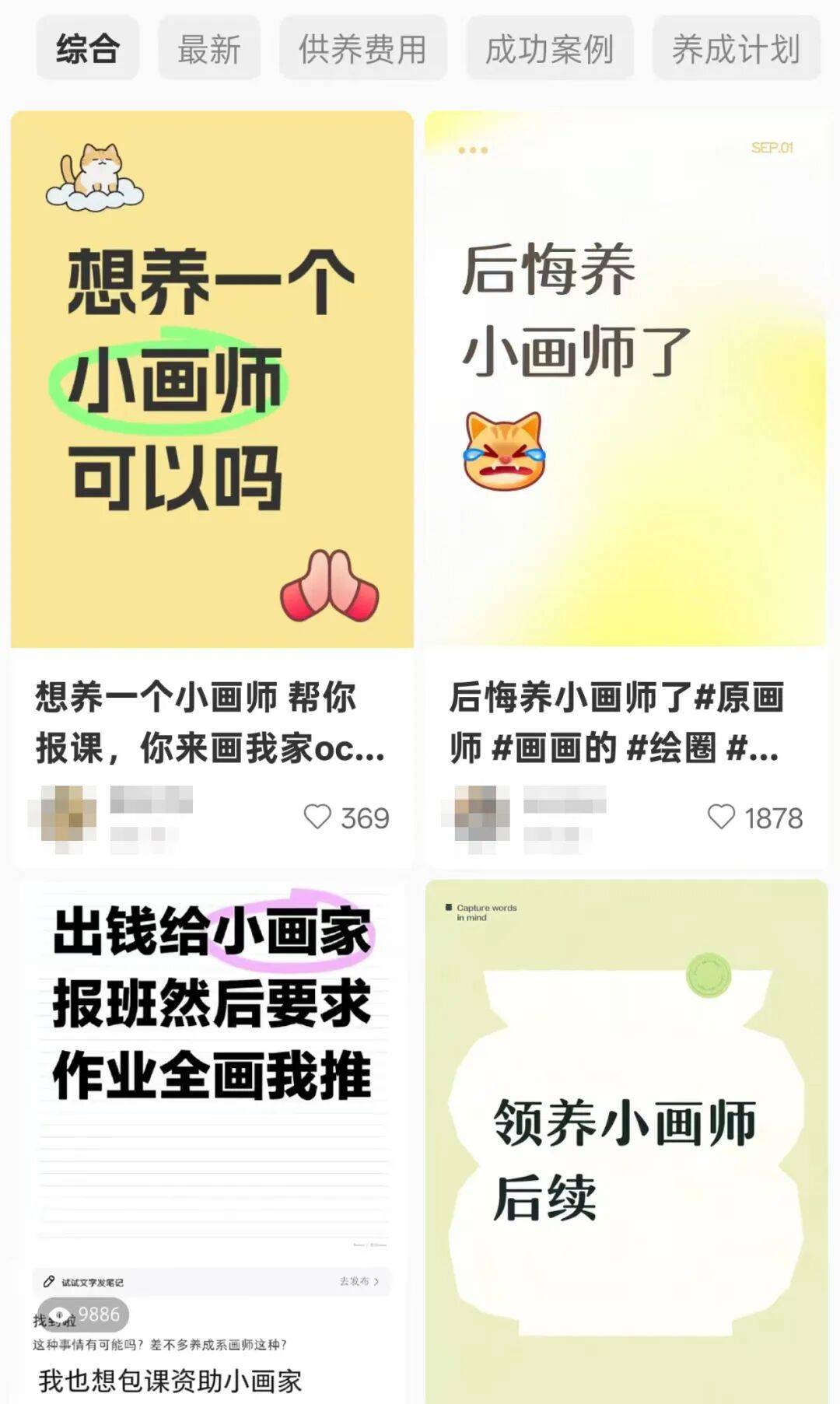
Core Viewpoint - The article discusses the emerging trend of "raising young artists" as a complex investment strategy that combines elements of value investing, employment relationships, and blind box economics, primarily involving minors as participants [7][12][18]. Group 1: Definition and Mechanics - "Raising young artists" involves investors (employers) seeking potential young artists online, providing them with training fees or regular learning funds, while the young artists practice drawing and give their works to the investors for free [12][13]. - This investment strategy allows investors to potentially obtain quality artwork at a lower cost compared to hiring established artists, betting on the young artists' growth and talent [14][58]. Group 2: Market Dynamics - The OC (Original Character) community has significantly expanded, driven by high demand for custom artwork and the concept of "raising OC" or "raising characters," which requires ongoing investment and development [21][26][30]. - The lack of standardized pricing and industry norms in the commissioning process leads to confusion and potential exploitation within the OC community [41][46]. Group 3: Risks and Challenges - The success of "raising young artists" is highly uncertain, with significant risks for the investors, including the potential for young artists to not meet expectations or to disengage after receiving funding [61][66]. - Many investors face challenges in assessing the talent and commitment of young artists, as there are no formal contracts or legal protections in place [65][66]. Group 4: Cultural Implications - The phenomenon reflects a broader trend of younger generations engaging in complex economic activities and creating informal economic systems, showcasing their adaptability and resourcefulness in a rapidly changing digital landscape [75][82]. - The article suggests that the current generation's ability to navigate these economic dynamics may redefine traditional notions of maturity and financial literacy [76][80].

红利国企ETF(510720)连续5日吸金超1.3亿元,关注真月月分红,连续分红17个月的红利国企ETF
Sou Hu Cai Jing· 2025-09-11 07:05
Group 1 - The high dividend sector is becoming a primary safe haven for short-term funds, with dividend ETF continuously attracting long-term capital subscriptions, reflecting a stable preference for domestic allocation funds [1] - Northbound capital's average daily trading volume remains relatively high, indicating strong participation willingness in a volatile market [1] - The dividend sector not only has defensive value but also benefits from the strengthening of "anti-involution" policy guidance [1] Group 2 - The Dividend State-Owned Enterprise ETF (510720) tracks the State-Owned Dividend Index (000151), which selects stocks with high dividend characteristics, stable dividends, and good liquidity, mainly covering traditional industries such as finance, energy, and industry [1] - The Dividend State-Owned Enterprise ETF (510720) has achieved monthly dividends since its listing, having continuously paid dividends for 17 months, making it one of the few ETFs that practice monthly dividends [1] - Investors without stock accounts can consider the Guotai CSI State-Owned Enterprise Dividend ETF Initiation Link A (021701) and Guotai CSI State-Owned Enterprise Dividend ETF Initiation Link C (021702) [1]
对话菁英投顾——“多金多玉组合”主创洪金钰
申万宏源证券上海北京西路营业部· 2025-09-11 02:51
Core Viewpoint - The article emphasizes the importance of balancing value investing with trend following, highlighting that investors often lose money during bull markets due to overconfidence and neglecting risk management [2][3]. Market Overview - The A-share market is currently experiencing wide fluctuations with clear structural characteristics, indicating that quality assets often present buying opportunities during corrections [7]. - The driving forces behind this year's structural market include continuous inflows of incremental capital, the relocation of household deposits, expanded financing balances, and foreign capital returning [7]. - Growth stocks, particularly in technology sectors like AI computing and semiconductors, remain favored in the current market environment [7]. Investment Philosophy - The "Four Good Principles" for stock selection include: - Good Industry: Focus on high-ceiling industries with clear business models and avoid sunset industries [10]. - Good Company: Select leading firms with strong competitive advantages and solid financial health [10]. - Good Price: Invest when the market undervalues a company, adhering to the principle of safety margin [10]. - Good Patience: Maintain a long-term perspective and avoid reacting to short-term market noise [11]. Investment Strategy - The "Duojin Duoyu Combination" service product has achieved a relative return of 114.37% compared to the CSI 500 index over its first year [13]. - The strategy combines deep fundamental research with trend-following tactics, focusing on both long-term value and short-term growth opportunities [13]. Trend Analysis - True Trends (Fundamental Trends): Focus on industries aligned with national policies and societal changes, selecting sectors expected to thrive in the next 3-5 years [14]. - Market Trends: Identify stocks in upward price channels through technical indicators and gauge market sentiment to capture thematic investment opportunities [16]. Positioning Strategy - Core Position (50%-70%): Invest in high-quality companies for long-term growth, making adjustments only for significant fundamental changes [17]. - Swing Position (30%-50%): Target stocks with both strong fundamentals and market momentum for capturing mid-term investment opportunities [17]. Buying and Selling Strategies - Buying Strategy: - Core Position: Use a pyramid buying approach, adding to positions as prices decline [18]. - Swing Position: Enter when stocks break through key resistance levels [18]. - Selling Strategy: - Core Position: Sell if fundamental logic is broken or if valuations reach historical highs [19]. - Swing Position: Sell upon reaching target returns or if technical trends deteriorate [20]. Risk Management - Maintain strict risk control measures, including limiting exposure to any single industry and individual stock [20]. - Regularly reassess portfolio allocations based on market conditions and overall valuation levels [21]. Insights - The article concludes with the importance of maintaining rationality, adhering to established strategies, and having patience in the investment journey [23].

实实在在让利 鼓励长期持有 公募基金费率改革迈入第三阶段
Zhong Guo Chan Ye Jing Ji Xin Xi Wang· 2025-09-10 23:59
Core Viewpoint - The recent public fund fee reform aims to lower investors' overall costs and promote a shift from scale-driven to value-driven approaches in the industry, encouraging long-term investment and benefiting both investors and the industry [1][3]. Group 1: Fee Reduction Measures - The new regulations lower the maximum subscription fees for equity funds, mixed funds, and bond funds to 0.8%, 0.5%, and 0.3% respectively, while also encouraging sales institutions to offer further discounts [2]. - The sales service fee rates for equity funds, mixed funds, index funds, bond funds, and money market funds have been reduced to 0.4% per year, 0.2% per year, and 0.15% per year respectively [2]. - The overall fee reduction is estimated to save investors approximately 30 billion yuan, representing a 34% decrease based on average data from the past three years [2]. Group 2: Long-term Investment Encouragement - The regulations simplify the redemption fee structure and eliminate sales service fees for fund shares held for over one year, promoting long-term investment and reducing transaction costs for investors [4][5]. - The reform aims to shift investor behavior from short-term trading to long-term holding, enhancing the investment experience and returns [4][5]. Group 3: Industry Transformation - This fee reform is the third phase of a broader initiative to transform the public fund industry from a focus on scale to one centered on investor returns, addressing long-standing issues in the industry [3][6]. - The regulations are expected to reshape the industry value chain, encouraging sales institutions to prioritize investor interests and improve service capabilities [6][7]. - The shift towards a performance-driven model will enhance investor protection and improve overall investment experiences, while larger firms may benefit from economies of scale during this transition [7][8].
六个月建仓期接近尾声,徐彦新基仍没动静,投资者:我在这基金里躲牛市
Sou Hu Cai Jing· 2025-09-10 20:25
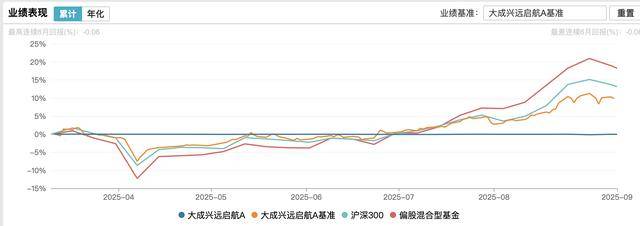
Core Viewpoint - The A-share market has shown unexpected enthusiasm since the beginning of the year, with many active equity funds recovering and achieving significant returns, while the newly established fund, Dachen Xingyuan Qihang, managed by Xu Yan, has remained inactive, leading to widespread controversy and questioning of its strategy [1][2][4]. Fund Performance - Dachen Xingyuan Qihang was established on March 11, 2025, but its net value has barely changed, with A-class shares at 0.9983 and C-class shares at 0.9953 as of September 9, 2025 [2][4]. - The fund has only invested in two stocks, Antu Biology and Meituan, with a stock position of just 0.73% and cash making up 84.95% of its net value [4]. Market Reaction - Since May, market skepticism has grown regarding the fund's "zero allocation" strategy, with investors expressing frustration over missed opportunities in a rising market [4][6]. - Xu Yan acknowledged the lack of systematic investment in the mid-year report, citing significant changes in market conditions and the need for caution due to rational valuation returns [4][5]. Comparison with Peers - In contrast to Dachen Xingyuan Qihang, many newly established active equity funds have quickly completed their allocations and participated in the market rally, with some achieving net value growth exceeding 20% [5][6]. - Funds like Anxin Balanced Growth, established on the same day as Dachen Xingyuan Qihang, have seen net value increases of 20.12% this year, highlighting the stark difference in performance [6]. Industry Trends - The performance of newly established funds this year has shown a clear dichotomy, with some achieving over 50% net value growth while others have recorded losses [7][9]. - The current market environment raises questions about the viability of value investing strategies that prioritize slow and steady approaches, especially in a rapidly changing market [9].
每日钉一下(价值策略指数有哪些?)
银行螺丝钉· 2025-09-10 14:05
Group 1 - The article emphasizes that funds are suitable investment products for ordinary people [2] - It suggests that new investors should consider specific types of funds and provides a free course to help them understand fund investment from scratch [2] - The article highlights the importance of psychological preparation for long-term investment [2] Group 2 - The value strategy index is derived from Benjamin Graham's teachings, focusing on a basket of low P/E and low P/B stocks [4] - The 300 Value Index selects 100 stocks from the CSI 300 based on low P/E, low P/B, and high dividend yield, showing significant growth since 2004 [5][6] - The Optimized 300 Index, a newer value strategy index, selects low-valuation stocks with certain profit growth requirements, aiming to avoid low-valuation traps [8][9] - The China Securities Value Index focuses on low P/E and low P/B stocks while requiring a historical ROE of at least 12%, optimizing traditional low-valuation stock selection [10] - Overall, value investing has performed well in the A-share market, but the scale of these strategies remains relatively small, accounting for less than 1% of A-share stock funds [11]

响应北京公募基金高质量发展行动 京东肯特瑞将开展多元化投教活动
Xin Lang Ji Jin· 2025-09-10 08:52
Group 1 - The core viewpoint of the articles emphasizes the launch of a series of diversified investor education activities by JD Kentrui Fund Sales Co., Ltd. to promote high-quality development in the public fund industry [1][2] - The investor education activities will combine online and offline methods, utilizing the JD Finance APP to create a dedicated "Investor Education Zone" with rich content resources [1] - Offline activities will focus on interactive experiences and precise services, including programs like "Future Financial Talent Cultivation Plan" and "Investment Strategy Sharing Sessions" in universities, business districts, and communities [1] Group 2 - As of July 2025, the number of new fund users on the JD Finance platform has increased by 58% year-on-year, while the number of trading users has grown by 47%, indicating a continuous rise in trading activity [2] - The investor demographic shows a significant presence of younger investors, with those aged 25-35 making up about 40% and those aged 18-25 accounting for approximately 20% [2] - The investment preferences of platform users reflect a diversified allocation strategy, with 68% in equity active funds and index funds, and 20% in stable bond funds and "fixed income+" products, indicating a more rational investment approach [2] Group 3 - The company views investor education as a crucial foundation for the high-quality development of the public fund industry, aiming to instill long-term and value investment concepts among investors [2] - JD Kentrui plans to deepen collaboration with regulatory bodies and public fund managers to continuously optimize educational content and services [2]
股债双擎驱动,36万亿险资重塑投资新生态
Huan Qiu Wang· 2025-09-10 07:00
Core Insights - The insurance capital market, with over 36 trillion yuan in assets, is undergoing a significant transformation, actively responding to low interest rates and asset scarcity through a "dual-engine" strategy of equity and bond investments [1][3] Group 1: Equity Investment Trends - Insurance capital has accelerated its equity investments, with a total stock investment balance reaching 3.07 trillion yuan, an increase of 640.6 billion yuan or 26.4% from the previous year, raising its proportion in total assets to 8.4% [1] - The increase in equity investments is driven by the need to counteract risks associated with low interest rates and is supported by favorable policies that encourage higher equity investment ratios and lower risk factors for stock investments [1][3] - Major insurance companies, such as China Life and China Ping An, have reported double-digit growth in their stock investment balances, reflecting a positive market performance [1] Group 2: Long-term Investment Strategies - Insurance capital is transitioning from being "financial investors" to "strategic investors," with a focus on long-term investment reforms and the expansion of private equity funds, which have reached a total scale of 222 billion yuan [3] - The frequency of insurance capital acquiring stakes in listed companies has reached a four-year high, with 32 instances recorded this year, particularly favoring bank stocks and stable, high-dividend assets in sectors like water, electricity, and pharmaceuticals [4] Group 3: Bond Investment Stability - Despite the surge in equity investments, bonds remain a crucial component of insurance capital's asset allocation, with a bond investment balance of 17.87 trillion yuan, accounting for nearly half of total assets [4] - The strategy for bond investments is evolving, with a focus on long-term bonds to match liability durations while increasingly allocating to high-grade credit bonds and local government bonds [4]

上海高恩私募:以产业视角,深耕医药投资 | 打卡100家小而美私募
私募排排网· 2025-09-08 00:00
Core Viewpoint - The article emphasizes the significance of small to medium-sized private equity firms, particularly highlighting Shanghai Gaoen Private Equity Fund Management Co., which focuses on deep value investment strategies and has shown strong performance in the healthcare sector [2][3]. Company Overview - Shanghai Gaoen Private Equity Fund Management Co. is located in Shanghai's Pudong New District and is registered as a private equity manager with a focus on deep value investment [2]. - The firm was founded by a team of experienced professionals with over 15 years of industry background, combining expertise from both the industrial and financial sectors [5]. Investment Strategy - The company has developed a proprietary deep value investment system based on unique insights into the Hong Kong stock market and the pharmaceutical sector, aiming to deliver sustainable long-term returns for investors [3]. - The flagship product has demonstrated consistent positive returns over eight years, with a compound annual growth rate of ***% [3]. Team Composition - The core team consists of members with diverse backgrounds and extensive experience, averaging over 20 years in the industry, which allows for a multi-dimensional understanding of market dynamics [5]. - Key member Gao Huiming has over 20 years of experience in the pharmaceutical industry, having worked with notable companies and led new drug development projects [6]. Competitive Advantages - The firm possesses a deep understanding of the pharmaceutical industry, leveraging both entrepreneurial and investment perspectives to build a robust resource network that supports investment decisions [7]. Investment Philosophy - The core investment philosophy is rooted in value investing, emphasizing rigorous fundamental research to uncover intrinsic value [8]. - The investment style includes a focus on business models and company fundamentals, a bottom-line thinking approach to risk assessment, and a global comparative analysis across markets [10]. Market Insights - The firm has been focused on the Hong Kong stock market since 2017, utilizing industry capital patience and insider perspectives to achieve excess returns [15]. - The current market valuation is deemed reasonable, but finding investment targets with sufficient safety margins is challenging, leading to a cautious cash reserve strategy [16].

银行股的城门立木——写在农业银行股价即将站上净资产之际
雪球· 2025-09-07 04:50
Core Viewpoint - The article discusses the contrasting performance of small-cap stocks and bank stocks in the A-share market, emphasizing the short-term gains in micro-cap and concept stocks while bank stocks have seen declines, highlighting a disconnect between market sentiment and fundamentals [2][3]. Summary by Sections Market Performance - Since July 2025, the ChiNext and STAR Market indices have risen approximately 30% in just two months, with some stocks increasing by 50-100%, while bank stocks have averaged a decline of about 10% [2]. - The article notes a peculiar trend where stocks with worsening fundamentals, such as liquor stocks, have rebounded significantly despite poor earnings, indicating a market behavior that often disregards fundamentals [2]. Investment Behavior - New investors are often swayed by short-term market movements, leading to a preference for high-volatility stocks that promise quick returns, which can result in losses when the market corrects [4][5]. - The article suggests that long-term investment in bank stocks requires a strong understanding and discipline, as many investors struggle to hold onto these stocks during downturns [3][4]. Valuation and Future Outlook - Bank stocks, particularly Agricultural Bank and China Merchants Bank, are highlighted as potential benchmarks for valuation, with Agricultural Bank's stock price nearing its net asset value, indicating a possible upward trend in valuation [6][10]. - The article identifies several city commercial banks, such as Chengdu Bank and Hangzhou Bank, as having strong fundamentals and potential for future growth, with current price-to-book ratios indicating they are undervalued [8][9]. Long-term Investment Strategy - The article advocates for a long-term investment strategy focused on banks with solid fundamentals, low valuations, and good growth potential, suggesting that investors should aim for annualized returns of 12-15% [9][10]. - It emphasizes the importance of selecting quality stocks based on fundamental analysis rather than short-term price movements, as this approach can lead to sustainable profits in the long run [10].