技术迭代

Search documents
关于光伏供给出清路径与时点的思考
Changjiang Securities· 2025-06-08 09:59
Investment Rating - The report maintains a "Positive" investment rating for the photovoltaic industry [15]. Core Insights - The report emphasizes the importance of the photovoltaic sector due to a dual bottom in both market sentiment and fundamentals, suggesting that policy changes or new technologies could accelerate supply clearing, with the end of 2025 being a critical observation point [3][10]. - It recommends gradual investment in the sector, particularly in silicon materials and battery components, as stock prices are expected to lead the fundamentals [13]. Summary by Sections Why Focus on Photovoltaics? - Dual Bottom in Sentiment and Fundamentals - The photovoltaic sector is currently experiencing low institutional holdings, with the proportion of heavy positions in A-shares dropping to 1.83% in Q1 2025, a significant decline of 0.59 percentage points [10][20]. - The entire supply chain is near cash loss, with the current situation being more severe than historical lows in industries like steel and coal [10][29]. What Scenarios Could Accelerate Supply Clearing? - Policy Relief or Technological Iteration - Historical cycles show that policy interventions have effectively stimulated demand during downturns. The current cycle may similarly require supply-side policies to address the oversupply situation [11][46]. - Technological advancements, particularly in battery efficiency, could lead to a differentiation in production quality, benefiting leading firms while forcing less competitive ones to exit the market [11][12]. When Will Supply Clear? - Key Observations for 2025 - The report identifies mid-year and year-end as critical observation points for policy direction and market conditions, with expectations of clearer domestic and international demand by mid-2025 [12][13]. When to Invest? - Preferred Segments - The report suggests focusing on silicon materials and battery components, especially if strong policies are introduced. Recommended companies include Tongwei Co., Daqo New Energy, and GCL-Poly Energy [13][20]. - In the absence of strong policies, investment should shift towards new technology segments, with specific recommendations for companies like LONGi Green Energy and JA Solar Technology [13][41].






中汽协发倡议,众专家亮观点(三)| 郑赟:借鉴国外经验制度,避免无序价格战
Jing Ji Guan Cha Bao· 2025-06-04 02:44
Core Viewpoint - The Chinese automotive industry is facing a new wave of price wars, which has raised concerns about unhealthy competition, profit erosion, and potential risks to product quality and consumer safety [1][6]. Group 1: Price War Characteristics - The current price war is characterized by three main features: greater intensity, broader scope, and faster response times. Over 20 mainstream brands have participated, with discounts typically ranging from 10% to 30%, and some models seeing reductions exceeding 40% [5]. - The inventory pressure in the automotive sector has reached alarming levels, with the inventory warning index hitting 62% in April 2025, indicating a significant oversupply [4]. - Consumer sentiment has shifted, with many now associating price cuts with reduced quality, leading to a decline in brand loyalty [7]. Group 2: Impact on the Industry - The ongoing price wars are expected to compress profit margins significantly, with projections indicating that leading automakers' net profit margins could drop from 8% to below 5% by 2025 [7]. - The average R&D intensity in the automotive industry is forecasted to decrease from 5.2% in 2024 to 4.1% in 2025, potentially hindering technological advancements and product safety [7]. - The pressure on supply chain companies is increasing, with component manufacturers facing forced price reductions that could lead to systemic risks in battery safety and chip supply [7]. Group 3: Recommendations to Address Price Wars - To mitigate the effects of the price war, it is suggested that automakers establish rational competition mechanisms, potentially modeled after the German automotive industry's practices [9]. - The government is encouraged to enhance regulatory oversight and implement stricter controls, including quality traceability systems for discounted models [9]. - Industry organizations should create collaborative platforms to improve supply and demand forecasting mechanisms [10].
共创草坪为何能连续涨停?
Sou Hu Cai Jing· 2025-06-03 10:50
从淮安起步的共创草坪,用二十年时间构建起横跨三大洲的产业版图。公司2024年年报显示,越南基地产 能已达3600万平方米/年,墨西哥工厂即将投产,全球最大人造草坪生产基地的产能持续释放。这种"中国 研发+东南亚制造"的模式,既规避了欧美贸易壁垒,又享受了越南10%的企业所得税优惠。在销售端,运 动草采用直销模式绑定国际足联认证客户,休闲草通过贴牌策略渗透家得宝、劳氏等零售巨头,形成"双 轮驱动"的独特优势。2024年上半年,美洲市场营收同比激增40%,欧洲市场增长25%,印证了这种全球化 布局的战略价值。 业绩增长的动能,在财务数据中体现得淋漓尽致。2025年一季度,公司净利润1.56亿元创历史新高,同比 增长28.73%,毛利率稳定在30%以上。这得益于高附加值产品的占比提升——Ultrasport系列运动草毛利率 达38%,较传统产品高出12个百分点。更值得关注的是现金流改善,经营活动现金流净额同比激增 176.9%,应收账款周转天数从89天缩短至78天,显示公司在供应链中的议价能力增强。与同行相比,其 30.16%的毛利率显著高于行业平均的22%,这种溢价能力源于持续的技术投入:2024年研发费用792 ...



拓荆科技吕光泉:一季度紧急出货致成本过高 属阶段性特殊情形
news flash· 2025-06-03 08:29
Core Viewpoint - The chairman of Tuojing Technology, Lv Guangquan, stated that the high costs in the first quarter were due to urgent shipments of new products and processes to meet customer demands, which is considered a temporary situation [1] Group 1: Financial Performance - The company confirmed that the high costs were associated with new products and processes that were shipped urgently to satisfy customer needs [1] - The situation was influenced by multiple factors, including export control policies from relevant countries, the urgency of customer demands, and the pace of technological iteration [1] Group 2: Future Outlook - The company believes that the occurrence of similar situations in the future is unlikely, indicating a positive outlook [1] - Most of the new products have passed customer validation and are gradually entering mass production, which is expected to enhance long-term cooperation with clients and increase market share in equipment [1]

光伏行业仍处于调整阵痛期,隆基绿能近十年首现亏损
Nan Fang Du Shi Bao· 2025-05-30 06:55
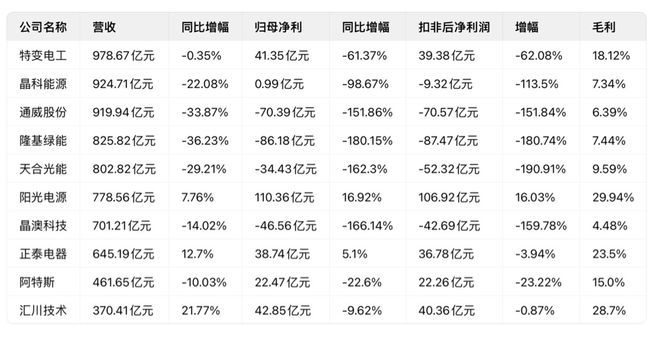
Core Insights - The photovoltaic industry is currently experiencing a phase of pain due to an adjustment cycle, with many companies facing losses. Among the top ten photovoltaic companies by revenue, 70% reported a decline in revenue, and 40% are operating at a loss, with Longi Green Energy facing the largest loss of over 8.6 billion yuan in 2024, marking its first annual loss in a decade [1][2][7]. Industry Overview - The industry is characterized by a temporary oversupply of production capacity, leading to significant losses for major players. Longi Green Energy's revenue fell by 36.23% to 82.58 billion yuan, with a net profit loss of 8.6 billion yuan, a staggering 180.15% decline year-on-year [2][5]. - The overall gross margin for Longi Green Energy dropped to 7.44%, a decrease of over 10 percentage points compared to the previous year. The gross margin for its silicon wafer and rod business was negative at -14.31%, while the module and battery segment also saw a significant decline [5][12]. Company Performance - Longi Green Energy's performance is indicative of broader industry trends, with other companies like Trina Solar and JinkoSolar also reporting substantial losses due to supply-demand imbalances and increased competition [7][8]. - In contrast, companies in the photovoltaic equipment supply sector, referred to as "selling shovels," such as Jiejia Weichuang, reported strong performance, with a revenue increase of over 116% to 18.9 billion yuan and a net profit of 2.76 billion yuan, reflecting a more favorable position in the current market [8][9]. Market Dynamics - The photovoltaic industry is undergoing a deep adjustment phase, with excess capacity and a lack of demand leading to significant financial strain on many companies. The industry is expected to see a clearing of outdated capacities and less competitive firms [7][12]. - Despite the challenges, there is an expectation that companies with core technological capabilities and strong cost control will emerge more resilient and may benefit from recovery opportunities in the future [12].
隆基绿能创始人李振国离任,背后有何隐情?
阿尔法工场研究院· 2025-05-27 10:15
Core Viewpoint - The resignation of Li Zhenguo, the founder and major shareholder of Longi Green Energy, is a significant event in the photovoltaic industry, driven by his desire to pursue a position as an academician in the Chinese Academy of Engineering, rather than a mere corporate role [4][6][9]. Group 1: Resignation Details - Li Zhenguo officially resigned from his positions as director, general manager, and legal representative of Longi Green Energy on May 26, marking a pivotal moment for the company and the industry [4]. - The decision to resign was not unexpected, as it had been discussed informally months prior, indicating a long-term intention rather than a sudden choice [6][9]. - Li Zhenguo will continue to serve as the head of the company's Central Research Institute and Chief Technology Officer, focusing on advancing photovoltaic technology [9][12]. Group 2: Implications for Longi Green Energy - Li Zhenguo's resignation means he will no longer participate in strategic decision-making or daily management, which raises questions about the future direction of Longi Green Energy [6][8]. - His departure from management roles aligns with the regulations that prohibit corporate leaders from being candidates for academician positions, emphasizing the importance of technical leadership in the photovoltaic sector [12][13]. - The company’s reliance on technological advancement as a core strategy is underscored by Li Zhenguo's belief that technology progress is the primary driver of the photovoltaic industry's success [11][12]. Group 3: Industry Context - The photovoltaic industry is currently facing significant challenges, including financial losses and market pressures, making Li Zhenguo's resignation particularly impactful [4][24]. - The trend of corporate leaders resigning to pursue academic roles has been observed in other companies, indicating a broader shift in how industry leaders view their contributions to technology and innovation [13][19]. - The emphasis on technology and innovation as the foundation for survival and growth in the photovoltaic sector is critical, as highlighted by Li Zhenguo's past statements regarding the industry's evolution [11][24].

利源股份(002501) - 2025年5月27日投资者关系活动记录表
2025-05-27 09:06
Group 1: Company Overview and Governance - The company is primarily engaged in the research, production, and sales of industrial aluminum profiles, building aluminum profiles, aluminum alloy deep processing products, automotive lightweight products, new energy products, and rail transit equipment components [4][6]. - Recent changes in the controlling shareholder are expected to positively impact the company's governance structure and business development [4][8]. - The company emphasizes risk prevention, strong management, and foundational stability as part of its overall operational principles [8][11]. Group 2: Financial Performance and Future Outlook - As of December 31, 2024, the company had 521 employees [6]. - The company aims to improve operational efficiency through lean management, cost control, and increased R&D investment [6][11]. - The company is focused on turning around its financial performance and achieving profitability in the second quarter of 2025 [6][11]. Group 3: Product Development and Market Strategy - The company plans to optimize its product structure and enhance processing depth to cover a complete manufacturing capability for automotive profiles and assemblies [8][11]. - There is an ongoing effort to explore new business opportunities, particularly in high-margin sectors, while maintaining a focus on automotive parts [6][11]. - The company will continue to adapt its production capabilities based on market and customer demands, including potential developments in the robotics sector [4][6][8]. Group 4: Investor Relations and Communication - The company actively engages with investors through online platforms and Q&A sessions to address concerns regarding performance and strategic direction [2][3]. - All significant matters will be disclosed in accordance with legal requirements, ensuring transparency for investors [3][11].

技术迭代驱动光伏行业迎拐点|从年报洞悉能源产业现代化密码
Zhong Guo Dian Li Bao· 2025-05-26 14:44
Core Viewpoint - The photovoltaic industry is experiencing a turning point in 2024, driven by technological iteration and policy adjustments, leading to a shift from low-cost competition to technological collaboration [1][6]. Group 1: Industry Performance - In 2024, 26 photovoltaic companies achieved revenue exceeding 10 billion yuan, with major players like TBEA, JinkoSolar, and Tongwei surpassing 90 billion yuan in revenue, while Longi Green Energy and Trina Solar exceeded 80 billion yuan [2]. - Among the 95 A-share listed photovoltaic companies, 33 reported revenue growth, but many faced revenue declines and net profit drops, indicating a structural challenge in the industry [1][2]. Group 2: Profit Distribution - The profit distribution within the photovoltaic supply chain has become highly polarized, with inverter and equipment manufacturers emerging as the biggest winners, while the module segment faces significant losses [3]. - Sunshine Power reported a net profit of 11.036 billion yuan, up 16.9%, while leading module manufacturers like JinkoSolar barely managed a profit of 0.99 million yuan, with others like Longi and Trina facing losses [3]. Group 3: Technological Advancements - The industry is entering a phase where innovation is crucial for survival, with N-type technology becoming a key differentiator [4][5]. - JinkoSolar achieved significant success with N-type TOPCon technology, shipping 92.87 GW of modules, of which 81.29 GW were N-type, representing 88% of their total shipments [4]. Group 4: Policy and Market Dynamics - The Chinese government is implementing stricter regulations to control low-efficiency production capacity, which is expected to reshape the industry landscape by 2025 [6]. - The market anticipates a potential turning point in 2025, with predictions of increased demand and a tightening supply of components, which may lead to a rebound in prices [6][7]. Group 5: Future Outlook - Companies are focusing on upgrading their production capacities and investing in R&D to maintain competitive advantages, with JinkoSolar planning to complete over 40% of its capacity upgrades by 2025 [7]. - The industry is expected to emerge from a period of adjustment, with leading companies likely to navigate through the cycle successfully due to their advanced capacities and global strategies [6][7].
光洋股份拟收购银球科技背后:交易不确定性下的多维挑战?
Xin Lang Zheng Quan· 2025-05-19 10:17
Core Viewpoint - The acquisition of YinQiu Technology by Guangyang Co., Ltd. is a strategic move aimed at enhancing market share and operational efficiency in the bearing industry, despite facing multiple risks and challenges [1][5]. Group 1: Acquisition Details - Guangyang Co., Ltd. is planning to acquire 100% equity of YinQiu Technology through a combination of issuing shares and cash payments, with an investment intention agreement already signed [1]. - The final terms of the acquisition, including share transfer quantity, ratio, transaction price, and payment method, will be determined in a formal agreement [1]. Group 2: Risks and Challenges - Transaction uncertainty risk exists as the restructuring is still in the planning stage, with core terms yet to be finalized and requiring approval from the China Securities Regulatory Commission [2]. - Business integration challenges arise from differing management cultures, as Guangyang specializes in automotive components while YinQiu focuses on large-scale production in the home appliance sector [2]. - The financial strain from the integration may be exacerbated by Guangyang's negative operating cash flow of -104 million yuan in 2024 and the need for continued investment in YinQiu's capacity expansion projects [2]. Group 3: Industry Competition - The bearing industry is experiencing intensified competition, with a CR5 of 58.3%, and leading companies like Wazhou and Luozhou are advancing in smart and long-life bearing technologies [3]. - Guangyang's R&D investment intensity is currently insufficient compared to industry leaders, which may hinder its ability to penetrate high-end markets [3]. - Foreign brands dominate the precision bearing market, holding over 65% market share, posing challenges for Guangyang's international expansion post-acquisition [3]. Group 4: Industry Impact and Future Outlook - The acquisition reflects a trend of consolidation in the bearing industry, with over 5,000 domestic bearing companies and a CR10 of only 28.1%, indicating a potential for market share growth through mergers [4]. - The combined market share of Guangyang and YinQiu is expected to increase from less than 2% to 4%-5%, positioning them in direct competition with other major players [4]. - There are opportunities for domestic substitution in the high-end bearing market, particularly in the electric vehicle sector, which could increase the penetration rate of domestic bearings from less than 30% to 50% if the integration is successful [4]. Group 5: Conclusion - The acquisition is a proactive choice for Guangyang Co., Ltd. to enhance its competitive position, with short-term benefits from scale effects and market expansion [5]. - Long-term competitiveness will depend on the depth of technological integration and breakthroughs in high-end markets [5]. - The ability to achieve a "1+1>2" effect will require overcoming challenges related to management integration and technological upgrades [5].

威高血净上市首日上涨56%,威海制造再添新势力
Qi Lu Wan Bao Wang· 2025-05-19 08:55
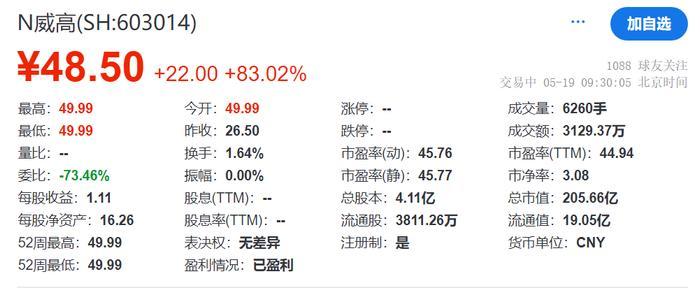
Core Viewpoint - The successful debut of Weigao Blood Purification Products Co., Ltd. on the Shanghai Stock Exchange marks a significant milestone for the Weigao Group, highlighting the growth potential of the medical device sector in Weihai [1][3]. Group 1: Company Performance - Weigao Blood Purification's initial public offering (IPO) price was set at 26.5 yuan per share, with the stock opening at 50 yuan, representing an 88.64% increase. By the end of the first trading day, the stock closed at 41.41 yuan, a 56.26% rise, with a turnover rate of 69.71% and a trading volume of 265,700 lots, amounting to 1.15 billion yuan in transaction value [1]. - On May 19, the net inflow of main funds was 275 million yuan, accounting for 23.88% of the total transaction value, while retail investors saw a net outflow of 532 million yuan, representing 46.21% of the total [1]. Group 2: Competitive Advantages - The company has established a competitive moat through its proprietary hollow fiber membrane technology, achieving a market share of 32.5% in blood dialysis devices and 31.8% in blood dialysis tubing, both ranking first in the industry. Its joint venture with Japan's Nikkiso has secured a 24.6% market share in blood dialysis machines, placing it second domestically [3]. - Weigao Blood Purification's collaboration with Taiermao to develop neutral peritoneal dialysis fluid, the first approved product of its kind in China, addresses a significant market need and reduces the risk of peritoneal fibrosis for patients [3][4]. Group 3: Market and Policy Environment - The "14th Five-Year Plan" by the National Health Commission emphasizes expanding peritoneal dialysis service coverage, which aligns with Weigao's strategic initiatives [3][5]. - The Shandong provincial government's support for innovative medical devices, including financial backing of up to 2 million yuan for products entering special review procedures, provides a conducive environment for Weigao's technological advancements [4]. Group 4: Future Growth Potential - The current penetration rate of peritoneal dialysis in China is below 10%, significantly lower than the international average of 20%, indicating substantial growth potential for Weigao's peritoneal dialysis business [4][5]. - Weigao plans to allocate 15% of its raised funds towards the research and development of peritoneal dialysis fluid, focusing on biodegradable materials, which could lead to technological advancements within 3-5 years [5]. - The medical device industry in Weihai has developed into a robust cluster, with over 200 manufacturing companies and significant market share in various products, further solidifying Weigao's position in the capital market [3][6].