美联储降息

Search documents
铜价可能以高位震荡趋势运行
Hua Long Qi Huo· 2026-03-02 07:17
Report Industry Investment Rating - Not provided Core Viewpoints - Copper prices are likely to fluctuate at high levels, with limited arbitrage opportunities and an advice to hold off on options contracts [4][26] Summary by Directory 1. Market Review - In February, the price of the main contract of Shanghai copper futures fluctuated at high levels, ranging from approximately 98,060 yuan/ton to 106,090 yuan/ton [7] 2. Macroeconomic Environment - The probability of the Fed cutting interest rates in the first half of the year is low. The probability of a 25 - basis - point rate cut by March is 4%, with a 96% chance of maintaining the current rate. By April, the probability of a cumulative 25 - basis - point cut is 17.3%, 82.1% for maintaining, and 0.6% for a cumulative 50 - basis - point cut. By June, the probability of a cumulative 25 - basis - point cut is 43% [2][9][26] 3. Supply and Demand 3.1 Refined Copper Production Growth - As of February 26, 2026, China's copper smelter refining fees were - 5.01 cents/pound, and rough smelting fees were - 50.96 dollars/kiloton. Copper processing fees remained at a low level [12] 3.2 High Spread between Refined and Scrap Copper - As of February 26, 2026, the price of refined copper in Shanghai was 102,000 yuan/ton, and the price of scrap copper in Foshan was 89,050 yuan/ton, with a spread of 4,045 yuan/ton. Seasonally, the current spread is at a relatively high level compared to the past five years [15] 4. Inventory - As of February 27, 2026, the Shanghai Futures Exchange's cathode copper inventory was 391,529 tons, an increase of 119,054 tons from the previous week. As of February 26, LME copper inventory was 253,600 tons, an increase of 3,950 tons from the previous trading day, with a cancelled warrant ratio of 5.19%. As of February 27, COMEX copper inventory was 601,541 tons, an increase of 493 tons from the previous trading day. As of February 26, Shanghai bonded area inventory was 88,600 tons, an increase of 1,100 tons from the previous week, Guangdong area inventory was 93,200 tons, and Wuxi area inventory was 114,100 tons [19] 5. Outlook 5.1 Factors Affecting Price Trends - Key factors influencing copper prices include US policy (Fed rate cuts may be further delayed), supply (refined copper processing fees remain extremely low, and the spread between refined and scrap copper remains high), and inventory (COMEX copper continues to accumulate significantly, and Shanghai copper inventory rises notably) [25] 5.2 Forecast - The Fed's delayed rate cuts are bearish for copper prices. China's copper smelter fees have increased slightly but remain low. Refined copper production has grown rapidly, the spread between refined and scrap copper remains high, and copper product output has decreased year - on - year. Overall, copper prices are likely to fluctuate at high levels [26]
大越期货沪铜早报-20260302
Da Yue Qi Huo· 2026-03-02 01:25
Group 1: Report Industry Investment Rating - No relevant information provided Group 2: Core View of the Report - The copper market has a complex situation. The supply side is disturbed with smelting enterprises reducing production and the scrap copper policy being relaxed. The manufacturing PMI in January was 49.3%, down 0.8 percentage points from the previous month, indicating a decline in manufacturing prosperity. The copper price has reached a new high and is currently fluctuating at a high level, with short - term shock operation. Geopolitical events in the Middle East should be noted [3]. Group 3: Summary by Related Catalogs Daily View - **Fundamentals**: Supply - side disturbances, smelting enterprise production cuts, and relaxed scrap copper policy. The January manufacturing PMI was 49.3%, down 0.8 percentage points from the previous month, with a decline in manufacturing prosperity; bullish [3]. - **Basis**: Spot price is 102140, basis is - 1780, at a discount to futures; bearish [3]. - **Inventory**: On February 27, copper inventory increased by 100 to 253700 tons, and the SHFE copper inventory increased by 119054 tons to 391529 tons compared with last week; neutral [3]. - **Disk**: The closing price is above the 20 - day moving average, and the 20 - day moving average is upward; bullish [3]. - **Main positions**: The main net position is long, and the long position is decreasing; bullish [3]. - **Expectation**: Geopolitical disturbances still exist. The Grasberg Block Cave mine event in Indonesia has fermented. The copper price has reached a new high and is currently fluctuating at a high level, with short - term shock operation. Pay attention to Middle East events [3]. Recent利多利空Analysis - **Likely**: Global policy easing and tight mine end [4]. - **Unlikely**: US comprehensive tariff fluctuations and the global economy is not optimistic, high copper prices will suppress downstream consumption [5]. Other Information - **Exchange Inventory**: SHFE copper inventory increased by 119054 tons to 391529 tons compared with last week [3]. - **Bonded Area Inventory**: The bonded area inventory has rebounded from a low level [13]. - **Processing Fee**: The processing fee has declined [15]. - **Supply - Demand Balance**: There is a slight surplus in 2024 and a tight balance in 2025. The Chinese annual supply - demand balance table shows different production, import, export, consumption, and balance data from 2018 - 2024 [19][21].
地缘风险及去库趋势驱动金银震荡偏强
Wu Kuang Qi Huo· 2026-02-28 14:00
1. Report Industry Investment Rating - No information provided in the report 2. Core Viewpoints of the Report - This week, precious metal prices fluctuated strongly. The continuous reduction of COMEX precious metal inventories and the pressure on deliverable inventories, along with strong demand - side support, geopolitical risks, and the weakening of the US dollar, all provided support for precious metal prices. However, the unexpected performance of US PPI data may delay the Fed's interest - rate cut process, which limits the upside space for gold to some extent. The short - term strategy suggests a bullish approach, with the reference operating range for the main contract of Shanghai gold being 1130 - 1250 yuan/gram and that for the main contract of Shanghai silver being 22400 - 24500 yuan/kilogram [11]. 3. Summary According to the Directory 3.1 Week - to - Week Assessment and Market Outlook - **Market Review**: Shanghai gold rose 3.41% to 1147.90 yuan/gram, Shanghai silver rose 16.36% to 23019.00 yuan/kilogram; COMEX gold rose 0.92% to 5296.40 US dollars/ounce, COMEX silver rose 7.26% to 94.39 US dollars/ounce; the 10 - year US Treasury yield was 4.02%, and the US dollar index fell 0.09% to 97.64 [11]. - **Fundamentals**: COMEX precious metal inventories continued to decline, with the silver inventory reduction trend being significant. The demand side remained strong. In 2026, the global silver supply gap was expected to reach 67 million ounces, and the global central bank's gold purchase volume was expected to reach 755 tons [11]. - **Influencing Factors**: Uncertainty in US tariff policies, geopolitical tensions, and the weakening of the US dollar provided support for gold prices. However, the unexpected performance of US PPI data may delay the Fed's interest - rate cut process, limiting the upside space for gold [11]. - **Strategy Recommendation**: Adopt a bullish approach in the short - term, with the reference operating range for the main contract of Shanghai gold being 1130 - 1250 yuan/gram and that for the main contract of Shanghai silver being 22400 - 24500 yuan/kilogram [11]. 3.2 Gold Weekly Review - **Price and Volume Data**: Shanghai gold rose 3.41% to 1147.90 yuan/gram, with a weekly high of 1151.06 yuan/gram and a low of 1146.48 yuan/gram; COMEX gold rose 0.92% to 5296.40 US dollars/ounce, with a weekly high of 5296.40 US dollars/ounce and a low of 5160.50 US dollars/ounce [20][23]. - **Inventory**: As of Friday, the COMEX gold inventory was 1036.40 tons [32]. - **Funding**: As of the latest reporting period, the net long position of COMEX gold managed funds was 96,000 lots, with long positions of 121,200 lots and short positions of 25,200 lots; the total position of major foreign gold ETF funds was 1747.53 tons [38][41]. 3.3 Silver Weekly Review - **Price and Volume Data**: Shanghai silver rose 16.36% to 23019.00 yuan/kilogram, with a weekly high of 23029.00 yuan/kilogram and a low of 22327.00 yuan/kilogram; COMEX silver rose 7.26% to 94.39 US dollars/ounce, with a weekly high of 94.39 US dollars/ounce and a low of 87.73 US dollars/ounce [44][48]. - **Inventory**: As of Friday, the COMEX silver inventory was 11207.60 tons [55]. - **Funding**: As of the latest reporting period, the net position of COMEX silver managed funds was 8523 lots, with long positions of 13365 lots and short positions of 4842 lots; the total position of major foreign silver ETF funds was 26360.56 tons [59][62]. 3.4 US Fiscal and Monetary - **Federal Reserve Balance Sheet**: The total assets of the Federal Reserve increased by 402 million US dollars week - on - week. There were changes in various items on the asset and liability sides, such as the reduction in the balance of reverse repurchase agreements and the increase in the balance of some deposits [65]. - **Federal Reserve Interest Rates**: The report presents relevant data on Federal Reserve interest rates, including the federal funds target rate, effective federal funds rate, and US Treasury yields [70]. 3.5 US Macroeconomic Data - **GDP**: The report shows the year - on - year and quarter - on - quarter growth rates of US GDP [75]. - **CPI**: The report presents data on US CPI, including year - on - year and core CPI, as well as the contribution of various components to CPI growth [78]. - **PPI**: US PPI and core PPI showed year - on - year and month - on - month increases, with cost - push inflationary pressures rising [81]. - **PMI**: The report shows data on US ISM - PMI manufacturing and its sub - items [83]. - **Housing**: The report presents data on US new private housing construction, new housing sales, and the S&P/CS housing price index [85]. - **Employment**: In January 2026, the private sector added 172,000 non - farm jobs, with significant differences in employment changes in different industries [88]. - **Personal Income**: The report shows data on the average hourly wage of US non - farm private sector employees and the year - on - year growth rate of personal disposable income [91]. 3.6 Global Liquidity Tracking - **Interest Rates of Major Economies**: The report shows the interest rates of major economies and their week - on - week changes [96][99]. - **Exchange Rates of Major Economies**: The report shows the week - on - week changes in the exchange rates of major economies against the RMB and the US dollar [102][103]. - **Stock Indexes of Major Economies**: The report shows the week - on - week changes in the stock indexes of developed and developing countries, as well as the week - on - week changes in the sectors of US and European stock markets [105][108].
【品种交易逻辑】主产国供应扰动频繁,沪锡上方还有多少空间?
Xin Lang Cai Jing· 2026-02-28 01:20
Group 1: Tin (沪锡) - The trading logic indicates that Nvidia's revenue exceeded expectations, supporting demand from new energy and AI orders, while supply tightens due to delays in Indonesian tin mine approvals and armed conflicts in the Democratic Republic of Congo [1][3] - Key risk factors include the exchange's risk warnings and adjusted trading limits, a weak order flow for solder due to the traditional off-season in consumer electronics, and an increase in domestic social inventory [1][3] - Important events to monitor include the actual recovery of tin supply from Myanmar, shipping rhythms from the Congo, the impact of geopolitical risks on supply, solder enterprise operating rates, and changes in order structures [1][3] Group 2: Alumina (氧化铝) - The trading logic suggests that the planned production capacity will exceed 10 million tons by 2026, narrowing the supply-demand gap, with an increase in Indonesian imports month-on-month [1][3] - Risk factors include a decrease in northern port inventories, raw material shortages, and environmental inspections leading to production cuts, alongside an 18% year-on-year increase in bauxite prices from Guinea, strengthening cost support [1][3] - Key events to watch are the environmental inspections in March, overseas bauxite supply conditions, the impact of EU carbon tariffs on export-oriented electrolytic aluminum plants, and industry hedging drivers [1][3] Group 3: Lithium Carbonate (碳酸锂) - The trading logic highlights the resumption of production at major mines in Yichun around the Spring Festival, with January production increasing by 53% year-on-year, while macro funds show a muted positive response [4] - Risk factors include concerns over Zimbabwe's export suspension, policy restrictions on inefficient mining and mining license cancellations, accelerated inventory depletion before the festival, and sustained year-on-year growth in new energy vehicle production and sales [4] - Important events to track include the actual resumption timeline and progress of the Jiangxiawo lithium mine, inventory data and depletion rates, upstream supply disruption news, and macro sentiment [4] Group 4: Fuel Oil (燃料油) - The trading logic indicates refinery restarts, high levels of Middle Eastern exports, and no significant shortfall in high-sulfur fuel oil, while structural adjustments in ship fuel demand are noted [2][4] - Risk factors include escalating tensions in the Russia-Ukraine and Middle Eastern regions, increased shipping risks, tightening supply in Singapore, and delays in Middle Eastern refinery restarts leading to short-term tightness in low-sulfur fuel oil [2][4] - Key events to monitor are developments in geopolitical conflicts, the progress of domestic and overseas refinery restarts, the execution of sanctions on Russian high-sulfur exports, unplanned maintenance at other Middle Eastern refineries, and the usage rhythm of low-sulfur fuel oil export quotas [2][4] Group 5: Coal (焦煤) - The trading logic shows that domestic coal mines are gradually resuming production post-holiday, with significant increases in capacity utilization and daily output, while the import of Mongolian coal remains high, maintaining supply pressure [5] - Risk factors include potential macro sentiment fluctuations due to important upcoming meetings and relaxed real estate controls in certain cities, as well as ongoing inventory accumulation at Mongolian coal ports [5] - Important events to observe include the overall resumption progress of coal mines, changes in Mongolian coal clearance volumes and port inventories, the resumption progress of downstream coking steel enterprises, and policy directions from significant macro meetings [5]
新浪财经资讯AI速递:昨夜今晨财经热点一览 丨2026年2月28日
Xin Lang Cai Jing· 2026-02-27 23:39
Group 1: Currency and Economic Policy - The offshore RMB appreciated over 600 basis points against the USD in three consecutive days after the Spring Festival, prompting the central bank to lower the foreign exchange risk reserve ratio for forward sales from 20% to 0% starting March 2, 2026, to stabilize exchange rate expectations and reduce corporate costs for forward purchases [10][10]. - The adjustment of the foreign exchange risk reserve ratio is aimed at guiding the RMB exchange rate to maintain basic stability at a reasonable and balanced level [10]. Group 2: Commodity Market Movements - International commodity markets experienced significant movements due to escalating tensions in the Middle East, with silver prices rising over 5% and gold prices also increasing on February 27 [11][11]. - The rise in commodity prices is attributed to the U.S. approving the evacuation of personnel from Israel and military buildup in the region, raising expectations of direct conflict between the U.S. and Iran [11]. Group 3: Stock Market Performance - The Dow Jones index fell by 1.59% to close at 48,710.54 points, with most bank stocks declining, including Citigroup down over 5% and Bank of America and Wells Fargo down over 4% [15][15]. - The Nasdaq index opened down 1.2%, with significant declines in technology stocks, including Microsoft and Nvidia, both dropping over 2% [17][17]. Group 4: Corporate Developments - Warner Bros. Discovery and Paramount Global reached a merger agreement valued at $110 billion, including approximately $29 billion in debt, marking one of the largest mergers in Hollywood in recent years [13][13]. - OpenAI announced a new investment of $110 billion, raising its valuation to $730 billion, with Amazon contributing $50 billion to the investment [17][17]. Group 5: Real Estate Transactions - Wanda Group sold the Shanghai Zhuangqiao Wanda Plaza for 2.048 billion yuan, marking the latest in a series of asset disposals, having sold over 80 Wanda Plazas since 2023 [18][18]. - The asset sales reflect ongoing liquidity pressures for Wanda, with asset monetization being a key strategy to alleviate debt and recover funds [18].
美股在PPI公布后扩大跌幅 标普恐创去年3月以来最差单月表现
Xin Lang Cai Jing· 2026-02-27 15:16
Group 1 - The U.S. stock market experienced a decline on Friday morning, with the S&P 500 index down 0.9%, the Nasdaq 100 index down 1%, and the Dow Jones also down 0.9%, indicating the worst monthly performance since March of the previous year [1][3] - Concerns over the artificial intelligence bubble have put pressure on technology stocks, with OpenAI raising $110 billion at a valuation of $730 billion [3] - The latest inflation data has strengthened market bets that the Federal Reserve will not lower interest rates in the short term, while geopolitical risks have pushed up U.S. Treasury yields, oil prices have risen, and gold prices have surpassed $5,200 [1][2] Group 2 - The Producer Price Index (PPI) data showed a higher-than-expected increase, with a month-on-month rise of 0.5%, revised from a 0.4% increase in December, and the core index, excluding food and energy, recorded the largest increase since July of the previous year [2][4] - Market participants are on alert for escalating tensions between the U.S. and Iran, as the U.S. has deployed significant military forces in the Middle East, contributing to market anxiety [2][4] - Northlight Asset Management's Chris Zaccarelli noted that the inflation data may give the Federal Reserve more reason to be patient regarding interest rate cuts, potentially waiting until the second half of the year for adjustments [4]
美国通胀韧性犹存!1月PPI超预期跳升,美联储后续降息动能恐受阻
智通财经网· 2026-02-27 14:14
Group 1 - The Producer Price Index (PPI) in the U.S. rose by 0.5% in January, marking the largest increase since September of the previous year, driven primarily by the services sector [1] - The core PPI, excluding food and energy, increased by 0.8% month-over-month, which is the highest rise since July [2] - Year-over-year, the PPI increased by 2.9%, surpassing the expected 2.6%, while the core PPI year-over-year rose to 3.6%, above the forecast of 3.0% [2] Group 2 - The sustained high readings of wholesale prices indicate slow progress in curbing inflation, with higher tariffs on imported materials prompting manufacturers to raise prices or seek cost-saving measures [2] - Despite some upward pressure on consumer prices from tariffs, businesses have not significantly raised prices as previously feared by economists [3] - The Federal Reserve is not in a hurry to lower interest rates again, given the slow progress in reducing inflation to its 2% target and recent stability in the labor market [3]


美债危机的解决路径,强美元
Sou Hu Cai Jing· 2026-02-27 13:44
Group 1 - The U.S. is increasingly reliant on allies to support its over $30 trillion debt, revealing significant structural vulnerabilities [1] - In 2025, allied nations are projected to net purchase $463.9 billion in U.S. Treasury bonds, the highest in eight years, while opposing nations are accelerating sales, reducing holdings by $125.2 billion, the largest decline in six years [1] - This financing model's sustainability is questionable due to the heavy reliance on a single bloc for support [1] Group 2 - A reversal in allies' willingness or ability to purchase U.S. debt could lead to a liquidity crisis in the Treasury market, potentially triggering systemic financial risks [2] - The strong dollar is viewed as the only viable path for the U.S. to address its debt crisis and avoid economic collapse [3] - The current high debt structure means that fluctuations in the dollar's exchange rate directly influence Treasury yields, impacting the survival of the U.S. real economy [3] Group 3 - A significant depreciation of the dollar would lead to a substantial decline in the real returns for international investors holding U.S. debt, necessitating higher nominal yields to compensate for currency losses and inflation expectations [4] - This scenario would sharply increase borrowing costs for the U.S. government and capital-intensive core industries, such as technology, finance, and defense, potentially crippling them [4] - A high-interest rate environment could suppress investment and innovation, leading to a vicious cycle of economic decline and worsening debt [4] Group 4 - To avoid systemic collapse, a strong dollar is essential, as it would attract global capital back to the U.S., increasing demand for Treasury bonds and lowering yields [5] - A low-interest rate environment is crucial for maintaining low financing costs for the government and providing affordable funding for domestic industries [5] - The necessity for a significant dollar appreciation is framed as a fundamental understanding to resolve current challenges [5] Group 5 - The mechanism for achieving dollar appreciation may seem counterintuitive, as traditional views suggest that interest rate cuts lead to currency depreciation [6] - However, during a global deflationary period, the opposite may occur, with the dollar appreciating despite rate cuts [7] - In a deflationary environment, cash becomes king, and the dollar's liquidity value is amplified, driving capital into dollar assets and increasing its value [8] Group 6 - Under specific macroeconomic conditions, the dollar index could rise to levels between 130 and 150 [9] - This appreciation is not based on absolute strength in the U.S. economy but rather on relative global recession and the stability of the U.S. financial system [10] - The unique economic structure of the U.S., including a significant trade deficit and dominance in high-tech and financial services, provides greater currency resilience compared to manufacturing-dependent countries [10] Group 7 - The path to resolving the U.S. debt crisis through dollar appreciation relies heavily on the continued support of global capital, particularly from allied nations [10] - The withdrawal of non-allied countries has altered the holding structure of U.S. debt, increasing dependence on allies [10] - Domestic political unpredictability, including tariff policies and interventions in central bank independence, threatens the foundation of this strategy [10]
贵金属日报-20260227
Guo Tou Qi Huo· 2026-02-27 12:41
Group 1: Report Industry Investment Rating - Gold is rated with one red star, indicating a bullish bias but limited operability on the market [1][4] - Silver is rated with three red stars, suggesting a clearer bullish trend and relatively appropriate investment opportunities [1][4] Group 2: Core View of the Report - Overnight precious metals continued to fluctuate with significant intraday volatility. The Geneva negotiation between the US and Iran ended, with the Iranian foreign minister stating that the negotiation made good progress, there are still differences but consensus is approaching in some areas, and technical consultations will be held next week. Short - term geopolitical and tariff prospects remain uncertain, and precious metals are waiting for a clearer direction from risk events [1] Group 3: Summary of Related Information - The Chinese Ministry of Commerce responded to the upcoming sixth round of China - US economic and trade consultations, stating that China is willing to work with the US to properly manage differences and expand practical cooperation through equal consultations [2] - US Vice - President Vance is unclear about Trump's decision on Iran. Possibilities include military strikes or diplomatic solutions. Trump is more inclined to the diplomatic option, which depends on Iran's words and deeds [2] - Fed's Goolsbee believes that interest rates can be cut but doesn't want to act prematurely before inflation eases. He is one of the most optimistic about rate cuts among Fed officials [2] - According to CME's "FedWatch", the probability of the Fed cutting interest rates by 25 basis points in March is 4%, and the probability of keeping rates unchanged is 96.0%. The probability of a cumulative 25 - basis - point rate cut by April is 17.3%, the probability of keeping rates unchanged is 82.1%, and the probability of a cumulative 50 - basis - point rate cut is 0.6%. The probability of a cumulative 25 - basis - point rate cut by June is 43% [2]
ATFX:美国PPI公布前夕黄金持稳 降息预期将如何定下月末行情
Xin Lang Cai Jing· 2026-02-27 12:09
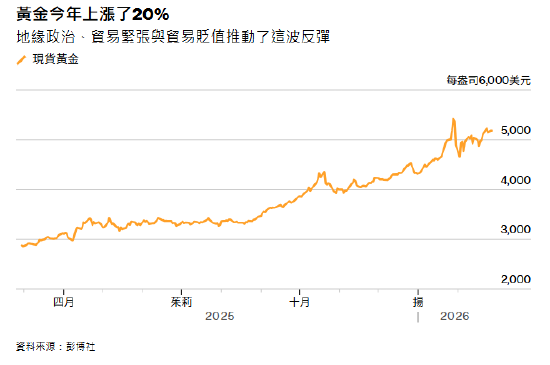
Core Viewpoint - The recent agreement between the U.S. and Iran to continue nuclear negotiations has led to a stabilization in gold prices, despite ongoing military tensions in the Middle East [1][8]. Group 1: Gold Price Trends - Gold has increased approximately 20% year-to-date, surpassing $5,000 per ounce after reaching a historical high at the end of January [1][8]. - The price of gold bars is expected to rise for the seventh consecutive month, marking the longest streak since 1973 [1][8]. - Gold prices have shown a rebound, with three consecutive weeks of gains in late February, stabilizing above $5,100 per ounce and testing resistance at $5,200 per ounce [7][15]. Group 2: Market Influences - Geopolitical tensions, trade disputes, and concerns over the depreciation of the dollar have contributed to the recent rally in gold prices [1][8]. - Investors have begun to increase their holdings in gold-backed exchange-traded funds (ETFs), with inflows this week surpassing earlier sell-offs, indicating a return of market interest [4][11]. - The market is closely monitoring the Federal Reserve's interest rate cut prospects, with expectations of a potential cut if inflation decreases, which could further support gold prices [7][14]. Group 3: Economic Indicators - The upcoming U.S. Producer Price Index (PPI) report is anticipated to show a year-on-year slowdown to 2.6%, down from 3%, which could influence market expectations regarding the Fed's next actions [7][14][15]. - If the PPI data comes in below expectations, it may reinforce the market's anticipation of further rate cuts, benefiting gold prices [15]. - Conversely, if the data exceeds expectations, it could indicate persistent inflation, potentially diminishing the urgency for rate cuts and exerting downward pressure on gold [15].