
耐心资本

Search documents
耐心资本崛起 保险资管能否扛起服务新质生产力的大旗?
Jing Ji Guan Cha Bao· 2025-12-31 01:59
站在"十四五"收官与"十五五"谋篇布局的关键节点,中国大资管行业正经历一场深刻的结构性重塑。截 至12月30日,上证指数收于3965.12点,年内累计上涨超700点,涨幅超23%,创近五年最佳表现。在这 轮以科技、高端制造和高股息资产为主线的结构性行情中,以保险资金为代表的长期资金持续净流入, 成为稳定市场中枢、支撑新质生产力估值的重要力量,"耐心资本"正从制度构想转化为真实市场动能。 中保投资董事长贾飙12月27日在中国财富管理50人论坛2025年会上指出,大资管行业已从监管套利驱动 的粗放增长,转向以"服务新质生产力、构建耐心资本、防范系统性风险"为内核的高质量发展新阶段。 他强调,在低利率、资产荒与AI革命三重压力下,唯有通过制度精准回应、能力系统升级与子行业错 位协同,才能支撑"十五五"期间金融供给侧改革的深层目标。 这一判断不仅关乎行业格局变迁,更触及国家金融体系如何有效引导长期资本流向科技创新、先进制造 与绿色转型等关键领域的根本命题。大资管,正在从市场工具升维为国家战略支点。 中国大资管行业的演进可划分为四个阶段:2003—2007年为起步期,标志性事件包括银行理财业务制度 化、保险资管公司成立 ...
从“金融中心”到“产业金融中心” 需克服三大挑战
Nan Fang Du Shi Bao· 2025-12-30 23:11
Core Viewpoint - Shenzhen's municipal government has officially proposed the establishment of an "Industrial Financial Center" as an independent strategic goal in its 15th Five-Year Plan, marking a significant shift in its financial development logic [2][4]. Financial Strategy - The proposal emphasizes the need for a financial system that directly supports industrial development, distinguishing Shenzhen's approach from traditional financial centers focused on capital allocation and liquidity [4][6]. - The strategy aims to create a national model for financial support of industries, particularly in advanced manufacturing and hard technology sectors, leveraging Shenzhen's strong industrial foundation [4][6]. Capital Development - The plan highlights the cultivation of "patient capital" to address the financing challenges faced by technology companies, which often have long development cycles and require long-term investment [5][6]. - Shenzhen aims to shift the focus of financial functions from merely accumulating capital to nurturing quality investments that support early-stage technology companies [6][8]. Systemic Innovations - The proposal outlines the need for a comprehensive financing system covering various investment types, including angel, venture, equity, and credit investments, to enhance risk-sharing mechanisms [7][8]. - It emphasizes the importance of establishing a robust legal framework for intellectual property to facilitate its capitalization and integration into the financial system [10][12]. Cross-Border Collaboration - The plan advocates for enhanced financial collaboration with Hong Kong, leveraging the unique strengths of both regions to create a synergistic effect in the Greater Bay Area [11][12]. - Specific pathways for cooperation include cross-border capital flows, technology asset recognition, and mutual recognition of financial products [12]. Risk Management - The proposal stresses the establishment of a comprehensive risk prevention system tailored to the unique risks associated with industrial finance, including regulatory innovations and collaborative mechanisms [13][14]. - It aims to avoid pitfalls such as financial hollowing and ensure that financial resources are effectively integrated into the industrial sector [13][14]. Expert Insights - Experts believe that Shenzhen's approach to building an industrial financial center could serve as a replicable model for other regions in China, emphasizing the importance of a stable market-oriented system [14][15]. - The focus on "market-driven, state-led" patient capital is seen as a key element that could facilitate deeper integration of finance and industry [14].

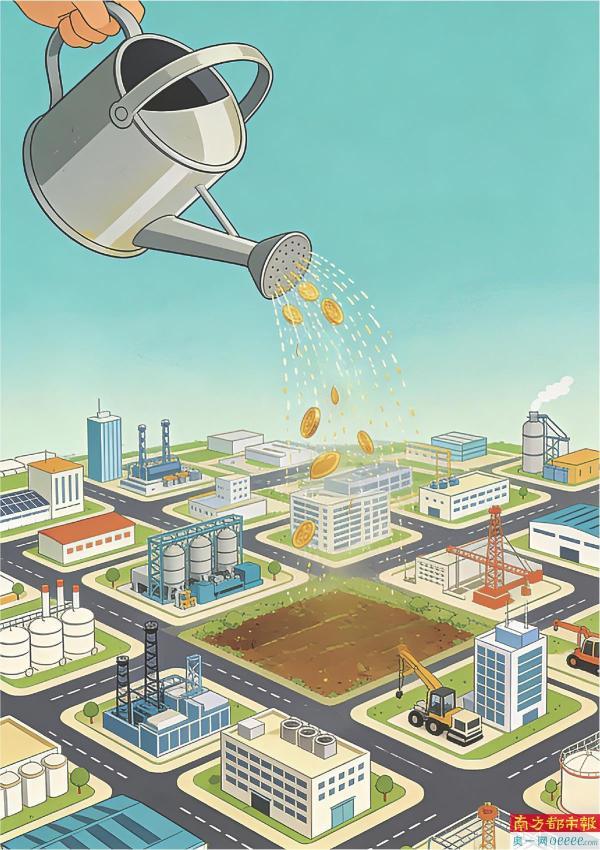
洞察2025|险资“变形记”!长钱解锁“牛市”新副本
Bei Jing Shang Bao· 2025-12-30 04:26
Core Viewpoint - The concept of "patient capital" is emerging as a key driver for financial empowerment in China's economy, particularly through the insurance sector, which is increasingly integrating long-term investment strategies with innovation [1][4]. Group 1: Policy Support for Long-term Investment - The China Securities Regulatory Commission emphasizes the need for a more attractive environment for long-term investments, aiming to create conditions where long-term funds are willing to enter and thrive in the market [4]. - A series of policies have been implemented to facilitate insurance capital's entry into the market, including adjustments to investment limits and risk factor settings for equity assets [5][6]. - These policies are designed to enhance the flexibility and profitability of insurance institutions' asset management, thereby fostering a culture of long-term investment [5][6]. Group 2: Growth in Insurance Capital Market Participation - As of the third quarter, the total balance of insurance funds reached 37.46 trillion yuan, a year-on-year increase of 16.5%, with stock investments accounting for 3.6 trillion yuan [6]. - The number of times insurance capital has made significant investments (or "took stakes") in companies reached 39 in the current year, the highest since 2016, indicating a shift towards more mature long-term value investment strategies [6][7]. - Insurance capital is diversifying its investment methods beyond direct stock purchases, including long-term investment reform trials that have approved a total of 222 billion yuan [6][7]. Group 3: Focus on Hard Technology Investments - Insurance capital is increasingly investing in hard technology sectors, demonstrating a commitment to long-term partnerships with innovative companies [8][9]. - By mid-2025, insurance capital's direct equity investments in technology sectors reached 42.59 billion yuan, with significant growth in investments in internet-related services [8][9]. - Major insurance companies are establishing specialized funds focused on technology innovation, indicating a strategic shift towards supporting advanced manufacturing and other high-tech industries [9][10]. Group 4: Challenges and Upgrades in Investment Practices - The insurance sector faces challenges such as macroeconomic fluctuations and increased uncertainty in technology investments, necessitating enhanced professional capabilities and risk management [11][12]. - There is a need for insurance companies to evolve from being passive investors to proactive value creators, which involves building specialized operational capabilities and comprehensive risk management frameworks [12][13]. - The transition from "long money" to "long wisdom" reflects a comprehensive upgrade in the professional capabilities and overall quality of insurance capital [13].

解读深圳“十五五”:资本锚定新质生产力,构建产业金融中心
Nan Fang Du Shi Bao· 2025-12-30 00:55
Core Viewpoint - Shenzhen has officially proposed the establishment of an "Industrial Financial Center" as an independent strategic goal in its 15th Five-Year Plan, marking a significant shift in its financial development logic and aiming to enhance the synergy between finance and industry [1][2][3]. Financial Center Development - The proposal signifies a fundamental change from traditional financial centers focused on capital allocation and liquidity to a model where financial success is measured by its ability to catalyze specific industrial clusters like advanced manufacturing and hard technology [2][3]. - Shenzhen aims to differentiate itself from other financial hubs like Shanghai and Beijing by creating a model that directly supports industry through finance, leveraging its strong industrial base [2][3]. Focus on Patient Capital - The plan emphasizes the cultivation of "patient capital" to address the inherent conflicts between the long-term nature of hard technology ventures and the short-term returns typically sought by traditional finance [4][5]. - Patient capital is defined as capital that is willing to endure longer investment horizons and support early-stage technology companies, thus becoming a partner in their development [4][5]. Systemic Innovations - The proposal outlines a comprehensive financing system that includes angel investment, venture capital, equity investment, and credit financing, aiming to reconstruct risk-sharing mechanisms [5][10]. - Innovations in the conversion of assets, particularly through intellectual property and data resources, are highlighted as critical to improving capital accessibility for technology firms [5][10]. Collaboration with Hong Kong - The plan emphasizes the importance of collaboration with Hong Kong's international financial center, aiming to create a synergistic effect that combines Shenzhen's industrial strengths with Hong Kong's capital market capabilities [9][10]. - Specific initiatives include enhancing cross-border financial services and developing a complete innovation financial chain that integrates financing, research, and market application [9][10]. Risk Management and Regulatory Framework - The proposal stresses the need for a robust risk prevention system tailored to the unique risks of industrial finance, including the establishment of a comprehensive debt monitoring system [10][11]. - Regulatory innovations, such as the "regulatory sandbox" for cross-border asset verification, are essential for addressing financing challenges faced by light-asset companies [10][11]. National Implications - Experts believe that Shenzhen's approach to building an industrial financial center could serve as a replicable model for other regions in China, promoting deeper integration of finance and industry [11][12]. - The strategic focus on patient capital, market-driven mechanisms, and intellectual property capitalization is seen as a pathway for enhancing the overall financial ecosystem in China [11][12].
今年一级市场回暖,有投资人看到新“光线”
第一财经· 2025-12-29 14:14
Core Viewpoint - The article discusses the recovery of the A-share and Hong Kong IPO markets in 2025, highlighting the active mergers and acquisitions, and the overall revitalization of the primary market, indicating a departure from the previous "winter" phase [3][4]. Group 1: Market Recovery - In 2025, the A-share market welcomed 111 new stocks with a total IPO fundraising amount of approximately 125.3 billion yuan, while the Hong Kong market saw 111 IPOs raising about 243.7 billion HKD [7]. - VC/PE-backed IPOs in China reached 102 companies in the first three quarters, involving 562 institutions, with a year-on-year increase of 27.4% in the number of institutions benefiting from IPOs [7]. - The launch of the National Venture Capital Guidance Fund with a 20-year lifespan, including a 10-year investment and a 10-year exit period, reflects a supportive policy environment for the investment market [3][4]. Group 2: Challenges in the Market - Despite the recovery, challenges remain, such as the difficulty for small General Partners (GPs) to raise funds, with over 80% of new registrations concentrated among top institutions and large state-owned platforms [10]. - The fundraising difficulty for private GPs has reached a ten-year high, with some Limited Partners (LPs) reportedly only investing in state-owned GPs, creating a competitive disadvantage for private funds [10][11]. - The current funding structure is becoming increasingly homogeneous, pushing GPs to transition from "professional investment institutions" to "comprehensive service providers" [12]. Group 3: Future Directions - The investment focus is shifting towards hard technology sectors such as information technology, semiconductors, and biomedicine, with a strategy that emphasizes investing in key links of the industrial chain rather than just star companies [8]. - The "15th Five-Year Plan" period is expected to see continued policy support for nurturing patient capital and improving risk management and incentive mechanisms [7]. - The need for a systematic redesign of mechanisms to address the issues of "patience" and "trust" in capital is emphasized, with a focus on long-term investment horizons and risk-sharing mechanisms [14].

从“规模扩张”到“机制重塑” 股权投资行业开启变革新周期
Zheng Quan Ri Bao Wang· 2025-12-29 13:09
Core Insights - The forum highlighted the transition of the primary market from "scale expansion" to "mechanism restructuring," emphasizing the need for institutional innovation to overcome bottlenecks in the investment chain [1] - The private equity sector is experiencing a significant shift from "beta-driven" to "alpha-driven" strategies, with a notable increase in the number of private fund managers being deregistered, indicating a market cleanup of "zombie institutions" [1] - The exit paths for private equity funds are diversifying, with S transactions and mergers and acquisitions becoming primary strategies, as traditional IPO exits face congestion [2] Group 1: Industry Trends - The number of private fund managers that have been deregistered from January to November reached 1,118, indicating a rapid industry cleanup [1] - The total transaction volume for S funds in the first half of 2025 exceeded the entire volume of 2024, amounting to approximately 78.4 billion yuan, suggesting a potential record high for the year [2] - The policy environment is becoming more favorable for private equity participation in mergers and acquisitions, with recent regulatory changes aimed at facilitating these activities [2] Group 2: Insurance Capital - Insurance capital is actively positioning itself in the private equity investment sector, leveraging its large scale and long-term investment horizon to create a comprehensive investment strategy across various stages of enterprise development [2] - The chairman of the China Insurance Investment Fund emphasized the need for policy optimization to fully unlock the potential of insurance capital in equity investments, advocating for clearer rules and innovative financial tools [3] - Discussions at the forum included the role of government-guided funds in enhancing quality and the integration of mother funds with industry finance for high-quality development [3]
今年一级市场回暖,有投资人看到新“光线”
Di Yi Cai Jing· 2025-12-29 12:55
Core Insights - The investment landscape in China's primary market has significantly improved in 2025, with a notable recovery in IPO activities and mergers and acquisitions, indicating a departure from the previous "winter" phase of the industry [1][3][4] Group 1: Market Recovery - In 2025, A-share IPOs have seen 111 new listings, raising approximately 125.3 billion yuan, while Hong Kong's IPOs reached 111 companies with a net fundraising of about 243.7 billion HKD [4] - VC/PE-backed IPOs for Chinese companies totaled 102 in the first three quarters, involving 562 institutions, marking a 27.4% year-on-year increase in the number of institutions benefiting from IPOs [4] - The overall investment environment has shifted positively, with fundraising, investment, and exit activities all showing signs of recovery [1][3] Group 2: Policy Support - Recent policy initiatives, including the launch of the National Venture Capital Guidance Fund with a 20-year lifespan, are designed to enhance the investment climate and support long-term capital [1][8] - The introduction of various supportive measures for venture and equity investments, such as the "17 Measures for Venture Capital," has provided new directions for the market [4][8] Group 3: Challenges in the Market - Despite the recovery, challenges remain, particularly for small and medium-sized General Partners (GPs), who face difficulties in fundraising, with over 80% of new registrations concentrated among leading institutions and state-owned platforms [6][7] - There is a growing trend where Limited Partners (LPs) prefer to invest only in state-owned GPs, which exacerbates the fundraising challenges for private GPs [6][7] Group 4: Future Investment Focus - The investment focus is shifting towards hard technology sectors such as information technology, semiconductors, and biomedicine, with a strategic emphasis on key links within the industrial chain rather than solely on star companies [5][6] - The upcoming "14th Five-Year Plan" period is expected to prioritize the development of patient capital and enhance risk management and incentive mechanisms [4][8]
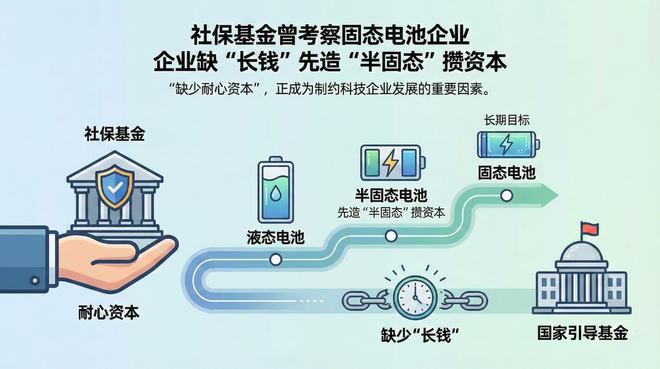
社保基金曾考察固态电池 企业因缺“长钱”先造“半固态”攒资本
Zhong Guo Jing Ying Bao· 2025-12-29 10:02
Core Viewpoint - The lack of patient capital is becoming a significant constraint on the development of technology companies, particularly in the context of critical stages of technological research and development [2] Group 1: Industry Challenges - Technology companies are more concerned about the premature exit of short-term capital than the technology itself during critical R&D phases, which can lead to funding chain disruptions and wasted investments [2] - The commercialization of solid-state batteries requires a systematic restructuring of the entire industry chain and ecosystem, which may take ten to twenty years to achieve [2][3] - Companies fear that investors may demand early exits before solid-state batteries are fully developed, jeopardizing their survival [2] Group 2: Market Strategy - To navigate these challenges, companies are opting for a "detour" strategy by initially entering the market with semi-solid batteries, which have higher technological maturity and lower requirements for existing production lines [3] - This approach allows companies to maintain market competitiveness, accumulate cash flow, and strengthen capital before fully advancing into the solid-state battery sector [3] Group 3: Capital Landscape - The lack of patient capital is a common issue faced by many Chinese technology companies, with long-term and stable capital primarily coming from pension funds and long-term life insurance funds [3] - In the primary market, both venture capital (VC) and private equity (PE) investments often require long cycles from project incubation to eventual exit, with some projects taking over ten years [4] - The current investment structure of many institutions struggles to support such lengthy investment cycles [4] Group 4: Policy Developments - The situation is expected to improve with the launch of the National Venture Capital Guidance Fund, which aims to mobilize social capital and provide stable funding for technology companies [4] - The fund will have a twenty-year lifespan, with ten years allocated for investment and another ten for exit, designed to offer more sustainable financial support for technology innovation [4]
战略科学家与耐心资本: 金融支持科技创新的机制重塑
Jin Rong Shi Bao· 2025-12-29 01:32
Core Viewpoint - The article emphasizes the importance of strategic scientists in bridging the gap between technology credit and capital investment, which is crucial for fostering a resilient and innovative economy in China. It highlights the need for a tailored technology credit system that aligns with national conditions and supports the development of patient capital [1][15]. Group 1: Role of Strategic Scientists - Strategic scientists play a critical role in reducing investment risks and optimizing capital allocation efficiency by providing authoritative endorsements that enhance the credibility of early-stage projects [2]. - They are essential in constructing a technology credit system that evaluates key nodes in the technology and industry chains, thereby addressing information asymmetry and mismatched evaluation standards [3]. - Their leadership in high-quality technology project reserves creates a positive feedback loop of "scientist credit—technology innovation—capital return," which enhances the willingness and scale of patient capital supply [3]. Group 2: Technology Credit Mechanism - Technology credit is defined as the trust established in the value of technology among the public, capital markets, and policymakers, which is essential for guiding the rational allocation of innovation capital [4]. - The lack of institutional mechanisms to effectively manifest and transmit technology credit to capital markets leads to a persistent information gap, resulting in misjudgments of high-potential technology firms as high-risk entities [4]. - Strategic scientists serve as key carriers of technology credit, transforming abstract technological potential into tangible, reliable signals that reduce investor risk assessment difficulties [4]. Group 3: Financing Characteristics of U.S. Tech Companies - The U.S. tech industry exhibits a "loss-financing" paradox, where many companies continue to receive capital despite long-term losses, supported by a capital market logic that prioritizes future potential over current profitability [6]. - Approximately 21% of tech companies that went public in 2024 were profitable, indicating a significant reliance on future expectations rather than current financial performance [6]. - The existence of "zombie unicorns," companies valued over $1 billion but failing to achieve profitability, underscores the unique financing dynamics in the U.S. tech sector [6]. Group 4: Policy Recommendations for China - Establish a "Strategic Scientist Committee" to identify and empower strategic scientists across key innovative fields, ensuring alignment with national strategic needs [12]. - Create a "Technology Credit Enhancement Fund" to provide credit backing for equity financing of projects led by strategic scientists, thereby reducing perceived risks for social capital [13]. - Develop a collaborative policy support framework that integrates finance, technology, and industry regulations to provide comprehensive support for certified strategic scientist enterprises [14].
耐心资本赋能绿色金融发展
Jin Rong Shi Bao· 2025-12-29 01:32
绿色发展是中国式现代化的鲜明底色,《中共中央关于制定国民经济和社会发展第十五个五年规划 的建议》(以下简称"'十五五'规划建议")明确提出"加快经济社会发展全面绿色转型,建设美丽中 国",而发展绿色金融是推动经济社会绿色转型的必然要求。目前,我国绿色金融的顶层设计基本形 成,绿色金融业务快速发展,根据中国人民银行统计,截至2025年三季度末,我国本外币绿色贷款余额 43.51万亿元,其中,基础设施绿色升级、能源绿色低碳转型、生态保护修复和利用为主要应用领域, 占比达74.97%,有力推动了我国经济社会的转型升级。近期,在《〈"十五五"规划建议〉辅导读本》 中,中国证券监督管理委员会主席吴清特别强调"加力培育壮大耐心资本、长期资本和战略资本",提 高"十五五"时期资本市场制度包容性、适应性。耐心资本作为一种注重长期投资、强调稳健回报的资本 形式,对于壮大绿色金融市场参与主体,为绿色金融发展提供可持续、长期、有耐心的资本具有重大意 义。 耐心资本在支持绿色金融发展方面具有天然优势 (一)从投资端来看,绿色金融领域为耐心资本提供了新的投资视角与机遇。2020年9月习近平总 书记在第七十五届联合国大会上正式宣布:"中 ...