人民币汇率

Search documents
X @Bloomberg
Bloomberg· 2025-07-27 23:25
今日必读🧪美欧协议将大部分关税定在15%💴专家建言增加人民币汇率弹性🔥特朗普以关税威胁敦促泰柬停火获取免费中文电子报《彭博财经早茶》,洞悉全球市场动态。Catch up on what's moving China's markets in our free Chinese language newsletter. https://t.co/lgpjtJwTbM ...
外汇市场供求平衡韧性足
Jing Ji Ri Bao· 2025-07-27 22:15
Core Viewpoint - The Chinese foreign exchange market is operating smoothly with a balanced supply and demand, stable foreign exchange reserves, and a resilient foreign trade environment, despite complex global conditions [1][5]. Exchange Rate Dynamics - The RMB exchange rate has shown increased two-way volatility and resilience, with the onshore RMB appreciating by 1,332 basis points and the offshore RMB by 1,796 basis points against the USD in the first half of the year [2][3]. - The USD index has decreased by 10.79% in the same period, contributing to the RMB's strength [2]. - Market analysts expect the RMB to maintain a stable range between 7.1 and 7.3 against the USD in the second half of the year, with limited potential for the RMB to break below 7 [4]. Foreign Exchange Reserves - As of June 2025, China's foreign exchange reserves reached $33,174 billion, marking a month-on-month increase of $322 billion and a continuous growth for six months [5][6]. - The increase in reserves is attributed to the depreciation of the USD and the overall rise in global financial asset prices [5]. Gold Reserves - China's gold reserves stood at 73.9 million ounces (approximately 2,298.55 tons) as of June, with a month-on-month increase of 70,000 ounces [6]. - The gold reserves represent 7.32% of the total foreign exchange reserves, which is below the global average of around 15% [6]. Cross-Border Investment Reforms - The State Administration of Foreign Exchange has proposed reforms to facilitate cross-border investment and financing, aiming to optimize the business environment and support high-quality economic development [7]. - These reforms include nine specific policies to enhance foreign exchange management and promote stable foreign investment [7]. Future Outlook - The foreign exchange market is expected to remain stable, supported by a recovering economy, balanced international payments, and enhanced market resilience [8]. - The implementation of proactive macroeconomic policies and the promotion of domestic demand are anticipated to further stabilize the RMB exchange rate [8].
如果汇率反转重回6.2,我们早就缩小了与美国GDP的差距
Sou Hu Cai Jing· 2025-07-27 19:50
Group 1 - The potential impact of a return to an exchange rate of 6.2 RMB to 1 USD could significantly reduce the GDP gap between China and the US, with China's GDP potentially increasing from 140 trillion RMB to 23 trillion USD, representing over 75% of the US GDP [1][3] - China's GDP gap with the US once peaked at 70% of global GDP, but the shift towards high-end manufacturing and technological advancements has changed the economic landscape, indicating a substantial accumulation of strength over recent years [3][5] - The transformation of China's economy from a low-cost manufacturing base to a global technology center is evident, particularly in sectors like high-speed rail, artificial intelligence, and semiconductors, showcasing China's competitive edge in international markets [5][7] Group 2 - Future GDP growth in China is expected to continue, especially with further integration into high-tech industries and international markets, potentially allowing China's GDP to approach or exceed that of the US [7][9] - The advancement of China's military-industrial complex, supported by technological progress, is enhancing its global standing across various sectors, including aerospace and cybersecurity, contributing to overall national strength [7][9] - The combination of military manufacturing and advanced technology is expected to significantly boost China's production capacity and technological reserves, enhancing its influence beyond just economic metrics [9]

2025年6月银行间外汇市场运行报告
Sou Hu Cai Jing· 2025-07-25 02:45
Group 1 - The interbank foreign exchange market showed stable trading with an average daily transaction volume of $208.2 billion in June, a year-on-year increase of 15.7% [2] - The average daily trading volume of the RMB foreign exchange market was $152.4 billion, up 8.9% year-on-year, while foreign currency trading grew over 30% [2] - The US dollar index experienced fluctuations, initially rising and then declining, ending the month at 96.77, a depreciation of 2.68% [3] Group 2 - The RMB exchange rate showed a steady increase, fluctuating between 7.17 and 7.19, with a month-end value of 7.1656, appreciating by 0.94% [4] - The CFETS RMB exchange rate index fell to its lowest level since 2021, closing at 95.35, a cumulative depreciation of 0.64% for the month [4] - The offshore and onshore exchange rates continued to align closely, with the average daily deviation being minimal [5] Group 3 - The foreign exchange market saw a shift towards net selling, with an average daily net selling of $8.51 million, an increase of $5.84 million from May [6] - The market sentiment index rose to 62.78, slightly above the historical average, indicating a stable trading environment [6] Group 4 - The implied volatility of foreign exchange options decreased, with the average daily transaction volume reaching $8.28 billion, a 6.12% increase from the previous month [7] - The short-term implied volatility for the RMB against the USD fell from 3.8% to around 3.5% [7] Group 5 - The interest rate differential between China and the US continued to narrow, with the 10-year US Treasury yield dropping to 4.23% by month-end [8] - The 1-year swap points increased to -1866 basis points, the highest in nearly eight months, indicating a shift in market dynamics [8][9] Group 6 - The US dollar liquidity remained loose, with the domestic dollar financing costs showing a clear advantage [10] - The overnight interest rate differential between domestic and foreign markets remained negative, reaching a new high of -18 basis points by month-end [11]

宏观视角看汇率
2025-07-25 00:52
Summary of Key Points from Conference Call Industry Overview - The discussion revolves around the macroeconomic perspective on exchange rates, particularly focusing on the US dollar, euro, and Chinese yuan [2][3][4]. Core Insights and Arguments 1. **Divergent Views on US Dollar**: There is a split within the US government regarding the dollar's strength. White House advisors advocate for a weaker dollar to enhance trade, while the Treasury Secretary emphasizes a strong dollar to attract capital [2][4][9]. 2. **Challenges in Exchange Rate Prediction**: Predicting exchange rates is complex due to multiple influencing factors. Even authoritative bodies like the IMF struggle to provide accurate forecasts [2][5][10][11]. 3. **Impact of Capital Flows**: Recent trends show that capital flows significantly influence exchange rates, with foreign exchange trading volumes far exceeding international trade volumes [2][8][14]. 4. **US Trade Deficit and Dollar Stability**: Despite a long-term trade deficit, the influx of foreign investment has prevented systemic depreciation of the dollar [2][15]. 5. **Foreign Investment in US Assets**: In 2023-2024, foreign investments accounted for 70% of net purchases in US equities, supporting the dollar despite high fiscal and trade deficits [2][15]. 6. **Potential for Yuan Strengthening**: The accumulation of $1.7 trillion in unconverted funds by Chinese exporters may lead to a stronger yuan, especially in the context of US debt monetization [2][17]. 7. **Market Reactions to Dollar Depreciation**: A weaker dollar is expected to benefit A-shares and Hong Kong stocks, enhancing risk appetite and liquidity in these markets [2][19]. 8. **Long-term Outlook for Global Markets**: The expectation of increased fiscal spending in the US and Europe may boost global demand and investment, positively impacting stock markets and commodities [2][19]. Additional Important Content 1. **Complex Interactions Among Currencies**: The interplay between major currencies is intricate, with recent trends showing the yuan's rise, the dollar's rebound, and the euro's slight weakening [3][7]. 2. **The Role of Theoretical Perspectives**: Different economic theories (e.g., classical vs. Keynesian) provide varying insights into the factors influencing exchange rates, highlighting the need for a comprehensive approach [10][11]. 3. **Current Trends in Currency Behavior**: The yuan's recent appreciation against the dollar is not indicative of a clear upward trend, as market dynamics remain complex and influenced by various factors [22][23]. 4. **Implications for Exports**: The yuan's appreciation against the dollar has a limited negative impact on overall exports, supported by adjustments in a basket of currencies [20][23]. 5. **Future of US Debt and Monetary Policy**: The US may adopt measures to manage increasing debt levels, potentially leading to a sustained pressure on the dollar in the medium to long term [18][19]. This summary encapsulates the key points discussed in the conference call, providing insights into the current state and future outlook of the currency markets and their implications for various stakeholders.
人民币对美元汇率盘中创近9个月新高,汇率韧性将会延续
Sou Hu Cai Jing· 2025-07-24 12:52
7月24日,中国人民银行授权中国外汇交易中心公布,当日银行间外汇市场人民币汇率中间价为1美元对 人民币7.1385元,相较前一交易日中间价7.1414元调升29个基点。人民币对美元中间价连续三个交易日 升值,续创2024年11月以来高点。 连续几日升值后,人民币汇率创阶段性升值高点。7月24日,人民币中间价连续第三个交易日升值,单 日调升29基点报7.1385,在岸人民币、离岸人民币对美元汇率盘中同步走高,一度收复7.15关口,三大 人民币汇率报价均创下2024年11月以来升值高点。对于下阶段人民币汇率表现,有分析人士指出,在经 济基本面形成有效支撑、稳汇率工具会适时出手的前景下,人民币汇率韧性将会延续。 人民币汇率创阶段高点 连平指出,当前人民币处于升值阶段,我国降息存在一定的窗口期。建议货币政策持续释放人民币汇率 稳定的预期,运用工具箱内的各种工具,保持人民币汇率在合理均衡水平上的基本稳定。加快步伐发展 离岸人民币市场和在岸人民币离岸金融体系,在保持人民币汇率基本稳定的同时,稳慎推进人民币国际 化。 在王青看来,中美经贸对话磋商进展、美元走势以及国内宏观政策的节奏和力度,都会影响人民币汇 率,而未来国内宏 ...
张斌:应当设定人民币兑美元的波动区间 重点守住下限
Sou Hu Cai Jing· 2025-07-24 08:43
Core Viewpoint - The article discusses the 20th anniversary of the RMB exchange rate reform, highlighting the shift from a fixed exchange rate to a managed floating exchange rate system based on market supply and demand, referencing a basket of currencies [1][3]. Exchange Rate Reform - The RMB exchange rate reform, known as "7·21," was implemented on July 21, 2005, transitioning from a single peg to the US dollar to a more flexible system [1]. - Since the reform, the People's Bank of China has gradually increased the daily fluctuation range of foreign exchange trading prices and reduced intervention in the exchange rate, enhancing the market's role in the formation of the exchange rate [1]. RMB Exchange Rate Trends - A report by the China Financial Forty Forum (CF40) analyzes the RMB exchange rate's fundamentals, valuation, and potential in the context of current foreign exchange management policies and the internationalization strategy of the RMB [3]. - From 2005 to early 2022, the RMB's real effective exchange rate appreciated nearly 60%, aligning with the faster productivity growth of China's trading partners [3]. - However, since 2022, despite rapid industrial upgrades and increasing export competitiveness, the RMB's real effective exchange rate has depreciated by over 15% [3][6]. Determinants of RMB Exchange Rate - The determinants of the RMB exchange rate include external forces (global financial market risk appetite and the US dollar index), domestic market forces (improvements in economic expectations), and domestic policy influences [4][5]. - The correlation between the RMB exchange rate and the US dollar index is significant but lower than that of developed countries' currencies [4]. Domestic Policy Impact - Since 2017, China's foreign exchange reserves have stabilized, indicating a reduced intervention by monetary authorities in managing the RMB exchange rate [5]. - The alignment of the RMB's central parity and spot exchange rate from 2017 to 2022 suggests a move towards a more flexible floating exchange rate system [5]. Demand Insufficiency - Demand insufficiency is identified as the primary reason for the RMB's continued depreciation since 2022, leading to low price levels and asset valuation [6]. - The low inflation and weak asset price expectations resulting from demand insufficiency reflect a market failure, causing an undervaluation of the RMB's real exchange rate [6]. Recommendations for Exchange Rate Management - To address the current situation, it is suggested to establish a wide fluctuation range for the RMB against the US dollar to prevent excessive distortion of the exchange rate [7]. - The implementation of this intervention should be firm, with strict penalties for actions that breach set limits, ensuring that market participants do not easily challenge the established boundaries [7].

外资交易台:若美国关税阻力加剧,中国出口将何去何从?
2025-07-24 05:04
Summary of Conference Call on Chinese Exports and US Tariffs Industry Overview - The discussion centers around the impact of rising US tariffs on Chinese exports and the potential rerouting of trade to other markets, particularly in the context of ongoing trade frictions between the US and China [1][2][3]. Key Points 1. **Resilience of Chinese Exports**: Despite an increase in the US effective tariff rate from approximately 10% to around 40%, Chinese exports have shown resilience, with overall exports up 6% year-on-year as of May and June 2025. This resilience is attributed to trade rerouting to other countries, particularly ASEAN markets [1][6][7]. 2. **Trade Rerouting Dynamics**: The pattern of Chinese exports indicates a 'see-saw' effect, where a decline in US-bound exports corresponds with a significant rise in exports to other markets. This suggests that while exports to the US have returned to 2019 nominal levels, overall export volumes remain robust [2][10][11]. 3. **Overcapacity Issues**: China's overcapacity remains a critical concern, with estimates indicating that Chinese production capacity exceeds global demand in several sectors: 149% for solar modules, 126% for lithium batteries, 113% for construction machinery, 108% for air conditioners, and 105% for electric vehicles as of 2024. This overcapacity is deeply rooted in China's fiscal and political systems, making it challenging to address quickly [15][16][18]. 4. **Impact on Global Economies**: The rerouting of Chinese exports is expected to create headwinds for manufacturing activities in other economies, particularly in Europe, and may lead to lower goods inflation outside the US. Each 1 percentage point increase in imports from China as a share of goods consumption is estimated to lower goods inflation by approximately 80 basis points [3][6][21]. 5. **Vulnerability of Other Economies**: Vietnam is identified as the most vulnerable to potential US tariffs on transshipment of goods from China, with about one-third of its total imports coming from China. Other countries like the Philippines, Korea, and Taiwan also face significant exposure to transshipment risks [4][19]. 6. **Concerns Over Anti-Dumping Actions**: Chinese companies are increasingly worried about the acceleration of anti-dumping actions in Europe, particularly in the UK. The emphasis on service and aftermarket support in Europe poses challenges for Chinese firms, especially in sectors like batteries and electrical equipment [5][34]. Additional Insights - **Current Account Surplus**: The ongoing trade rerouting is likely to contribute to a continued upside surprise in China's current account surplus, which is a key factor supporting a constructive outlook on the RMB in the medium term [3][18]. - **Sector-Specific Growth**: Certain sectors, particularly capital goods, have outpaced overall export growth, indicating a shift in competitive dynamics and market opportunities for Chinese manufacturers [32][34]. - **Long-Term Outlook**: While immediate trade rerouting may provide temporary relief, the long-term sustainability of this strategy remains uncertain, with potential payback effects anticipated in the coming months [10][11]. This summary encapsulates the critical insights from the conference call regarding the state of Chinese exports amid rising US tariffs and the broader implications for global trade dynamics.
分析人士:人民币汇率的稳健表现是内外因素交织作用的结果
news flash· 2025-07-23 22:21
在美元指数年内大幅波动、跌逾10%的背景下,人民币对美元汇率在双向浮动中彰显韧性,呈现"稳中 偏强"格局,截至7月23日,较年初升值近2%,并保持基本稳定。分析人士普遍认为,人民币汇率的稳 健表现是内外因素交织作用的结果,其中内生动力是根本。在经济基本面形成有效支撑、稳汇率工具将 适时出手的前景下,人民币汇率的韧性将会延续。(上证报) ...
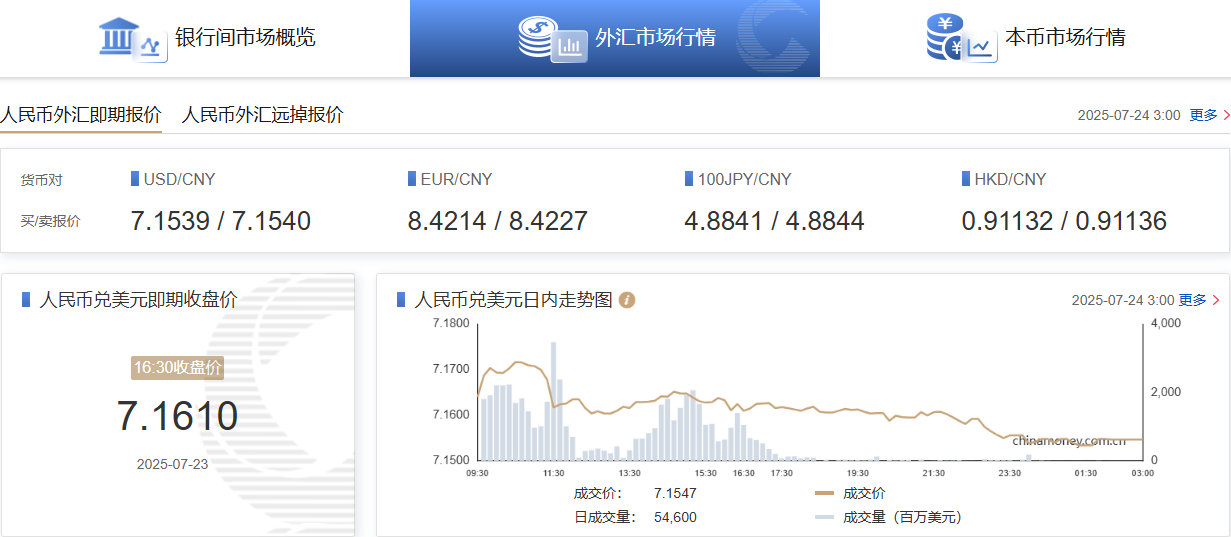
在岸人民币兑美元(CNY)北京时间03:00收报7.1547元,较周二夜盘收盘涨148点。成交量546.00亿美元。
news flash· 2025-07-23 19:13
在岸人民币兑美元(CNY)北京时间03:00收报7.1547元,较周二夜盘收盘涨148点。成交量546.00亿美元。 ...