
美联储缩表

Search documents
美联储9月议息会议点评:点阵图的重大分歧或值得关注
Guolian Minsheng Securities· 2025-09-19 12:41
Group 1: Federal Reserve Actions - The Federal Reserve lowered the policy interest rate by 25 basis points in September 2025, bringing the target range to 4%-4.25%[4] - The market had anticipated a 25 basis point cut with a probability of 96.1% prior to the meeting[7] - This marks a total of 125 basis points cut in the current cycle, with four reductions since the beginning of the cycle[16] Group 2: Divergence in Dot Plot - The dot plot indicates a widening divergence among committee members regarding future rate cuts, with 9 members supporting 2 more cuts this year, while 6 members believe there should be no further cuts[8] - One member suggested a reduction to below 3%, implying a need for cuts exceeding 50 basis points in the next two meetings[8] - The voting showed one dissenting vote, with Stephen I. Miran advocating for a 50 basis point cut instead of 25[28] Group 3: Economic Outlook - The Fed slightly raised its GDP growth forecast for 2025 to a median of 1.6% while maintaining the unemployment rate at 4.5%[9] - Inflation expectations for 2026 were slightly adjusted upward, with the Fed showing more tolerance for deviations from the 2% inflation target[9] - The Fed's statement highlighted a weakening job market as a significant reason for the rate cut, reflecting concerns over employment risks[10] Group 4: Market Reactions - Following the announcement, the Dow Jones increased by 0.57%, while the S&P 500 and Nasdaq fell by 0.1% and 0.33%, respectively[4] - Short-term Treasury yields declined, with the 3-month yield dropping by 2 basis points[30] - The dollar index showed volatility, initially falling before rebounding by the close of trading[30]
花旗:美联储的焦点政策,不只是降息,还有缩表
美股IPO· 2025-09-17 23:28
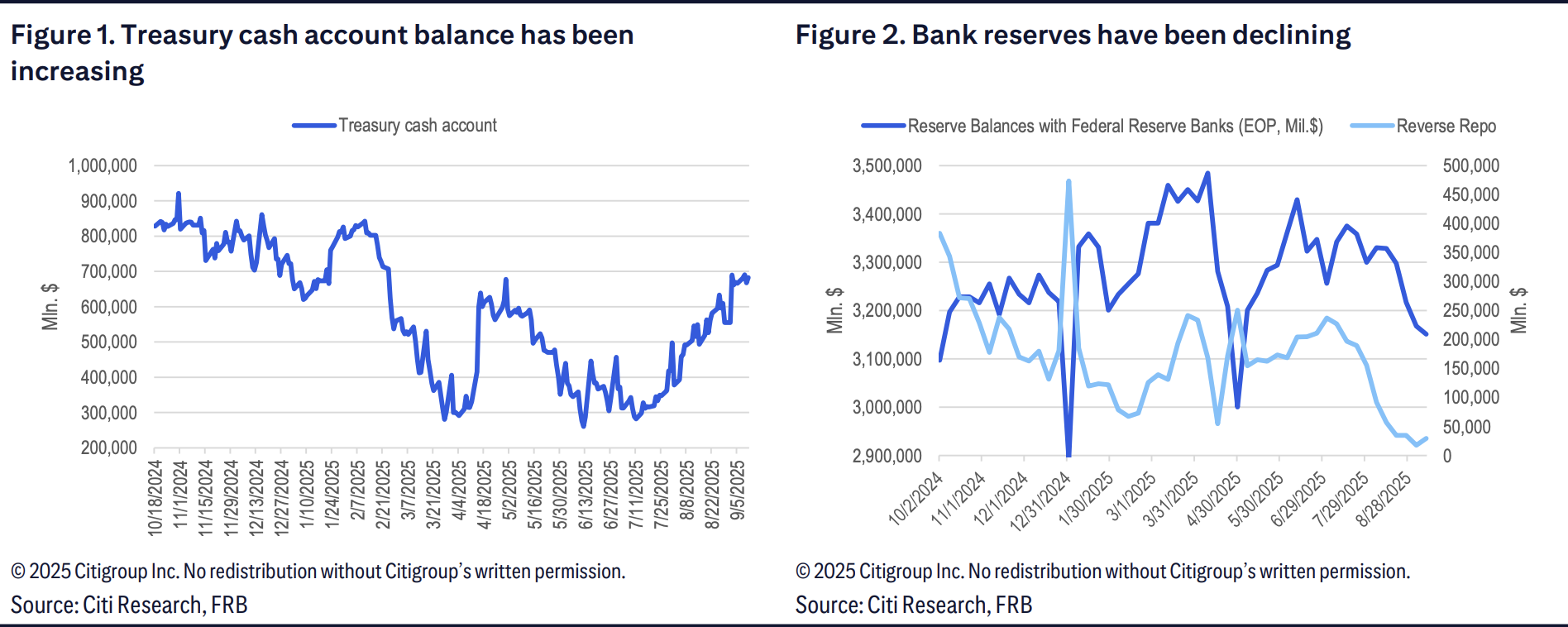
Core Viewpoint - Citigroup indicates that as the U.S. Treasury rebuilds its cash account, the reverse repo balance is being consumed, leading to a decline in bank reserves and increased pressure in the repo market, which may prompt Federal Reserve officials to discuss the balance sheet issue in their upcoming meeting [1][3][9] Group 1: Federal Reserve's Balance Sheet Reduction - The Federal Reserve's balance sheet reduction is nearing its final phase, with signs of liquidity tightening in the market [3][9] - According to Citigroup, the Fed's holdings of Treasury securities have decreased from approximately $5.8 trillion to $4.2 trillion, and mortgage-backed securities (MBS) have dropped from about $2.7 trillion to $2.1 trillion [4] - The Fed's balance sheet liabilities have shifted liquidity from reverse repos and bank reserves to the U.S. Treasury cash account, which has increased to about $680 billion and is expected to rise to around $850 billion [4][6] Group 2: Repo Market Pressure - As the reverse repo balance approaches zero, additional liquidity flowing into the Treasury cash account will primarily come from bank reserves, which are expected to decline to approximately $2.8 to $2.9 trillion by year-end [6] - The Secured Overnight Financing Rate (SOFR) has been above the Interest on Reserve Balances (IORB) for most of September, exceeding IORB by 11 basis points recently, indicating rising repo market pressure [6][8] - Despite the increased pressure in the repo market, the effective federal funds rate remains relatively stable, with a slight risk of rising in relation to reverse repo rates in the coming months [8] Group 3: Implications for Investors - Citigroup expects that if repo market pressures persist, the Federal Reserve may end its balance sheet reduction by the end of the year, although a specific timeline may not be immediately announced [9] - The change in the Fed's balance sheet reduction pace could impact short-term interest rate markets and the yield curve, potentially stabilizing market liquidity and supporting risk assets while exerting downward pressure on short-term rates [9]



美联储的焦点政策:不只是降息,还有缩表
Hua Er Jie Jian Wen· 2025-09-17 13:00
Core Viewpoint - The Federal Reserve's balance sheet reduction plan may soon enter its final phase, with discussions on ending the tapering timeline expected in upcoming meetings due to signs of liquidity tightening in the market [1][7]. Group 1: Balance Sheet Reduction - The Federal Reserve's balance sheet has been shrinking, with holdings of U.S. Treasuries decreasing from approximately $5.8 trillion to $4.2 trillion, and mortgage-backed securities (MBS) dropping from about $2.7 trillion to $2.1 trillion [2]. - The liquidity has shifted from reverse repos and bank reserves to the U.S. Treasury cash account, which has increased to around $680 billion and is projected to rise to about $850 billion in the coming weeks [2][5]. Group 2: Market Pressure Signals - The overnight secured financing rate (SOFR) has been above the interest on reserve balances (IORB) for most of September, exceeding it by 11 basis points recently, indicating rising pressure in the repo market [1][5]. - As reverse repo balances approach zero, additional liquidity flowing into the Treasury cash account will primarily come from bank reserves, which are expected to decline to approximately $2.8 to $2.9 trillion by year-end [5]. Group 3: Future Expectations - Citigroup anticipates that if repo market pressures persist, the Federal Reserve may conclude its balance sheet reduction by the end of this year, although a specific timeline has yet to be determined [1][7]. - The current market pressure is relatively mild compared to the 2018-2019 period, suggesting that the Federal Reserve is better prepared to address liquidity issues, which may lead to a smoother policy transition [7].
流动性危机的苗头初现,美联储缩表可能很快收官?
Jin Shi Shu Ju· 2025-09-03 01:37
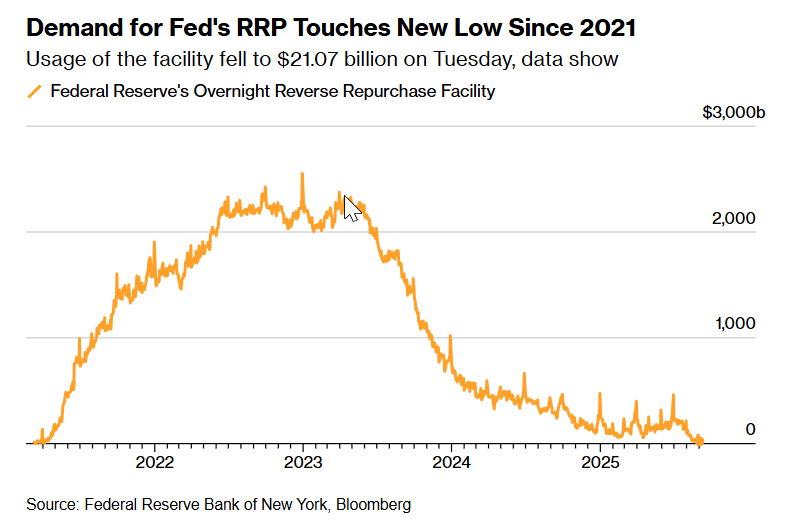
Group 1 - The demand for the Federal Reserve's overnight reverse repurchase agreement (RRP) tool has dropped to its lowest level in over four years, with 17 participants depositing a total of $21.07 billion [1] - The usage of the RRP tool has decreased significantly from approximately $460 billion at the end of June to the current levels, indicating a trend of declining liquidity in the financing market [3] - The balance of the RRP tool is approaching zero, which could lead to a loss of funds from bank reserves, a critical buffer for market stability [7] Group 2 - The current balance of bank reserves remains at $3.2 trillion, indicating that liquidity is still in a comfortable range despite the pressures from the declining RRP balance [7] - The Federal Reserve's asset balance is currently at $6.6 trillion, and any further liquidity scarcity may necessitate a halt to its long-standing balance sheet reduction process [8] - Market volatility in September may exert upward pressure on money market rates, potentially impacting liquidity, even as the Fed has slowed its monthly balance sheet reduction pace [8]
潜在美联储主席候选人洛根放风:缩表仍有空间,9月货币市场恐再临考验
智通财经网· 2025-08-25 22:53
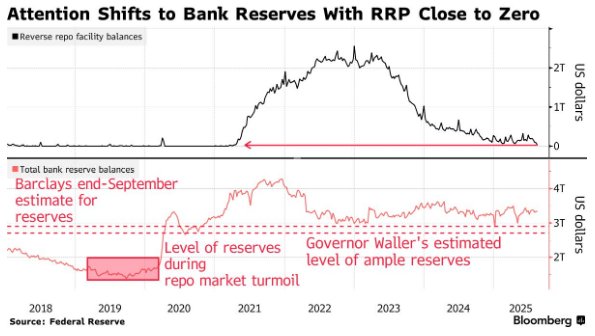
Core Viewpoint - The Dallas Fed President Logan indicated that the money market may face temporary pressures around the end of next month, despite the Fed having room to continue reducing its balance sheet [1][2] Group 1: Monetary Policy and Market Conditions - Logan mentioned that temporary pressures might be observed during the September tax date and quarter-end, which could lead investors to utilize the Fed's overnight liquidity tools again, similar to June [1] - Since 2022, the Fed has been reducing its balance sheet to lower reserves to a more efficient level, reversing previous asset purchases made to stimulate the economy during the pandemic [1] - Currently, bank reserves are approximately $3.3 trillion, with the estimated minimum sufficient level around $2.7 trillion according to Fed Governor Christopher Waller [1] Group 2: Repo Market and Interest Rates - Logan noted that the average repo market rates have been about 8 basis points lower than the interest rate paid on bank reserves by the Fed in recent months, indicating more room to reduce reserves [2] - She emphasized the importance of continuing to provide upper limit tools while encouraging market participants to use them when economically attractive [2] Group 3: Fed Communication and Policy Review - Logan expressed satisfaction with the Fed's framework review but acknowledged that there is still work to be done in improving communication methods [2] - She suggested that adjustments may be needed for the Summary of Economic Projections (SEP) to avoid overemphasizing the median while neglecting diverse viewpoints [2]
市场“余钱”耗尽?美联储隔夜逆回购跌破300亿,创四年新低
Jin Shi Shu Ju· 2025-08-15 00:40
Group 1 - The scale of funds parked in the Federal Reserve's overnight reverse repurchase agreement (RRP) tool has dropped to its lowest level in over four years, raising market concerns about the cash held by banks at the Fed, which is a key indicator of liquidity conditions [1] - As of Thursday, 14 participating institutions had a total of $28.8 billion in the RRP, marking the lowest level since April 2021, with the number of bidding institutions also at its lowest since then [1] - The usage of the RRP tool has been declining as the U.S. Treasury issues more short-term debt to cover its growing deficit, drawing cash away from this critical backup funding source [1] Group 2 - Analysts estimate that by the end of August, RRP usage could approach zero, defining "exhaustion" as a range of $0 to $20 billion [2] - With the RRP balance nearing zero, there is little buffer left for banks, making reserves a focal point for market observation [2] - Since June 2022, the Federal Reserve has been reducing its bond holdings, with a slowdown in the pace of balance sheet reduction observed in April [2] Group 3 - Federal Reserve Governor Waller indicated that the Fed should be able to reduce bank reserve levels to around $2.7 trillion without putting pressure on bank reserves [3]
美联储隔夜逆回购余额骤降至四年新低,流动性关键缓冲濒临“枯竭”
智通财经网· 2025-08-14 23:43
Core Viewpoint - The balance of a key Federal Reserve tool, the overnight reverse repurchase agreement (RRP), has dropped to its lowest level in over four years, raising concerns about liquidity in the U.S. banking system [1][2]. Group 1: RRP Tool Usage - 14 participating institutions deposited a total of $28.8 billion through the RRP on Thursday, marking the lowest balance since April 2021 [1]. - The RRP tool is primarily used by banks, government-sponsored enterprises, and money market funds to earn interest by lending to the central bank [1]. - The usage rate of the RRP tool is declining due to the U.S. Treasury issuing more short-term bonds to cover a growing deficit, leading to a reduction in cash reserves [1][2]. Group 2: Impact on Bank Reserves - The balance of bank reserves remains stable at approximately $3.3 trillion, indicating that reserves are still in a comfortable range [3]. - Analysts predict that total reserves could drop below $3 trillion by mid-September and below $2.9 trillion by the end of September, excluding the impact of RRP changes [3]. - Federal Reserve officials have indicated that they could reduce bank reserve levels to around $2.7 trillion without causing stress to the banking system [3]. Group 3: Market Implications - As the RRP balance approaches zero, bank reserves will become a focal point for market observers, particularly regarding the extent to which reserves can decline before the Fed halts its balance sheet reduction [2]. - The reduction in RRP balances is expected to limit the buffer available to banks, potentially impacting market stability [2].
美欧日央行暂时进入观望期——全球货币转向跟踪第8期
一瑜中的· 2025-08-06 16:04
Global Monetary Policy Tracking - The major central banks of the US, Eurozone, and Japan have maintained their interest rates unchanged as of July 2025, with the Federal Reserve holding rates at 4.25%-4.5% [2][12] - The expectation for rate cuts in the US has decreased, with the anticipated number of cuts dropping from nearly 3 in early July to less than 2 by the end of July, and the probability of a September cut falling from 90% to about 40% [3][19] - In the Eurozone, the expectation for a rate cut has also cooled, with the probability of a September cut decreasing from 42% to approximately 10% [3][19] - Japan's central bank has maintained its policy rate unchanged for the fourth consecutive time, with inflation expectations being revised upwards [3][15] Global Liquidity Tracking - The Federal Reserve's balance sheet has contracted, with reserves shrinking by $57.7 billion since the beginning of the tapering process, and a monthly reduction of $47.6 billion in July 2025 [4][27] - The liquidity in the non-bank sector is tightening, as indicated by the frequent positive spread between SOFR and EFFR rates, reflecting a significant liquidity squeeze in non-bank institutions [4][30] - The liquidity premium in the US dollar market remains elevated, with the Libor-OIS spread maintaining a high level, indicating that liquidity is still ample despite some tightening [6][40] Credit Risk Premium - Since July 2025, the OAS of US high-yield credit bonds and the CDS prices for high-yield and investment-grade bonds have seen a slight increase, indicating a rise in credit risk premium [9][45] - In contrast, CDS prices for credit bonds in Europe, Japan, and Asia remain low, suggesting a relatively stable credit environment outside the US [9][45]

全球货币转向跟踪第8期:美欧日央行暂时进入观望期
Huachuang Securities· 2025-08-06 04:43
Group 1: Global Monetary Policy Overview - The major central banks of the US, Eurozone, and Japan have maintained their interest rates unchanged as of July 2025, with the Federal Reserve holding rates at 4.25%-4.5%[2] - In July 2025, 4 out of 26 tracked economies reduced interest rates, down from 6 in June 2025[2] - The European Central Bank (ECB) paused its rate cuts after seven consecutive reductions, while the Bank of Japan has also kept its policy rate unchanged for the fourth consecutive time[2] Group 2: Interest Rate Expectations - The Federal Reserve's expectation for rate cuts has cooled, with the anticipated number of cuts for the year dropping from nearly 3 in early July to less than 2 by the end of July[3] - The probability of a rate cut in September for the Federal Reserve decreased from 90% to about 40% but rebounded to nearly 90% in early August due to significant downward revisions in US non-farm payroll data[3] - The ECB's rate cut expectations fell from a forecast of one more cut in July to no cuts by the end of July, with September cut probability dropping from 42% to approximately 10%[3] Group 3: China's Interest Rate Position - China's nominal interest rate increased slightly, leading to a rise in real interest rates from 3% in June to 3.1% in July 2025, placing it at the 69th percentile historically since 2014[3] - China's real interest rate ranking among 13 major economies has dropped to 10th place in 2025, down from 11th in 2024[3] Group 4: US Federal Reserve's Balance Sheet and Liquidity - As of July 30, 2025, the Federal Reserve's reserves have shrunk by $57.7 billion compared to pre-tightening levels, with a monthly reduction of $47.6 billion in July[4] - The use of the discount window has increased, indicating potential liquidity stress among some smaller banks[4] - The SOFR-EFFR spread has frequently turned positive since 2025, reflecting tightening liquidity conditions for non-bank institutions[5] Group 5: Global Financial Market Liquidity - The bid-ask spread for US 10Y Treasuries has increased, indicating tighter supply-demand conditions, with the spread at the 66th percentile historically since 2001[6] - Credit spreads for high-yield bonds in the US have slightly widened since July, while spreads in Japan, Europe, and Asia remain low[6]
美联储7月议息会议点评:何时降息的分歧扩大
Guolian Minsheng Securities· 2025-08-01 03:26
Group 1: Federal Reserve's Interest Rate Decision - The Federal Reserve maintained the policy interest rate at 4.25%-4.5% during the July 2025 meeting, aligning with market expectations[4] - There was a notable division regarding future rate cuts, with 2 dissenting votes advocating for a 25 basis point cut[8] - Market expectations for rate cuts in 2025 have become more uncertain, with the probability of 2 or more cuts dropping from 67% to 50%[8] Group 2: Economic Indicators - The U.S. economy showed resilience, with a robust job market and moderate inflation pressures, allowing the Fed to remain cautious[11] - The actual GDP growth for the first half of 2025 averaged 1.3%, slightly above the Fed's median forecast of 1.4%[21] - Inflation data for June indicated a year-on-year CPI increase of 2.7%, slightly above expectations, while core CPI rose by 2.9%[42] Group 3: Market Reactions - Following the Fed's decision, major stock indices showed mixed results, with the Dow Jones down 0.38% and the Nasdaq up 0.15%[15] - U.S. Treasury yields increased, with the 2-year yield rising by 8 basis points and the 10-year yield by 4 basis points[31] - Most sectors in the S&P 500 declined, particularly materials, real estate, and energy, while utilities and information technology saw slight gains[35]