量化紧缩(QT)

Search documents
【真灼港股名家】经济增长乏力 英伦银行QT步伐却放慢
Sou Hu Cai Jing· 2025-09-16 10:08
Core Viewpoint - The Bank of England (BoE) is expected to maintain its key interest rate at 4% during the upcoming monetary policy meeting, while also slowing down its plan to reduce government bond holdings due to rising bond yields and economic challenges [1][2]. Group 1: Monetary Policy - The BoE lowered its key interest rate from 4.25% to 4% last month, continuing a gradual easing cycle that began in August 2024 to address economic slowdown following inflation spikes in 2022 [1]. - The BoE's current strategy involves a cautious and gradual approach, with rate cuts of 25 basis points every three months [1]. - There are indications that the BoE may not lower rates in the upcoming meetings in November or December, as four out of nine members of the monetary policy committee voted against a rate cut last month [1]. Group 2: Quantitative Tightening (QT) - The BoE is expected to slow down the pace of its quantitative tightening, having reduced its government bond holdings by £100 billion over the past 12 months, bringing the total from a peak of £895 billion to £586 billion by the end of August [2]. - The market anticipates that the QT pace will significantly slow to approximately £70 billion, as rising bond yields have increased government borrowing costs [2]. - The BoE's approach to reducing bond holdings primarily involves allowing bonds to mature without reinvestment, with some active sales, which differs from the strategies employed by the Federal Reserve and the European Central Bank [2].


“央行超级周”来了--这36小时交易员要“连轴转”了
美股IPO· 2025-09-14 11:00
Core Viewpoint - The upcoming "Central Bank Super Week" will see major central banks, including the Federal Reserve and the Bank of Canada, announce interest rate decisions, with expectations of a 25 basis point rate cut from the Fed to address a weakening labor market and respond to calls from the White House [1][3][4]. Group 1: Federal Reserve's Rate Decision - The Federal Open Market Committee (FOMC) is anticipated to announce a 25 basis point rate cut, marking the first reduction since Trump's second term began, influenced by pressure from the White House and signs of labor market weakness [4][5]. - Economic data, including retail sales and unemployment claims, will be critical indicators leading up to the Fed's decision, with expectations of a 0.3% increase in retail sales for August [5]. Group 2: Global Central Bank Actions - The Bank of England is likely to maintain its benchmark rate at 4%, focusing on its quantitative tightening plans amid recent market volatility [6]. - The Bank of Japan is expected to keep rates unchanged, signaling no immediate tightening actions despite a path towards policy normalization [6]. - The Bank of Canada is projected to follow the Fed's lead with a rate cut, reducing its overnight rate to 2.5% due to disappointing employment data and economic contraction [6]. Group 3: Emerging Markets Central Banks - Most emerging market central banks, including those in Indonesia, Brazil, and South Africa, are expected to adopt a cautious stance and maintain current interest rates, with Brazil's rate likely remaining at a 19-year high of 15% [7].

海外债市系列之六:海外央行购债史:美联储篇
Guoxin Securities· 2025-09-11 15:09
Report Industry Investment Rating - Not provided in the given content Core View - Similar to the Bank of Japan, the Fed's bond - buying policy was initially a tool for liquidity adjustment. In 2008, the sub - prime mortgage crisis led to systemic financial risks and exhausted traditional interest - rate cut space, prompting the Fed to turn to QE. In 2020, the COVID - 19 outbreak restarted QE. In the short term, the impact of the QE policy on Treasury yields evolves more through investors' expectations, while in the long term, the US QE significantly affects long - term Treasury yields. Large - scale bond purchases provide liquidity to the financial market and drive down interest rates to some extent [1][66]. Summary by Different Stages First Stage (Before 2008): Traditional Monetary Policy Tool for Providing Liquidity - **Macro Background and Policy Objectives**: To meet the continuous expansionary demand for base money, the Fed used open - market operations (permanent and temporary) to control the money supply and influence interest rates. Asset purchases mainly supported currency issuance, while repurchase transactions smoothed liquidity disturbances [14][15]. - **Bond - buying Method**: One - way purchases in the primary and secondary markets. The Fed usually conducted weekly bond - buying operations in the secondary market through the SOMA. From 2004 - 2006, it carried out 40, 24, and 39 cash - bond transactions respectively, with average single - time increases of $1.28 billion, $1.04 billion, and $0.92 billion [20]. - **Impact on the Bond Market**: The Fed's bond - buying had a relatively limited impact on the bond market as its core goal was to limit the impact on normal market functions and the purchase scale was generally small. US Treasury yields were mainly determined by market expectations of future economic growth, inflation, and policy rates [38]. Second Stage (2008 - 2014): Quantitative Easing after the Sub - prime Mortgage Crisis - **Macro Background and Policy Objectives**: The 2008 sub - prime mortgage crisis led to a liquidity crisis. The Fed implemented QE to stabilize the financial and real - estate markets, lower long - term interest rates, and stimulate the economy by purchasing assets and expanding its balance sheet [39][40]. - **Bond - buying Method**: Continuous purchases in the secondary market. The QE process included three rounds and a twist operation. QE1 (2008.11 - 2010.3) had a total scale of $1.725 trillion; QE2 (2010.11 - 2011.6) involved buying $600 billion of long - term Treasuries; the twist operation (2011.9 - 2012.12) sold short - term Treasuries and bought an equal amount of long - term Treasuries; QE3 (2012.9 - 2014.10) was an open - ended plan. The Fed started tapering in 2013 [41][44]. - **Impact on the Bond Market**: The actual bond - buying operations had inconsistent effects on bond yields. After the QE policy was introduced, the bond market traded more based on investors' expectations. In the long run, the QE policy significantly reduced US bond yields. From October 2008 to October 2014, the yields of 1 - year and 10 - year Treasuries dropped by 124BP and 166BP respectively [47][48]. Third Stage (2015 - 2018): Difficult Exploration of Normalization - **Macro Background and Policy Objectives**: With the US economy's moderate recovery, the Fed aimed to exit the ultra - loose policy through passive balance - sheet reduction to avoid asset price bubbles and financial risks [49][50]. - **Bond - buying Method**: No reinvestment after bond maturity. The Fed raised interest rates 9 times from the end of 2015 to the end of 2018 and started QT in October 2017, gradually reducing its bond holdings [51][52]. - **Impact on the Bond Market**: After the QT policy was implemented, US Treasury yields continued to rise. It is believed that balance - sheet reduction increased Treasury yields as it meant less demand for US Treasuries and occurred during the late stage of the interest - rate hike cycle [55]. Fourth Stage (2019 - 2022): Unprecedented Response to the Pandemic - **Macro Background and Policy Objectives**: The COVID - 19 outbreak in 2020 led to an economic slowdown and market panic. The Fed launched an "unlimited QE" to start the crisis - response mode [56][57]. - **Bond - buying Method**: Unlimited QE - Taper - Balance - sheet reduction. The Fed cut interest rates to zero in March 2020, launched a $700 billion QE plan, and then an "unlimited QE". It started tapering in November 2021 and planned to end QE in mid - 2022. Balance - sheet reduction started in May 2022 [58][60][61]. - **Impact on the Bond Market**: After the "unlimited QE" was announced, US bond yields declined. However, due to factors such as investors' expectations and economic fluctuations, the ultimate impact of the Fed's bond - buying was limited. In 2022, the Fed's bond - buying failed to lower bond yields [63][65].
高盛交易员的市场观察:这个夏天真正的主角是中国股市
美股IPO· 2025-08-31 01:54
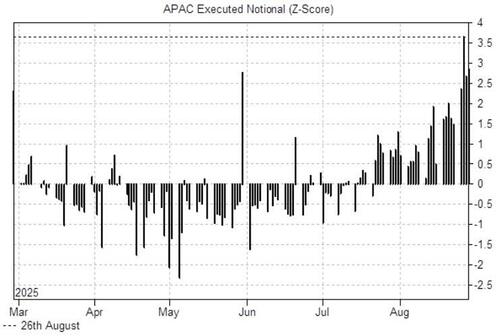
Group 1 - The core viewpoint is that the Chinese stock market has become an unexpected highlight in the summer of 2025, outperforming expectations with the Shanghai Composite Index breaking a ten-year high and retail investor financing nearing the peak levels of 2015 [1][2][5] - The Chinese stock market remains undervalued with a low holding ratio, while trading momentum continues to strengthen, potentially creating a self-reinforcing effect [3][5] - The A-share market has seen a record of 12 consecutive days with trading volumes exceeding 20 trillion yuan, marking the longest historical record, and Goldman Sachs' Asia-Pacific business recorded its largest single-day trading volume this week [3] Group 2 - In the U.S. market, the expectation of interest rate cuts has become a key driver for stock market increases, with an 85% probability of the Federal Reserve starting to cut rates in September [4] - Despite a 4.8% year-on-year growth in S&P 500 companies' Q2 revenues, sales growth has slowed when adjusted for exchange rates, particularly among small and medium-sized companies [4] - The European market has experienced structural changes this summer, with the risk premium gap between core and peripheral countries narrowing, particularly between Italian BTPs and French OATs [6]


高盛交易员的市场观察:这个夏天真正的主角是中国股市
Hua Er Jie Jian Wen· 2025-08-30 08:51
Group 1: Chinese Stock Market - The Chinese stock market has significantly outperformed expectations this summer, becoming one of the most surprising trading opportunities in the market [1][2] - The market remains undervalued with low net long positions, while trading momentum continues to strengthen, potentially creating a self-reinforcing effect [2][4] - The Shanghai Composite Index has reached a 10-year high, and retail investor financing balances are nearing the peak levels seen during the 2015 market bubble [2][4] Group 2: U.S. Stock Market - The expectation of interest rate cuts has been a key driver for the U.S. stock market's rise, with an 85% probability that the Federal Reserve will begin cutting rates in September [5] - Despite a 4.8% year-over-year revenue growth for S&P 500 companies in Q2, sales growth has slowed when adjusted for exchange rates, particularly for small-cap companies [5] - Managing liquidity risk will be crucial for both the Federal Reserve and investors as the year progresses, especially with the potential end of quantitative tightening (QT) in October [5] Group 3: European Market - There has been a structural change in the European market this summer, with the risk premium between core and peripheral countries narrowing, particularly between Italian BTPs and French OATs [6][7] - Political instability in Europe adds uncertainty to the market, with potential risks from political events in France and the Netherlands [7] - European bank stocks have risen by 52% this year, prompting investors to consider how to protect their gains amid changing political and interest rate conditions [7]
美联储隔夜逆回购工具几近枯竭 短期利率控制能力或承压
智通财经网· 2025-08-27 07:08
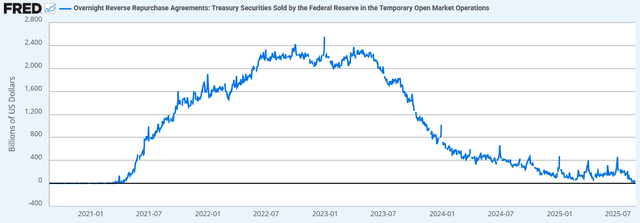
Core Points - The Federal Reserve maintains the Overnight Reverse Repurchase Agreement (RRP) as part of its open market operations, allowing non-bank entities to store cash in exchange for a set interest rate [1] - The usage of RRP peaked at $2.5 trillion at the end of 2022 but has since declined over 95% to a recent low of $22 billion [1] - The decline in RRP usage indicates a shift in liquidity management, with the U.S. Treasury issuing more short-term bonds to cover deficits, drawing funds away from RRP [3] Group 1 - The Federal Reserve still holds $3.3 trillion in reserves, down from a peak of $4.2 trillion in 2022, despite the reduced RRP usage [4] - The low RRP usage suggests that short-term interest rates will be more market-driven, potentially leading to greater volatility during tax payment periods and quarter-ends [5] - The depletion of RRP and the Treasury's bond issuance will directly consume bank reserves, which are crucial for market stability and the pace of the Fed's balance sheet reduction [5] Group 2 - The proposed "Fiscal Reserve Interest Accountability Act" could eliminate the Fed's ability to pay interest on reserves, potentially leading to a significant outflow of the $3.3 trillion in reserves back to the private market [6] - This legislative change may shift liquidity dynamics, favoring risk assets but could impair the Fed's ability to set short-term interest rates, increasing volatility during critical financial periods [7] - The current environment differs from the pre-2008 era, raising questions about the Fed's capacity to manage short-term rates without the ability to pay interest on reserves [6][7]
长期日债收益率创1999年来新高!日企避雷长债埋隐患
Di Yi Cai Jing· 2025-08-22 07:00
Group 1 - Japanese government bond yields have reached multi-decade highs, with the 20-year yield at 2.655% and the 30-year yield at 3.185%, reflecting significant increases from earlier this year [3][5] - The rise in yields is driven by fiscal pressures, political instability, and changes in trade dynamics, leading to a recalibration of investor risk perception [3][4] - Domestic investors, including life insurance companies, have reduced their holdings of Japanese government bonds by 1.35 trillion yen since October 2024, indicating a decline in demand [4] Group 2 - Japanese corporations are shifting from issuing long-term bonds to short-term financing, with approximately 75% of bond issuances this fiscal year concentrated in maturities of 5 years or less [6] - The trend towards shorter maturities is influenced by rising interest rate expectations and increased caution among investors regarding duration risk [6][7] - The increase in short-term bond issuance may lead to higher short-term financing costs and increased refinancing risks for companies [6][7] Group 3 - The rise in Japanese bond yields is expected to impact the Japanese economy and global equity markets, potentially suppressing corporate investment and household spending [7] - The Bank of Japan's decision to slow down its quantitative tightening reflects concerns over the economic risks associated with rising yields [7] - Analysts warn that the surge in bond yields could lead to a significant adjustment in global markets, as the relative attractiveness of equities diminishes [7]

美国通胀黏性凸显政策困局 美联储降息博弈剑拔弩张
Xin Hua Cai Jing· 2025-08-14 05:33
Core Economic Insights - The U.S. economy is at a crossroads with persistent core inflation and rising tariff costs on one side, and a weakening job market along with political pressure on monetary policy decisions on the other [1] - The latest data shows the core Consumer Price Index (CPI) rose to 3.1% year-on-year in July, exceeding market expectations of 3.0%, marking a five-month high [1] - The core CPI's month-on-month increase of 0.3% is the highest since January, breaking seasonal trends of lower inflation during mid-year [1] Producer Price Index (PPI) Trends - Economists predict the core Producer Price Index (PPI), excluding food and energy, will rise to 2.9% year-on-year, with a month-on-month increase of 0.2% [2] - Research indicates that U.S. companies have been able to absorb about 64% of tariff costs as of June, but this is expected to drop to below 10% in the coming months, leading to a direct pass-through of costs to consumers [2] - The anticipated PPI for July is expected to show a month-on-month increase of 0.3% and a year-on-year rise of 2.6%, significantly above market expectations [2] Federal Reserve's Policy Dilemma - The Federal Reserve is experiencing notable internal divisions regarding monetary policy, with differing views on the impact of tariffs on inflation and the state of the labor market [3] - Chicago Fed President Goolsbee expresses caution regarding the assumption that tariffs will not drive inflation, while Atlanta Fed President Bostic suggests the labor market is near full employment, allowing for a more measured approach to policy adjustments [3] - Both officials acknowledge that upcoming key data, particularly the August non-farm payroll report, will be crucial for September's policy decisions [3] Political Influence on Monetary Policy - Political pressure from the Trump administration complicates the Federal Reserve's independence, with public calls for significant interest rate cuts [4] - The Treasury Secretary has suggested a substantial rate cut of 50 basis points, contrasting with market expectations that have surged to a 96% probability of a rate cut in September [4] Long-term Structural Challenges - There are concerns regarding the effectiveness of monetary policy tools, with former New York Fed President Dudley questioning the impact of quantitative tightening on financial conditions [5] - Current officials are reflecting on the potential for interest rates to return to neutral levels if the economy stabilizes, but rising costs from global supply chain restructuring may permanently elevate inflation [5] Market Outlook - Analysts believe that regardless of whether the Fed opts for a 25 or 50 basis point cut in September, the emphasis will be on a gradual and data-dependent approach [7] - The futures market assigns a 69% probability to another rate cut in October, although this expectation may be overly optimistic [7] - Key indicators to watch include revisions to August non-farm employment data, trends in core service inflation, and the alleviation of global supply chain pressures [7]
什么情况?日本新发10年期国债现零交易
Sou Hu Cai Jing· 2025-08-13 10:42
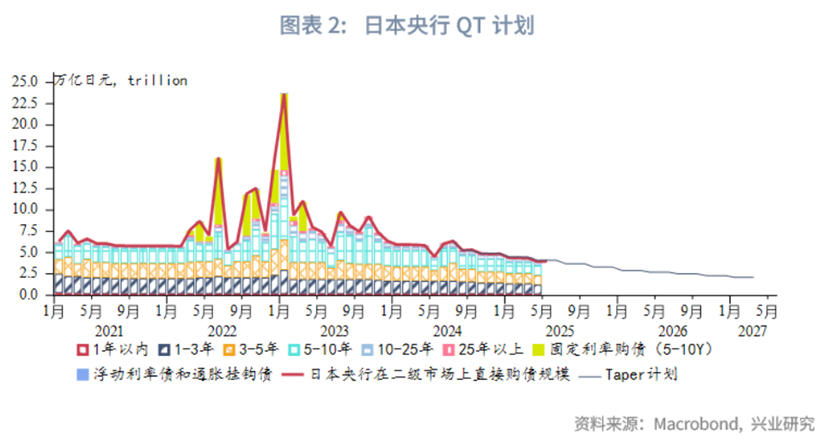
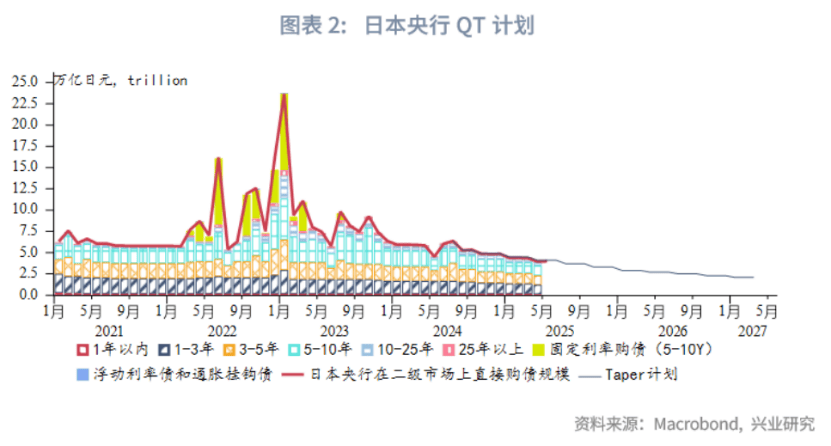
Group 1 - Japan's newly issued 10-year government bonds had no transactions for the first time since March 27, 2023, highlighting the ongoing volatility in the global market and significant rise in yields, particularly for long-term bonds [1] - According to recent analysis, the Bank of Japan (BOJ) plans to implement a Quantitative Tightening (QT) strategy starting August 2024, which will reduce its total government bond holdings by 7%-8% by March 2026 and by 16%-17% by March 2027 [1] - The BOJ's decision to slow down the QT plan and maintain its long-term bond purchase strategy, along with the Ministry of Finance's plan to reduce long-term bond issuance by 3.2 trillion yen, is expected to alleviate liquidity concerns in the Japanese government bond market [1] Group 2 - As liquidity in the government bond market improves, short-term declines in Japanese bond yields and a potential depreciation of the yen are anticipated, with the 10-year bond yield having already decreased by 15 basis points from its peak in May, with an additional potential decline of 15-30 basis points [1] - In the medium term, interest rate hikes and QT are expected to support a rebound in the yen and an eventual rise in Japanese bond yields, with the 10-year bond yield potentially reaching a central level of 1.88% [3]
日本新发10年期国债全天无交易,为2023年3月以来首次
Huan Qiu Wang· 2025-08-13 01:14
Group 1 - Japan's newly issued 10-year government bonds had no transactions for the first time since March 27, 2023, highlighting the ongoing volatility in the global market and significant rise in yields, particularly for long-term bonds [1] - The Bank of Japan (BOJ) is expected to implement a quantitative tightening (QT) plan starting August 2024, which will reduce its total government bond holdings by 7%-8% by March 2026 and 16%-17% by March 2027, indicating a slowdown in the pace of bond purchases [1] - The Japanese Ministry of Finance plans to reduce the issuance of long-term government bonds by 3.2 trillion yen, which is anticipated to alleviate concerns regarding market liquidity [1] Group 2 - As liquidity in the government bond market improves, short-term declines in Japanese bond yields and a depreciation phase for the yen are expected, with the 10-year bond yield having already decreased by 15 basis points from its peak in May, with potential for an additional 15-30 basis points decline [2] - The volatility of the yen is returning, and with the end of previous carry trade unwinding, the yen's safe-haven appeal is diminishing, as the market shifts towards a risk-off sentiment, pushing the USD/JPY towards the resistance level of 150 [2] - In the medium term, continued interest rate hikes and QT are expected to support a rebound in the yen and an eventual rise in Japanese bond yields, with the 10-year bond yield potentially reaching a central level of 1.88% [4]