硬科技

Search documents
科创板配置新选择 AI指数增强价值凸显
Bei Jing Shang Bao· 2025-07-02 07:07
Group 1 - The core viewpoint emphasizes the increasing long-term investment value of the Sci-Tech Innovation Board (STAR Market) as part of China's strategy for technological self-reliance, with the STAR Market Composite Index reflecting the overall performance of high-tech companies [1] - The STAR Market Composite Index covers 569 companies with a market capitalization coverage exceeding 96%, focusing on six core technology sectors that align with national strategic directions [3] - The launch of the Hongde STAR Market Composite Index Enhanced Fund aims to provide investors with a tool for optimizing equity allocation and accessing core technology assets through AI-driven quantitative stock selection [1][5] Group 2 - The enhanced strategy of index funds has gained significant attention, with 82 new funds established in the first half of the year, raising a total of 39.225 billion yuan, marking increases of 382% and 680% year-on-year, respectively [2] - 83% of index-enhanced funds outperformed their benchmarks in the first half of the year, with 36 funds achieving excess returns of over 7% [2] - The fund management utilizes AI technology and quantitative models to systematically extract individual stock alpha from vast amounts of data, enhancing investment efficiency [2][4] Group 3 - The STAR Market Composite Index has shown a high annualized volatility of 33% and a return of 22.98% since its inception, indicating its potential for strategy optimization [3] - The fund's AI model dynamically optimizes stock selection by processing extensive data, while strict risk management and transaction cost optimization are also key components of its strategy [4] - The fund is designed for investors who are optimistic about the long-term development of China's hard technology sector and seek to enhance long-term compound returns while managing risks associated with high volatility [6]
IPO受理现小高峰 未盈利企业加速拥抱资本市场
Zheng Quan Shi Bao· 2025-07-01 19:10
Core Insights - The number of IPO applications received in June reached a record high for the year, with 150 companies applying, driven by periodic financial data updates and an improving regulatory framework under the registration system [1][2][3] Group 1: IPO Application Trends - A total of 177 companies' IPO applications were accepted in the first half of the year, a significant increase from 29 in the same period last year, with June alone accounting for over 85% of the total [2][4] - The last few days of June saw a surge in applications, with 41 new IPOs accepted on June 30, including 32 by the Beijing Stock Exchange [2][7] - The increase in IPO applications is linked to the financial reporting cycle, as companies must submit applications within six months of their financial report's validity [3][4] Group 2: Industry Distribution and Market Sentiment - Manufacturing companies dominate the IPO applications, particularly in sectors like computer, communication, and electronic equipment manufacturing [4] - The number of IPO withdrawals has decreased significantly, with only 66 withdrawals reported by June 30, compared to last year's higher figures, indicating improved market confidence among quality companies [4][6] Group 3: Support for Unprofitable Companies - The acceptance of IPO applications from unprofitable companies has increased, with four such companies applying in June, primarily in the semiconductor sector [5][6] - Notable examples include DaPuWei, which reported projected revenues of approximately 5.57 billion yuan in 2022 but incurred losses, and Zhaoxin Integrated, which focuses on high-end processors [5] Group 4: Future Outlook - The A-share market is expected to see a steady increase in IPO numbers in 2025, particularly from companies in key manufacturing and strategic emerging industries like semiconductors and new energy [8]
探寻浙大系创业军团精神坐标 “求是”力量与“创新”特质
Shang Hai Zheng Quan Bao· 2025-07-01 19:09
Group 1 - Zhejiang University has produced a significant number of entrepreneurs, with 366 alumni serving as leaders in 327 listed companies, collectively managing over 6 trillion yuan in market value [4][8] - The entrepreneurial spirit of Zhejiang University is characterized by a focus on technology, idealism, and a balance between profit and ethics, reflecting the unique "Zhejiang phenomenon" in the business market [4][5] - The growth of Zhejiang University alumni in leadership roles has increased by 1.95 times in nine years, with the number of listed companies rising by 2.1 times [8] Group 2 - The university's culture emphasizes practicality and a strong focus on application, with entrepreneurs valuing both technical research and real-world implementation [7][9] - The establishment of the "Innovation and Entrepreneurship Enhancement Class" in 1999 has fostered a culture of innovation, leading to the creation of over 1200 startups and several unicorn companies [12][14] - Zhejiang University alumni have a strong network that supports mutual investment and collaboration, contributing to a thriving entrepreneurial ecosystem [14][16] Group 3 - The university's commitment to "seeking truth and innovation" is seen as a core value, with a focus on ethical development and continuous improvement in technology and products [9][10] - The integration of government support, research breakthroughs, and innovative business models is crucial for the future success of hard-tech companies in China [17] - The collaboration between new tech companies and traditional industries is viewed as a significant advantage for the economic development of Zhejiang [17][18]


“IPO潮”来了
FOFWEEKLY· 2025-07-01 09:59
Core Viewpoint - The article emphasizes the significant increase in IPO activities in the A-share market during the first half of the year, driven by favorable policies and a renewed interest in technology and consumption sectors [2][3][20]. Summary by Sections IPO Surge - In the first half of the year, 177 companies were accepted for IPOs in the A-share market, a 4.5-fold increase compared to the same period last year [3][9]. - June was particularly notable, with 150 companies accepted for IPOs, accounting for 85% of the total for the first half [3][9]. - On June 30 alone, 41 IPO applications were accepted, marking the highest single-day record for the year [10]. Policy Support - Recent policy changes have positively impacted the IPO market, including the resumption of the fifth set of standards for unprofitable companies on the Sci-Tech Innovation Board [8][15]. - A joint document from six departments supports quality enterprises in the consumption industry to raise funds through IPOs and other means [8][15]. Market Dynamics - The first half of the year saw a notable increase in IPO applications, particularly in June, with a month-on-month growth exceeding four times [9][10]. - The majority of new applications were concentrated in the North Exchange, with 115 companies applying [9]. Investment Opportunities - The article highlights a revival in the investment landscape, particularly in the medical and consumer sectors, with several unprofitable companies recently receiving IPO approvals [15][16]. - The positive momentum in the IPO market is expected to create richer investment opportunities for the industry [16]. Hong Kong Market Performance - The Hong Kong IPO market has also shown significant growth, with 43 IPOs completed in the first half of the year, a 43.33% increase year-on-year [17]. - The total fundraising amount reached 1,067.13 billion HKD, a substantial increase compared to the previous year [17]. Future Outlook - The article suggests that 2025 will be a promising year for the venture capital industry, with both A-share and Hong Kong IPO markets showing signs of recovery [20][21]. - The need for diversified exit strategies, particularly in mergers and acquisitions, is emphasized for venture capital firms to adapt to the evolving market [20][21].

这30家公司决定中国硬科技未来!
和讯· 2025-07-01 08:33
Core Viewpoint - "Hard technology" has become a strategic support for national competitiveness and a key engine for high-quality development in the context of intensified Sino-U.S. technological competition and the deep restructuring of global supply chains [1][28]. Summary by Sections Overview of the Hard Technology Sector - The "2025 China Hard Technology Listed Company Value List" was jointly launched by Hexun Financial Research Institute and ZD Insights, focusing on identifying resilient and technologically advanced companies in China's capital market [1]. - The first sub-list, the Growth Potential List, highlights the top 30 high-growth representatives from 1,326 listed companies in the information technology sector, covering key areas such as semiconductors, artificial intelligence, and IT hardware [1][28]. Growth Potential List Highlights - The top companies include: 1. Changchuan Technology - Semiconductor testing equipment supplier [4] 2. Lexin Technology - IoT chip design company [4] 3. Haitai Ruisheng - AI data service provider [5] 4. Haiguang Information - High-end processor supplier [6] 5. Hengxuan Technology - Smart audio SoC chip supplier [6] - These companies demonstrate strong performance in revenue expansion and R&D investment, representing the "future new forces" in China's hard technology sector [1]. Key Trends in the Hard Technology Sector - **Trend 1: Accelerated Progress in Semiconductor Self-Control** The domestic semiconductor industry is showing strong resilience and growth potential, with many companies in the top 30 focusing on semiconductor design, manufacturing, and packaging [29]. - **Trend 2: Continuous Increase in R&D Investment Intensity** The average R&D expense ratio for the top 30 companies is 24%, with an average growth rate of 24% in R&D investment, indicating a strong commitment to technological innovation [32][33]. - **Trend 3: Scene-Driven Technology Application Efficiency** Companies are leveraging specific application scenarios to drive technological advancements, enhancing overall industry competitiveness [36][37]. - **Trend 4: Accelerated Release of Data Element Value** Companies like Haitai Ruisheng and Kirin Xinan are capitalizing on data value, contributing to the rapid growth of China's digital economy [39][40]. - **Trend 5: Significant Regional Cluster and Industry Chain Synergy** Major cities like Shenzhen, Beijing, and Shanghai are forming high-concentration industrial belts, enhancing collaboration and growth among technology companies [41][44]. Conclusion - The growth potential list and the identified trends illustrate a shift in China's new generation of information technology from scale expansion to quality improvement, with a focus on self-reliance and innovation [28][29].
【深度】禾元生物上会,科创投资“起跑”
Sou Hu Cai Jing· 2025-07-01 00:12
Group 1 - The core viewpoint of the articles is that recent reforms by the China Securities Regulatory Commission (CSRC) are revitalizing the capital market, particularly for hard technology and unprofitable companies, by reintroducing listing standards that enhance inclusivity and adaptability [2][4][5] - The CSRC announced the reactivation of the fifth set of standards for the Sci-Tech Innovation Board (STAR Market) and the introduction of a third set of financial standards for the ChiNext board, aimed at supporting high-quality unprofitable tech companies to go public [2][3] - Market participants express renewed confidence in investing in previously overlooked sectors, with a consensus that the reintroduction of these rules sends a positive signal for the listing of hard tech and unprofitable companies in the A-share market [2][4] Group 2 - The first company to utilize the newly reintroduced fifth set of standards, He Yuan Biological, is set to have its IPO meeting on July 1, marking a significant milestone after a two-year hiatus [3] - Investment banks are actively adjusting their strategies to focus on emerging sectors, particularly in artificial intelligence, commercial aerospace, and low-altitude economy, as they anticipate a surge in IPO applications from tech companies that were previously hesitant [4][5] - The expansion of applicable standards is seen as a gradual process, with expectations that it will eventually encompass a broader range of emerging industries, thereby enhancing the growth trajectory of these companies [5][6] Group 3 - The reactivation of the fifth set of listing standards is viewed as a significant support for high-growth unprofitable tech companies, with expectations that it will improve exit channels and optimize the investment environment [8][9] - Investment firms are increasingly focusing on the market size, technological leadership, and future alignment of unprofitable companies with market demands as key criteria for evaluation [5][9] - The policy changes are expected to foster a positive ecosystem for investment in unprofitable tech companies, encouraging a new wave of listings and investments in innovative sectors [8][9]

民企出口含“新”量提升
Ren Min Ri Bao Hai Wai Ban· 2025-06-30 22:59
Core Insights - China's private enterprises are increasingly becoming the main force in foreign trade, with a significant shift from low-cost manufacturing to high-tech exports, particularly in sectors like industrial robots and green technology [3][6][13]. Group 1: Export Growth and High-Tech Products - In the first five months of the year, China's private enterprises achieved a total import and export value of 10.25 trillion yuan, a growth of 7%, with exports reaching 6.97 trillion yuan, up 8% [3]. - The export value of industrial robots increased by 55.4% year-on-year, with private enterprises being the primary manufacturers [3][5]. - High-tech product exports from private enterprises reached a historical high of nearly 1 trillion yuan in the first quarter, with industrial robots and high-end machine tools seeing growth rates of 67.4% and 16.4%, respectively [5][6]. Group 2: Technological Innovation and R&D Investment - Private enterprises contributed over 50% of the total R&D investment and personnel in China, with the top 1,000 private companies investing a total of 1.39 trillion yuan in R&D in 2023 [7][9]. - The continuous increase in R&D investment efficiency has led to a significant rise in the technological added value of export products [6][9]. - Companies are focusing on core technology development to enhance their competitiveness in international markets, with many achieving breakthroughs in previously monopolized technologies [8][9]. Group 3: Policy Support and Market Expansion - The Chinese government has implemented various policies to support private enterprises in their international expansion, including improved intellectual property protection and financial risk-sharing mechanisms [9][12]. - Many private enterprises are transitioning from trade-based models to localized operations, establishing factories and warehouses overseas to enhance their global presence [14]. - In Brazil, several Chinese private car manufacturers have announced significant plans, indicating their growing influence in international markets [14].
创业板时隔近两年再度纳新药企!联亚药业换赛道再闯A股,高度依赖第一大客户
Bei Jing Shang Bao· 2025-06-30 11:14
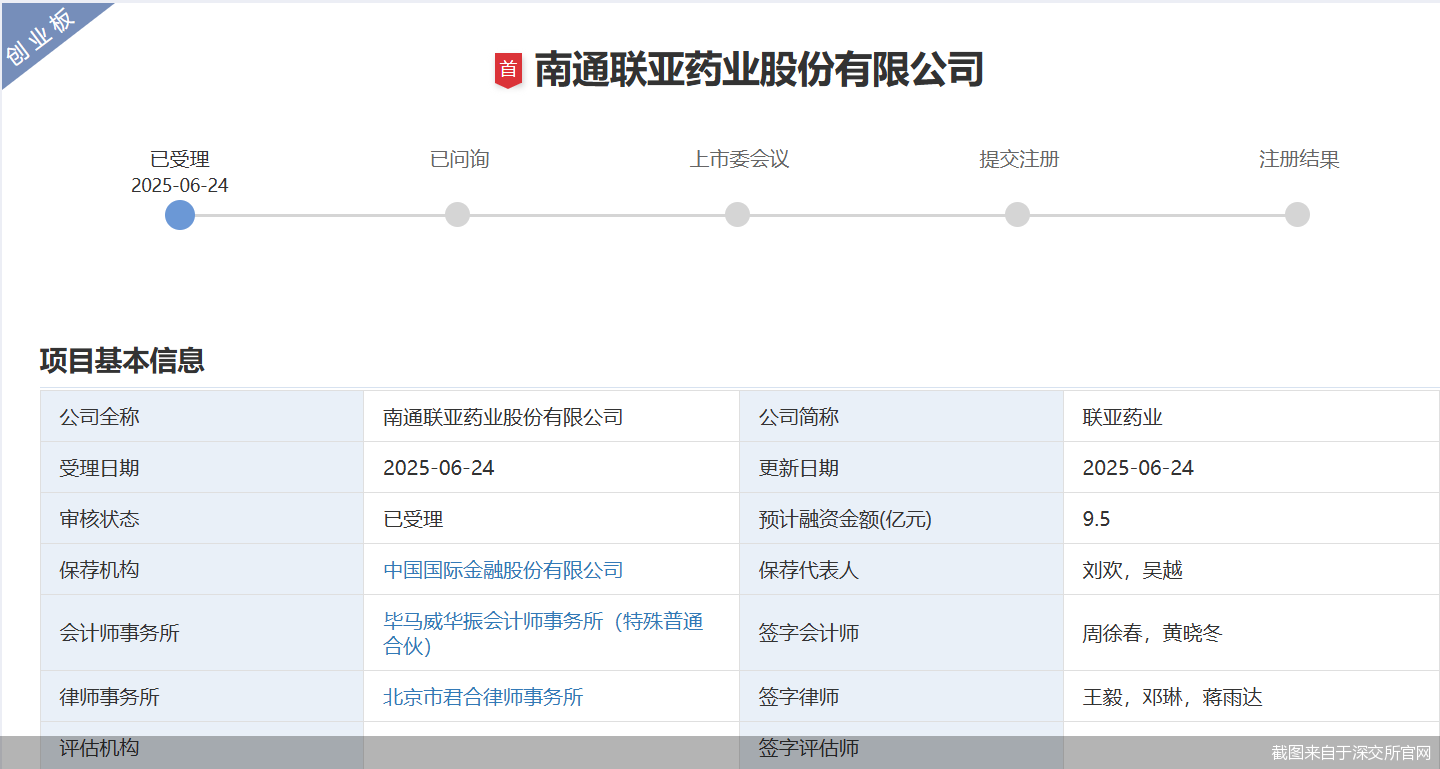
Core Viewpoint - Nantong Lianya Pharmaceutical Co., Ltd. has successfully submitted its IPO application for the ChiNext board, marking the return of pharmaceutical companies to this market after nearly two years [1][3] Company Overview - Lianya Pharmaceutical focuses on the research, production, and sales of complex drug formulations, primarily offering high-end generic drugs, including controlled-release formulations and low-dose drug formulations [3] - The company has previously attempted to list on the Sci-Tech Innovation Board but withdrew its application after three rounds of inquiries [3][4] IPO Details - The company aims to raise 950 million yuan (approximately 9.5 billion yuan) for its IPO, a decrease from the previously planned 1.05 billion yuan (approximately 10.5 billion yuan) during its Sci-Tech Innovation Board application [1][5] - The funds will be allocated to industrialization base projects, drug research and development, and working capital [6] Fund Allocation - The industrialization base project will receive 306 million yuan for production base construction and 266 million yuan for R&D center construction, expected to add 1 billion tablets and 100 million capsules in production capacity [6] - The drug R&D project will receive 328 million yuan, focusing on 28 product pipelines across various therapeutic areas, including gynecology, hypertension, central nervous system disorders, and diabetes [6] Financial Performance - Lianya Pharmaceutical has shown increasing net profits, with projected revenues of approximately 550 million yuan, 700 million yuan, and 866 million yuan for the years 2022 to 2024, respectively [8] - Corresponding net profits are expected to be around 113 million yuan, 116 million yuan, and 260 million yuan for the same period [8] Customer Dependency - The company has a significant reliance on its largest customer, Ingenus, which accounted for over 50% of its revenue during the reporting period [9] - Revenue from Ingenus was approximately 398 million yuan, 397 million yuan, and 449 million yuan for the years 2022 to 2024, representing 72.36%, 56.63%, and 51.87% of total revenue, respectively [9][10] - Ingenus is a comprehensive pharmaceutical company based in the U.S., focusing on the development and commercialization of generic drugs [10]
港交所,已成青岛企业上市首要选择
Sou Hu Cai Jing· 2025-06-30 06:59
Core Viewpoint - The trend of companies from Qingdao going public in Hong Kong is gaining momentum, with multiple firms submitting applications for listing on the Hong Kong Stock Exchange (HKEX) in 2023 [1][4]. Group 1: Companies Going Public - Qingdao Guoen Technology Co., Ltd. submitted its listing application to the HKEX on June 26, marking it as the fifth company from Qingdao to pursue a Hong Kong listing this year [1]. - Other companies that have applied for listing include GoerTek, Wenda Technology, Saintong Special Medical, and Kute Intelligent, all of which have significant hard technology attributes and are leaders in their respective sectors [5][8]. Group 2: Market Preferences - The HKEX is favored due to its lower entry requirements and shorter review periods, with nearly 80% of new listings from Qingdao in the past two years being on the HKEX [4]. - The companies listed are primarily in emerging industries such as new generation information technology, artificial intelligence, and life sciences, indicating a strong market demand for hard technology firms [9]. Group 3: Globalization Strategy - A key reason for Qingdao companies seeking to list in Hong Kong is to advance their globalization strategies, allowing them to raise funds in Hong Kong dollars or US dollars for overseas projects [10]. - Companies like Guoen and Kute Intelligent aim to enhance their international presence and operational capabilities through dual listings in both A-shares and H-shares [11][13]. Group 4: Recent Developments - As of 2024, Qingdao has a total of 19 companies listed on the HKEX, raising a total of 11.586 billion yuan, covering various industries including home appliance manufacturing and artificial intelligence [14]. - Recent activities include a roadshow event in May 2023, where several Qingdao companies showcased their potential for future listings, indicating a robust pipeline of candidates for the HKEX [16].
国资创投考核“松绑” 单项目可100%亏损
经济观察报· 2025-06-28 02:54
如今,政策的调整为创投行业带来了"转机"。随着政府引导基 金考核的"松绑",多地政府引导基金纷纷建立了单个项目 100%容亏等容错机制。在这样的政策支持下,国资创业投资 氛围明显转变,从"不敢投"转向"更敢投",国资LP(有限合 伙)投资正迎来新的发展机遇。 作者:蔡越坤 封图:图虫创意 在国资创投领域深耕多年的任明发现,以往的国资考核机制与早期科技项目投资的高风险、长周期 特点存在一定错位,导致创投行业陷入"不敢投""怕投错"的困境。 如今,政策的调整为创投行业带来了"转机"。随着政府引导基金考核的"松绑",多地政府引导基金 纷纷建立了单个项目100%容亏等容错机制。在这样的政策支持下,国资创业投资氛围明显转变, 从"不敢投"转向"更敢投",国资LP(有限合伙)投资正迎来新的发展机遇。 2025年6月21日,湖北省政府种子基金成立,为初创企业提供更有力的资金支持。同时发布的《湖 北省重构政府引导基金体系工作方案》(下称《工作方案》)提出,允许单个投资项目"100%亏 损"。无独有偶,经济观察报记者关注到,2025年以来,四川省、广州市均曾提出政府引导基金投 资时单个企业(项目)最高允许100%亏损。 任明认 ...