
新能源汽车

Search documents
江铃福特30周年 轻客销量王的硬实力藏不住| 头条
第一商用车网· 2026-01-04 14:00
Group 1 - Heavy truck sales increased by 13% in December, raising questions about the total sales volume for the year and projections for 2026 [4] - Companies such as Foton, Yutong, Chery, XCMG, and YuanCheng have made bulk deliveries of heavy trucks [4] - FAW Jiefang has released its performance report for the entire year of 2025 [4] Group 2 - A significant procurement order for new energy sanitation vehicles has emerged in Shanghai, with a budget of 34.03 million yuan [6] - The debut of the "black box" and 15 industry-leading features for Chery's commercial vehicle, the big VAN, has been highlighted [6]

锡月报:短期宏观氛围积极,预计锡价震荡运行-20260104
Wu Kuang Qi Huo· 2026-01-04 13:30
1. Report Industry Investment Rating - Not provided in the content 2. Core Viewpoints of the Report - In December 2025, tin prices were high and strong. In terms of supply, the operation of tin ingot smelters in Jiangxi and Yunnan remained stable at a high level. In terms of demand, the demand for consumer electronics entered the traditional off - season at the end of the year, but the operating rate of tin solder enterprises remained stable supported by new - energy vehicles and AI servers. In the spot market, downstream enterprises adopted a low - inventory strategy with weak purchasing willingness. Tin inventory increased for three consecutive weeks. High prices significantly inhibited tin demand, and it is expected that tin prices will fluctuate and weaken in the future [11][13] 3. Summaries According to Relevant Catalogs 3.1 Monthly Evaluation and Strategy Recommendation - Cost side: In November 2025, the import of tin concentrates in China increased significantly, and the shortage of raw material supply was alleviated. The import volume of tin ore and its concentrates was 15,099 tons, a month - on - month increase of 29.81% and a year - on - year increase of 24.42%. The imports from Myanmar (the largest source) and the Democratic Republic of the Congo (the second - largest source) changed differently [12] - Supply side: The resumption of tin mines in Wa State, Myanmar, advanced, and the export volume increased significantly. However, the shortage of raw materials for smelting enterprises in Yunnan still existed, and the short - term operating rate remained stable with limited upward momentum. In Jiangxi, due to the significant reduction in scrap, the supply of crude tin was insufficient, and the output of refined tin remained at a low level. Overall, it is difficult to further improve the operating level of smelters in the short term [12] - Demand side: At the end of the year, the demand for consumer electronics entered the traditional off - season, but the operating rate of tin solder enterprises remained stable supported by new - energy vehicles and AI servers. In November, the output of tin solder of sample enterprises increased by 0.95% month - on - month, and the operating rate rose slightly by 0.69% compared with October. In the现货 market, downstream enterprises adopted a low - inventory strategy, resulting in a three - week increase in tin inventory. As of December 26, 2025, the social inventory of tin ingots in major domestic markets was 10,367 tons, an increase of 186 tons from the previous Friday [12] 3.2 Futures and Spot Market - Not provided with specific text analysis content, only relevant data graphs are presented, including the basis of Shanghai tin main contract and the LME tin premium (0 - 3) [19][20] 3.3 Cost Side - Not provided with specific text analysis content, only relevant data graphs are presented, including China's monthly tin ore production, tin ore import volume, tin concentrate price, and tin concentrate processing fee [24][26] 3.4 Supply Side - Not provided with specific text analysis content, only relevant data graphs are presented, including domestic refined tin monthly output, domestic recycled tin monthly output, tin output and operating rate in Yunnan and Jiangxi regions, refined tin export and import profits, domestic refined tin import volume, and Indonesia's refined tin import and export [30][32][35] 3.5 Demand Side - The year - on - year growth rate of China's semiconductor sales rebounded slightly, and the global semiconductor sales maintained high growth. The report also presented data graphs of domestic computer production, smartphone production, output of household appliances (washing machines, air conditioners, refrigerators, color TVs), China's photovoltaic cell production, domestic key enterprise tin - plated strip production, domestic PVC monthly output, downstream solder enterprise operating rate, and domestic tin apparent consumption [43][44][46] 3.6 Supply - Demand Balance (Inventory) - Not provided with specific text analysis content, only relevant data graphs are presented, including China's social inventory and LME inventory [60]
比亚迪首次全年反超特斯拉,全球纯电王座易主
3 6 Ke· 2026-01-04 12:54
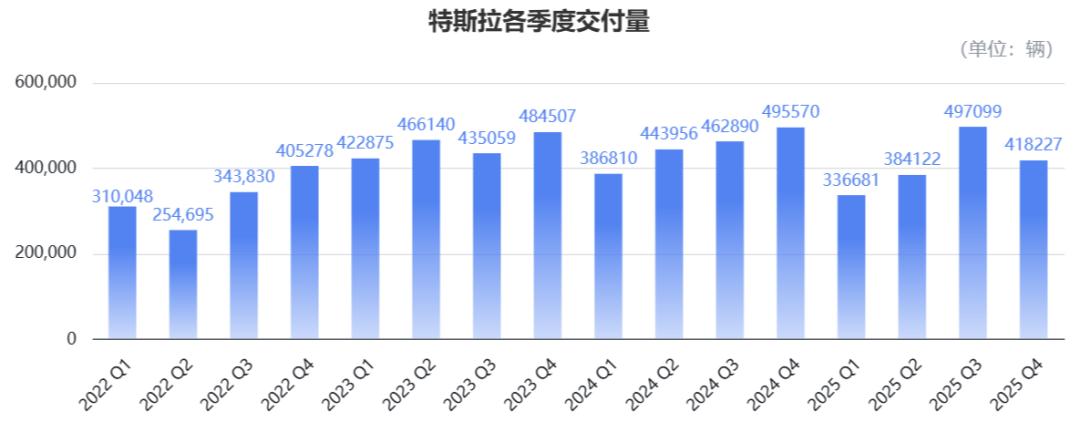
Core Insights - The global electric vehicle sales leader has shifted from Tesla to BYD, marking a significant change in the market dynamics [1][2][12] - Tesla's sales in 2025 declined, with a total of 1.655 million vehicles sold, a 9% year-over-year decrease, while BYD's sales reached 2.257 million, a 27.9% increase [7][12] Group 1: Tesla's Performance - In Q4 2025, Tesla delivered 418,227 vehicles, a 16% decline year-over-year, with Model 3/Y accounting for 406,585 units [2][5] - The decline in Tesla's sales was anticipated due to the expiration of U.S. tax incentives, leading to a surge in Q3 deliveries [5][10] - Tesla's total sales for 2025 were 1.655 million vehicles, down from 1.8086 million in 2023, marking a second consecutive year of decline [7][10] Group 2: BYD's Growth - BYD's total sales for 2025 reached 4.6 million vehicles, a 7.73% increase, with pure electric vehicle sales at 2.257 million, representing a 27.9% increase [12][24] - BYD's overseas sales surged by 145%, contributing to 22.8% of total sales [24] - This marks the first time BYD has topped the global sales chart for pure electric vehicles, surpassing Tesla's 1.636 million units [12][13] Group 3: Market Dynamics and Competitors - The competition in the electric vehicle market is intensifying, with Chinese automakers gaining significant market share [16][42] - Other notable performers include Xpeng, which saw a 125.9% increase in sales, and Li Auto, which faced an 18.8% decline [20][35] - The overall landscape indicates a shift towards a more diversified and competitive market, moving away from Tesla's previous dominance [42]


PCB行业资本热潮再起,700亿景旺电子冲刺港股
Huan Qiu Lao Hu Cai Jing· 2026-01-04 12:43
Core Viewpoint - Jingwang Electronics has officially submitted its prospectus to the Hong Kong Stock Exchange, marking the start of its A+H capital platform construction, coinciding with the booming PCB industry and the company's expansion into overseas markets [1][2][3]. Company Overview - Jingwang Electronics is the world's largest automotive electronic PCB supplier and has been deeply involved in the PCB sector for 33 years [2][3]. - The company has maintained an overseas revenue share of around 40%, with major clients including top automotive suppliers and leading AI computing companies [2][4]. Expansion Plans - To meet the increasing demand from overseas clients, Jingwang Electronics began constructing a factory in Thailand in 2023, which is expected to commence production in early 2026 [2][3]. - The funds raised from the Hong Kong listing will primarily be used to expand and upgrade production capacity, including the construction of a second phase in Thailand [3][5]. Industry Trends - The PCB industry is experiencing a significant surge in interest due to the explosive growth in AI computing and electric vehicles, with the PCB index price increasing by 144% over the year [4]. - The high-end PCB market concentration ratio (CR10) has risen from 25% in 2020 to 30% in 2024, indicating a shift towards larger players like Jingwang Electronics as smaller firms exit the market [4][5]. Financial Performance - Jingwang Electronics has reported continuous revenue growth over the past three years, with revenues of 12.659 billion and 11.083 billion yuan for the first three quarters of 2024 and 2025, respectively, reflecting year-on-year growth of 17.68% and 22.08% [4]. - The automotive electronics segment generated 5.066 billion yuan in revenue during the first three quarters of 2025, marking a year-on-year increase of 22.72% [4]. Market Outlook - The market for data infrastructure PCBs and automotive electronic PCBs is projected to grow significantly, with expected increases from $12.5 billion and $9.2 billion in 2024 to $23 billion and $12.2 billion by 2030, respectively [5]. - The industry is witnessing a capacity expansion race, with multiple PCB companies, including Jingwang Electronics, investing heavily in new facilities and upgrades to meet rising demand [5].

继续停牌!恒大汽车最新公告
Xin Lang Cai Jing· 2026-01-04 12:26
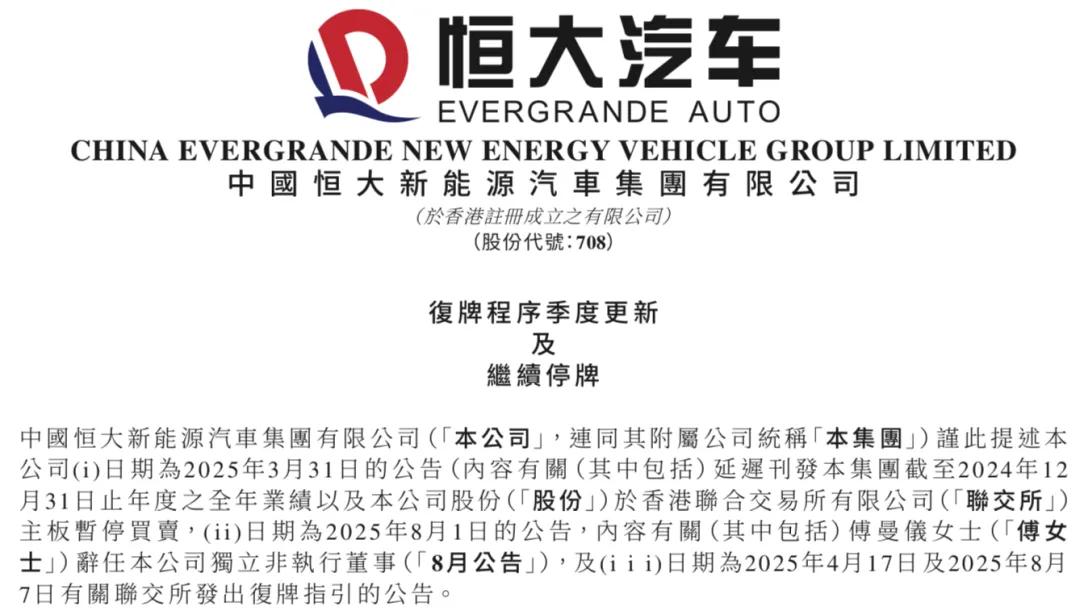
Core Viewpoint - Evergrande Auto is facing significant liquidity challenges, leading to the suspension of trading and delays in financial reporting, while exploring asset sales to support operations [1][3][5] Group 1: Financial Challenges - The company has not allocated resources to hire auditors for the fiscal year ending December 31, 2024, resulting in delays for the interim results expected by June 30, 2025 [3][11] - As of June 30, 2024, Evergrande Auto reported revenues of 38.377 million, a decrease of 75.17% year-on-year, and a net loss of 20.257 billion, an increase in loss of 194.73% compared to the previous year [7][17] - Total assets were reported at 16.369 billion, with cash and cash equivalents of only 39 million, while total liabilities reached 74.35 billion [7][17] Group 2: Operational Issues - Several subsidiaries of the company are undergoing bankruptcy proceedings, with courts appointing managers and approving restructuring plans [1][5] - The company has only launched one model, Hengchi 5, and is facing production halts and significant debt pressure [7][17] Group 3: Strategic Moves - Evergrande Auto is actively seeking strategic investors or buyers to alleviate liquidity issues and facilitate restructuring, but has faced challenges in the current market environment [3][12] - The company is also looking to appoint independent non-executive directors to fill vacancies and comply with listing rules [9][19]
2026年新能源车的第一颗雷,炸了!
Xin Lang Cai Jing· 2026-01-04 12:26
Core Viewpoint - The recent bankruptcy application of Qoros Auto, once hailed as "China's first global car," has resulted in over 35 billion yuan in debt, marking a significant failure in the new energy vehicle sector [1][41]. Group 1: Company Overview - Qoros Auto, established 18 years ago with over 50 billion yuan invested, has failed to survive past 2025 and is now facing bankruptcy [3][41]. - The company has accumulated over 1,000 enforcement cases and more than 350 billion yuan in frozen equity, with over 3,000 associated risk information entries [7][45]. - Qoros was once considered a high-end autonomous brand and had a promising start, but has now become a cautionary tale in the automotive industry [7][43]. Group 2: Market Position and Challenges - The automotive industry is likened to a "survival of the fittest" arena, where only those with strong ecosystems can thrive, while others face rapid collapse [5][43]. - Qoros aimed to position itself as a high-end brand, assembling an international team and targeting German quality standards, but this strategy proved overly ambitious [8][49]. - Despite initial acclaim for its first model, Qoros 3, the company struggled with low sales, selling only 6,967 units in 2014, which led to significant financial losses [12][50]. Group 3: Financial Performance - Qoros reported cumulative losses of 6.6 billion yuan over three years from 2014 to 2016, with annual losses of 2.2 billion yuan in 2014, 2.5 billion yuan in 2015, and 1.9 billion yuan in 2016 [15][54]. - The company faced a liquidity crisis after its major investor, Baoneng Group, also encountered financial difficulties, leading to halted production and a disbanded R&D team [30][69]. Group 4: Industry Implications - The downfall of Qoros signifies a shift in the new energy vehicle market from a "marketplace" model to a "finals" model, where only the strongest survive [34][74]. - The competitive landscape is evolving, with increasing stakes and a clear trend towards the elimination of weaker players [35][76]. - The case of Qoros serves as a reflection of the industry's need for robust strategies, understanding of consumer needs, and adaptability to market changes [73][77].
曝小米与阿里巴巴全球速卖通签署战略合作 曾多次合作
Xin Lang Cai Jing· 2026-01-04 12:03
Group 1 - Xiaomi's international business unit has signed a strategic cooperation agreement with Alibaba's AliExpress [1][6] - Xiaomi entered the Spanish market in 2017, launching the MIX 2 and Xiaomi A1 smartphones, and has built a diverse cooperation ecosystem with partners like Ingram Micro and AliExpress for product marketing and distribution [3][8] - AliExpress has established an official store to sell Xiaomi products, in addition to other retailers like Amazon and Carrefour providing sales channels [3][8] Group 2 - The collaboration between AliExpress and Xiaomi extends to the automotive sector, with plans to launch a car sales business by June 2025, focusing on Chinese brands and a significant proportion of new energy vehicles [4][9] - Popular models such as Xiaomi SU7, BYD Yuan, Geely Xingyuan, Li Auto L7, and Xpeng G9 are expected to be featured, with many benefiting from AliExpress's substantial subsidy policy for overseas expansion [4][9]


全球棋盘上的中国车:不只卖车,更要“造局”
3 6 Ke· 2026-01-04 11:54
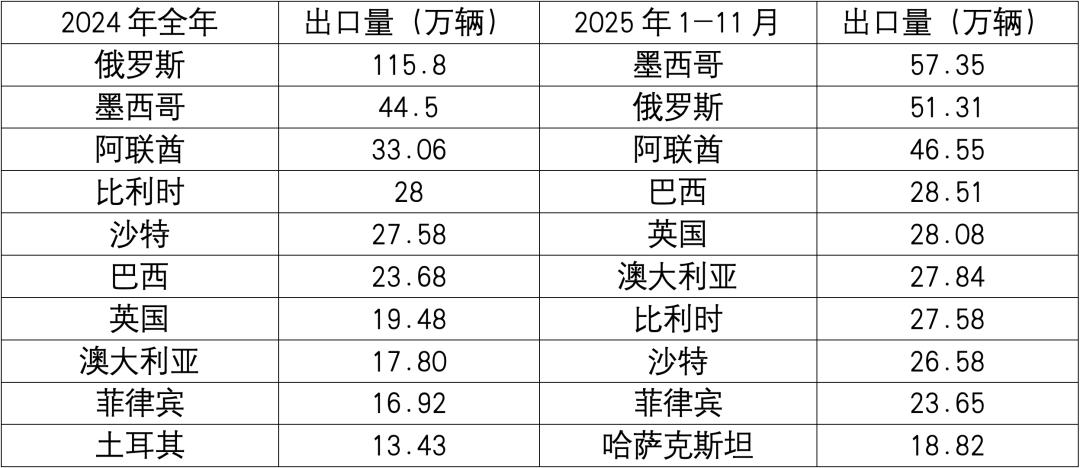
Core Insights - In 2025, China's automobile exports demonstrated resilience and vitality amidst challenges, with total exports reaching 7.33 million units from January to November, a year-on-year increase of 25%, and an expectation to exceed 8 million units for the entire year [1] Group 1: Market Dynamics - The Russian market, previously the largest for Chinese automobile exports, saw a dramatic decline, with exports dropping to 513,000 units from January to November 2025, a 50% year-on-year decrease, causing it to fall to the second position [2][3] - In contrast, the European market experienced significant growth, with Chinese brand car sales in Europe reaching 78,358 units in November 2025, a 108% increase year-on-year, resulting in a market share of 7.4% [3] - Mexico emerged as the largest single market for Chinese automobile exports, with 573,500 units exported, while the UAE ranked third with 465,500 units [4] Group 2: Structural Changes in Exports - The export structure is shifting, with a notable increase in the export of new energy vehicles (NEVs), which reached 3.01 million units from January to November 2025, a 62% increase year-on-year, and plug-in hybrid electric vehicles (PHEVs) accounting for 13% of total exports, up 8 percentage points [6] - The growth of PHEVs is attributed to their suitability for diverse markets, particularly in regions where charging infrastructure is still developing [6] Group 3: Localization and Ecosystem Development - Chinese automakers are transitioning from merely exporting vehicles to establishing local manufacturing and supply chains, with companies like BYD investing in local production facilities in Europe and Southeast Asia [9][10] - The number of Chinese automotive parts companies in Thailand has surged from approximately 48 in 2017 to 165 by March 2025, indicating a growing industrial cluster [9] Group 4: Challenges Ahead - Despite strong export figures, Chinese automakers face significant challenges in brand recognition and service networks in established markets like Europe, where consumer preference remains heavily skewed towards local brands [11][12] - In Southeast Asia, entrenched Japanese brands dominate the market, making it difficult for Chinese brands to gain a foothold despite rapid growth in electric vehicle sales [12][14] - The reliance on imported components for local production in markets like Thailand poses risks to customer satisfaction and operational efficiency [14]
上汽跃进2025销量大增127%!2026年挑战5.6万辆
Xin Lang Cai Jing· 2026-01-04 11:30
Core Insights - The core objective of SAIC Yujin is to achieve a sales target of 50,000 units in 2026, with a challenge to reach 56,000 units, while establishing itself as the leading electric card smart ecosystem in China [1][12]. 2025 Performance - In 2025, SAIC Yujin's total sales reached 40,000 units, marking a significant year-on-year increase of 127%, with market share rising from 2.0% to 4.0% [2][12]. - The company's new energy vehicle (NEV) business emerged as a key growth driver, delivering 21,000 units, a staggering year-on-year increase of 201%, and accounting for 53% of total sales [4][14]. Market Strategy and Product Development - The company plans to implement a dual-track strategy focusing on both new energy and traditional energy products, with 32 development projects planned, 24 of which are set to launch in 2026 [7][16]. - Specific product launches include the DANA T1/T2/T3 series, which will feature high-capacity battery options, and the introduction of LNG-powered products and CNG light trucks [16][20]. Overseas Expansion - SAIC Yujin aims to adopt a differentiated strategy in overseas markets, leveraging its group resources to penetrate regions such as Europe, Latin America, Southeast Asia, and the Middle East [9][18]. Ecosystem and Collaboration - The company emphasizes the importance of deepening partnerships, particularly with CATL, to enhance battery swapping networks and share resources across the entire value chain [11][20]. - Initiatives include the establishment of a new energy increment award and enhanced support for partners to foster collaborative growth [9][18].


2025:中国高端汽车的“仰望”时刻
Zhong Guo Xin Wen Wang· 2026-01-04 10:27
Core Insights - In 2025, China's new energy vehicles (NEVs) achieved a historic market penetration rate of 51%, surpassing traditional fuel vehicles for the first time, marking a significant shift in the automotive industry [1] - The launch of the Yangwang U9 Xtreme, which reached a top speed of 496.22 km/h and a Nürburgring lap time of 6 minutes and 59.157 seconds, signifies a new era in automotive performance and innovation [1] Industry Transformation - The automotive industry has transitioned from "mechanical sovereignty" dominated by Western manufacturers to a "digital definition" led by innovative technologies [2] - Yangwang's approach has redefined vehicles from mechanical constructs to intelligent systems driven by algorithms and data, shifting the competitive focus from mechanical complexity to system intelligence [2] Product Innovations - The Yangwang U9 Xtreme is recognized as the world's fastest production car, featuring a 1200V ultra-high voltage platform and four high-performance motors, generating over 3000 horsepower [3] - The Yangwang U8L Ding Shi version redefines safety by integrating a full aluminum chassis and advanced active safety features, transforming safety from passive to proactive measures [4] - The Yangwang U7 introduces a chip-level revolution in comfort and handling, utilizing a cloud-based system that significantly enhances response times and driving precision [5] Ecosystem Development - Yangwang's emergence is supported by China's robust trillion-dollar industrial cluster in the NEV sector, showcasing the strength of "Chinese-style innovation" [6] - China has established six major automotive industry clusters, leading to significant advancements in hybrid engine efficiency, battery costs, and fast-charging technologies [7] Global Market Position - In the 2025 global automotive parts rankings, 15 Chinese companies made the list, reflecting the strong aggregation effect within China's automotive industry [7] - Yangwang's technological advancements are rooted in China's collective efforts in semiconductor, precision motor, and materials science sectors, enabling rapid product development [8] Brand Recognition - Yangwang has gained recognition in the high-end market, with endorsements from prominent Chinese entrepreneurs, indicating a shift in consumer perception towards domestic brands [9] - The brand has attracted customers from luxury brands like Mercedes-Benz and Porsche, with a high percentage of full-price purchases, demonstrating its acceptance in elite consumer circles [9] Cultural Impact - Yangwang is becoming a symbol of Eastern luxury, with its influence extending beyond products to cultural phenomena, as seen in its appeal to global figures and celebrities [10] - In November 2025, China's automotive exports reached 728,000 units, with NEV exports surging by 260.8%, highlighting the global integration of Chinese automotive brands [10] Future Outlook - Yangwang exemplifies a new industrial civilization that values technology while emphasizing humanistic concerns, showcasing a commitment to social responsibility through its vehicles [11] - The integration of AI and smart technologies in the automotive sector is expected to drive profound changes in product forms and manufacturing processes [11] Conclusion - Yangwang's journey from inception to a leading brand in the automotive industry illustrates a successful model of high-end manufacturing in China, emphasizing technological innovation and cultural resonance [12] - The brand signifies a pivotal moment for China's automotive industry, positioning it as a key player in defining the future of global automotive standards [12]