去美元化

Search documents
中国算总账,特朗普禁令颁布,不许7国买俄石油,全面收割已开始
Sou Hu Cai Jing· 2026-01-10 10:48
Core Viewpoint - The article discusses the recent legislative actions taken by the Trump administration aimed at prohibiting seven major countries, including China, India, and Brazil, from purchasing Russian oil, with severe sanctions and tariffs as consequences for non-compliance [1][3]. Group 1: Legislative Actions and Intentions - The new legislation is a significant escalation in the U.S.-Russia geopolitical conflict, aiming to cut off funding to Russia's military operations [3]. - The underlying strategy is not merely to sanction Russia but to exert control over global energy markets, similar to the U.S. approach towards Venezuela [5][19]. - The U.S. aims to monopolize the energy supply by pushing out Russian oil and filling the resulting market gap with American oil [22][23]. Group 2: Historical Context and Strategy - The U.S. has previously implemented a five-step strategy to control Venezuela's oil resources, which includes cutting off external connections, monopolizing extraction, depriving sales rights, controlling funds, and enforcing forced repatriation of revenues [7][11][15][17]. - This strategy is now being adapted to apply pressure on the seven targeted countries, aiming to create a similar dependency on U.S. energy [19][26]. Group 3: Global Energy Market Dynamics - Russia's oil exports are heavily reliant on these seven countries, with China and India accounting for nearly 90% of its oil exports [19]. - The U.S. seeks to disrupt this trade flow, not just to weaken Russia but to secure a larger share of the global energy market for itself [22][23][26]. - The potential rise in oil prices due to disrupted Russian oil supplies could have detrimental effects on Western economies already facing inflation [32]. Group 4: China's Position and Response - China, as the largest energy importer, holds significant bargaining power and could counteract U.S. efforts by continuing to engage in energy trade with Russia and other suppliers [30][34]. - The article emphasizes that China's market position and industrial capabilities provide it with leverage against U.S. sanctions, particularly in critical resource sectors like rare earth elements [38][40]. - The geopolitical landscape is shifting, with the potential for a more multipolar energy market, challenging U.S. dominance [50][52].

全球资产加速去美元化:黄金储备超越美债 美元信用遭遇严重挑战
Sou Hu Cai Jing· 2026-01-10 09:46
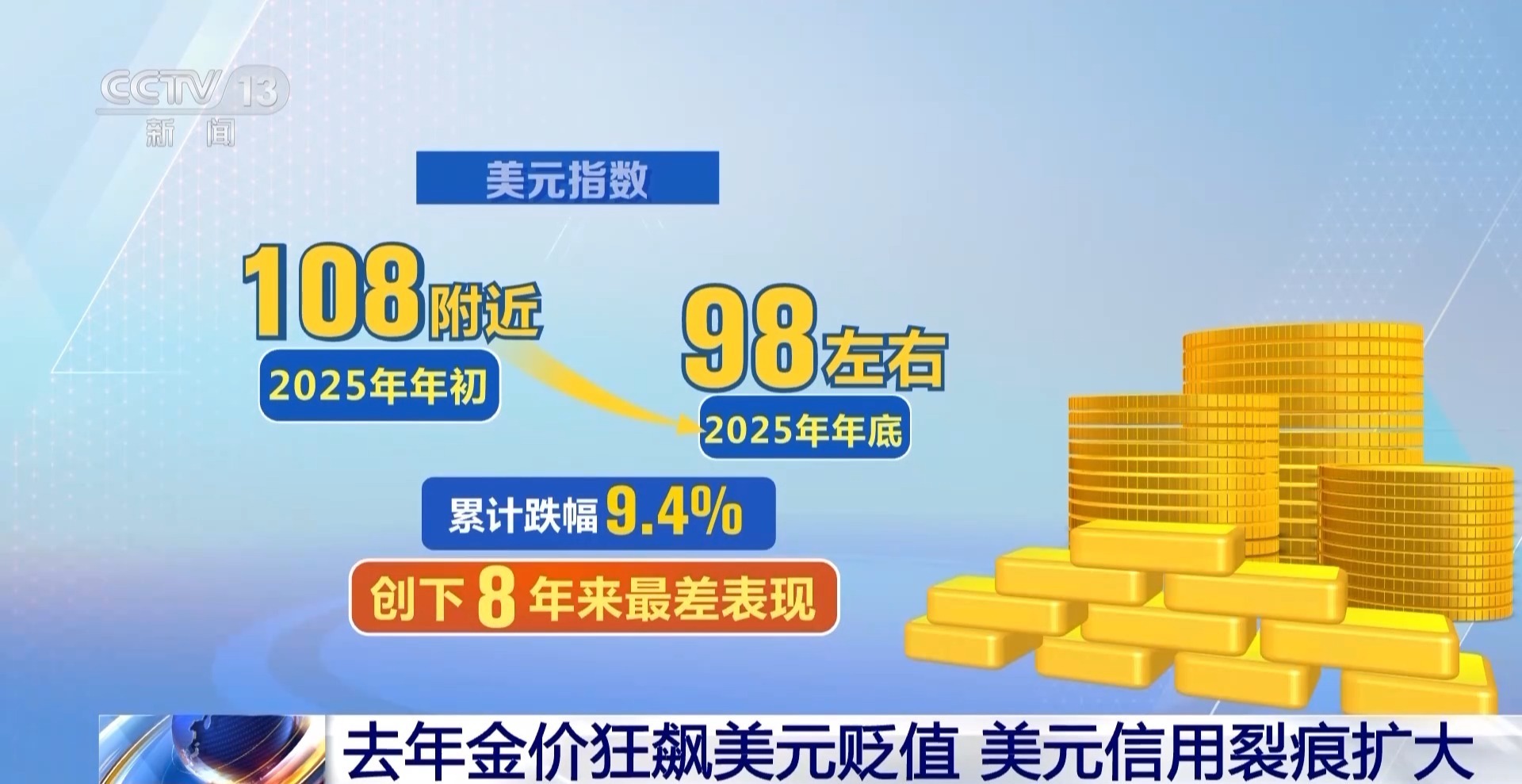
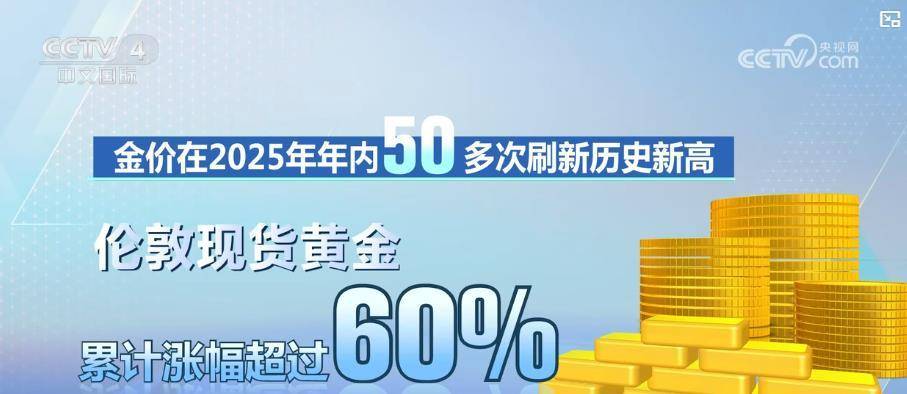
Group 1 - The core viewpoint is that by 2025, the dollar's credibility faces significant challenges, with gold prices soaring and the dollar depreciating, leading to a decline in its share of global foreign exchange reserves [1][5][9] - Central banks globally are increasing their gold holdings to enhance the diversity and stability of their asset portfolios, resulting in a substantial rise in international gold prices, with over 60% increase in the London spot gold price throughout 2025 [3][9] - The dollar index has dropped from around 108 at the beginning of 2025 to approximately 98 by the end of the year, marking a cumulative decline of 9.4%, the worst performance in eight years [5][9] Group 2 - The share of the dollar in global foreign exchange reserves continues to decline, with the International Monetary Fund reporting a decrease from 57.08% in Q2 2025 to 56.92% in Q3 2025, remaining below 60% for over ten consecutive quarters, the lowest since 1995 [7][9] - The proportion of U.S. Treasury bonds in central bank reserves, excluding the Federal Reserve, fell below 25% by mid-2025, while gold's share rose above 25%, marking the first time since 1996 that gold surpassed U.S. debt in central bank reserves [9] - Experts indicate a declining risk appetite for dollar assets among global capital, suggesting that the trend of decreasing dollar share in global foreign exchange reserves is unlikely to reverse, leading to a more diversified international monetary system [9]
美国强掳马杜罗、觊觎格陵兰,为美元霸权“续命”!
Mei Ri Jing Ji Xin Wen· 2026-01-10 09:23
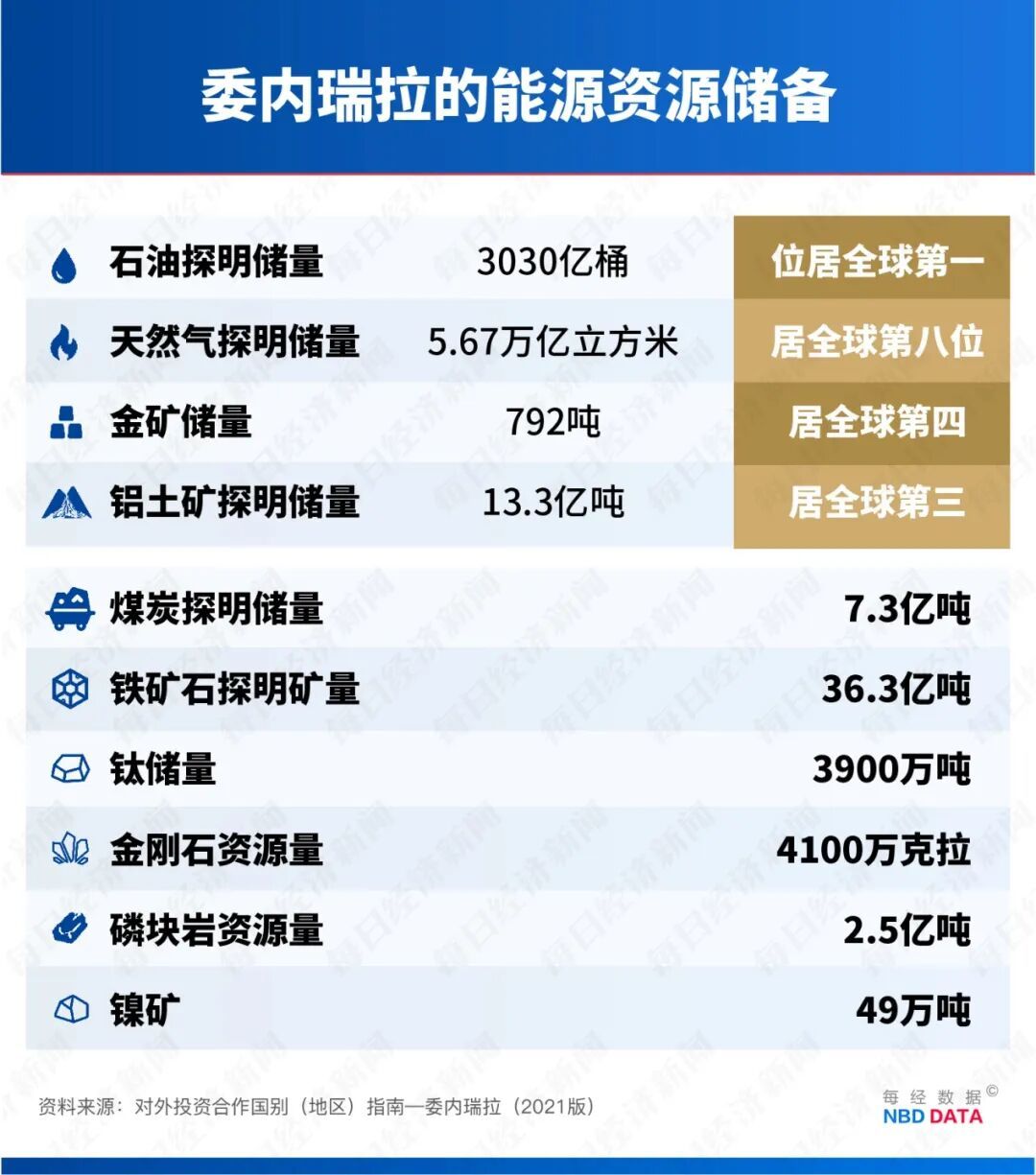
Group 1 - The U.S. government is attempting to exert control over Venezuela's oil resources and Greenland's rare earth minerals, with plans to invest $100 billion in Venezuela's oil industry [1][4][5] - Approximately 20% of global oil trade is now conducted without using the U.S. dollar, indicating a significant decline in the dollar's dominance in oil transactions [1][22] - The U.S. is facing a dual challenge of diminishing dollar hegemony and a national debt exceeding $38 trillion, prompting aggressive resource acquisition strategies [1][26] Group 2 - Venezuela has proven oil reserves of 303 billion barrels, making it the country with the largest oil reserves globally, which aligns with U.S. energy needs [6][9] - Greenland is home to 1.5 million tons of rare earth elements and various strategic minerals, making it a target for U.S. resource control efforts [10][12] - The U.S. aims to secure energy and resource dominance as a means to stabilize the dollar and U.S. Treasury bond attractiveness, which has been declining [25][28] Group 3 - The U.S. Secretary of State has prioritized energy and resource dominance in foreign policy, reflecting the strategic importance of these resources [3] - The U.S. plans to control the sale of Venezuelan oil and has stated that it will begin extracting and selling up to 50 million barrels of oil from Venezuela [5][19] - The U.S. is exploring various options to acquire Greenland, including financial purchase and military intervention, highlighting its strategic importance [10][18]
金价飙升53克项链单日涨1.5万
Sou Hu Cai Jing· 2026-01-10 08:32
Group 1 - The core viewpoint of the article highlights the significant surge in gold prices, with a notable increase in gold jewelry prices, leading to widespread consumer concern and market reactions [1][2]. - Gold jewelry prices have seen a dramatic rise, with specific items like the Chow Sang Sang pearl four-leaf clover necklace increasing by 15,200 yuan to 136,000 yuan, translating to a per gram price of 2,560 yuan, which is significantly higher than the base gold price [2]. - The international gold price reached 4,507 USD per ounce as of January 10, marking a nearly 4% weekly increase, while domestic gold jewelry brands reported prices between 1,392 and 1,410 yuan per gram, up over 16 yuan per gram since the beginning of the year [2]. Group 2 - Consumer reactions are polarized, with wedding groups expressing anxiety as the cost of "three golds" has surged from 40,000 yuan to over 80,000 yuan, prompting some to consider alternatives like bank gold bars or renting jewelry [3]. - Investors are divided in their behavior; early gold hoarders are cashing out with significant profits, while latecomers face premium risks, particularly in silver, which has shown higher volatility [3]. - The surge in gold prices is attributed to three main factors: a restructuring of the global monetary system, a 9.4% decline in the US dollar index in 2025, and increased geopolitical risks that have heightened demand for safe-haven assets [4][5][6]. Group 3 - The market anticipates that the Federal Reserve will lower interest rates by over 50 basis points in 2026, which would reduce the holding costs of gold [7]. - Technical analysis indicates that the price level of 4,400 USD is a critical support level, and the breach of the 4,500 USD resistance has triggered additional buying [8]. - Retail investor behavior has intensified market volatility, with some individuals chasing prices higher and panic selling during short-term corrections [9]. Group 4 - There are concerns regarding the pricing mechanisms of gold jewelry brands, with prices exceeding the benchmark by over 40%, and a significant gap between purchase and resale prices [10]. - Institutional predictions are highly polarized, with bullish forecasts from firms like Goldman Sachs and UBS suggesting prices could reach 4,900-5,000 USD, while cautious views from Citigroup warn of potential short-term corrections of 15%-20% [11]. - Ordinary consumers face risks related to premium traps and high loss rates on resale, as brand gold jewelry is primarily a consumer product rather than an ideal investment [12].
美国强掳马杜罗 盯上格陵兰 意欲何为?2026年CES盘点:AI迈入“物理世界”;内存涨价潮引爆市场,闪迪大涨37% | 一周国际财经
Mei Ri Jing Ji Xin Wen· 2026-01-10 05:24
Group 1 - The Trump administration is aggressively targeting Venezuela and Greenland for their vast natural resources, with plans to invest $100 billion to control Venezuela's oil and to exploit Greenland's rare earth minerals [1][3][6] - Approximately 20% of global oil trade is now conducted without using the US dollar, and the dollar's share in global foreign exchange reserves has dropped to a historic low of 56.92% [1][21][25] - The weakening of the "petrodollar" system, which has historically supported the dollar's dominance, is a significant concern for the US, especially with over $38 trillion in national debt [3][25][19] Group 2 - Venezuela holds the world's largest proven oil reserves at 303 billion barrels, which is about 17% of the global total, primarily located in the Orinoco Belt, making it highly compatible with US refining needs [7][11][6] - The US plans to control the sale of Venezuelan oil, with immediate plans to refine and sell up to 50 million barrels, allowing any country to purchase as much as they want [6][19] - Greenland is home to 1.5 million tons of rare earth minerals and 34 critical minerals, with significant untapped oil and gas reserves, making it strategically valuable for the US [13][15][16] Group 3 - The US Secretary of State has prioritized the competition for energy and resource dominance as a key diplomatic objective [5] - The US aims to regain control over energy pricing and resources to counteract the trend of "de-dollarization" and to stabilize its financial system [25][19] - The potential for resource extraction in both Venezuela and Greenland faces challenges, including environmental concerns and local opposition, which could delay returns on investment [25][32]
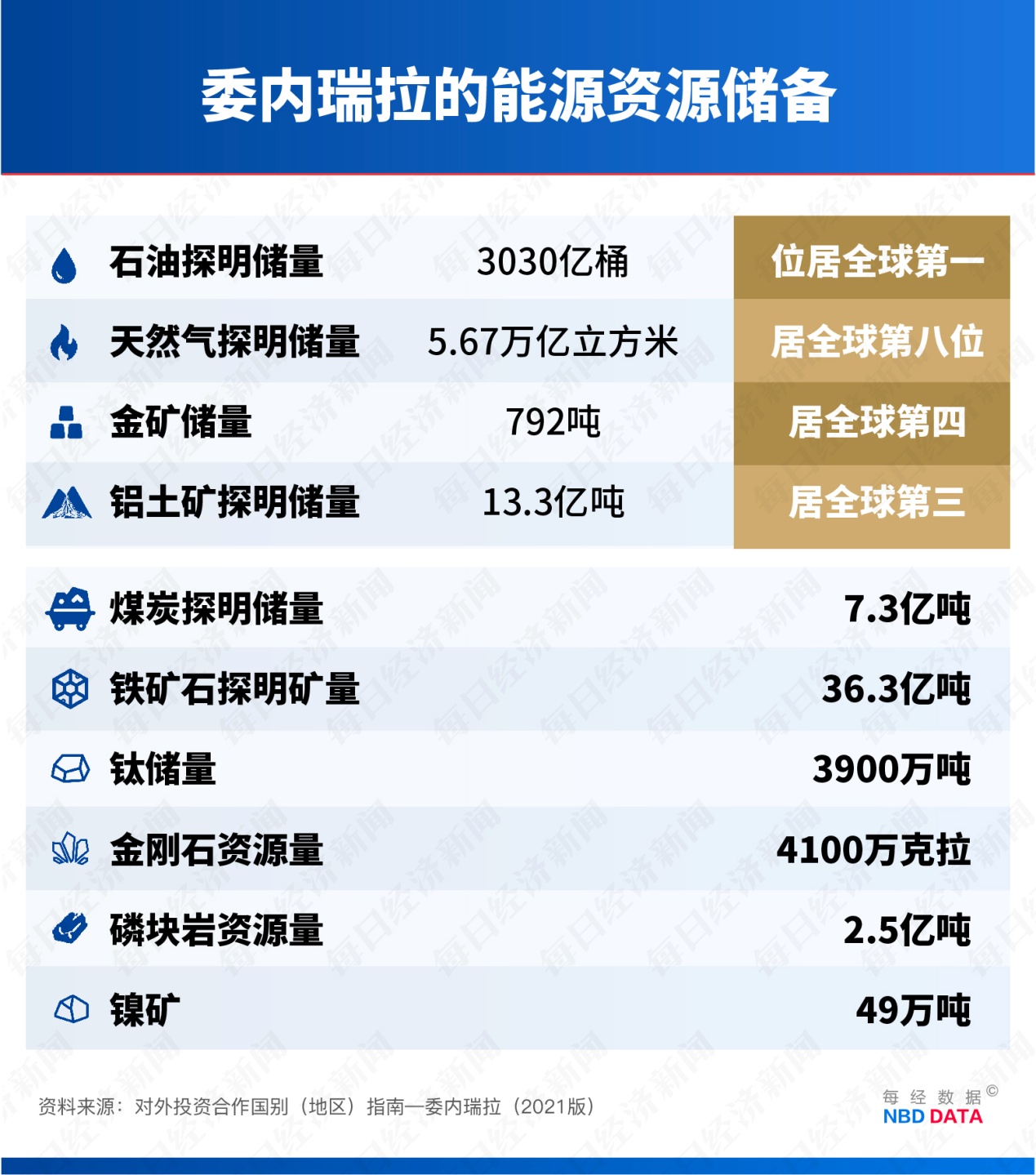
不止3030亿桶石油和150万吨稀土!美国盯上委内瑞拉和格陵兰岛 为美元美债“续命”
Mei Ri Jing Ji Xin Wen· 2026-01-10 05:14
强掳委内瑞拉总统马杜罗后,美国总统特朗普"必须拥有整个格陵兰"的强硬表态又震惊全球。 南到掌控全球最丰富石油资源的委内瑞拉,北到坐拥150万吨稀土的格陵兰岛,美国紧盯这两大 "资源宝库"背后,是美元霸权减弱与超38万亿美元债务压顶 带来的双重焦虑。 当前,全球约20%的石油交易已不再使用美元结算,美元在全球外汇储备中的份额也降至新低,产油国对美债的兴趣也大不如前。"石油—美元—美债"的旧 循环已经松动。 抢夺海外资源,真能为美元和美债"续命"? 资源丰富,是委内瑞拉和格陵兰岛的共同优势,也是美国试图染指的主要原因。 | 石油探明储量 | 3030亿桶 | 位居全球 | | --- | --- | --- | | 天然气探明储量 ▲ 4 | 5.67万亿立方米 | 居全球货 | | 金矿储量 | 792吨 | 居全球 | | △ 铝土矿探明储量 | 13.3亿吨 | 居全球 | | 煤炭探明储量 | | 7.3 | | ∞ 铁矿石探明矿量 | | 36.3 | | & 钛储量 | | 3900 | | % 我刚已经浪量 | | 4100万 | | 磷块岩资源量 | | 2.5 | | | | 49 | | 盗料 ...
去年金价狂飙美元贬值全球资产加速去美元化
Xin Lang Cai Jing· 2026-01-10 02:25
Core Insights - In 2025, global central banks increased their gold holdings to enhance portfolio diversity and stability, leading to a significant rise in international gold prices, which saw over 50 record highs throughout the year [1] - Conversely, the US dollar index fell from around 108 at the beginning of 2025 to approximately 98 by year-end, marking a cumulative decline of 9.4%, the worst performance in eight years [1] - The share of the US dollar in global foreign exchange reserves continued to decline, with the International Monetary Fund reporting a drop from 57.08% in Q2 2025 to 56.92% in Q3 2025, remaining below 60% for over ten consecutive quarters, the lowest level since 1995 [1] - The trend of de-dollarization is becoming more pronounced globally, as more countries increase their gold reserves, resulting in global central bank gold holdings surpassing US Treasury securities for the first time in nearly 30 years [1] - Experts indicate a decreasing risk appetite for dollar-denominated assets, suggesting that the downward trend in the dollar's share of global foreign exchange reserves is unlikely to reverse, leading to a more diversified international monetary system [1]
去年金价狂飙美元贬值,美元信用裂痕扩大产加速去美元化
Sou Hu Cai Jing· 2026-01-10 01:43
钛媒体App 1月10日消息,2025年全球央行纷纷增持黄金,以增强资产组合的多元性与稳定性,这导致 国际黄金价格大涨。金价在2025年年内50多次刷新历史新高,伦敦现货黄金累计涨幅超过60%。与之相 反的是,美元指数从2025年年初的108附近,下跌到年底的98左右,累计跌幅9.4%,创下8年来最差表 现。美元在全球外汇储备中的占比也是一跌再跌。国际货币基金组织发布的数据显示,2025年第三季 度,美元在全球外汇储备中的占比从第二季度的57.08%下降至56.92%,连续超10个季度低于60%,创 1995年以来的最低值。(广角观察) ...
2025年金价狂飙美元贬值 全球资产加速去美元化
Sou Hu Cai Jing· 2026-01-10 00:52
Core Viewpoint - The article highlights the significant decline in the value of the US dollar and the concurrent rise in gold prices, indicating a structural challenge to the dollar's creditworthiness and a shift towards de-dollarization in global asset allocation [1][2][6][8]. Group 1: Gold Price Surge - In 2025, gold prices reached new historical highs over 50 times, with a cumulative increase of over 60% in London spot gold [2]. - The global central banks are increasing their gold holdings to enhance the diversity and stability of their asset portfolios [2][9]. Group 2: Decline of the US Dollar - The US dollar index fell from around 108 at the beginning of 2025 to approximately 98 by the end of the year, marking a cumulative decline of 9.4%, the worst performance in eight years [4]. - The share of the US dollar in global foreign exchange reserves decreased from 57.08% in Q2 2025 to 56.92% in Q3 2025, remaining below 60% for over ten consecutive quarters, the lowest level since 1995 [4]. Group 3: Structural Challenges to Dollar Credit - The aggressive tariff policies of the US government and increased intervention in the independence of the Federal Reserve have raised concerns about the sustainability of US government debt, further undermining the dollar's credit foundation [6]. - The frequent weaponization of the dollar through financial sanctions has shaken global confidence in the dollar, a trend expected to continue [8]. Group 4: Shift Towards De-dollarization - The trend of de-dollarization is evident as global central banks increase their gold reserves, surpassing US Treasury holdings for the first time in nearly 30 years [9]. - By mid-2025, the share of US Treasuries in central bank reserves fell below 25%, while gold's share rose above 25%, marking a significant shift in asset allocation [9][11]. - The risk appetite for dollar assets is declining, suggesting a long-term downward trend in the dollar's share of global foreign exchange reserves and an evolution towards a more diversified international monetary system [11].
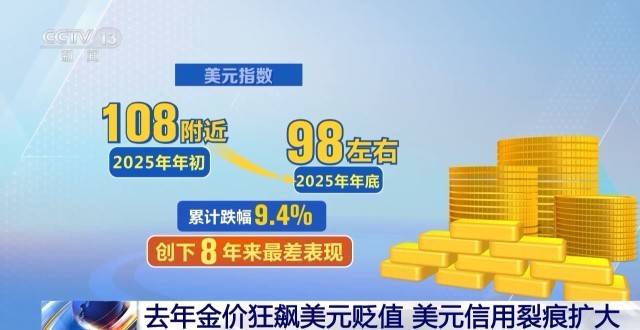
视频丨去年金价狂飙美元贬值 全球资产加速去美元化
Yang Shi Xin Wen· 2026-01-10 00:34
Core Insights - The article highlights a significant decline in the value of the US dollar and a corresponding surge in gold prices, indicating a potential challenge to the dollar's credibility by 2025 [1][3][5]. Group 1: Dollar Performance - The US dollar index fell from around 108 at the beginning of 2025 to approximately 98 by the end of the year, marking a cumulative decline of 9.4%, the worst performance in eight years [3]. - The share of the dollar in global foreign exchange reserves has been continuously decreasing, with the International Monetary Fund reporting a drop from 57.08% in Q2 2025 to 56.92% in Q3 2025, remaining below 60% for over ten consecutive quarters, the lowest since 1995 [3]. Group 2: Gold Price Surge - In 2025, gold prices reached new historical highs more than 50 times throughout the year, with the London spot gold price increasing by over 60% cumulatively [1]. - The global central banks are increasing their gold holdings to diversify and stabilize their asset portfolios, leading to a significant rise in international gold prices [1][5]. Group 3: Structural Challenges to Dollar Credibility - The aggressive tariff policies of the US government have severely impacted global multilateral trade and increased intervention in the independence of the Federal Reserve, raising concerns about the sustainability of US government debt [5]. - The frequent weaponization of the dollar through financial sanctions has eroded global confidence in the dollar, suggesting a continued trend towards de-dollarization in global asset allocation [7]. Group 4: Shift in Global Asset Allocation - By mid-2025, the share of US Treasury bonds in central bank reserves (excluding the Federal Reserve) fell below 25%, while gold's share rose above 25%, marking the first time since 1996 that gold surpassed US debt in central bank reserves [7]. - The global capital's risk appetite for dollar assets is declining, indicating that the downward trend of the dollar's share in global foreign exchange reserves is unlikely to reverse, leading to a more diversified international monetary system [9]. Group 5: Future of International Monetary System - Despite the decline of the dollar, the weak economic performance of Europe and Japan suggests that the euro and yen are unlikely to replace the dollar in the short term, prompting central banks to allocate more foreign exchange reserves to gold [11]. - The long-term decline of the dollar indicates a shift towards a multipolar international monetary system, where a few major currencies will compete and balance against each other [11].