
资产配置

Search documents
中央汇金,万亿元持仓情况出炉
Jin Rong Shi Bao· 2025-09-02 09:47
Group 1 - The central government-backed investment entity, Central Huijin, significantly increased its holdings in stock ETFs during the first half of the year, reaching a record high of over 1.28 trillion yuan, accounting for more than 30% of the total stock ETF market [1][2] - Central Huijin's total stock ETF holdings increased by 236.2 billion yuan, or 22.7%, from the end of last year, with the number of shares rising by 657.9 million, or 21.2% [1] - Central Huijin's investment in 21 stock ETFs remained unchanged, with only one ETF experiencing a reduction in holdings due to a share consolidation [1] Group 2 - Central Huijin Asset Management actively increased its stock ETF holdings, with the number of ETFs held rising by over 50% compared to the end of last year, and a total investment exceeding 210 billion yuan in 12 new ETFs [2] - The total holdings of Central Huijin Asset Management reached 612.35 billion yuan by the end of June [2] - The actions of Central Huijin have been perceived as a stabilizing force in the market, enhancing investor confidence and attracting more foreign investment into the A-share market [2][3] Group 3 - There is a growing confidence among investors in Chinese assets, particularly among overseas investors, as they increasingly seek to diversify their portfolios away from the US dollar [3] - The current macroeconomic environment is favorable for capital inflows into the Chinese stock market, with the characteristics of A-share market returns becoming more appealing [3] - The continued support from entities like Central Huijin is expected to guide long-term capital into the market, promoting steady progress towards high-quality development of the A-share market [3]
投资债基的秘密,藏在这份报告中!快来看看吧
Sou Hu Cai Jing· 2025-09-02 07:27
Core Insights - Bond funds have shown increasing average returns over the past 3, 5, and 7 years, with a widening gap between the best and worst performers [2][4][5] - The recent recovery in the A-share market has heightened investor interest in equity investments, but bond funds remain essential for stabilizing asset allocation [2][4] - The report titled "China Fund Industry Marathon Master Gathering 2025" analyzes extensive data to assess the long-term performance of bond funds [2] Performance Analysis - The average returns for the entire bond fund market over the past 3, 5, and 7 years are 8.37%, 17.32%, and 32.36% respectively, with a notable increase in the proportion of funds yielding positive returns [4][5] - Specific categories of bond funds, such as pure bond funds and mixed bond funds, have also demonstrated improved performance over time, with average returns of 9.49%, 17.64%, and 28.12% for pure bond funds over the past 3, 5, and 7 years [5][6] - The number of bond funds with positive returns has increased significantly, with 99.42% of funds achieving positive returns over the past 7 years [4] Risk and Performance Discrepancies - "Rights-containing" bond funds have shown mixed results, with some experiencing significant declines during market adjustments [6][7] - A total of 203 bond funds reported negative returns over the past 3 years, with a concentration in "rights-containing" funds [6][7] - Notably, some "rights-containing" funds have also achieved outstanding performance, with several funds exceeding 30% returns over the past 7 years [8][9] Top Performing Funds - The top-performing bond funds over the past 3 years include 富国久利稳健配置 A (41.20%), 华夏大中华信用精选 A 人民币 (34.97%), and 华商恒益稳健 (32.51%) [10] - Over the past 5 years, 华商丰利增强定开 A (131.24%) and 华商恒益稳健 (95.43%) lead the performance rankings [10] - For the past 7 years, 华商丰利增强定开 A (170.07%) and 汇丰晋信 2026 (127.30%) are among the top performers [10]


美股三大指数最新表现分析
Xin Lang Cai Jing· 2025-09-02 03:17
Group 1 - The S&P 500 Index has an annualized return of approximately 10.26% since its inception in 1957, covering about 83% of the total U.S. market capitalization and over 50% of the global stock market [1] - The Nasdaq 100 Index has shown remarkable performance, increasing nearly 194 times from 100 points at its inception in 1985 to 14,694.24 points as of September 20, 2024, with only 8 years of decline in the past 40 years [1] - The Dow Jones Industrial Average reflects the market dynamics of 30 leading industrial companies across various sectors, serving as a barometer for the health of the U.S. economy [2] Group 2 - In the past month, technology and consumer goods companies have shown significant performance among the top 30 stocks in the U.S. market, indicating a strong market response to technological innovation and consumer demand [2] - The top 30 companies by market capitalization in 2025 are primarily concentrated in high-growth and high-value sectors, particularly technology and finance, showcasing their strong adaptability and innovation in the current economic landscape [2] - The top 30 companies in terms of dividend yield in 2025 demonstrate robust dividend policies, providing stable returns for income-seeking investors [3] Group 3 - Diversified investment tools are crucial for household asset allocation in the current market environment, with many investors prioritizing suitable funds or ETFs for their financial planning [3] - The performance of the S&P 500, Nasdaq 100, and Dow Jones Industrial Average not only reflects the overall trend of the U.S. stock market but also offers rich information and investment opportunities for investors [3]
鹏华郑科:权益市场蓄势待发,新质生产力有望引领趋势
Zhong Guo Jing Ji Wang· 2025-09-02 02:36
回顾2025年上半年,国内权益市场延续结构性牛市格局,机器人、港股、创新药、银行等板块轮番上 涨,呈现出"多点开花"的赚钱效应。与此同时,地缘冲突推升避险需求,商品类资产出现阶段性对冲机 会;国内债市受低利率环境制约,票息收益空间有限;美股则因政策预期反复,波动显著加剧,单一资 产投资难度明显提高。 2025年上半年,A股市场震荡上行,结构性机会频现,权益资产吸引力持续提升,为以资产配置见长的 公募FOF提供了施展能力的平台。中信证券研报显示,截至二季度末,公募基金管理总规模达33.7万亿 元,各类型基金普遍实现规模扩张。其中,公募FOF表现尤为突出:全市场FOF产品数量达519只,管 理规模攀升至1667亿元,新发FOF募集规模超186亿元。从业绩角度看,二季度中证FOF指数的区间收 益为0.71%。偏股型FOF、平衡型FOF和偏债型FOF的季度收益中枢分别约2.11%、1.62%和1.19%。 市场回暖,部分FOF产品凭借出色的资产配置与基金优选能力脱颖而出,成为本轮结构性行情中的领跑 者。其中,鹏华基金首席资产配置官郑科执掌的鹏华易诚积极3个月持有期混合(FOF) (A:019245;C:019246) ...
懒人投资必备!基金定投最全攻略:从入门到精通
Sou Hu Cai Jing· 2025-09-02 02:24
Group 1 - The core mechanism of systematic investment plans (SIPs) involves "fixed time + fixed amount + fixed target," achieving two main functions [2] - SIPs are compared to one-time investments, showing that SIPs can accumulate more low-cost shares during market downturns, leading to higher returns during market rebounds [4][5] - A practical example illustrates that a monthly investment of 1,000 yuan over six months can yield a net profit of 2,299.53 yuan, resulting in an actual return rate of 38.33% [6][10] Group 2 - Basic and enhanced strategies for SIPs include valuation strategies that adjust investment amounts based on historical price-to-earnings (PE) ratios, which can improve annualized returns [9] - Common misconceptions about SIPs include the belief that they can operate completely automatically, which is not true; regular performance reviews are necessary [14] - The article emphasizes the importance of selecting quality assets and allowing sufficient time for compound interest to work, aligning with Warren Buffett's investment philosophy [18]
李嘉诚坦言:未来10年,将存款换成这4种资产,或将衣食无忧
Sou Hu Cai Jing· 2025-09-01 23:39
Core Insights - The traditional investment avenues such as real estate and bank deposits are no longer considered safe, as highlighted by Li Ka-shing's statement that the next decade requires embracing new lifestyles and investment strategies [1][15][17] Group 1: Investment in Self - The most valuable asset is one's own brain, emphasizing the importance of continuous learning and skill acquisition to avoid being left behind in a rapidly changing job market [3][5] - Investing in personal development, such as financial literacy and professional skills, is deemed more beneficial than keeping funds idle in a bank [5][15] Group 2: Health as Wealth - Health is regarded as the most precious wealth, with Li Ka-shing advocating for prioritizing health over material possessions [7][9] - Simple habits like regular exercise, proper sleep, and a balanced diet are more effective for maintaining health than expensive insurance [7][9] Group 3: Gold as a Safe Haven - Gold is highlighted as a stable asset amidst market pressures, serving as a hedge against inflation and economic uncertainty [9][11] - Investors are encouraged to include gold in their asset allocation, with a recommended proportion of 20% to 30% of family assets [11][13] Group 4: Quality Assets and Bonds - The real estate market has shifted, and the focus should be on purchasing the right properties rather than speculative investments [13][15] - Quality assets are defined as those with strong risk resistance, such as government bonds, blue-chip stocks, and prime real estate in core urban areas [13][15] Conclusion - The insights from Li Ka-shing suggest a paradigm shift in investment strategies, moving away from reliance on traditional assets towards a diversified approach that includes personal development, health, gold, and quality investments [15][17]

瑞银:投资者对投资中国的信心不断增强 外资配置意愿逐步提高
Zhi Tong Cai Jing· 2025-09-01 23:24
Group 1 - The overall confidence of investors in Chinese investments is increasing, particularly among overseas investors who are gradually raising their allocation to non-US assets, including Chinese assets [1] - As of June, foreign investors' holdings in A-shares exceeded 3 trillion RMB, accounting for 7.4% of the total free float market capitalization of A-shares [1] - There is a notable increase in participation from overseas investors, particularly from the US and the Middle East, in the 22nd UBS Securities China A-Share Seminar compared to previous years [1] Group 2 - The current global interest rate cut expectations, combined with low domestic interest rates, have created a favorable liquidity environment for capital inflow into the Chinese stock market [2] - The continuous strengthening of economic policies and a clearer external environment are expected to support the upward trend of A-shares, with high-quality companies likely to achieve higher valuations [2] - Technological innovation remains a core competitive advantage for Chinese companies and will be a focal point for future investments in China [2]
多家黄金企业上半年净利润增幅超100%
21世纪经济报道· 2025-09-01 15:57
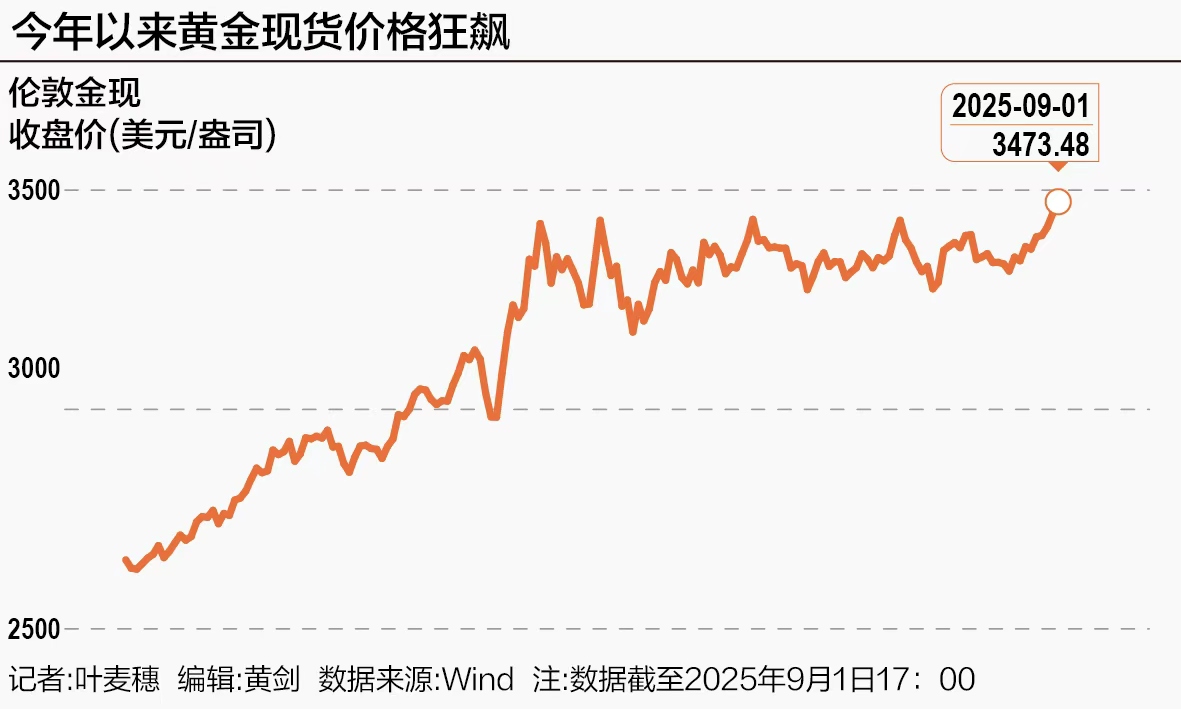
记者丨叶麦穗 编辑丨黄剑 市场担忧美联储独立性受到挑战,投资者避险情绪升温,国际金价上周上涨2.86%。整个8 月, 国际金价累计涨幅超过5%,创下今年4月以来的最佳单月表现 。9月1日(截至北京时间 17:00),黄金再度驶入上涨通道,最高触及3489.86美元/盎司,距离历史新高仅有一步之 遥。与此同时,COMEX黄金期货价格盘中最高冲至3557.1美元/盎司,站上历史最高点。 多家机构积极上调了黄金价格展望,多数机构认为明年站上4000美元/盎司不是梦 。在金价迭 创新高之际,黄金上游采矿公司的业绩也是全线飘红,其中多家公司的净利润实现翻倍。 多家机构上调黄金价格展望 据新华社报道,8月25日,美国总统特朗普解雇美联储理事库克,引发市场对美联储独立性受 政治干预的担忧。最新CME"美联储观察"数据显示,9月维持利率不变的概率为12.6%,降息 25个基点的概率为87.4%,到10月维持利率不变的概率为5.6%,累计降息25个基点的概率为 45.8%,累计降息50个基点的概率为48.6%。 市场的主流观点认为,近期聚焦于美联储货币政策转向的逻辑,叠加美联储独立性受质 疑,重新推升市场避险买盘,关注金价能否 ...



金价迭创新高,多家黄金企业半年净利润翻倍
2 1 Shi Ji Jing Ji Bao Dao· 2025-09-01 12:56
Core Viewpoint - The market is concerned about the independence of the Federal Reserve, leading to increased investor risk aversion and a significant rise in international gold prices, which saw a monthly increase of over 5% in August, the best performance since April of this year [1][3]. Gold Price Outlook - Multiple institutions have raised their gold price forecasts, with UBS predicting that gold prices could reach $4,000 per ounce next year, and adjusting their 2026 price targets to $3,600 and $3,700 per ounce for March and June respectively [3][4]. - Citibank has also increased its three-month gold price forecast from $3,300 to $3,500 per ounce, citing deteriorating economic growth and inflation prospects in the U.S. as key drivers [4]. - Goldman Sachs maintains a target of $3,700 per ounce by the end of 2025, with potential for prices to reach $3,810 to $3,880 if central bank purchases exceed expectations [4]. Mining Companies Performance - Gold mining companies have reported significant profit growth, with all 11 listed gold mining companies showing positive net profit growth in the first half of the year [6][10]. - Shandong Gold achieved a revenue of 56.77 billion yuan, a year-on-year increase of 24.01%, and a net profit of 2.808 billion yuan, up 102.98% year-on-year, benefiting from rising gold prices and optimized cost control [9][10]. - Western Gold reported a revenue of 5.03 billion yuan, a 69.01% increase year-on-year, with net profit rising by 131.94% due to increased gold production and higher prices [10]. Investment Trends - The rise in gold prices has led domestic asset management institutions to recognize the importance of gold in asset allocation, with nearly 45% of 515 FOF products now holding gold ETFs, up from 192 last year [4][5]. - The recent policy allowing insurance companies to invest in gold is expected to bring approximately 200 billion yuan in incremental funds to the gold market [5].


银河基金蒋磊:债券资产配置正当时 可转债双重属性更具吸引力
Zheng Quan Ri Bao Wang· 2025-09-01 08:44
Core Viewpoint - The A-share market is witnessing new highs, leading to increased interest in multi-asset allocation, particularly in bonds as a long-term investment option that can withstand market cycles [1] Group 1: Bond Market Insights - The recent correction in the bond market has improved the valuation attractiveness, presenting a potential opportunity for investment [1] - Galaxy Leading Bond A (519669) has achieved positive returns for nearly 12 consecutive years, with an annualized return exceeding its performance benchmark, highlighting its long-term investment value [1] - The fund's asset allocation strategy is diversified, including government bonds, financial bonds, corporate bonds, medium-term notes, and convertible bonds, balancing risk and return through macro analysis and individual bond selection [1] Group 2: Convertible Bonds Strategy - The unique value of the convertible bond market lies in its dual characteristics: it can exhibit equity-like behavior in a rising stock market and provide bond-like returns during market fluctuations [1] - The fund manager employs a quantitative model to select convertible bonds, ensuring quality and reasonable valuation while maintaining liquidity in the pure bond portion [2] - A four-tier defense system is established for risk control, including overall risk exposure management, cross-market risk awareness, internal diversification within the convertible bond portfolio, and adherence to disciplined investment processes [2]