国补政策

Search documents
拼多多:重回摇钱树?
Hu Xiu· 2025-08-25 23:34
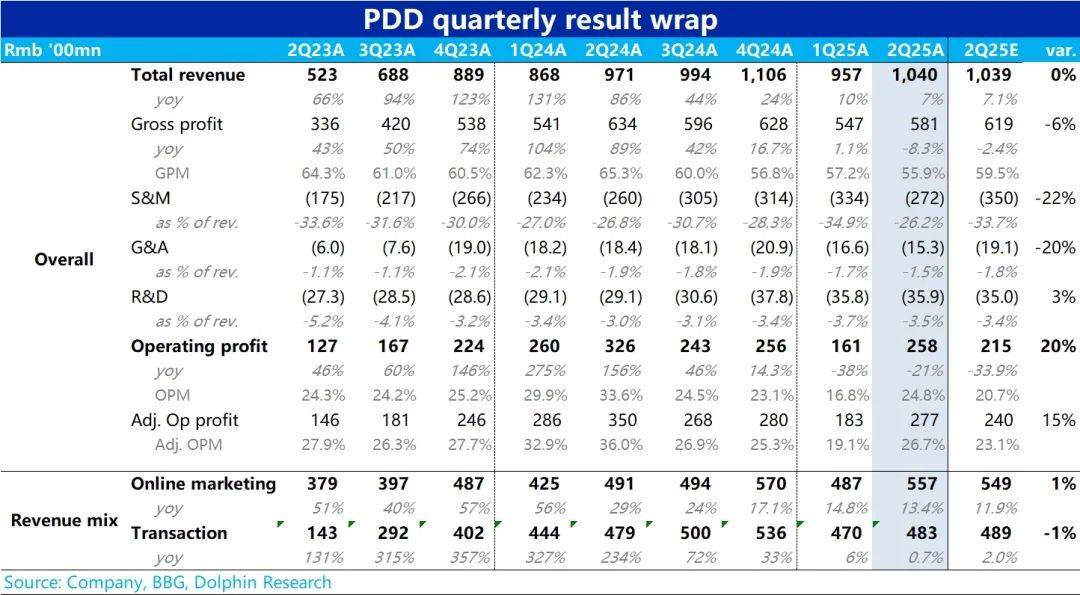
Core Viewpoint - Pinduoduo's Q2 performance exceeded expectations, leading to a temporary stock price surge, but the overall growth remains stable and lacks significant surprises [1][17]. Revenue Performance - Total revenue for Q2 reached approximately 104 billion RMB, a year-on-year increase of 7%, aligning closely with market expectations after two consecutive quarters of underperformance [2][39]. - The revenue growth rate continues to slow, primarily due to the impact of Temu's transition from a fully managed to a semi-managed model, which has affected revenue recognition [3][40]. Advertising Revenue - Core advertising revenue grew by 13.4% year-on-year, consistent with market expectations, indicating that the growth of Pinduoduo's main platform has stabilized [4][41]. - The narrowing trend in advertising monetization rates appears to have ended, suggesting that Pinduoduo's growth advantage over competitors may have diminished [5][6]. Temu's Performance - Temu's commission-based revenue for the quarter was approximately 48.3 billion RMB, showing less than 1% year-on-year growth, which was anticipated by the market [7][45]. - Despite the challenges posed by increased tariffs in the U.S., Temu's overall GMV growth is estimated to have remained above 40% due to rapid adaptation and market expansion efforts [9][48]. Marketing Expenditure - Marketing expenses were significantly lower than expected, totaling 27.2 billion RMB, which was nearly 8 billion RMB less than anticipated, contributing to the profit exceeding expectations [10][57]. - The reduction in marketing spending is attributed to decreased investment in the main platform, reflecting a potential improvement in competitive positioning [12][59]. Profitability - The overall operating profit margin improved to nearly 25%, up from 17% in the previous quarter, with actual operating profit around 25.8 billion RMB, exceeding market expectations by 4.3 billion RMB [14][63]. - Although net profit reached 30.8 billion RMB, influenced by investment income, the underlying profitability remains strong as long as expenses are managed effectively [15][64]. Future Outlook - The company is likely to maintain a certain level of subsidies in its main platform to counterbalance its relative disadvantages in the market, especially in light of competitors' strong performance [20][24]. - Temu's long-term growth potential remains uncertain, but the recent shift towards a more diversified market approach may enhance its resilience against single-market dependencies [28][31].


拼多多:重回摇钱树?掰不过管理层 “按头跪”
Xin Lang Cai Jing· 2025-08-25 14:28
Core Viewpoint - Pinduoduo's Q2 performance exceeded profit expectations, leading to a temporary stock price surge, but revenue growth remains stable and unremarkable, indicating a potential slowdown in growth momentum [1][5]. Revenue Performance - Total revenue for Q2 reached approximately 104 billion RMB, a year-on-year increase of 7%, aligning closely with market expectations after two consecutive quarters of underperformance [1][10]. - Core advertising revenue grew by 13.4% year-on-year, also meeting market expectations, suggesting that growth in Pinduoduo's main platform has stabilized [1][11]. Temu's Performance - Transaction commission revenue for Temu was about 48.3 billion RMB, showing negligible growth of less than 1% year-on-year, primarily due to increased tariffs and the shift from full to semi-managed business models [2][15]. - Despite challenges, Temu's overall GMV growth is estimated to exceed 40%, indicating resilience through market expansion and business model adaptation [2][7]. Marketing and Expenses - Marketing expenses were significantly lower than expected at 27.2 billion RMB, nearly 8 billion RMB less than anticipated, contributing to a stronger profit performance [2][20]. - R&D expenses continued to grow at approximately 23% year-on-year, while management expenses decreased by nearly 17%, reflecting improved operational efficiency [2][20]. Profitability - Operating profit margin improved to nearly 25%, up from 17% in the previous quarter, with actual operating profit around 25.8 billion RMB, exceeding market expectations by 4.3 billion RMB [3][23]. - Net profit reached 30.8 billion RMB, influenced by investment income exceeding 10 billion RMB, showcasing Pinduoduo's strong profitability under effective cost control [3][24]. Market Position and Future Outlook - Pinduoduo's performance, while stable, lags behind competitors like JD.com and Vipshop, which reported stronger growth, indicating a relative disadvantage in the current market environment [5][12]. - The company may need to maintain subsidy efforts in its main platform to counterbalance competitive disadvantages, although the negative impact of subsidies is expected to diminish over time [5][6].
ST帽子还没摘,苏宁开始反攻线下了
Di Yi Cai Jing· 2025-08-25 04:41
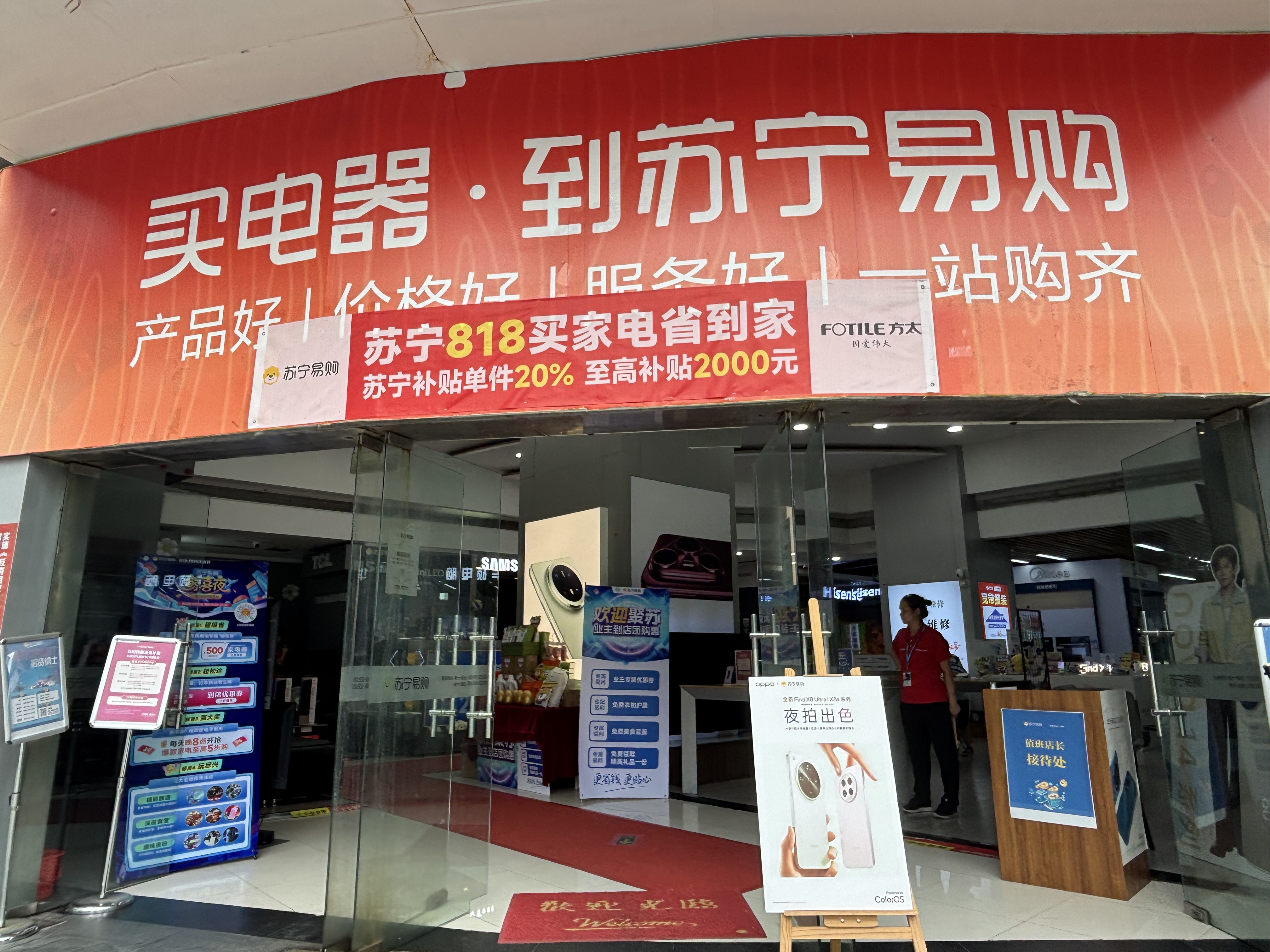
Core Viewpoint - Suning is attempting to revitalize its offline business through aggressive expansion of large stores, despite facing significant challenges and a history of financial difficulties [1][10]. Group 1: Offline Expansion Strategy - Suning has opened several large stores, including the Suning Max and Suning Pro formats, with individual store areas exceeding 40,000 square meters [3][9]. - As of June 2024, Suning has established 10 Suning Max stores and over 100 Suning Pro stores nationwide, indicating a strong commitment to its offline strategy [3][8]. - The company aims to enhance the quality of its offline stores while integrating online and offline sales channels to attract high-end customers [3][8]. Group 2: Financial Performance and Goals - After years of losses, Suning reported a net profit of 610 million yuan for 2024, marking its first annual profit since 2020 [8]. - The company has set a target to achieve comprehensive profitability by 2025, focusing on operational improvements and store innovations [2][8]. - In the first quarter of 2024, Suning's overall store sales revenue increased by 19.3% year-on-year, with comparable store sales rising by 23.3% [8]. Group 3: Impact of National Subsidies - National subsidy policies, such as trade-in programs, have provided Suning with opportunities to boost sales of high-end appliances, with orders for trade-in services increasing by 81% year-on-year [11][12]. - The demand for high-end appliances has shifted from single products to bundled solutions, enhancing the value of offline retail [11][12]. - Suning's stock price has shown recovery, reaching 2.38 yuan per share during peak sales periods influenced by national subsidies [11]. Group 4: Challenges and Market Competition - Suning faces ongoing challenges in managing cash flow and long-term store operations, particularly as national subsidy policies undergo adjustments [13][14]. - The company has closed 110 stores while opening 25 new ones in the first quarter of 2025, indicating a strategic realignment of its store network [14]. - Increased competition from rivals like JD.com, which is rapidly expanding its own store formats, poses additional challenges for Suning in the offline market [14].

国补新变动,有的暂停有的加码,要抓紧了!
猿大侠· 2025-08-24 04:11
Core Viewpoint - The article discusses the recent changes in the "old-for-new" subsidy policies in China, highlighting the reactivation of national subsidies and the varying local implementations that affect consumer access to these benefits [1][8][12]. Group 1: National Subsidy Policy - The national "old-for-new" subsidy program has been officially restarted with a total of 69 billion yuan allocated to various provinces, extending the subsidy period until December 31, 2025 [1]. - Consumers are encouraged to take advantage of the subsidies, but there is a strict deadline for applications, with no extensions allowed for late submissions [1]. Group 2: Local Policy Adjustments - Several provinces, including Qinghai, Guizhou, and Inner Mongolia, have suspended their automobile replacement subsidies, with some regions also halting vehicle scrapping policies [2][4]. - Wuhan has announced a suspension of its automobile replacement subsidy while continuing the vehicle scrapping policy, indicating a selective approach to subsidy implementation [4]. Group 3: Regional Variations and Consumer Impact - The rapid changes in subsidy policies have left consumers uncertain, as benefits that were available one day may be withdrawn the next [7]. - Despite some regions pausing their policies, others like Chongqing have increased their automobile replacement subsidy by 300 million yuan, demonstrating a commitment to stimulate automotive consumption [9][12]. Group 4: Consumer Strategies and Financial Support - Consumers are now required to act quickly to secure subsidies, often needing to "抢券" (grab coupons) to access benefits, which has led to a competitive environment akin to ticket sales for concerts [13][15]. - A new personal consumption loan subsidy policy will be implemented starting September 1, 2023, providing financial incentives for consumers, which can complement the "old-for-new" policies [17].

订单横“扫”全球!已排单到年底!什么这么火
Huan Qiu Wang· 2025-08-22 12:38
Core Insights - China is a major production base for robotic vacuum cleaners, with a significant increase in export orders this year, particularly during the peak production season [1][3] - The "National Subsidy" policy has stimulated market demand, leading to a notable increase in sales of robotic vacuum cleaners [7][9] Group 1: Export Market Dynamics - A robotic vacuum cleaner company in Suzhou is experiencing a surge in export orders, with an average of 30 containers shipped daily during peak periods [3] - The company has expanded production capacity and introduced automation to meet the growing demand, reducing the average production cycle from 40 days to 30 days [5] - The European market remains a key focus, with exports to this region seeing over 100% growth [5] Group 2: Domestic Market Growth - From January to July, Suzhou exported a total of 55.88 million home appliances, including robotic vacuum cleaners, marking a 4.2% year-on-year increase [7] - Domestic sales of robotic vacuum cleaners reached 10.6 billion yuan from January to July, reflecting a 40% year-on-year growth [9] Group 3: Technological Advancements - The rapid development of AI algorithms and the localization of core components have accelerated the iteration speed of robotic vacuum cleaners [11][13] - Companies are focusing on enhancing cleaning technology, human-machine interaction, and environmental perception to shorten R&D cycles [13][14] - New technologies, such as self-cleaning rollers and advanced sensors, are being integrated into products to improve performance [13][14]
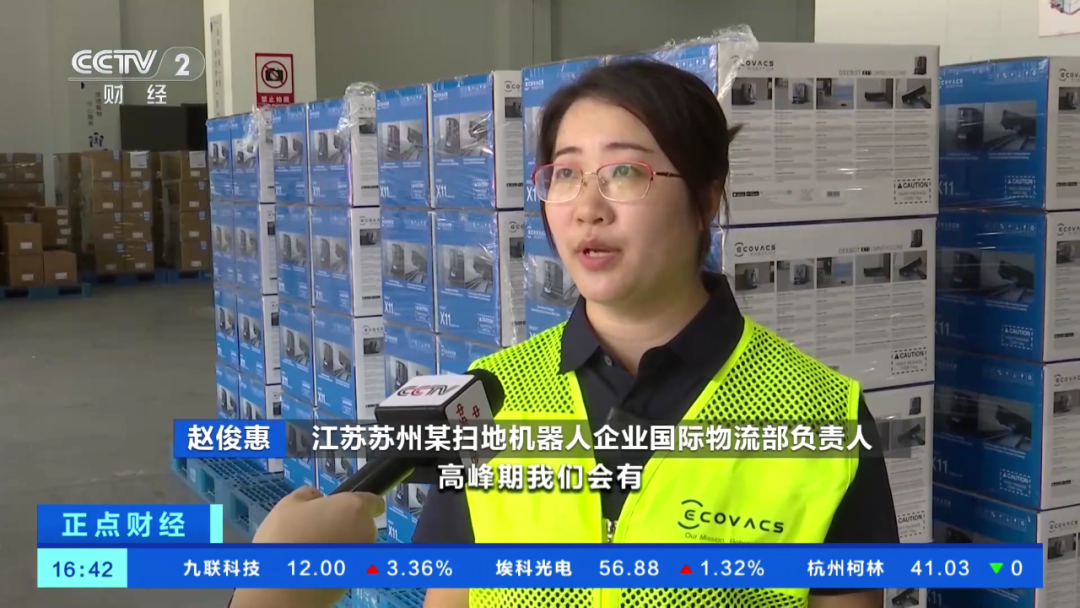
中国扫地机器人订单横扫全球扫地机器人订单排到年底了
Xin Lang Cai Jing· 2025-08-22 11:56
Core Insights - China is a major production base for robotic vacuum cleaners, currently experiencing a peak in export orders due to significant growth in demand [1] - Domestic sales of robotic vacuum cleaners have also surged, driven by government subsidies and changing consumer preferences [1] Group 1: Export Market - Export orders for robotic vacuum cleaners have increased significantly, with some companies reporting full production capacity since the beginning of the year [1] - The European market has seen over 100% growth in orders for robotic vacuum cleaners [1] Group 2: Domestic Market - The domestic market for robotic vacuum cleaners has benefited from the "national subsidy" policy, which lowers purchase costs for consumers [1] - From January to July of this year, domestic sales revenue for robotic vacuum cleaners reached 10.6 billion yuan, representing a 40% year-on-year increase [1]

箭牌家居(001322) - 001322箭牌家居投资者关系管理信息20250821
2025-08-21 13:06
Financial Performance - In the first half of 2025, the company's operating revenue was 2.837 billion CNY, a year-on-year decrease of 8.12% [1] - Gross profit margin was 29.47%, an increase of 2.43 percentage points year-on-year [1] - Net profit decreased by 25.96% year-on-year [1] - The company's net profit after deducting non-recurring gains and losses increased by 6.33% year-on-year [2] Revenue Breakdown - Domestic main business revenue was 2.726 billion CNY, a year-on-year decrease of 5.83%, accounting for 97.37% of total revenue [2] - Retail revenue was 1.138 billion CNY, a year-on-year increase of 4.22% [2] - E-commerce revenue was 576 million CNY, a year-on-year decrease of 7.85%, accounting for 20.59% of total revenue [2] - Home decoration channel revenue was 462 million CNY, a year-on-year decrease of 3.51%, accounting for 16.51% [2] - Engineering channel revenue was 549 million CNY, a year-on-year decrease of 21.35%, accounting for 19.62% [2] Cost and Expenses - Operating expenses increased by 1.19%, with selling expenses rising by 5.41% due to increased strategic investments in overseas markets [3] - The increase in operating expenses led to a 2.53% rise in the expense ratio [3] Market and Strategy - The fluctuation in the new housing market has impacted demand growth in the bathroom industry, but the demand from existing housing continues to be released [3] - The company plans to focus on retail channel construction and refine operational management, expanding the store efficiency enhancement project [3][4] - The company is actively pursuing international expansion, establishing partnerships with local distributors and expanding its online sales through overseas e-commerce platforms [4] Policy Impact - The national subsidy policy has positively influenced the company's sales structure and gross profit margin [4] - The clarity of the national subsidy policy affects the company's operational strategy, but the ongoing refinement of management is deemed more critical [4]
华为重返中国手机市场第一,Q2智能手机出货量终结六连增
Nan Fang Du Shi Bao· 2025-08-18 13:21
Core Insights - The Chinese smartphone market experienced a decline in shipments in Q2 2025, with a total of 68.86 million units shipped, representing a year-on-year decrease of 4.1%, ending a six-quarter growth streak [1][2] - Huawei regained the top position in the Chinese market with a shipment of 12.5 million units, capturing approximately 18% market share, despite a slight decline of 3.4% compared to the previous year [1][2] - The overall market is under pressure, with major competitors like Vivo and OPPO facing significant declines in shipments, while Xiaomi was the only brand among the top five to achieve positive growth [2] Market Dynamics - The competitive landscape among leading smartphone manufacturers has intensified, with Huawei, Vivo, OPPO, Xiaomi, and Apple being the top five players in the market [2] - Vivo and OPPO reported shipments of 11.9 million and 10.7 million units respectively, reflecting year-on-year declines of 10.1% and 5.0% [2] - Xiaomi's shipments reached 10.4 million units, marking a year-on-year increase of 3.4%, attributed to a strong performance in Q1 but a lack of new product launches in Q2 [2] Broader Market Trends - The global smartphone market saw a slight year-on-year growth of 1.0% in Q2 2025, reaching 295.2 million units, with Samsung maintaining its lead due to strong sales of its mid-range A series [3] - Economic uncertainty has negatively impacted demand in the low-end market segment in China, contributing to the overall decline in the domestic market [3] - The anticipated "national subsidy" policy had limited impact on market demand, and the mid-year "618" e-commerce promotion primarily served to clear existing inventory rather than stimulate new device sales [3]
7月社零总额同比增长3.7%,无印良品回应多地关店 | 财经日日评
吴晓波频道· 2025-08-16 00:30
Group 1: Consumer Retail and Economic Indicators - In July, the total retail sales of consumer goods reached 38,780 billion yuan, with a year-on-year growth of 3.7%. Excluding automobiles, retail sales were 34,931 billion yuan, growing by 4.3% [2] - For the first seven months, total retail sales amounted to 284,238 billion yuan, with a growth rate of 4.8%. Excluding automobiles, the figure was 257,014 billion yuan, growing by 5.3% [2] - Online retail sales for the first seven months reached 86,835 billion yuan, with a year-on-year growth of 9.2%, and physical goods online retail sales accounted for 24.9% of total retail sales [2] - The industrial added value for large-scale enterprises in July grew by 5.7% year-on-year, with a month-on-month increase of 0.38% [4] - The real estate market showed a decline in housing prices across major cities, with new residential prices in first-tier cities dropping by 0.2% month-on-month [6][7] Group 2: Company Performance and Market Trends - NetEase reported a revenue of 27.9 billion yuan for Q2, a year-on-year increase of 9.4%, but below the expected 28.4 billion yuan [11] - JD.com achieved a revenue of 356.7 billion yuan in Q2, marking a year-on-year growth of 22.4%, but faced a significant drop in net profit by 51% [13] - MUJI announced the closure of several stores in China due to declining profitability, indicating challenges in maintaining market presence [15][16] - The stock market showed a rebound with the Shanghai Composite Index rising by 0.83%, indicating a shift in market sentiment and potential for further growth [17][18]



电厂 | 京东增收不增利,责任都在外卖?
Sou Hu Cai Jing· 2025-08-15 10:20
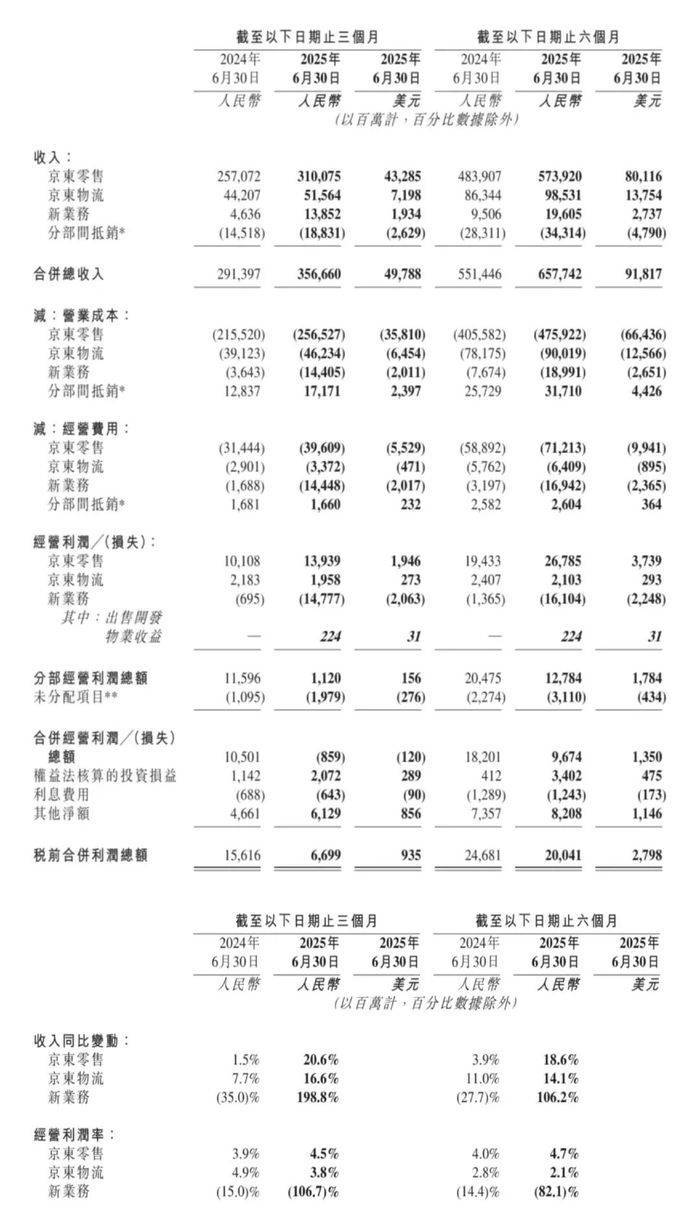
京东对外卖业务的投入在其最新财报中得到了充分体现。 8月14日,京东发布2025年第二季度业绩,总收入为3567亿元,同比增长22.4%,为近三年以来最快增幅;但经营利润变成了经营亏损,为9亿 元;非美国通用会计准则下,京东经营利润和归属于上市公司普通股股东的净利润分别为9亿元、74亿元,同比均出现大幅下滑。 在叠加618大促和国补政策效应的第二季度,京东的收入涨了,利润却降了,增收不增利的原因已经写在了财报里——对于新业务的战略投入增 加,而这里的"新业务",主要是指外卖。 从收入结构来看,零售板块收入的增长,依然是京东收入增长的主要动力。来自零售、物流、新业务三个板块的收入分别同比增长了20.6%、 16.6%、198.8%——新业务收入虽然成倍增长,但基数较低。具体到收入占比最大的零售板块,商品收入为2824亿元,同比增长20.7%。其中,大 头的带电品类表现突出,收入同比增长23.4%;日用百货品类的增速为16.9%,增速有所加快,但逊色于前者。 | | | 截至以下日期止三個月 | | | 截至以下日期止六個月 | | | --- | --- | --- | --- | --- | --- | -- ...