拼多多主站

Search documents
拼多多(PDD):加码供应链升级再造,追求长期高质量增长
Guohai Securities· 2026-03-28 15:27
Investment Rating - The report maintains a "Buy" rating for Pinduoduo (PDD.O) [1] Core Insights - Pinduoduo's Q4 2025 revenue reached 123.9 billion RMB, representing a year-over-year increase of 12% and a quarter-over-quarter increase of 14%. However, Non-GAAP net profit decreased by 12% year-over-year to 26.3 billion RMB, significantly below Bloomberg's consensus estimate of 31.2 billion RMB. The revenue growth remains robust, but profit margins are under pressure due to tax and foreign exchange losses [5][10] - The management plans to heavily invest in supply chain upgrades, aiming to create a new version of Pinduoduo over the next three years, with profitability expected to fluctuate across different quarters [7][10] - The domestic e-commerce sector shows a slowdown in advertising revenue growth, while transaction commission revenue continues to perform steadily. The management emphasizes that future performance will depend on the value created for the supply chain rather than just traffic acquisition [7][10] Financial Performance Summary - For Q4 2025, Pinduoduo reported: - Revenue: 123.9 billion RMB (YoY +12%, QoQ +14%) - Gross Profit: 68.8 billion RMB (YoY +9%, QoQ +12%) - Operating Profit: 27.7 billion RMB (YoY +8%, QoQ +11%) - Net Profit: 24.5 billion RMB (YoY -11%, QoQ -16%) - Non-GAAP Net Profit: 26.3 billion RMB (YoY -12%, QoQ -16%) [5][10] Profitability and Expense Ratios - The gross profit margin for Q4 2025 was 55.5%, while the operating profit margin was 22.4%. The net profit margin stood at 19.8%, and the Non-GAAP net profit margin was 21.2% [15] - Expense ratios for Q4 2025 included: - R&D Expense Ratio: 4.0% (YoY +0.6pct, QoQ +0.03pct) - Sales and Marketing Expense Ratio: 27.7% (YoY -0.6pct, QoQ -0.3pct) - Management Expense Ratio: 1.4% (YoY -0.5pct, QoQ -0.3pct) [11] Earnings Forecast and Valuation - The forecast for Pinduoduo's revenue from 2026 to 2028 is as follows: - 2026: 506.9 billion RMB - 2027: 564.5 billion RMB - 2028: 603.5 billion RMB - Non-GAAP net profit estimates for the same period are: - 2026: 124.3 billion RMB - 2027: 149.4 billion RMB - 2028: 167.0 billion RMB - The target market capitalization for 2026 is projected at 1,319.7 billion RMB, corresponding to a target price of 135 USD per ADS [8][16][17]

下沉与出海:拼多多双线夺路闯关
3 6 Ke· 2026-02-04 01:43
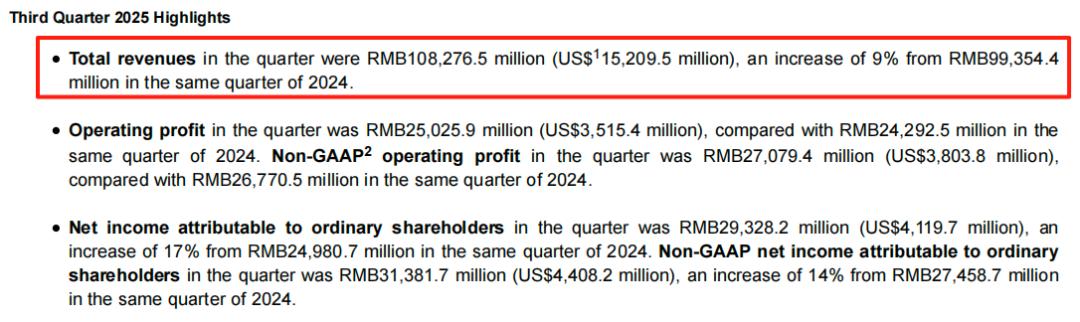
Core Viewpoint - Pinduoduo is experiencing a significant strategic transformation, facing challenges in both domestic and international markets, with a shift from aggressive growth strategies to a focus on efficiency and structural adjustments [2][3][6]. Domestic Market Performance - In Q3 2025, Pinduoduo reported total revenue of RMB 1,082.8 billion, a year-on-year increase of 9%, marking a shift to single-digit growth rates [3][6]. - Online marketing services and other revenues grew by only 8.1%, the lowest increase in recent years, indicating systemic challenges in its core monetization capabilities [6]. - The absence of state subsidies during major sales events has led to a decline in consumer spending, particularly on non-essential items, further impacting revenue [6][12]. - The company's gross merchandise volume (GMV) growth slowed to 10%, primarily driven by an increase in average order value rather than transaction volume [12]. Competitive Landscape - The Chinese e-commerce market is undergoing structural changes due to the rise of instant retail and AI technologies, posing significant challenges to Pinduoduo's low-price and social marketing model [7][11]. - Pinduoduo's core user base, which is price-sensitive and tolerant of longer delivery times, is at odds with the efficiency-driven user profiles of instant retail competitors [13]. - The company's community group buying business, Duoduo Maicai, has seen strategic contraction due to mismatched capabilities in real-time delivery and local operations [13]. International Expansion Challenges - Temu, Pinduoduo's global strategy core, has seen a 68% year-on-year increase in monthly active users, but faces regulatory pressures in the U.S. and EU that threaten its low-price business model [15][18]. - The U.S. has implemented significant tariffs and removed tax exemptions for low-value imports, while the EU plans to increase taxes on imports, impacting Temu's operational costs [18][19]. - In contrast, the Latin American market shows strong growth, with a 122% increase in monthly active users, but logistical challenges and high costs hinder effective operations [21][22]. - Temu's reliance on low prices may lead to higher subsidy costs in Latin America, where purchasing power is lower compared to North America and Europe [23]. Strategic Adjustments - Pinduoduo is shifting from a growth-first approach to a model that balances compliance and growth, requiring deeper involvement in supply chain and logistics management [24][25]. - The company faces short-term pain with slowing growth and rising costs, but this transition is essential for establishing a sustainable competitive position in the global retail landscape [25].

又一巨头藏不住了!靠捡漏狂揽5.2万亿,抄美团后路收割下沉用户
Sou Hu Cai Jing· 2025-12-18 11:13
Core Viewpoint - Pinduoduo, after ten years in the market, adopts a low-profile strategy amidst fierce competition in the internet sector, focusing on supply chain, logistics, and technology rather than engaging in direct confrontations with competitors [2][57]. Group 1: Company Milestones and Strategy - Pinduoduo celebrates its tenth anniversary with minimal fanfare, contrasting with other companies that typically hold grand celebrations [4]. - The company acknowledges a slowdown in growth and lack of sustainable profits during its earnings call, which raises questions about its future strategy [6]. - Pinduoduo employs a "flanking strategy" in the competitive landscape, particularly in the national subsidy war, adapting its approach to secure subsidies and maintain competitive pricing [8][10]. Group 2: Market Adaptation and Innovations - Pinduoduo shifts from a "light operation" model to establish subsidiaries aimed at securing subsidy qualifications and lowering prices on key products [11]. - The company capitalizes on the shift in subsidy focus from large appliances to fast-moving consumer goods, reinforcing its reputation for low prices [13]. - A new smart coupon system is being tested to retain potential buyers by offering targeted discounts based on user behavior [15][16]. Group 3: Expansion and Growth - Pinduoduo's "Westward Plan" aims to penetrate previously underserved regions, enhancing its logistics capabilities and expanding its market reach [18]. - The unexpected rise of "Duoduo Grocery" fills the market gap left by competitors, leading to significant growth in community group buying [20][22]. - By September 2024, "Duoduo Grocery" achieves a GMV close to 300 billion yuan, with growth rates exceeding 60% [26]. Group 4: International Strategy - Pinduoduo's international platform, Temu, expands rapidly, covering nearly 90 countries and achieving a revenue target of $90 billion for 2024 [30][32]. - Temu's strategy includes aggressive subsidies in European markets to attract price-sensitive consumers, while also focusing on compliance and local operations [35][37]. Group 5: Financial Performance and Industry Impact - Pinduoduo's financial outlook shows a profit exceeding 100 billion yuan in 2024, with a strong cash reserve of over 400 billion yuan, positioning it well against industry risks [43]. - The company's strategies have disrupted the e-commerce landscape, forcing competitors like Alibaba and JD to adopt low-price strategies [45]. - The community group buying sector is transformed, with "Duoduo Grocery" emerging as a dominant player following the exit of Meituan [47].


不做外卖不谈 AI,拼多多暗渡陈仓
晚点LatePost· 2025-12-04 12:09
Core Viewpoint - Pinduoduo has quietly continued to grow in its tenth year, focusing on defensive strategies amid increasing competition and market challenges, while adapting its subsidy strategies to maintain market share and user engagement [2][3][4]. Group 1: Company Growth and Market Position - Pinduoduo's GMV (Gross Merchandise Volume) has continued to grow by 15% to 20%, outperforming Alibaba and JD.com, although slightly below Douyin's e-commerce growth [3][6]. - The company aims for its domestic e-commerce GMV to reach 6 trillion yuan, including various services like Duoduo Grocery and Kuaiduo [3]. - Pinduoduo's Duoduo Grocery has seen significant growth, with GMV nearing 300 billion yuan, surpassing the combined GMV of Duoduo Grocery and Meituan's grocery service from the previous year [8][9]. Group 2: Competitive Strategies - Pinduoduo has adjusted its subsidy strategies in response to national subsidies, focusing on fast-moving consumer goods rather than competing directly on high-value items [5][6]. - The company has implemented "smart coupons" to target users who frequently browse but do not purchase, offering discounts to encourage conversions [5]. - Pinduoduo has expanded its presence in less competitive regional markets, such as Xinjiang and Tibet, to capture more users and increase GMV [5][10]. Group 3: Operational Efficiency - Pinduoduo has maintained a lower operational cost structure compared to competitors, allowing it to offer competitive pricing without extensive subsidies [4][10]. - The company has a three-tiered workforce structure, which helps in controlling costs while maintaining service efficiency [10]. - Pinduoduo's focus on reducing human resource costs has enabled it to achieve profitability in its grocery business, with expectations of continued growth at 20% to 30% annually [10][11]. Group 4: International Expansion - Pinduoduo's international platform, Temu, has achieved significant revenue growth, with expectations to reach 90 billion dollars in sales, expanding into nearly 100 countries [13][15]. - Temu is shifting towards compliance and local operations, with a focus on optimizing logistics and merchant expansion in key markets [13][15]. - The management structure has evolved to better oversee both domestic and international operations, reflecting a strategic shift in focus [14][15]. Group 5: Financial Position - Pinduoduo holds a substantial cash reserve of 423.8 billion yuan, positioning it as one of the internet companies with the highest cash holdings in China [17].

拼多多(PDD):25Q3 季报点评:外部负向影响减弱,基本面边际向好
Orient Securities· 2025-11-21 11:08
Investment Rating - The report maintains a "Buy" rating for Pinduoduo with a target price of $179.21 per ADS, reflecting a reasonable valuation of $254.4 billion USD (¥18,031 billion CNY) [3][5][14]. Core Insights - The report indicates that external negative impacts are diminishing, leading to a marginal improvement in the company's fundamentals. The advertising revenue for Q3 2025 was reported at ¥53.35 billion, showing a year-on-year growth of 8.1%, although it was below expectations [2][11]. - The company is expected to achieve revenues of ¥434.9 billion, ¥504.5 billion, and ¥553.6 billion for 2025, 2026, and 2027 respectively, with Non-GAAP net profits projected at ¥116.8 billion, ¥143.6 billion, and ¥168.8 billion for the same years [3][12]. Financial Summary - **Revenue Forecast**: The company is projected to generate revenues of ¥434,885 million in 2025, with a year-on-year growth of 10.4% [4][12]. - **Profitability Metrics**: The Non-GAAP net profit for 2025 is expected to be ¥116,835 million, with a profit margin of 26.9% [12][19]. - **Valuation Metrics**: The report employs a Sum-of-the-Parts (SOTP) valuation method, estimating the main platform's value using a P/E ratio of 9, leading to a valuation of ¥1,163.6 billion for the main site alone [13][14]. - **Market Performance**: The stock price as of November 19, 2025, was $118.02, with a 52-week high of $139.41 and a low of $87.11 [5][11].
外卖大战 “烧” 到拼多多?
36氪未来消费· 2025-11-20 07:23
Core Viewpoint - Pinduoduo's Q3 financial results indicate a slowdown in growth, particularly in advertising revenue, which has dropped to single-digit growth for the first time, raising concerns about the company's future performance [2][5][6]. Financial Performance - In Q3, Pinduoduo reported revenue of 108.3 billion yuan, a year-on-year increase of 9%, slightly above market expectations and better than the previous quarter's 7% growth [3]. - Operating profit for the quarter was 27.1 billion yuan, reflecting a year-on-year growth of only 1% [3]. - Following the earnings report, Pinduoduo's stock price fell over 7%, marking its worst single-day performance since the release of Q1 results [4]. Advertising Revenue - Pinduoduo's advertising revenue for the quarter was 53.3 billion yuan, missing expectations by 2.1 billion yuan and showing only an 8% year-on-year increase [5]. - This marks the first time Pinduoduo's advertising revenue growth has fallen to single digits, contrasting with Alibaba's 10% growth in customer management revenue for Q2 [6][7]. Reasons for Slowdown - The management team attributed the slowdown to increased competition and the unsustainability of high growth rates as the platform scales [8]. - Analysts suggest that the decline in advertising revenue may be due to a slowdown in GMV growth, which was only 9% in Q3, slightly above the industry average [9]. - Increased competition from platforms like Douyin and the impact of the instant retail battle are also seen as contributing factors [9]. Marketing Expenses and Subsidies - Pinduoduo's marketing expenses decreased by 0.5% year-on-year to 30.3 billion yuan, which was 2.6 billion yuan less than market expectations, as national subsidies have lessened [12]. - The reduction in subsidies has alleviated some financial pressure on Pinduoduo, allowing for a potential recovery in operating profit [12]. International Expansion - Pinduoduo's commission revenue reached 54.9 billion yuan in Q3, a 10% year-on-year increase, driven by clearer tariff policies and the expansion of Temu in international markets [14]. - Temu has seen significant growth, leading in global e-commerce app downloads and monthly active users, with a total download count exceeding 1.2 billion [15]. - However, international expansion poses challenges due to varying compliance requirements across countries and logistical issues in Latin America [16]. Future Outlook - Temu is expected to achieve breakeven in the first half of 2026 and potentially turn a profit in the second half, which could signal a new phase of profitability for Pinduoduo [17].

拼多多十年 那些变与不变
Huan Qiu Wang· 2025-10-15 07:02
Core Insights - Pinduoduo has completed its first decade, emphasizing its commitment to consumer benefits and innovative promotional strategies like "100 Billion Subsidy" [1][2] - The company has amassed over 9 million active users and more than 10 million active merchants, significantly impacting daily life in China [1][3] - Pinduoduo's approach to e-commerce focuses on inclusivity and affordability, redefining consumption upgrades for a broader audience [6][9] Group 1: Business Strategy - Pinduoduo's strategy is characterized by a focus on core e-commerce operations rather than chasing fleeting trends, prioritizing consumer and merchant interests over short-term profits [1][11] - The company has successfully penetrated rural markets, enhancing digital literacy and access to goods for underserved populations [4][6] - Pinduoduo's unique business model emphasizes a "reverse paradigm" in e-commerce, concentrating on agricultural product sales and supply chain optimization [11][12] Group 2: Consumer Experience - The platform's user-friendly design and features like group buying have made online shopping accessible to older demographics [6][9] - Pinduoduo has transformed the shopping experience by offering significant discounts and a wide range of products, catering to diverse consumer needs [3][4] - The introduction of "100 Billion Subsidy" has built consumer trust and loyalty, leading to a substantial increase in transaction volume [4][12] Group 3: Merchant Impact - Pinduoduo has facilitated significant growth for merchants, with some reporting revenue increases from millions to over a billion yuan through the platform [8][9] - The company has initiated various support programs for merchants, including a "100 Billion Relief" plan to alleviate operational costs [12][13] - Pinduoduo's focus on community and collaboration has fostered a sustainable ecosystem for merchants, encouraging innovation and local economic development [11][16]

拼多多(PDD):25Q2季报点评:Q2业绩明显改善,看好下半年盈利能力提升
Orient Securities· 2025-08-29 02:16
Investment Rating - The report maintains a "Buy" rating for the company [5][3] Core Views - The company's Q2 performance shows significant improvement, with expectations for enhanced profitability in the second half of the year [8] - Revenue forecasts for 2025-2027 have been adjusted upwards to 447.72 billion CNY, 498.03 billion CNY, and 540.14 billion CNY respectively, reflecting a more favorable competitive landscape [3][9] - The target price for the company is set at 175.06 USD per ADS, based on a sum-of-the-parts (SOTP) valuation of 248.5 billion USD [3][10] Financial Information Summary - For 2023, the company reported revenue of 247.64 billion CNY, with a year-on-year growth of 90% [4] - The projected net profit for 2025 is 112.66 billion CNY, with a slight increase in growth rate expected in subsequent years [4] - The company achieved a Non-GAAP net profit of 32.71 billion CNY in Q2 2025, significantly exceeding market expectations [8][9] Revenue and Profitability Forecast - The company is expected to achieve a Non-GAAP net profit of 1,220 billion CNY, 1,469 billion CNY, and 1,612 billion CNY for 2025-2027 [3][9] - The gross margin is projected to stabilize around 59.9% in 2025, with net profit margins expected to be 25.2% [4][9] Market Performance - The company's stock price as of August 27, 2025, was 123.02 USD, with a 52-week high of 155.67 USD and a low of 87.11 USD [5] - The company has shown strong relative performance over various time frames, including a 28.27% increase over the past year [6]
单季理财赚百亿,“拒不分红” 拼多多要当 “巴菲特”?
3 6 Ke· 2025-08-27 06:25
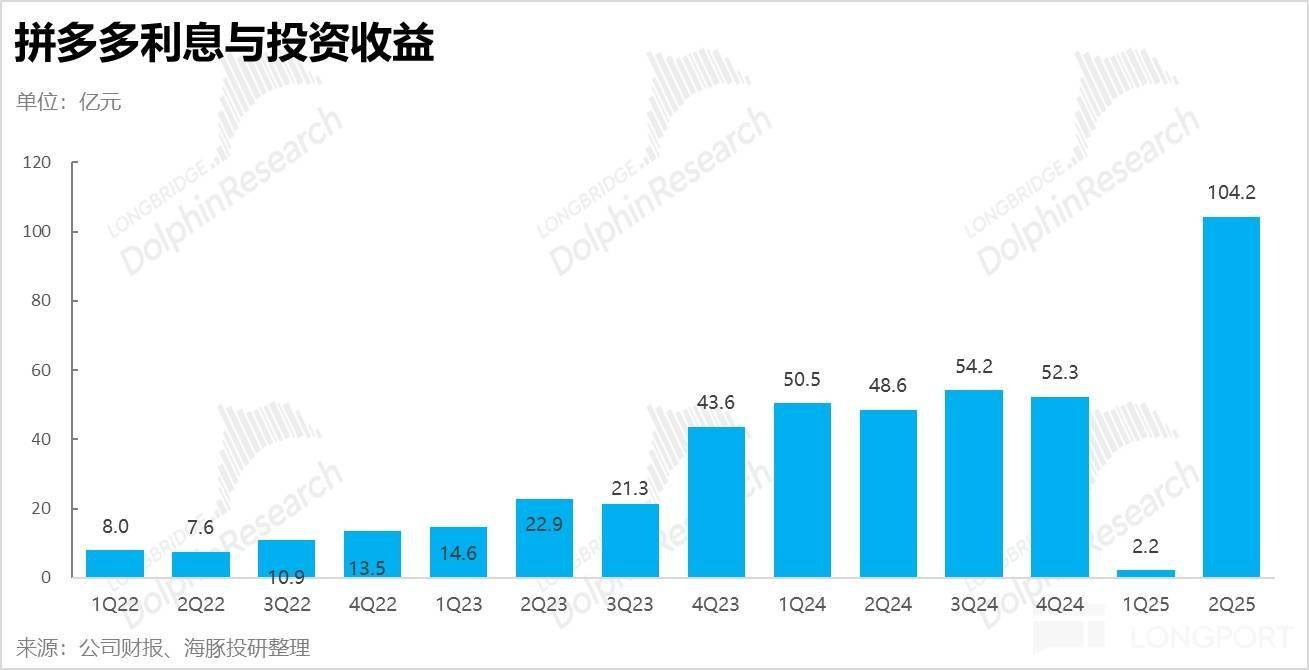
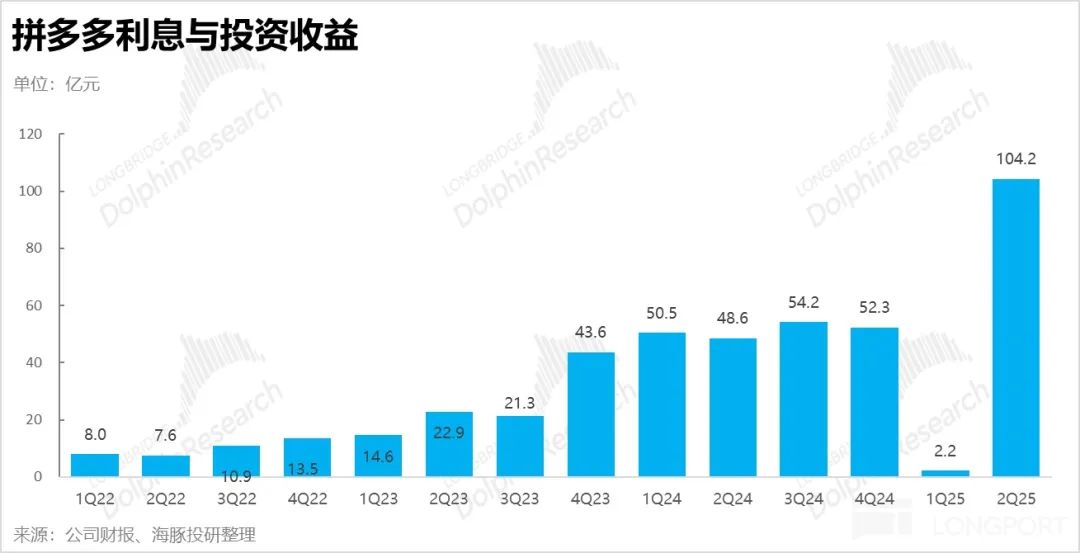
Core Viewpoint - Pinduoduo has accumulated significant cash assets and is facing the critical question of how to utilize these funds effectively as it transitions from a growth phase to a mature phase [1] Group 1: Financial Performance - In the latest quarter, Pinduoduo's interest and investment income reached a level of 10 billion RMB, which is a notable contribution compared to the 25.8 billion RMB operating profit from its main business [1] - The average quarterly profit remains around 5.3 billion RMB, consistent with the previous year's performance [1] Group 2: Cash and Investment Assets - As of the second quarter, Pinduoduo has 538.8 billion RMB (approximately 75 billion USD) in cash or idle funds that can generate interest or be invested [3] - The key components of idle funds include monetary funds, restricted cash, short-term investments, and other non-current assets [3] Group 3: Short-term Investments - Short-term investments, which account for 60% of the total, primarily consist of fixed deposits and held-to-maturity bonds, with a growing portion allocated to stock trading [5][6] - The stock trading balance increased from 17.2 billion RMB in 2023 to 44.5 billion RMB in 2024, indicating a shift towards higher-risk investments to enhance yield [6] Group 4: Non-current Assets - Pinduoduo's non-current assets are primarily composed of long-term fixed deposits and held-to-maturity bonds, with minimal equity investments [8] - The company maintains a clean balance sheet with no significant external equity investments or cross-industry mergers [10] Group 5: Investment Returns - The overall return on cash and investment assets has remained between 4-5% over the past two years, aligning with the risk-free return rates of U.S. Treasury bonds [13] - The yield from fixed deposits and held-to-maturity bonds is approximately 4%, consistent with recent U.S. Treasury rates [15] Group 6: Capital Allocation Strategy - Pinduoduo's return on equity (ROE) stands at 13.5%, significantly higher than the 4-5% return on idle cash, highlighting the need for optimized capital allocation [16] - The company faces a strategic decision on whether to reinforce its core business, explore new markets, or consider dividends and share buybacks as growth slows [16] - The potential for cash accumulation without strategic investment could lead to declining ROE and valuation concerns [16][17]
单季理财赚百亿!“拒不分红” 拼多多要当 “巴菲特”?
Sou Hu Cai Jing· 2025-08-26 13:32
Core Viewpoint - Pinduoduo has accumulated significant cash assets and is facing the critical question of how to utilize these funds effectively as it transitions from a growth phase to a mature phase [1] Group 1: Financial Performance - In the second quarter, Pinduoduo's cash or idle funds that can generate interest or be invested totaled approximately 538.8 billion RMB, equivalent to about 75 billion USD [3] - The company's interest and investment income for the quarter reached a substantial level of 10 billion RMB, which is notable compared to the 25.8 billion RMB operating profit from core business [1][3] - The average quarterly income from interest and investments remains around 5.3 billion RMB, consistent with the previous year's performance [1] Group 2: Investment Strategy - Pinduoduo's short-term investments, which account for 60% of its investment portfolio, primarily consist of fixed deposits and held-to-maturity bonds, with a growing portion allocated to stock trading, increasing from 17.2 billion RMB in 2023 to 44.5 billion RMB in 2024 [5][10] - The company has maintained a clean balance sheet with minimal external equity investments or cross-industry mergers, focusing instead on core e-commerce operations [9] - The overall return on cash and investment assets has remained between 4-5%, aligning with the risk-free rate of U.S. Treasury bonds [13] Group 3: Capital Allocation Considerations - Pinduoduo's return on equity (ROE) for the first half of the year was 13.5%, significantly higher than the 4-5% return on idle cash, indicating a clear priority for capital allocation [15] - The company faces two main options for future capital allocation: either increase investments in core business areas or consider dividends and share buybacks as growth slows [15][16] - The current strategy appears to lack effective market value management, raising concerns about potential declines in ROE and overall valuation if cash accumulation continues without strategic deployment [16]