
消费品以旧换新政策

Search documents
补贴效果如何?以旧换新的“国补”资金如何抵达消费者?
Sou Hu Cai Jing· 2025-06-06 13:40
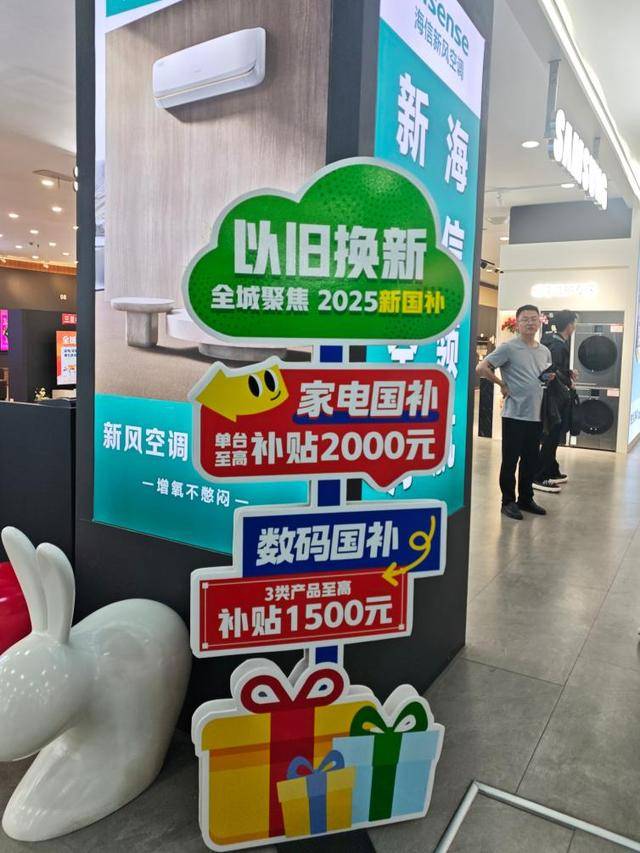
"可享受国家补贴""国补再减15%"……如今,无论是线上店铺,还是线下卖场,百姓在购买消费品时, 都可常见这些标语。 去年以来,我国持续实施消费品以旧换新政策,实打实的"真金白银"惠及消费者,激发消费活力。这 些"国补"资金是如何抵达消费者的? 今年以来,财政等相关部门加快推进超长期特别国债的发行使用。截至目前,2025年超长期特别国债已 下达两批到地方,共计1620亿元。 从地方来看,各省份根据中央资金分配情况按比例安排配套资金,强化资金保障,优化资金管理。 "山东多措并举,多渠道筹措资金,认真落实地方15%的配套要求,切实提升对消费品以旧换新的资金 保障能力。"山东省财政厅有关处室负责人说。 这位负责人介绍,在省级层面的资金分配上,综合考虑常住人口、地区生产总值、汽车保有量等因素, 合理确定对各市支持资金规模,向人口多、经济活跃、消费潜力大的地区倾斜。 图为位于山东省泰安市的三源家电线下卖场里展示的"国补"政策。新华社记者申铖 摄 资金从哪来? 根据去年和今年的政府工作报告及相关部署,实施消费品以旧换新政策的相关资金来自财政资金,中央 和地方都有"出资"。 具体来看,家电以旧换新、汽车报废更新等领域补贴资 ...

国家统计局工业司统计师于卫宁:“两新”政策效应持续显现 专用设备行业利润同比增长13.2%
news flash· 2025-05-27 01:36
Core Viewpoint - The "Two New" policy continues to show effects, with the specialized equipment industry experiencing a profit increase of 13.2% year-on-year in the first four months of the year [1] Group 1: Policy Impact - The implementation of ultra-long-term special bond funds has effectively supported the "Two New" policy, leading to significant growth in specialized and general equipment industries [1] - The specialized equipment and general equipment industries' profits increased by 13.2% and 11.7% respectively, contributing to a 0.9 percentage point increase in industrial profits above designated size [1] Group 2: Sector Performance - The electronic and electrical machinery specialized equipment manufacturing sector saw a remarkable profit growth of 69.8% [1] - The general component manufacturing sector experienced a profit increase of 24.7% [1] - The mining, metallurgy, and construction specialized equipment manufacturing sector reported a profit growth of 18.3% [1] Group 3: Consumer Goods Sector - The effects of the consumption upgrade policy are evident, with significant profit increases in various consumer goods sectors [1] - The manufacturing of specialized parts for household electrical appliances, kitchen appliances, and non-electric household appliances saw profit growths of 17.2%, 17.1%, and 15.1% respectively [1]
市场持续升温 潜力加速释放
Liao Ning Ri Bao· 2025-05-27 01:17
Group 1 - The core viewpoint of the articles highlights the significant impact of the "old-for-new" consumption policy in boosting consumer spending in Liaoning province, with a notable increase in retail sales and consumer participation in exchange programs [2][3] - In the first four months of the year, the total retail sales of consumer goods in Liaoning reached 331.38 billion yuan, marking a year-on-year growth of 6.8%, which is consistently above the national average for 26 consecutive months [2] - The retail sales of household appliances and audio-visual equipment surged by 97.1%, while furniture sales increased by 90.7%, indicating strong market performance in these sectors [2] Group 2 - The provincial government has implemented three rounds of consumption promotion policies this year, including the "Six Policies to Boost Consumption in Liaoning," aimed at stimulating consumer enthusiasm and supporting business growth [3] - The "old-for-new" policy has been expanded to include over 20 categories of household appliances, significantly enhancing its effectiveness in driving consumer spending [3] - In the first four months, approximately 2.795 million consumers participated in the "old-for-new" program, receiving subsidies totaling 2.88 billion yuan, which directly stimulated over 23.55 billion yuan in consumption [3] Group 3 - To maintain the current positive momentum and further stimulate consumption potential, the provincial government plans to create new consumption scenarios through various events such as beer festivals, music concerts, and food festivals [4] - The government aims to integrate commerce, tourism, culture, and sports to attract more consumers to Liaoning, leveraging major events and performances to enhance consumer engagement [4] - Continued implementation of the "old-for-new" policy and the "Six Policies to Boost Consumption" will be prioritized to foster new growth points in consumption and invigorate the market [4]

家居业一周|盈峰集团拟增持顾家家居,*ST建艺副董事长辞职
Bei Ke Cai Jing· 2025-05-26 13:16
Group 1: Furniture Industry - In April, the retail sales of furniture reached 15.3 billion yuan, showing a year-on-year growth of 26.9% [2] - From January to April, the total retail sales of furniture amounted to 58.3 billion yuan, with a year-on-year increase of 20.2% [2] - The retail sales of building and decoration materials in April were 13.8 billion yuan, growing by 9.7% year-on-year [2] Group 2: Miniso Group - Miniso Group reported a total revenue of 4.43 billion yuan for the first quarter of 2025, reflecting a year-on-year growth of 19% [3] - The gross profit margin for the quarter was 44.2%, an increase of 0.8 percentage points compared to the same period last year [3] - The adjusted net profit for the quarter was 590 million yuan, with an adjusted net profit margin of 13.3% [3] Group 3: Yingfeng Group and Kuka Home - Yingfeng Group plans to increase its stake in Kuka Home by acquiring up to 104 million shares at a price of 19.15 yuan per share, totaling no more than 1.997 billion yuan [4] - After the acquisition, Yingfeng Group will hold 11.26% of Kuka Home's total shares, while combined with its affiliates, it will control 37.37% of the company [4] Group 4: Corporate Changes - Guo Wei resigned from his positions as vice chairman and acting chairman of *ST Jianyi due to personal reasons [6] - The company reported a loss of 830 million yuan in 2024, a decrease of 47.23% year-on-year [6] - Huang Fuqing, the vice president of Guangdong Jusen Precision Technology Co., Ltd., also resigned for personal reasons, with no impact on the company's operations [5] Group 5: IPO and Market Changes - Zhuhai Zhancheng New Materials Co., Ltd. has changed its IPO plan from the ChiNext board to the Beijing Stock Exchange [7] - The company specializes in the research, production, and sales of wood coatings and other paint products [8] - In 2024, Zhancheng New Materials achieved a revenue of 1.573 billion yuan, with a year-on-year growth of 3.52% [8]


“成绩单”出炉 1至4月机械工业生产及投资均稳定增长
news flash· 2025-05-23 22:58
Core Viewpoint - The Chinese machinery industry has shown stable growth in production and investment during the first four months of the year, with significant increases in various sectors [1] Production Growth - The value added in five major sectors of the machinery industry has maintained a growth trend year-on-year: - General equipment manufacturing increased by 9% - Specialized equipment manufacturing grew by 4% - Automobile manufacturing rose by 11.2% - Electrical machinery and equipment manufacturing increased by 12.7% - Instrumentation manufacturing grew by 9.2% [1] Investment Trends - Fixed asset investment in the machinery industry showed varied results: - General equipment manufacturing investment increased by 17.9% - Specialized equipment manufacturing investment grew by 8.4% - Automobile manufacturing investment surged by 23.6% - Electrical machinery and equipment investment decreased by 7.5% - Instrumentation manufacturing investment fell by 15.1% [1] Production of Key Products - The cumulative production of representative products in the machinery industry has shown strong growth: - Metal cutting machine tools reached a cumulative production of 260,000 units, up by 16.8% - Industrial robots reached a cumulative production of 221,000 sets, up by 34.1% [1] Policy Impact - The macro policy combination effect continues to release, maintaining rapid growth in production supply. The "Two New" policy and industrial upgrades are driving sustained growth in the equipment manufacturing sector. The effects of the consumer goods replacement policy are steadily expanding domestic demand [1]
商务部消费促进司负责人谈2025年4月我国消费市场情况
news flash· 2025-05-23 08:18
Group 1 - The consumption market is maintaining steady growth due to the effective implementation of the old-for-new policy and organized promotional activities [1] - In April, the total retail sales of consumer goods reached 3.72 trillion yuan, representing a year-on-year growth of 5.1% [1] - From January to April, the total retail sales of consumer goods amounted to 16.18 trillion yuan, with a year-on-year increase of 4.7% [1]
商务部:4月份商品零售额同比增长5.1%,增速比一季度加快0.5个百分点
news flash· 2025-05-23 08:16
Core Insights - In April, the retail sales of consumer goods increased by 5.1% year-on-year, with the growth rate accelerating by 0.5 percentage points compared to the first quarter [1] - Retail sales of units above the designated size grew by 6.6%, with an acceleration of 0.8 percentage points from the first quarter [1] Group 1: Policy Impact - The "old-for-new" consumption policy has shown significant effectiveness, contributing to the stable growth of the consumption market [1] - Retail sales of home appliances, cultural and office supplies, furniture, and communication equipment for units above the designated size increased by 38.8%, 33.5%, 26.9%, and 19.9% year-on-year, respectively [1] Group 2: Automotive Sector - According to the Automotive Circulation Association, the retail volume of passenger cars in April increased by 14.5% year-on-year [1] Group 3: Upgraded Goods - Retail sales of upgraded goods such as gold, silver, and jewelry, as well as cosmetics for units above the designated size, increased by 25.3% and 7.2% year-on-year, respectively [1]
消费品以旧换新基层调研:销售火爆,期待政策不断优化
Di Yi Cai Jing· 2025-05-22 12:31
Core Viewpoint - The continuation and expansion of the national subsidy policy for replacing old consumer goods have significantly boosted sales in the home appliance and automotive sectors, contributing to economic stability and growth [1][4][8]. Group 1: Sales Performance - The JD Electric flagship store in Jinan reported a sales revenue exceeding 1 billion yuan within the first four months of this year, driven by the national subsidy policy [1][2]. - The cumulative purchase of old-for-new home appliances has surpassed 100 million units since the policy's implementation, with over 40 million units purchased in 2025 alone [2]. - Retail sales of home appliances and audio-visual equipment increased by 19.3% year-on-year in the first quarter, with March showing a remarkable growth of 35.1% [2]. Group 2: Automotive Sector Impact - The automotive sales at Shandong Changshuo have doubled due to the combined effect of national and local subsidies, with significant sales growth continuing into the traditionally slow first quarter [3]. - In the first four months of this year, China's automotive production and sales reached 10.175 million and 10.06 million units, respectively, marking year-on-year growth of 12.9% and 10.8% [3]. Group 3: Economic and Industrial Upgrades - The subsidy policy has not only stimulated consumer spending but also facilitated industrial transformation and upgrades, with a notable increase in the purchase of energy-efficient products [4][5]. - In Shandong, 61.8% of new vehicle purchases were electric, and 87.6% of old-for-new home appliances sold were of first-level energy efficiency [5]. Group 4: Policy Implementation Challenges - Some consumers have reported delays in receiving subsidies, prompting local governments to streamline the approval process to expedite fund disbursement [6][7]. - A pre-allocation mechanism for subsidies has been established in Shandong to alleviate the financial burden on home appliance retailers, allowing for up to 80% of funds to be advanced [7]. Group 5: Future Policy Considerations - Stakeholders express a desire for the continuation and optimization of the subsidy policy, with suggestions to expand the range of eligible products and increase the price cap for certain categories [8][9]. - The diminishing marginal utility of the subsidy policy has been noted, with recommendations for ongoing central government support to maintain the program's effectiveness [9].
蝶变、拉满、C位……划重点!解锁4月经济数据顶压增长背后政策“组合拳”密码
Yang Shi Wang· 2025-05-20 01:58
Group 1 - Industrial production has seen rapid growth, with the added value of equipment manufacturing and high-tech manufacturing increasing by around 10%. The production of 3D printing equipment and industrial robots has surged by over 50%. This growth is attributed to macro policy measures that have accelerated industrial upgrades, leading to enhanced production efficiency and quality [1][3] Group 2 - Market sales are on the rise, driven by the effectiveness of the "old-for-new" consumption policy. Retail sales in categories such as home appliances, cultural and office supplies, and furniture are experiencing high growth. Various local departments are implementing special actions to boost consumption, enriching consumption scenarios and continuously releasing consumption potential [4][6] Group 3 - Foreign trade has shown resilience, with total goods import and export volume increasing by 2.4% year-on-year from January to April 2025, accelerating by 1.1 percentage points compared to the first quarter. This growth is notable against the backdrop of rising unilateralism and protectionism, supported by China's strong manufacturing capabilities and the proactive response of foreign trade enterprises through market diversification strategies [8][10] Group 4 - Investment is steadily expanding, with high-tech industry investments leading the way. Investments in information services and computer and office equipment manufacturing are in a high growth phase, indicating optimistic market expectations and strong demand for industrial upgrades, reflecting the trend of China's economic transition towards innovation-driven growth [10][12]
4月经济数据点评:经济保持韧性
Tai Ping Yang Zheng Quan· 2025-05-20 01:45
Group 1: Economic Performance - In April, China's industrial added value increased by 6.1% year-on-year, exceeding the expected 5.2% and down from 7.7% in the previous month[5] - The retail sales of consumer goods in April grew by 5.1% year-on-year, slightly below the expected 5.5% and down from 5.9% in March[5] - Fixed asset investment (excluding rural households) from January to April rose by 4.0% year-on-year, below the expected 4.3% and down from 4.2% in the previous period[5] Group 2: Sector Analysis - The manufacturing sector showed resilience, with April's manufacturing investment growth at 8.2% year-on-year, despite a 0.9 percentage point decline from the previous month[26] - Infrastructure investment (excluding electricity, heat, gas, and water production and supply) grew by 5.8% year-on-year from January to April, consistent with the first quarter[28] - Real estate development investment recorded a year-on-year decline of 11.3% in April, continuing a downward trend[30] Group 3: Employment Trends - The urban surveyed unemployment rate in April was 5.1%, down from 5.2% in March, indicating a seasonal decline[32] - The unemployment rate for local registered labor was 5.2%, while for migrant workers it was 4.8%, both showing a decrease from previous values[32]