碳市场

Search documents
我国碳市场领域第一份中央文件印发,全国碳市场建设迈入新阶段
Ren Min Ri Bao· 2025-09-07 03:04
Core Viewpoint - The issuance of the "Opinions" by the Central Committee of the Communist Party of China and the State Council marks a significant step in strengthening the national carbon market, providing a more comprehensive institutional guarantee and robust support for its construction [1][2]. Group 1: Carbon Market Development - The national carbon market consists of a mandatory carbon emissions trading market and a voluntary carbon market, which operate independently but are interconnected through a quota clearing mechanism [2]. - As of August 22, 2023, the mandatory carbon market has seen a cumulative transaction volume exceeding 680 million tons, with a transaction value of 47.41 billion yuan, while the voluntary market has recorded 2.49 million tons of certified voluntary emission reductions, amounting to 210 million yuan [2]. - The "Opinions" outline a timeline and roadmap for the development of the national carbon market, aiming for comprehensive coverage of key emission sectors by 2027 and a transparent voluntary carbon market by 2030 [3][4]. Group 2: Quota Management and Regulation - The establishment of a clear and transparent carbon emissions quota management system is essential for the healthy operation of the carbon trading market [4]. - The current quota distribution method is based on intensity control, with plans to gradually implement total quota control for stable emission sectors by 2027 [4]. - The government aims to enhance data quality management and strengthen regulatory measures to prevent data manipulation in carbon emissions reporting [5][6]. Group 3: Market Vitality and Financial Integration - The ecological environment department plans to collaborate with financial institutions to develop green financial products related to carbon emissions rights and certified voluntary emission reductions [6]. - New policies such as carbon pledging and carbon repurchase are being explored to improve financing channels for key emission units and enhance their proactive engagement in energy conservation and emission reduction [6][7]. - The "Opinions" emphasize the importance of involving qualified financial institutions and individuals in the carbon market to broaden participation and enhance market dynamics [7].
碳讨 | 建设“路线图”出炉 我国碳市场迎来首份中央文件
Xin Jing Bao· 2025-09-05 21:15
Core Viewpoint - The release of the "Opinions" marks the first central document in China's carbon market sector, outlining a clear timetable and roadmap for the development of the national carbon market by 2027 and 2030 [1][2]. Group 1: National Carbon Market Development - The national carbon market consists of a mandatory carbon emissions trading market and a voluntary greenhouse gas reduction trading market, which are interconnected to form a comprehensive carbon market system [2][3]. - As of August 22, 2023, the mandatory carbon market has seen a cumulative trading volume of over 680 million tons, with a transaction value of 47.41 billion yuan, while the voluntary market has recorded 2.49 million tons of certified voluntary emission reductions, amounting to 210 million yuan [2]. Group 2: Market Expansion and Coverage - By 2027, the mandatory carbon market aims to expand its coverage to include major industrial sectors, while the voluntary market will extend to biomass utilization and solid waste treatment, achieving full coverage in key areas [1][2]. - The government plans to gradually shift from intensity control to total control of carbon emissions, establishing a clear and transparent carbon emissions quota management system [3]. Group 3: International Cooperation and Leadership - The "Opinions" emphasize the importance of international cooperation in climate governance, positioning the improvement of the national carbon market as a significant step in demonstrating China's commitment to global climate leadership [4][5]. - China's experience in carbon trading and voluntary reduction markets is seen as valuable for other developing countries facing similar challenges in balancing economic development and carbon reduction [5][6]. Group 4: Financial Empowerment and Market Vitality - The "Opinions" propose enhancing market vitality by diversifying trading products and expanding trading participants, including the introduction of financial institutions into the carbon market [7][8]. - Financial institutions are encouraged to develop green financial products related to carbon emissions rights and certified voluntary emission reductions, thereby supporting greenhouse gas reduction efforts [7][8].
ESG动态跟踪月报(2025年8月):全国碳市场纲领性文件落地,国际气候金融监管分化-20250905
CMS· 2025-09-05 11:36
- The report focuses on the regulatory dynamics, market trends, and product issuance in the ESG field, providing a systematic review of important information from the past month for investors' reference[2][5] - In August 2025, a significant guiding document for the national carbon market was released, aiming to cover key industrial sectors by 2027[12][13] - The People's Bank of China and six other departments issued opinions to promote financial support for new industrialization, emphasizing green finance and technological innovation[5][23] - The State Administration for Market Regulation issued guidelines to establish a national carbon measurement center, enhancing the technical support for carbon peak and carbon neutrality goals[17] - The Shanghai government released a comprehensive reform action plan for the carbon market, aiming to establish Shanghai as an international center for carbon trading, finance, pricing, and innovation[19] - Guangdong province introduced policies to support green finance development through carbon emission quota pledges, marking a significant step in carbon financial innovation[21] - The State Administration of Foreign Exchange launched a pilot program for green foreign debt business, expanding cross-border green financing channels for enterprises[30] - The People's Bank of China, the Financial Regulatory Administration, and the National Forestry and Grassland Administration jointly issued a notice to support high-quality forestry development, emphasizing innovative financial support for forestry rights mortgages[32] - The Shanghai Stock Exchange published a report on the 20-year ESG practice in the Shanghai market, highlighting the achievements and progress in sustainable development[34] - The China Association for Public Companies released an analysis report on the sustainable information disclosure of listed companies in 2025, showing significant improvements in both quality and quantity of ESG disclosures[36] - The world's first "super-zero carbon building" was inaugurated in Qingdao, showcasing innovative green building practices and energy self-sufficiency[38] - Internationally, the EU continued to advance the Circular Economy and Carbon Border Adjustment Mechanism (CBAM), while the UK proposed simplifying climate disclosure standards for financial institutions[41][43][46] - The market showed divergence: Standard Chartered Bank participated in a $150 million carbon credit transaction, while the Net-Zero Banking Alliance suspended activities and faced legal challenges[48][50] - As of the end of August, there were 915 ESG-themed funds in the market, with a total scale of approximately 1.02 trillion yuan, showing a slight growth since the beginning of the year[55] - Active ESG funds had an average return of 10.87% in the past month, with all five themes achieving cumulative returns of over 30% in the past year[60] - Passive ESG funds had limited short-term excess returns but showed bright spots in some themes over the long term[61] - The main ESG indices generally rose, with the 300 ESG and CSI A500 indices balancing volatility and returns[73] - The ESG bond market remained active, with green bonds continuing to dominate, although the issuance scale declined in August[77]
一周碳要闻:我国碳市场迎来首份中央文件(碳报第162期)
Bei Ke Cai Jing· 2025-09-05 09:25
Policy Release - The National Development and Reform Commission is soliciting public opinions on the draft of the "Basic Rules for the Long-term Electricity Market" to regulate the long-term electricity market and protect the rights of various operators [1] - The draft emphasizes the importance of balancing long-term supply and demand for electricity and stabilizing market expectations through the long-term electricity market [1] Industry Dynamics - The National Energy Administration released the "China Natural Gas Development Report (2025)," predicting a 7.3% year-on-year increase in natural gas consumption in 2024, with urban gas consumption growing by 11.1% [3] - Reports indicate that by 2035, electricity will account for over 40% of total energy consumption in China, up from 30% currently [4][5] - The world's largest offshore wind turbine, with a capacity of 26 megawatts, has been successfully installed, marking a significant advancement in high-end equipment manufacturing in China [6] - The largest "coal-fired molten salt thermal storage" project in China has commenced commercial operation, enhancing the flexibility of coal-fired power generation [7][8] Local News - Xiamen has released the first national contract template for the maritime transport of lithium battery energy storage systems, aiming to standardize the industry and facilitate international trade [9][10] - Qinghai Province plans to achieve a green and low-carbon transformation for export-oriented enterprises by 2030, focusing on industries like aluminum and lithium batteries [11] - Guangdong Province is exploring a "green electricity direct connection" model for industrial parks to optimize energy supply [12] - Sichuan Province aims for its renewable energy industry chain to exceed 500 billion yuan in revenue by 2027, focusing on solar, wind, and hydrogen energy [12] Carbon Market Development - The Central Government has released the first official document on carbon market development, outlining a roadmap for expanding the market to cover more industries by 2027 [13][14] - The document emphasizes the importance of enhancing market functions and expanding trading products and participants to improve market vitality [19][20]
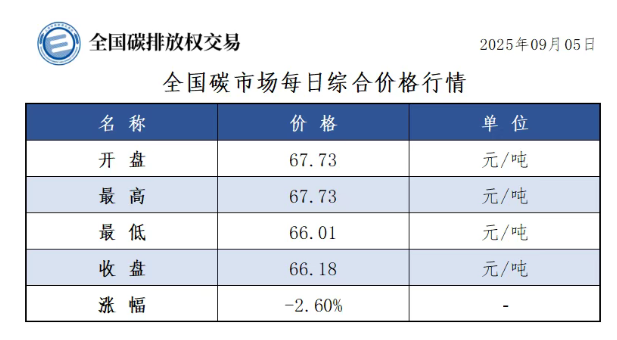
9月5日全国碳市场综合价格收盘价66.18元/吨,较前一日下跌2.60%
Xin Hua Cai Jing· 2025-09-05 09:22
Core Points - The national carbon market opened at a price of 67.73 yuan per ton, with a closing price of 66.18 yuan per ton, reflecting a decrease of 2.60% from the previous day [1][2][4] - The total trading volume for carbon emission allowances today was 478,812 tons, with a total transaction value of approximately 31.64 million yuan [2][4] - Cumulative trading volume in the national carbon market reached 704,047,174 tons, with a total transaction value of approximately 48.37 billion yuan as of September 5, 2025 [4] Trading Details - The highest price recorded today was 67.73 yuan per ton, while the lowest was 66.01 yuan per ton [1][2] - The trading volume for different transaction types included 181,735 tons in listed agreement trading, 295,077 tons in bulk agreement trading, and 2,000 tons in single-direction bidding [2][3] - The single-direction bidding today had a maximum selling volume of 200 tons, with a transaction price of 67.30 yuan per ton [3]

全国碳市场建设迈入新阶段
Ren Min Ri Bao· 2025-09-05 01:23
Core Viewpoint - The issuance of the "Opinions on Promoting Green and Low-Carbon Transition and Strengthening National Carbon Market Construction" marks the first central document in China's carbon market sector, aiming to provide a more comprehensive institutional guarantee and stronger capability support for the national carbon market construction [1][2]. Summary by Relevant Sections National Carbon Market Development - The national carbon market consists of a mandatory carbon emissions trading market and a voluntary carbon emissions trading market, which operate independently but are interconnected through a quota clearing mechanism [2]. - As of August 22, 2023, the mandatory carbon market has seen a cumulative transaction volume exceeding 680 million tons, with a transaction value of 47.41 billion yuan, while the voluntary market has recorded 2.49 million tons of certified voluntary emission reductions, amounting to 210 million yuan [2]. Timeline and Roadmap - The "Opinions" outline a timeline for the national carbon market's development, aiming to cover major industrial sectors by 2027 and achieve full coverage in key areas by 2030 [3]. - The mandatory carbon market will expand to include major industrial sectors, while the voluntary market will broaden its scope to include biomass utilization and solid waste treatment [3]. Quota Management System - A clear and transparent carbon emissions quota management system is essential for the healthy operation of the national carbon trading market [4]. - The quota distribution system will balance emission reduction targets with economic costs and industry differences, with a gradual shift towards total quota control by 2027 [5]. Development of Voluntary Carbon Market - The government aims to accelerate the development of the voluntary carbon market by focusing on key areas and technologies related to carbon neutrality [6]. - Strengthening market regulation and ensuring accurate carbon emission data are critical for the success of the carbon market [6]. Systematic Improvement - The construction of the national carbon market is a complex system engineering task that requires a problem-oriented and goal-oriented approach [7]. - The government will enhance the reliability of data and inclusivity of industries within the carbon market [7]. Implementation Strategies - The implementation of the "Opinions" will focus on expanding the coverage of the mandatory carbon market and developing the voluntary market with a robust methodological framework [8]. - Financial institutions will be encouraged to develop green financial products related to carbon emissions, such as carbon pledges and carbon repurchase agreements, to enhance market liquidity and reduce financing costs [8]. Management Enhancement - Strict regulations on carbon emissions verification and improved technical standards for key industries will be enforced [9]. - The government will strengthen the entire process of carbon emissions data quality supervision and combat fraudulent activities [9].

我国碳市场领域第一份中央文件印发 全国碳市场建设迈入新阶段
Ren Min Ri Bao· 2025-09-05 00:48
Core Viewpoint - The issuance of the "Opinions on Promoting Green and Low-Carbon Transition and Strengthening National Carbon Market Construction" marks the first central document in China's carbon market sector, aiming to provide a more comprehensive institutional guarantee and stronger capability support for the national carbon market construction [1] Group 1: Carbon Market Development - The national carbon market consists of a mandatory carbon emissions trading market and a voluntary carbon emissions trading market, which operate independently but are interconnected through a quota clearing mechanism [2] - As of August 22, 2023, the mandatory carbon market has seen a cumulative transaction volume exceeding 680 million tons, with a transaction value of 47.41 billion yuan, while the voluntary carbon market has recorded a cumulative transaction of 2.49 million tons, valued at 210 million yuan [2] - The "Opinions" outline a timeline and roadmap for the development of the national carbon market, aiming for full coverage of key emission sectors by 2027 and a transparent voluntary carbon market by 2030 [3] Group 2: Quota Management and Distribution - The establishment of a clear and transparent carbon emissions quota management system is essential for the healthy operation of the national carbon trading market [4] - The quota distribution system will balance emission reduction targets with economic costs and will gradually implement total quota control for stable emission industries by 2027 [5] Group 3: Voluntary Carbon Market and Data Quality - The development of the national voluntary carbon emissions trading market is emphasized, focusing on key areas for carbon peak and neutrality, and establishing a methodology system for voluntary reduction projects [6] - Continuous enhancement of data quality management is crucial, with measures including monthly verification of key emission data and the use of big data and blockchain for risk monitoring [6] Group 4: Market Mechanism and Financial Integration - The construction of the national carbon market is a complex system project that requires a problem-oriented and goal-oriented approach, enhancing the reliability of data and inclusivity of industries [7] - The ecological environment department plans to explore green financial products related to carbon emissions rights and certified voluntary reduction amounts, which will help improve financing channels for key emission units [8] Group 5: Management and Compliance - Strict regulation of carbon emissions verification and enhancement of the responsibility of key emission units for carbon accounting and reporting are necessary [9] - Comprehensive supervision of carbon emissions data quality will be enforced to combat fraudulent activities [9]
我国碳市场领域第一份中央文件印发 全国碳市场建设迈入新阶段(美丽中国)
Ren Min Ri Bao· 2025-09-04 22:17
Core Viewpoint - The issuance of the "Opinions on Promoting Green and Low-Carbon Transition and Strengthening National Carbon Market Construction" marks the first central document in China's carbon market sector, providing a more comprehensive institutional guarantee and stronger capability support for the national carbon market construction [1][2]. Group 1: National Carbon Market Development - China has established a national carbon emissions trading market that includes both a mandatory carbon market and a voluntary carbon market, which operate independently but are interconnected through a quota clearing mechanism [2][3]. - As of August 22, 2023, the cumulative transaction volume of the mandatory carbon market exceeded 680 million tons, with a transaction value of 47.41 billion yuan, while the voluntary carbon market recorded a cumulative transaction of 2.49 million tons, valued at 210 million yuan [2][3]. Group 2: Timeline and Roadmap - The "Opinions" outline a timeline and roadmap for the national carbon market, aiming to cover major industrial sectors by 2027 and achieve comprehensive coverage in key areas by 2030 [3][4]. - The mandatory carbon market will expand to include major industrial sectors, while the voluntary market will extend to biomass utilization and solid waste treatment by 2027 [3][4]. Group 3: Quota Management System - A clear and transparent carbon emissions quota management system is essential for the healthy operation of the national carbon trading market [4][5]. - The quota distribution system will balance emission reduction targets with economic costs and industry differences, gradually implementing total quota control by 2027 [4][5]. Group 4: Development of Voluntary Carbon Market - The government aims to actively develop the national voluntary greenhouse gas reduction trading market, focusing on key areas and technologies for carbon neutrality [6][7]. - Strengthening market regulation and ensuring accurate carbon emission data are crucial for the success of the carbon market [6][7]. Group 5: Enhancing Market Vitality - The Ministry of Ecology and Environment plans to collaborate with financial institutions to explore green financial products related to carbon emissions rights and certified voluntary reduction amounts [8][9]. - Initiatives like carbon pledging and carbon repurchase will help improve financing channels for key emission units and enhance their proactive engagement in energy-saving and carbon reduction efforts [8][9]. Group 6: Management Improvement - Strict regulations on carbon emissions verification and enhanced oversight of data quality are necessary to ensure compliance and integrity within the carbon market [9].
长青集团:目前第三批CCER方法学尚处于征求意见阶段
Zheng Quan Ri Bao Zhi Sheng· 2025-09-04 09:08
Group 1 - Changqing Group announced on September 4 that the third batch of CCER methodology is still in the public consultation phase [1] - According to the methodology, a biomass cogeneration project with a capacity of 30MW is expected to generate over 120,000 tons of voluntary carbon reduction annually [1] - Information on carbon market trading prices can be obtained from the public market [1]

碳市场领域首份中央文件出台,高排放行业进入倒计时
Sou Hu Cai Jing· 2025-09-04 09:02
Core Viewpoint - The recent policy shift in China's carbon market signifies a transition from intensity-based constraints to total volume control, impacting high-emission industries such as steel, cement, and electrolytic aluminum, which will face stricter regulations by 2027 [1][3][6] Group 1: Policy Changes and Market Development - The new guidelines aim to establish a national carbon trading market based on total volume control by 2030, moving away from the previous intensity-based approach [1][4] - As of July 2025, the national carbon market has recorded a cumulative trading volume of 680 million tons and a transaction value exceeding 46.7 billion yuan, with carbon prices stabilizing around 72 yuan per ton [1][3] - The policy emphasizes a gradual transition from free allocation of quotas to a mixed system of free and paid allocations, enhancing the scarcity and price signals of carbon quotas [4][5] Group 2: Industry-Specific Challenges - The steel, cement, and electrolytic aluminum industries collectively emit approximately 3 billion tons of CO2 equivalent annually, accounting for over 20% of national emissions, making them critical to the implementation of carbon constraints [6][9] - The steel industry is expected to increase the proportion of electric furnace steel to 15% by 2025 and promote low-carbon smelting technologies, aligning with the new carbon market price signals [7][11] - The cement industry faces unique challenges due to high process emissions, necessitating a combination of strategies such as reducing clinker ratios and utilizing alternative fuels to achieve deep emissions reductions [9][10] Group 3: Market Mechanisms and Financial Integration - The policy encourages the introduction of diverse trading products and financial instruments to enhance market liquidity and attract more capital into the carbon market [5][12] - The establishment of a monthly certification system for key parameters and the use of advanced technologies like big data and blockchain are aimed at improving the quality of carbon emissions data [13][14] - Companies are advised to integrate carbon asset management into their daily operations, utilizing quota trading and financial tools to optimize carbon asset transactions and cash flow [14]