
全国统一大市场

Search documents
“破界”,建设全国统一大市场先行区
Xin Hua Ri Bao· 2025-07-11 21:34
Core Viewpoint - The Long Triangle region is advancing towards a unified national market through enhanced cooperation among the market regulatory departments of Shanghai, Jiangsu, Zhejiang, and Anhui, focusing on breaking barriers, establishing standards, and promoting digital transformation [1][2][4]. Group 1: Cooperation and Achievements - The Long Triangle region has implemented over 170 high-frequency government services and applications for cross-province "one-stop" processing, with 40 types of high-frequency electronic certificates recognized across provinces [2]. - A total of 6.98 billion data entries have been collected in the regional business entity database, with data update cycles reduced from monthly to daily [2]. - Since the 14th Five-Year Plan, the region has signed 45 cooperation agreements and published 18 policy documents, indicating a strong commitment to regulatory integration [6]. Group 2: Regulatory Framework and Standards - The region aims to deepen fair competition reforms, enhance anti-monopoly and anti-unfair competition enforcement collaboration, and promote a unified regulatory framework [2][4]. - A joint action plan for quality support and standard leadership in key industries such as biomedicine and artificial intelligence has been established [3]. - The Long Triangle region is working on international standardization research and the development of green and low-carbon standards [3]. Group 3: Digital Transformation and Data Sharing - A digital collaborative action plan is underway to enhance cross-province regulatory data sharing and optimize various databases [3]. - The region is focused on building a strong data foundation for regulatory collaboration, enhancing data sharing applications, and creating impactful shared scenarios [3]. Group 4: New Initiatives and Projects - Six new cooperation agreements have been signed, including those focused on platform economy innovation and integrated risk warning systems [5]. - The agreements aim to address significant issues in the online market and enhance regulatory collaboration among platform enterprises [5]. Group 5: Consumer Protection and Market Potential - The Long Triangle region is implementing a three-year action plan to optimize the consumer environment, including the establishment of trusted stores and markets [7]. - There is a focus on enhancing food safety regulations and cross-regional cooperation in food production and operation oversight [7][8]. - The region aims to improve consumer rights protection mechanisms and establish a system for handling consumer disputes across different cities [8].
更好服务全国统一大市场建设 扎实推动海洋经济高质量发展
Xin Hua Ri Bao· 2025-07-11 21:31
Group 1 - The meeting emphasized the importance of implementing Xi Jinping's recent speeches, focusing on leveraging red resources and accelerating the development of new productive forces while ensuring safety and high-quality development [1][2] - The meeting highlighted the significance of building a unified national market, aiming to address economic circulation bottlenecks and expand institutional openness, thereby connecting domestic and international markets [1] - The meeting discussed the need to enhance the quality of marine economy development, emphasizing innovation, efficient collaboration, and industry updates to establish Jiangsu as a strong marine province [1] Group 2 - The meeting underscored the importance of the global civilization initiative and the role of Jiangsu in enhancing international cultural exchanges to support national diplomatic efforts [2] - The meeting conveyed the strategic importance of paired assistance to Xinjiang, focusing on integrating Jiangsu's strengths with Xinjiang's needs in various sectors such as industry, education, and culture [2] - The meeting reviewed the draft decision on promoting collaborative technological innovation in the Yangtze River Delta region [3]
积极推进市场监管公平统一——加快建设全国统一大市场一线观察之六
Xin Hua She· 2025-07-11 14:29
Group 1 - Fair competition is a fundamental principle of market economy and a requirement for building a unified national market [1][3] - The government is implementing measures to standardize procurement and bidding, and to enhance law-based market regulation [1][5] - The recent focus on addressing "involution" competition highlights the need for comprehensive regulation of local government and enterprise behavior [3][7] Group 2 - The solar energy sector is experiencing significant developments, with Trina Solar announcing a contract to supply over 700MW of photovoltaic components to an Austrian energy giant [2] - The Ministry of Industry and Information Technology is promoting orderly competition in the photovoltaic industry and encouraging technological innovation [2][6] - The automotive industry is also focusing on innovation, with companies like Dongfeng Motor and JAC collaborating with tech firms to enhance product quality [6][7] Group 3 - The implementation of the Fair Competition Review Regulations aims to strengthen source constraints and address the abuse of administrative power [5][12] - Recent legislative efforts, including the Private Economy Promotion Law, are designed to create a stable and transparent environment for private enterprises [12][13] - The establishment of a "white list" system in Jilin province aims to enhance credit risk management and support the vitality of businesses [13]
不断畅通要素流动“血脉”——加快建设全国统一大市场一线观察之五
Xin Hua Wang· 2025-07-10 16:07
Core Viewpoint - The construction of a unified national market is essential for the smooth flow and efficient allocation of resources, which is a cornerstone for high-quality development [1] Group 1: Policy and Reform Initiatives - The Central Committee and State Council have emphasized the need to promote the free flow of goods and resources across a larger scope, aiming to create a unified market for factors and resources [1] - Various regions are intensifying reforms for market-oriented allocation of factors, continuously improving the institutional framework to enhance the flow of resources [1][3] - A series of reform measures are being implemented to address issues such as rural land utilization, urban settlement policies, and the integration of capital markets for small and medium enterprises [5][9] Group 2: Talent Mobility and Development - The facilitation of talent mobility is a critical aspect of building a resource market, with significant reforms in regions like Shenzhen and Chongqing to attract and retain skilled professionals [2][3] - In Shenzhen, over 12,000 Hong Kong residents have benefited from relaxed employment regulations, enhancing the local talent pool [2] - In Chongqing, reforms have led to the recognition of 645 rural talents with senior titles, addressing talent shortages in public services and engineering [2] Group 3: Market Mechanisms and Efficiency - The establishment of unified trading rules and standards is crucial for breaking down barriers and enhancing the efficiency of resource transactions [6][10] - The electricity market in Shanxi exemplifies the shift towards a competitive pricing mechanism, allowing for real-time price adjustments and promoting the utilization of renewable energy [7] - The data market is projected to exceed 160 billion yuan in transaction volume by 2024, reflecting a 30% year-on-year growth, indicating positive trends in the factor market [6] Group 4: Ecosystem Development and Collaboration - A robust ecosystem is vital for the orderly flow of resources, with initiatives aimed at attracting diverse participants to create complete industrial chains [11] - The Shenzhen Data Exchange has seen a compound annual growth rate of over 50% in transaction volume, indicating a thriving data trading environment [11] - Collaborative efforts across regions, such as the G60 Science and Technology Innovation Corridor, aim to integrate supply chains and enhance innovation ecosystems [12]
新突破、新变化竞相迸发积蓄澎湃动能 “数”看中国经济增长“成色”↓
Yang Shi Wang· 2025-07-10 05:00
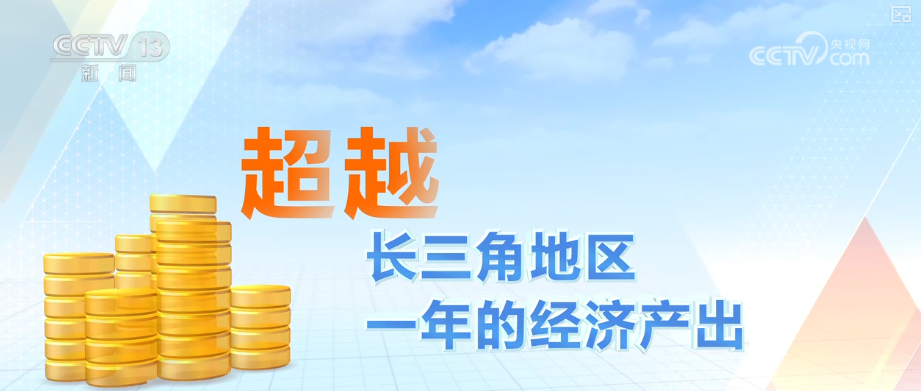
Economic Growth - During the "14th Five-Year Plan" period, China's economy is expected to reach approximately 140 trillion yuan by 2025, with an economic increment exceeding 35 trillion yuan, surpassing the annual economic output of the entire Yangtze River Delta region and exceeding the GDP of the world's third-largest economy [1] - The manufacturing industry's added value has consistently remained above 30 trillion yuan annually, maintaining China's position as the world's leading manufacturing power for 15 consecutive years [2] New Industries and Market Reforms - The "new economy" added value has surpassed 24 trillion yuan in 2024, equivalent to the combined GDP of Beijing, Shanghai, and Guangdong [4] - The government has cleared 4,218 regulations that hinder the establishment of a unified national market, reducing the market access negative list from 151 to 106 items [4] Investment and Infrastructure - By 2024, the proportion of market-oriented electricity transactions in total electricity consumption reached 63%, indicating a robust investment climate for private capital in nuclear power and industrial equipment [6] - A total of 102 major projects are expected to meet their planning goals by the end of 2025, with significant progress made on key infrastructure projects [6] Technological Advancements - In 2024, total R&D expenditure is projected to reach 3.6 trillion yuan, accounting for 2.68% of GDP, positioning China as the second-largest in the world for R&D investment [11] - The added value of high-tech manufacturing increased by 42% compared to the end of the "13th Five-Year Plan," while the core industries of the digital economy grew by 73.8%, contributing 10.4% to GDP [13] Innovation Ecosystem - China is forming a unique innovation ecosystem, with a focus on integrating technological and industrial innovation, and promoting a supportive environment for comprehensive innovation [14]

需求进入淡季,沪钢涨势放缓
Qi Huo Ri Bao· 2025-07-10 00:38
Core Viewpoint - The recent emphasis on advancing the national unified market construction and regulating low-price disorderly competition is expected to enhance market expectations for supply-side reforms, leading to a rebound in rebar futures prices, although the upward momentum may slow as market sentiment stabilizes and fundamentals take precedence [1] Group 1: Supply Side Dynamics - There is an increasing expectation in the market for steel mills to reduce production, particularly in light of the recent "anti-involution" meeting and potential production restrictions in Tangshan from July 4-15 [2] - The current steel industry situation is significantly different from 2016, with this year's steelmaking profits reaching the highest level in three years, and the total profit for the black metal smelting and rolling industry from January to May turning profitable at 31.6 billion yuan [2] - Despite the high profits in steelmaking, the willingness of steel mills to actively reduce production remains low, and the overall impact of the Tangshan production restrictions is expected to be limited [2] Group 2: Demand Pressure - The market anticipates a decline in rebar demand as the end-user demand enters a low season, although recent consumption has shown resilience with a weekly apparent consumption of 2.2487 million tons, slightly exceeding market expectations [3] - The total inventory of rebar has seen a slight decrease of 37,900 tons, maintaining a total of 5.4521 million tons, indicating that the turning point for inventory accumulation has not yet appeared [3] - The ongoing adjustment cycle in the real estate sector and suboptimal infrastructure funding are expected to continue to suppress rebar demand, with high temperatures and rainy weather in July further limiting demand improvement [3] Group 3: Market Outlook - Overall, the rebar market is expected to enter a phase of weak supply and demand as the low season deepens, with limited upward potential until new macroeconomic benefits emerge, particularly around the pressure level of 3,100 yuan per ton [4]
赵一德在调研融入和服务全国统一大市场建设工作时强调找准自身定位 发挥比较优势 在推动构建新发展格局中展现更大作为
Shan Xi Ri Bao· 2025-07-10 00:05
Group 1 - The core viewpoint emphasizes the importance of integrating and serving the national unified market, as highlighted by the provincial secretary Zhao Yide during his research in Xi'an and Xixian New Area [1] - Zhao Yide stresses the need for a high-efficiency, fair, and open bidding market as a crucial component of the national unified market, advocating for innovations in institutional rules, operational models, and regulatory systems [1] - The implementation of "digital + bidding" practices is recognized as a positive step towards enhancing the efficiency and reducing costs in the bidding process, which is essential for optimizing the business environment [1] Group 2 - Zhao Yide discusses the development and future planning of the Xi'an Xixian Comprehensive Bonded Zone, emphasizing the need to leverage the advantages of free trade zones and bonded areas to enhance cross-border e-commerce ecosystems [2] - The provincial secretary encourages the continuous improvement of customs service efficiency and regulatory effectiveness to support high-level openness in international trade [2] - The promotion of the "single window" for international trade is highlighted as a key measure for facilitating trade, with a focus on aligning with international standards and expanding service functions across the entire supply chain [2]
全力以赴稳增长 坚定信心挑大梁——2025年上半年河南经济形势分析暨全年展望
He Nan Ri Bao· 2025-07-09 23:24
Economic Overview - In the first half of 2025, Henan's economy is showing a positive trend, with a projected GDP growth of around 5.5%, which is above the national average [1][12] - The province's economic indicators are expected to demonstrate a continuous improvement, with a focus on high-quality development and stability [1][12] Economic Performance Characteristics - The GDP for the first quarter reached 14,945.58 billion yuan, with a year-on-year growth of 5.9%, which is 1.2 percentage points higher than the same period in 2024 [2] - Industrial output has shown significant growth, with a 8.4% increase in industrial value added from January to May, outperforming both Sichuan and the national average [2] - The service sector also performed well, with a 5.8% increase in the value added of the tertiary industry in the first quarter [2] Domestic Demand and Investment - Consumer demand has been robust, with retail sales reaching 11,820.14 billion yuan from January to May, a 7.5% increase year-on-year [3] - Fixed asset investment grew by 6.6% in the same period, maintaining the top position in central China [3] - Industrial investment surged by 29.5%, significantly higher than the national average [3] Innovation and New Industries - High-tech manufacturing value added increased by 15.5% from January to May, indicating strong growth in new industries [4] - The production of lithium-ion batteries and new energy vehicles saw remarkable growth, with increases of 89.9% and 38.6% respectively [4] - The technology transaction volume reached 105.3 billion yuan, a 136% increase, reflecting a vibrant innovation ecosystem [4] Foreign Trade and Investment - Henan's total import and export value grew by 27.0% from January to May, ranking third nationally [5] - The number of foreign trade enterprises increased by 11.5%, and foreign direct investment saw a 27.5% rise [5] - The logistics sector also experienced growth, with cargo and passenger transport volumes increasing significantly [5] Employment and Income - Employment policies have been prioritized, with over 56,520 new urban jobs created in the first five months [6] - The per capita disposable income for residents grew by 5.7% in the first quarter, above the national average [6] Strategic Focus and Future Outlook - The government is committed to maintaining economic stability and growth, with a focus on expanding domestic demand and enhancing market confidence [7][8] - Policies aimed at promoting consumption and investment are expected to yield positive results in the latter half of the year [13][14] - The overall economic trajectory for Henan is anticipated to remain positive, with key indicators expected to exceed national averages [12][23]
新国标发布 企业物资采购将建立统一编码规则
news flash· 2025-07-09 22:02
Core Viewpoint - The release of the national standard for enterprise procurement material classification coding aims to establish a unified coding system for corporate procurement in China, enhancing supply chain efficiency and supporting the construction of a unified national market [1] Group 1 - The national standard titled "Guidelines for the Classification and Coding of Enterprise Procurement Materials" was officially published on July 10 [1] - This standard, along with two previously released group standards, forms a comprehensive standard system for enterprise procurement management in China [1] - The implementation of this national standard is set for September 1, 2025, with pilot programs to be conducted in certain central state-owned enterprises and large private enterprises [1]
“十四五”期间中国经济增量预计超35万亿元
Shang Hai Zheng Quan Bao· 2025-07-09 18:22
Group 1 - China's innovation breakthroughs are driving industries towards mid-to-high-end transformation, with a shift from quantity to quality and from follower to leader in many fields [1] - The "decoupling and chain-breaking" efforts by external forces are reinforcing China's determination for self-reliance and accelerating the pace of independent innovation [1] Group 2 - The average life expectancy in China has reached 79 years, reflecting the tangible benefits of economic development and technological progress [2] - The "14th Five-Year Plan" includes seven livelihood indicators, the highest proportion in any five-year plan, aimed at enhancing people's sense of gain, happiness, and security [2] - China has established the world's largest education, social security, and healthcare systems, with over 95% coverage in compulsory education and basic insurance [2] - The national comprehensive transportation network is being rapidly improved, with over 10,000 kilometers of new high-speed rail lines added during the "14th Five-Year Plan," making China's high-speed rail mileage double that of other countries combined [2] Group 3 - The number of private enterprises in China has increased to over 58 million, reflecting a growth of more than 40% since the end of the "13th Five-Year Plan" [3] - The "14th Five-Year Plan" focuses on reform as a central task, emphasizing the need to streamline economic circulation and enhance market efficiency [3] - The establishment of a unified national market is progressing, with significant reductions in market access restrictions and the introduction of the Private Economy Promotion Law [3] - Comprehensive reforms are ongoing, with a commitment to address deep-seated issues and ensure the implementation of reform measures outlined in the 20th National Congress [3]