
智能化

Search documents
构建汽车行业央企ESG评价体系:核心在于环境和供应链指标:A股央企ESG系列报告之五
Shenwan Hongyuan Securities· 2025-10-14 05:08
Investment Rating - The report does not explicitly state an investment rating for the automotive industry, but it emphasizes the importance of ESG (Environmental, Social, and Governance) management in the context of technological innovation and sustainable development [3][6]. Core Insights - The automotive industry is undergoing a technological transformation with the rise of electrification, and balancing technological innovation with green sustainable development is a critical issue [3][6]. - The report outlines the establishment of an ESG evaluation system for state-owned enterprises (SOEs) in the automotive sector, focusing on environmental and supply chain indicators [3][8]. - The report highlights the need for SOEs in the automotive industry to enhance their supply chain ESG management to mitigate risks associated with complex and lengthy supply chains [3][8]. Summary by Sections 1. Automotive Industry SOE ESG Policies - The automotive industry is facing new technological changes and must adhere to various national policies aimed at promoting electric, connected, and intelligent development [7][8]. - Key policies include the "14th Five-Year Plan for Automotive Industry Development" and the "New Energy Vehicle Industry Development Plan (2021-2035)" [6][7]. - Recent policies emphasize the need for a safe and controllable supply chain and significant improvements in green development levels [7][8]. 2. Constructing the Automotive Industry SOE ESG Evaluation System - The ESG evaluation system includes five additional indicators specific to the automotive industry: contributions to industry standards, internationalization, technological progress, employee training, and supply chain capability enhancement [8][9]. - The evaluation system consists of five main categories of positive indicators and one category of negative indicators, with a total of 19 primary indicators and 53 secondary indicators [8][9]. - The environmental indicators are aligned with national carbon neutrality policies and include aspects such as waste management and energy management [10][11]. 3. Core Assumptions of Risks - The report notes that the pace of policy implementation related to ESG may not meet expectations, which could impact the automotive industry's transition to sustainable practices [28].
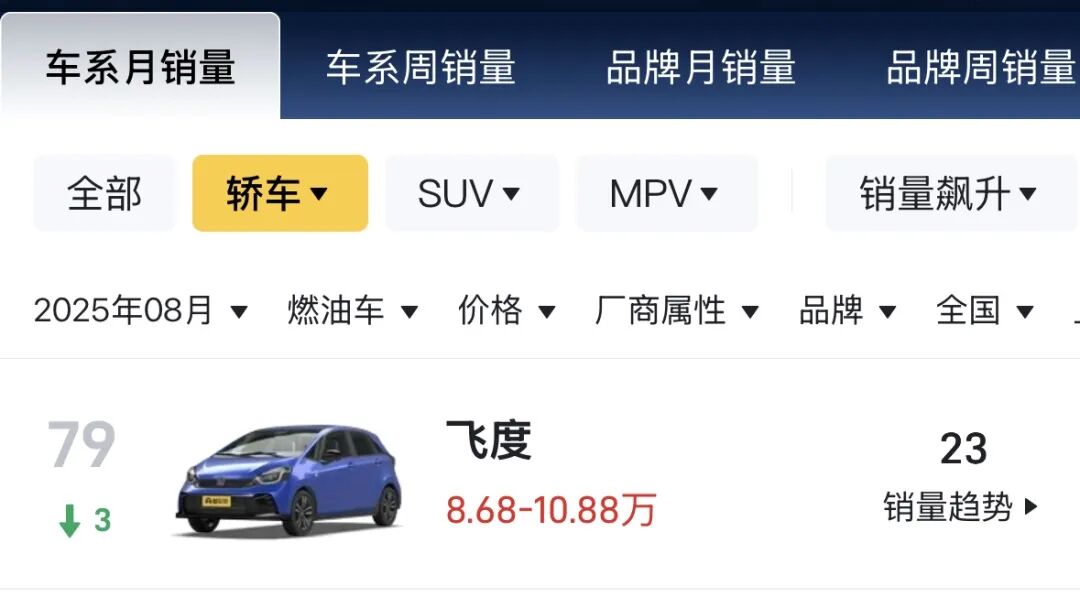
昔日“国民神车”陨落,月销量只剩两位数,2025年了谁还在买飞度?
Xin Lang Cai Jing· 2025-10-14 04:43
Core Viewpoint - The Honda Fit, once a popular choice in the Chinese market, has seen a dramatic decline in sales, with only 23 units sold in August 2025, marking a significant drop from its peak sales of 146,000 units per year [2][4][6]. Group 1: Sales Performance - The Honda Fit's sales have plummeted, with a monthly sales figure of just 23 units in August 2025, down from a peak of 14.6 million units [2][4]. - In July 2025, the Fit's sales fell below double digits for the first time, recording only 75 units sold, ranking 76th in the market [4]. - Cumulatively, the Fit sold 2,676 units in the first three quarters of 2025, with an average monthly sales of around 400 units in the first half of the year [4][6]. Group 2: Market Context - The decline of the Honda Fit reflects broader trends in the fuel vehicle market, as electric and smart vehicles gain popularity, supported by government policies and advancements in technology [8][9]. - Competing electric vehicles, such as the Geely Xingyuan and BYD Seagull, have taken over the market, with the Xingyuan selling over 46,000 units in August 2025 alone [9][10]. - The Fit's fuel efficiency, while competitive in the past, is now overshadowed by the lower operating costs of electric vehicles, making it less appealing to cost-conscious consumers [9][10]. Group 3: Consumer Preferences - Many former Honda Fit buyers are now opting for electric vehicles due to their lower running costs and advanced technology features [9][10]. - The Fit's interior and technology have not kept pace with competitors, lacking modern features such as advanced driver assistance systems and smart infotainment options [10]. - Despite its decline, some loyal customers still appreciate the Fit for its reliability and fuel efficiency, but this sentiment is not enough to sustain its market position [11][12]. Group 4: Future Outlook - Honda plans to introduce a new version of the Fit, which will include both fuel and hybrid variants, aiming to regain market interest [16][18]. - The new Fit is expected to feature improvements in fuel efficiency, with the hybrid version achieving a WLTC combined fuel consumption as low as 3.8L/100km [18]. - However, there are concerns about the vehicle's design and whether it can attract new buyers in a market increasingly dominated by electric vehicles [18].

每25秒出口一辆车,每40秒卖出一辆新能源:奇瑞的“加速度”密码
2 1 Shi Ji Jing Ji Bao Dao· 2025-10-14 04:12
Core Insights - Chery Automobile successfully listed on the Hong Kong Stock Exchange, marking the largest IPO of a car company in the Hong Kong market in 2025, symbolizing a significant milestone in the development of China's automotive industry [1][2] Sales Performance - In the first three quarters, Chery Group sold over 2 million vehicles, achieving a record sales pace, with 587,500 units of new energy vehicles sold, representing a year-on-year growth of 77.1% [1][3] - In September alone, Chery's new energy vehicle sales reached 91,590 units, maintaining a strong year-on-year growth of 55.4% [3] Product Development - Chery plans to launch over 60 new models by 2025, including various versions of sedans and SUVs, with 35% of the IPO proceeds allocated for developing different vehicle versions [4][7] - The successful launch of popular models like the Fengyun A9L and Jietu Shanhai L7 PLUS has significantly contributed to sales growth [3][4] Technological Advancements - Chery has made significant strides in technology, with a focus on hybrid and electric vehicle innovations, including the Kunpeng Tianqing hybrid engine achieving over 48% thermal efficiency [5][6] - The company has initiated a global open-source hybrid technology plan, promoting collaborative innovation in the industry [6] Financial Performance - Chery's mid-year report for 2025 indicated a revenue of 141.6 billion yuan, a year-on-year increase of 26.3%, with the new energy sector's revenue soaring by 141.9% [7] - The net profit for the first quarter of 2025 was reported at 4.726 billion yuan [7] Global Expansion - Chery exported 936,000 vehicles from January to September 2025, marking a year-on-year growth of 12.9%, with significant sales in high-regulation markets like Europe [8] - The company has successfully entered new markets, including Hungary and Germany, and plans to expand further into Denmark, Croatia, and France [8] Brand Recognition - Chery ranked 233rd in the 2025 Fortune Global 500, showcasing rapid growth among automotive companies [9] - The company has over 17.72 million global users, with more than 5.43 million overseas users, indicating a deepening global network [9]
财联社汽车早报10月14日
Xin Lang Cai Jing· 2025-10-14 01:57
Group 1 - The Ministry of Industry and Information Technology (MIIT) is seeking public feedback on draft requirements for vehicle production enterprises, aiming to enhance the intelligence and connectivity capabilities of automotive companies and raise production access thresholds [1] - The MIIT's revised requirements emphasize a systematic approach, safety standards, problem orientation, and adaptation to industry changes, focusing on improving product safety and after-sales service capabilities [1] - The trend towards electrification, intelligence, and connectivity is identified as a core factor determining the technological level of the automotive industry [1] Group 2 - In the first three quarters, China's self-owned brand electric vehicle exports accounted for 59.5% of total electric vehicle exports, showing a significant increase compared to the previous year [1] - The General Administration of Customs reported that high-tech product exports reached 3.75 trillion yuan, growing by 11.9%, contributing over 30% to the overall export growth [1] Group 3 - The China Passenger Car Association reported that retail sales of passenger cars in September reached 2.241 million units, a year-on-year increase of 6.3% and a month-on-month increase of 11% [4] - Cumulative retail sales for the year reached 17.005 million units, reflecting a year-on-year growth of 9.2% [4] - The penetration rate of new energy vehicles in the domestic passenger car market reached 57.8% in September, up 5 percentage points from the same period last year [4] Group 4 - The Secretary-General of the China Passenger Car Association, Cui Dongshu, indicated that the automotive market is expected to maintain stable growth in the fourth quarter, with upward adjustments to the 2025 growth forecast anticipated [6][7] - The upcoming adjustment of the new energy vehicle purchase tax exemption policy is expected to stimulate consumer purchases before the end of the year [6] Group 5 - Seres has passed the listing hearing on the Hong Kong Stock Exchange and plans to issue up to 331 million shares for its IPO, with funds aimed at enhancing technology R&D and expanding marketing channels [8] - Xiaomi's customer service addressed concerns regarding the SU7 vehicle's safety features following an accident, stating that the vehicle will unlock after detecting a collision [8] Group 6 - XPeng Aeroht announced the signing of agreements for the first batch of 600 flying cars in the Middle East, indicating a strategic move towards global expansion [9] - Pirelli celebrated its 20th anniversary in China, reaffirming its commitment to the market and planning further investments [9] Group 7 - Polestar has closed its last physical store in China, shifting to an online sales model to better align with the rapidly changing consumer demands in the market [10]
推动制造业转型走深走实
Sou Hu Cai Jing· 2025-10-14 01:51
Core Viewpoint - The Chinese manufacturing industry is crucial for the national economy and is undergoing significant transformation towards high-end, intelligent, green, and integrated development, contributing over 30% to global manufacturing growth during the "14th Five-Year Plan" period [1][2][3]. Group 1: Manufacturing Industry Development - The manufacturing sector is the backbone of the national economy, essential for economic stability, transformation, and improving people's lives [2][4]. - From 2020 to 2024, China's total industrial output value is expected to increase from 31.3 trillion yuan to 40.5 trillion yuan, with manufacturing output rising from 26.6 trillion yuan to 33.6 trillion yuan, maintaining a global share of approximately 30% [3]. - The innovation investment in manufacturing has steadily increased, with R&D expenses of large-scale manufacturing enterprises accounting for over 1.6% of revenue, and over 75% of national R&D funding coming from manufacturing [3]. Group 2: Factors Driving Transformation - The transformation of the manufacturing industry is supported by various favorable factors, including strong governmental policies aimed at promoting high-quality development [4][5]. - The integration of digital technologies and the real economy is crucial, with enterprises leveraging AI and big data for comprehensive upgrades across manufacturing processes [4][6]. - Despite progress, challenges remain, such as gaps in innovation capabilities compared to leading manufacturing nations and the need for improved standardization in the transformation process [4][7]. Group 3: Strategic Focus Areas for Future Development - To accelerate the transformation of the manufacturing industry, three key areas should be prioritized: enhancing technological innovation, improving policy environments, and optimizing industrial systems [5][6][8]. - Strengthening technological innovation involves increasing R&D investments and integrating digital and green technologies across all manufacturing processes [6]. - Creating a supportive policy environment includes establishing comprehensive policy frameworks that guide infrastructure, technological innovation, and market development towards manufacturing [7]. - Promoting the integration of advanced manufacturing with modern service industries can enhance competitiveness and foster new growth drivers for the manufacturing sector [8].
研判2025!中国钓鱼竿行业发展背景、市场规模、进出口情况、重点品牌及前景展望:居民休闲消费升级与技术革新,带动钓鱼竿规模增至44.12亿元[图]
Chan Ye Xin Xi Wang· 2025-10-14 00:44
Core Insights - The fishing rod industry in China is experiencing significant growth, driven by rising disposable income and a shift towards high-quality outdoor leisure activities, with the market size projected to increase from 2.159 billion yuan in 2015 to 4.412 billion yuan in 2024, reflecting a compound annual growth rate (CAGR) of 8.27% [1][11] - Technological advancements, particularly in materials like carbon fiber, are enhancing the performance of fishing rods, making them lighter and more sensitive, which aligns with consumer demand for personalized and tech-savvy fishing experiences [1][11] - The industry is expected to expand further due to improved recreational infrastructure, increased popularity of fishing culture, and ongoing product innovation [1][11] Industry Overview - Fishing rods are essential tools for fishing activities, categorized by fishing methods into hand rods, sea rods, and lure rods, each designed for specific fishing environments and techniques [3][4] - The fishing rod industry is supported by a robust supply chain, with upstream materials including fiberglass, carbon fiber, and various metals, while downstream includes sales channels like specialty fishing stores and e-commerce platforms [8][9] Market Dynamics - The disposable income of Chinese residents has increased from 26,000 yuan in 2017 to 41,300 yuan in 2024, with a CAGR of 6.83%, which has positively impacted consumer spending on leisure activities, including fishing [8] - The fishing rod market is primarily export-oriented, with exports significantly outpacing imports, which account for about one-tenth of the export volume [11][12] Competitive Landscape - The Chinese fishing rod market is characterized by intense competition, dominated by local brands such as Guangwei, Dajia, and Huashi, while international brands like Daiwa and Shimano hold a significant share in the high-end market [12] - Guangwei Group, established in 1987, is a key player in the industry, focusing on outdoor fishing gear and carbon fiber products, with a production capacity of 10 million fishing rods annually [12][13] Development Trends - The industry is witnessing a trend towards lightweight fishing rods, driven by the application of high-performance carbon fiber materials, enhancing user experience and reducing physical strain during fishing [14] - The integration of smart technology into fishing rods is emerging, with features like real-time data monitoring and connectivity with smart devices, redefining modern fishing experiences [15]


提高门槛 完善标准 工信部修订多项汽车领域审查要求
Zhong Guo Jin Rong Xin Xi Wang· 2025-10-13 23:55
Core Viewpoint - The Ministry of Industry and Information Technology (MIIT) has revised the admission review requirements for road motor vehicle production enterprises and products to enhance product quality and safety, adapting to the new trends in the automotive industry and promoting sustainable development [1][3]. Group 1: Enterprise Review Requirements - The revised "Enterprise Review Requirements" raise the standards for enterprises' capabilities in intelligence, connectivity, and production admission thresholds, emphasizing cybersecurity and data security [1][2]. - New requirements for "group management" have been introduced, enhancing the efficiency of admission management and resource utilization in the industry [2]. - The review process has been adjusted to reduce the burden on enterprises by modifying production equipment requirements and relaxing certain R&D capability demands based on product characteristics [2]. Group 2: Product Review Requirements - The "Product Review Requirements" now include standards related to reliability and vehicle safety, reinforcing the safety baseline for vehicles [2]. - The revisions aim to standardize and clarify review requirements, improving the precision and effectiveness of the review process [2]. - The approach maintains a prudent and inclusive principle, creating a regulatory pathway for the application of emerging technologies and supporting industry innovation [2]. Group 3: Industry Challenges and Responses - The automotive industry is rapidly transitioning towards electrification, intelligence, and connectivity, leading to new safety risks and challenges in management [3]. - The need for improved admission review requirements is underscored by concerns over irrational competition, which may compromise product safety and consumer rights [3]. - The MIIT emphasizes the importance of balancing development and safety, ensuring that the revised requirements support the transformation and upgrading of the automotive industry [3].
“一滴油”到“一片材料”,石油炼化智慧蝶变
Zhong Guo Chan Ye Jing Ji Xin Xi Wang· 2025-10-13 23:35
Core Insights - The integration of artificial intelligence in China's PetroChina Guangdong Petrochemical plant has led to a 12% reduction in energy consumption, saving approximately 180,000 tons of standard coal annually [1] - The company is undergoing a transformation towards high-end, intelligent, and green development, addressing the challenges of low-end surplus and high-end shortages in the refining industry [1] - The production of petrochemical products has significantly increased, with a 32% growth in commodity volume and a 40% increase in specialty refined products since 2020 [3] Group 1 - The AI model at the Guangdong Petrochemical plant controls over 2,000 parameters, enhancing operational efficiency and vitality [1] - The company is implementing a self-revolution by shutting down inefficient units and restructuring its resource pool to focus on value chain enhancement [1] - The introduction of advanced technologies, such as the Ethylene 2.0 technology, has improved yield and reduced energy consumption in new projects [2] Group 2 - The production of aviation kerosene and specialty refined products has increased by 20.3% and 5.8% respectively, showcasing the continuous improvement in product quality and production capacity [3] - The company has successfully replaced imported additives with domestic alternatives, demonstrating its commitment to technological innovation [3] - China's PetroChina is expanding its intelligent solutions internationally, marking a shift from technology importation to exportation [3] Group 3 - The restructuring of the Guangxi Petrochemical Qinzhou base has enhanced the value chain, increasing the value derived from a single drop of oil significantly [2] - The company is positioned to lead in the global petrochemical industry with its innovative practices and high-quality development strategies [4]

纵深推进数字化智能化国际化 圆通速递构筑快递物流生态体系
Zhong Guo Zheng Quan Bao· 2025-10-13 21:49
Core Viewpoint - YTO Express is focusing on enhancing its core express delivery services while advancing its digitalization, intelligence, and internationalization strategies to achieve high-quality development and expand its logistics ecosystem [1][7]. Digitalization and Intelligence - The application of machine vision, edge computing, digital twin technology, and AI models is significantly improving YTO Express's operational efficiency and quality control [2][3]. - The company is implementing AI-driven tools like the "AI Assistant for Couriers," which saves couriers 30 to 60 minutes daily by optimizing delivery routes and tasks [3][4]. - Customer service enhancements include the deployment of intelligent arbitration systems, leading to a 16% reduction in repeat customer inquiries and improved service quality [4][5]. International Expansion - YTO Express has accelerated its internationalization efforts, including the opening of a new processing center in Melbourne and partnerships with companies like Xiaomi for cross-border logistics [5][6]. - The company has established over 150 cargo routes and operates a fleet of 13 aircraft, supporting its international logistics capabilities [6][8]. - YTO Express is expanding its presence in emerging markets and enhancing its supply chain logistics products across various sectors [6][8]. Business Performance - The express delivery volume is projected to grow from 16.543 billion pieces in 2021 to 26.573 billion pieces by 2024, with revenue increasing from 45.155 billion yuan to 69.033 billion yuan in the same period [8][9]. - As of mid-2025, the company has achieved a 21.79% year-on-year growth in express delivery volume and a 10.19% increase in revenue [8]. Quality Development Focus - YTO Express aims to enhance operational efficiency and service quality by focusing on timeliness, fulfillment quality, customer service, and precise marketing strategies [9].

纵深推进数字化智能化国际化圆通速递构筑快递物流生态体系
Zhong Guo Zheng Quan Bao· 2025-10-13 20:56
Core Insights - YTO Express has achieved significant growth by enhancing its digital, intelligent, and international capabilities, focusing on core express services while exploring diversified strategic layouts [1][4][6] - The company is committed to deepening its core express business and advancing its digital transformation, utilizing advanced technologies such as AI and machine learning to improve operational efficiency and service quality [2][3] Digital Transformation - The application of machine vision, edge computing, digital twin technology, and AI models has significantly improved quality control, operational standardization, and logistics efficiency [1][2] - The introduction of the "AI Assistant" for couriers has optimized route planning and saved each courier 30 to 60 minutes of work daily [3] Operational Efficiency - In the first half of the year, YTO Express reduced its per-package transportation cost to 0.37 yuan, a decrease of 26% from 2021 [3] - The company has seen improvements in service metrics, with a decrease in overall delivery time by 8.58%, lost package rates down over 59%, and a 16% reduction in repeat customer inquiries [4] International Expansion - YTO Express has launched new international operations, including a processing center in Melbourne and partnerships with companies like Xiaomi for cross-border logistics [4][5] - The company has opened over 150 cargo routes and operates a fleet of 13 aircraft, enhancing its international logistics capabilities [5][6] Market Position and Growth - The express delivery volume is projected to grow from 16.543 billion packages in 2021 to 26.573 billion packages by 2024, with revenue increasing from 45.155 billion yuan to 69.033 billion yuan in the same period [6][7] - As of mid-2025, YTO Express has established a comprehensive service network covering all provinces and major cities in China, with a 99.93% coverage rate in county-level cities [6][7] Commitment to Quality Development - The company aims to enhance operational efficiency and service quality while focusing on timely delivery, customer service, and precise marketing strategies [7] - YTO Express is dedicated to achieving high-quality development that aligns with social progress and enhances brand value [7]