
AI

Search documents
AI末日报告说了什么?影响哪些市场?
Hu Xiu· 2026-02-24 11:00
Group 1 - The US stock market is experiencing volatility, raising questions about whether the AI end-of-month report will continue to impact the market negatively [3] - The A-share market opened positively on the first day of the Year of the Horse, with all three major indices closing in the green, particularly in sectors like oil and gas, chemicals, and electric grid equipment [3] - Recent developments regarding tariffs from former President Trump have led to a 10% increase in global tariff rates, which was later adjusted to 15%, creating mixed reactions globally [3] Group 2 - The tariff situation has prompted urgent communications between Europe and the US, while it is perceived as a relatively favorable development for China [3]
With his tariff plan in tatters, Trump vows ‘to do absolutely terrible things to foreign countries … in a much more powerful and obnoxious way’
Yahoo Finance· 2026-02-24 10:51
Foreign trade partners of the U.S. are losing their patience with the White House. Countries that thought they had low-level tariff deals of 10% or so are now potentially looking at 15%. And countries that fought the White House and got higher tariffs may now see only a 10% tax level. “The perversity of what happened at the weekend was that those who got good deals, the allies, have been most disadvantaged,” Andy Haldane, the former central bank economist and current president of the British Chambers of Com ...

连连支付重磅推出连连财智 开启企业全球收支数智化新征程
Sou Hu Cai Jing· 2026-02-24 10:43
Core Viewpoint - Lianlian Payment has officially launched a new global expense management platform, Lianlian Caizhi, aimed at addressing the digital expense management needs of enterprises, providing a one-stop solution for corporate payments, expense control, and fund management to support refined operations and global growth [1][3]. Group 1: Platform Features - The Lianlian Caizhi platform integrates various resources and services to facilitate corporate payment processes, automate employee reimbursements, and enhance financial management efficiency, ultimately helping enterprises reduce costs and increase efficiency [5][6]. - The platform covers diverse corporate payment scenarios, including deferred payments, global travel bookings, and corporate procurement, offering convenient and comprehensive value-added services [5][6]. - Lianlian Caizhi incorporates AI modules, utilizing advanced technologies such as natural language processing and enhanced search capabilities to provide intelligent, secure, and convenient support for enterprises [6][7]. Group 2: Business Potential - The platform has demonstrated strong business potential across different types of enterprises, showcasing three significant advantages: convenience through a dedicated corporate credit card for global travel, compliance with comprehensive traceability and classification of expenses, and increased efficiency through integrated financial management [7]. - The launch of Lianlian Caizhi marks a significant advancement in Lianlian's service system, paving the way for broader industry applications and deeper integration within the industrial chain, thus serving as a new engine for industrial transformation and high-quality development [7]. - Lianlian Payment aims to continue deepening its focus on enterprise-level payment and digital services, leveraging technological innovation to enhance the Lianlian Caizhi platform and streamline the entire expense management process for enterprises [7].

新材料板块上行,新材料ETF国泰(159761)涨超2.4%,行业景气获市场关注
Mei Ri Jing Ji Xin Wen· 2026-02-24 10:35
Group 1 - The strong demand for AI is driving both price and volume increases in the PCB industry, with several AI-PCB companies experiencing robust orders and full production capacity, leading to significant growth in performance [1] - The demand for AI copper-clad laminates is high, and due to slow expansion of overseas production, leading manufacturers in this sector are expected to benefit positively [1] - The PCB industry is showing an "accelerating upward" trend, with increasing tension in the supply of copper-clad laminates, maintaining a high level of industry prosperity [1] Group 2 - The Guotai New Materials ETF (159761) tracks the New Materials Index (H30597), which includes listed companies involved in advanced basic materials, key strategic materials, and cutting-edge new materials, reflecting the overall performance of securities in the new materials sector [1] - The index components possess high technical barriers and good growth potential, focusing on industries such as chemicals, non-ferrous metals, and electronics [1]
最高或赔4.31亿,国投瑞银,去年要白干了
Xin Lang Cai Jing· 2026-02-24 10:26
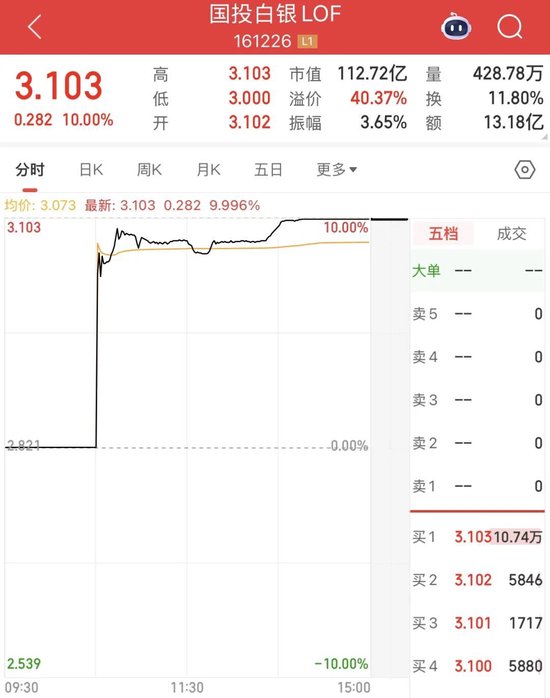
Core Viewpoint - The news highlights the recent recovery of the stock market on the first trading day of the Year of the Horse, with all three major indices rising, and the国投瑞银白银LOF finally hitting the limit up after several consecutive declines before the New Year. However,国投瑞银 is facing significant financial repercussions due to a compensation plan for investors affected by valuation adjustments [1][24]. Group 1: Compensation Plan Details - The compensation plan for国投瑞银白银LOF will officially start on February 26, and it is a tiered compensation scheme [24][28]. - For individual investors with valuation adjustments below 1,000 yuan, the compensation will be based on the actual impact amount, which accounts for over 90% of the redeeming investors on that day [4][25]. - For those with valuation adjustments exceeding 1,000 yuan, the compensation will be calculated based on a fixed amount plus a certain percentage of the excess amount [5][26]. - The compensation only applies to investors who redeemed on February 2, and no compensation is mentioned for those who have not redeemed [6][27]. Group 2: Financial Impact on国投瑞银 - The compensation plan could result in国投瑞银 facing a maximum loss of approximately 4.31 billion yuan, which could mean a year of no profit for the company [14][35]. -国投资本's 2024 net profit is reported to be 2.694 billion yuan, indicating that the maximum loss from this incident would be around 134.7 million yuan, which is not significant for国投资本 but is critical for国投瑞银 [10][31]. - The compensation will negatively impact国投资本's net profit for 2026, with the estimated impact being less than 5% of the audited net profit for 2024 [28][37]. Group 3: Ongoing Challenges for国投瑞银 - The compensation plan is seen as a significant step in protecting small investors, but it has not completely quelled market disputes, especially among larger investors who are uncertain about their compensation amounts [17][38]. -国投瑞银 has faced lawsuits from investors previously, particularly regarding poor performance and management strategies that diverged from contractual obligations [39]. - The overall performance of国投瑞银 has been underwhelming, with a decline in total assets from 278.614 billion yuan at the end of 2024 to 256.125 billion yuan by February 11, 2026, primarily due to declines in bond and money market funds [40][42].
影视股开局失利,深股通狂抛光线传媒!4机构卖出每日互动1.65亿
Ge Long Hui· 2026-02-24 10:23
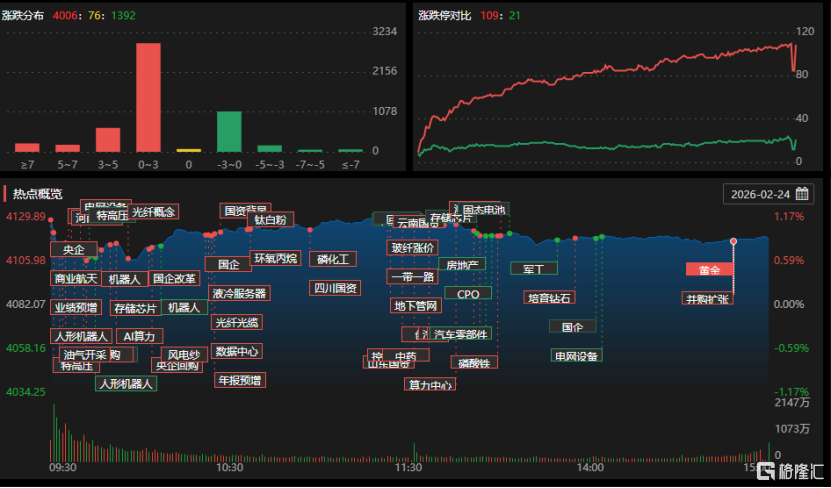
Market Overview - On the first trading day of the Year of the Rabbit, all three major A-share indices rose, with the Shanghai Composite Index up by 0.87%, the Shenzhen Component Index up by 1.36%, and the ChiNext Index up by 0.99% [1] - Over 4,000 stocks increased in value, with more than 100 stocks hitting the daily limit [1] Sector Performance - The oil and gas extraction, precious metals, and cultivated diamond sectors saw significant gains, while the film and cinema, AI applications, tourism and hotels, liquor, and duty-free shop sectors experienced declines [1] Individual Stock Highlights - Notable stocks included: - Han Jian He Shan, which achieved five consecutive daily limits in nine days [3] - Yu Neng Holdings, which recorded four consecutive daily limits [3] - GCL-Poly Energy, part of the photovoltaic sector, also achieved five daily limits in nine days [3] - Other stocks with notable performance included: - New Jin Power (+20.07%), Tongyuan White Ancestor (+20.04%), and Qian Neng Zhi Xin (+20.01%) [4] Trading Volume and Turnover - The trading volume and turnover for several stocks were highlighted, with significant figures such as: - New Jin Power with a turnover of 7.96 million and a trading volume of 123.3 thousand [4] - Tongyuan White Ancestor with a turnover of 11.84 million and a trading volume of 94.09 thousand [4] Top Net Buy and Sell Stocks - The top net buy stocks included: - Huagong Technology with a net buy of 5.23 billion, Shenzhen South Circuit with 4.21 billion, and Hunan Silver with 3.44 billion [5] - The top net sell stocks included: - Light Media with a net sell of 6.33 billion, Dazhi Technology with 5.83 billion, and Tax Friend Shares with 2.54 billion [6] Institutional Activity - Institutional net buying was significant in stocks like Huagong Technology and Shanghai Film, with net buys of 1.89 billion and 1.85 billion respectively [8] - Conversely, Tax Friend Shares and Daily Interaction saw substantial net selling by institutions, with net sells of 3.20 billion and 1.65 billion respectively [9] Company-Specific Developments - Huagong Technology reported that its optical module business is operating at full capacity, with orders extending to Q4 2026 [13] - Shenzhen South Circuit is involved in PCB and AI computing, with expected growth in orders for high-end DRAM products [18] - Hunan Silver anticipates a significant increase in net profit due to rising silver and gold prices, projecting a growth of 67.88% to 126.78% [23]





北水动向|北水成交净买入31.31亿 内资全天抢筹南方恒生科技近16亿港元
智通财经网· 2026-02-24 10:09
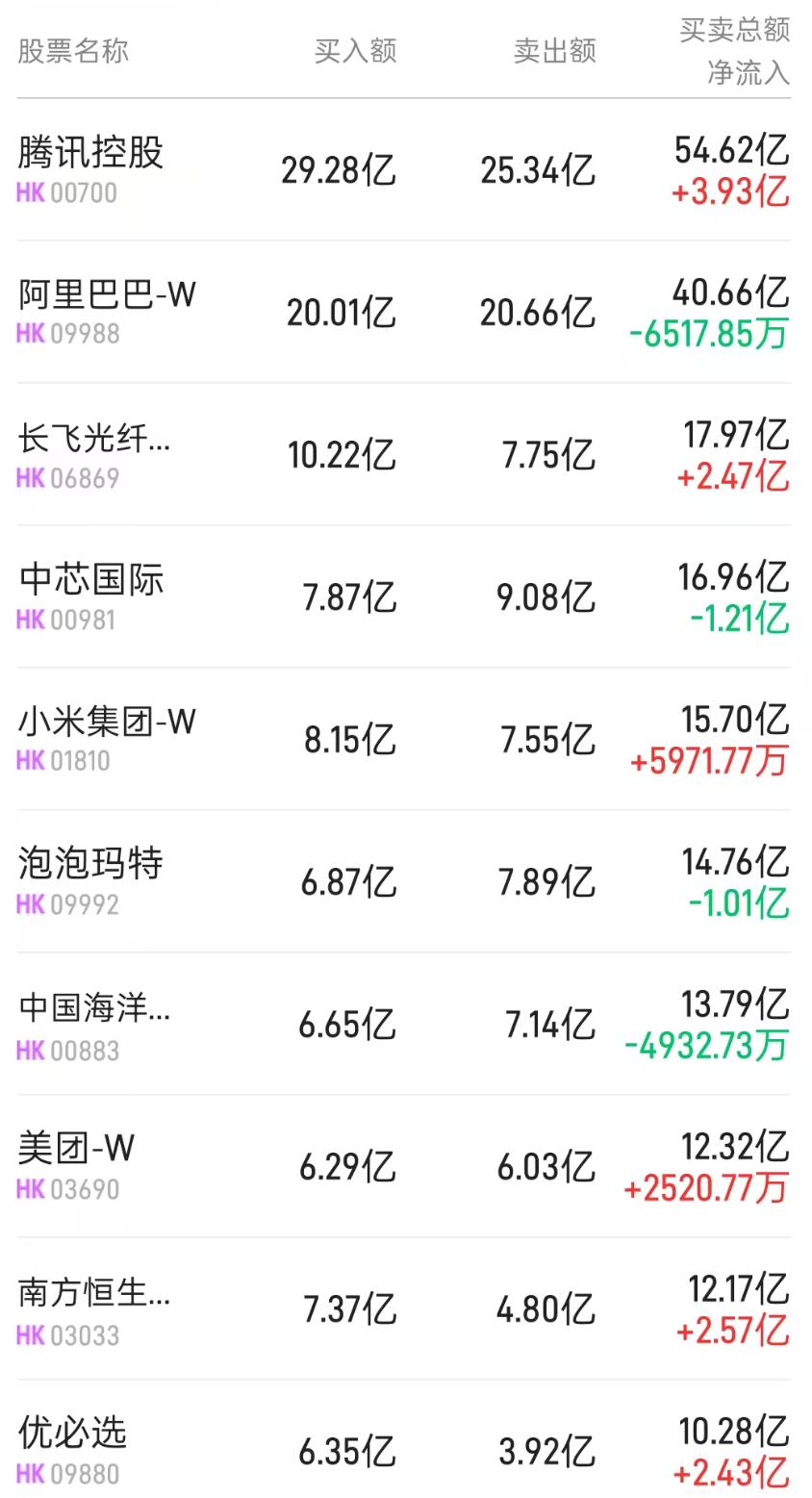
Group 1: Market Overview - The Hong Kong stock market saw a net inflow of 31.31 billion HKD from northbound trading, with 9.6 billion HKD from Shanghai and 21.7 billion HKD from Shenzhen [1] - The most bought stocks included Southern Hang Seng Technology (03033), Meituan-W (03690), and Xiaomi Group-W (01810) [1] - The most sold stocks were CNOOC (00883), Tencent (00700), and Alibaba-W (09988) [1] Group 2: Stock Performance - Southern Hang Seng Technology (03033) received a net inflow of 15.84 billion HKD, supported by positive sentiment in the tech sector [5] - Meituan-W (03690) saw a net inflow of 6.87 billion HKD, with a report indicating a 79% year-on-year increase in travel spending during the Spring Festival [5] - Xiaomi Group-W (01810) had a net inflow of 4.37 billion HKD, with plans to focus on core technologies like chips and AI over the next five years [5] Group 3: Individual Stock Insights - Tencent Holdings (00700) had a total trading volume of 54.62 billion HKD, with a net inflow of 3.93 billion HKD [2] - Alibaba-W (09988) experienced a net outflow of 651.785 million HKD, with total trading of 40.66 billion HKD [2] - SMIC (00981) received a net inflow of 2.2 billion HKD, with expectations of sales growth exceeding industry averages by 2026 [6][7]





公募基金指数跟踪周报(2026.02.09-2026.02.13):地缘关税扰动并存,市场结构趋势延续-20260224
HWABAO SECURITIES· 2026-02-24 10:08
Report Industry Investment Rating No relevant content provided. Core Viewpoints of the Report - In the short - term, the event disturbances during the Spring Festival holiday do not strongly drive a comprehensive market rise. The market may continue its characteristics of structural differentiation and high - level volatility. The logic of price increases due to anti - involution, geopolitical disturbances, and supply - demand mismatches in the AI supply chain will run through the whole year. Attention should be paid to long - position opportunities in细分 fields. However, the Two Sessions will be held on March 4th, and the detailed 15th Five - Year Plan will be finalized, which means that the policy - favorable expectations for technology and growth will be realized. One needs to beware of the decline risk after the growth style's good news is exhausted. With the in - depth and continuous promotion of anti - involution policies, the demand side will stabilize under the tone of fiscal stimulus and economic recovery. The reversal of the supply - demand contradiction may consolidate the performance inflection point of leading industry companies. Focus on the mid - stream industries with profitability repair and ROE improvement [3][14]. - The bond market has both bullish and bearish factors. After the Spring Festival, the concentrated maturity of reverse repurchases may put some pressure on short - term market liquidity, but the central bank is likely to maintain a supportive attitude, and the liquidity disturbance is probably controllable. The supply pressure of local bonds will decrease after the festival. However, the yield of the 10 - year Treasury bond has fallen below 1.8%, and the resistance to further decline has increased. The purchasing power of institutional allocation funds may decline after the festival, and the market game will intensify before the Two Sessions with a low probability of interest rate cuts. Although the relative value of coupon allocation still exists, the downward space for bond yields of various maturities may be limited [4][15]. Summary by Relevant Catalogs 1. Weekly Market Observation 1.1. Equity Market Review and Observation - During the week before the Spring Festival holiday (2026.02.09 - 2026.02.13), the Shanghai and Shenzhen 300 rose 0.36%, the CSI 500 rose 1.88%, and the ChiNext Index rose 1.22%. The market had some enthusiasm, but the sentiment was restrained, and the trading volume did not effectively increase, remaining at around 2 trillion. The rebound hotspots were concentrated in the TMT and media industries. Pan - technology stocks were significantly repaired, and there was a concentrated rise in sub - directions such as diesel generators and gas turbines related to the North American computing power power outage. The market was still mainly characterized by a structural trend, and all market mainlines were basically centered around the AI narrative [12]. - During the Spring Festival holiday, the US tariff unconstitutional ruling and the Middle East situation injected new uncertainties into the market. The US Supreme Court ruled that Trump's imposition of reciprocal tariffs under the International Emergency Economic Powers Act was unconstitutional. Trump's administration then announced a 10% temporary tariff on imported goods for 150 days starting from February 24th and later proposed to raise it to 15%. The US - Iran negotiation was completed without a substantial agreement, and Trump threatened a "limited - scale" military strike on Iran. The release of the US December PCE inflation data and the Fed's FOMC meeting minutes weakened the market's expectation of an optimistic Fed interest rate cut [13]. - Domestically, the long - holiday consumption data was mixed. The travel traffic reached a new high, highlighting the prosperity of the service - based tourism consumption economy, but there was internal structural differentiation. The overall consumption showed the characteristics of increasing volume but decreasing price, and traditional consumption in areas such as film and real estate was weak, while consumption in areas such as return - home tourism, outbound tourism under visa - free policies, and smart wearable devices was strong. The popularity of humanoid robots and AI applications during the Spring Festival Gala is expected to continuously boost the market's enthusiasm for technology [14]. 1.2. Pan - Fixed - Income Market Review and Observation - In the week before the Spring Festival holiday (2026.02.09 - 2026.02.14), the bond market performed well. The yield of the 1 - year Treasury bond decreased by 0.62BP to 1.31%, the yield of the 10 - year Treasury bond decreased by 2.03BP to 1.79%, and the yield of the 30 - year Treasury bond decreased by 0.50BP to 2.25%. Driven by the pre - holiday allocation demand, the bond market continued its oscillatory recovery trend [15]. - The US Treasury yield curve flattened last week (2026.02.09 - 2026.02.23). The 1 - year US Treasury yield rose 5BP to 3.50%, the 2 - year yield fell 7BP to 3.43%, and the 10 - year yield fell 19BP to 4.03%. The decline in long - term US Treasury yields was mainly due to the speech of the National Economic Council Chairman suggesting a possible downturn in the employment market and the lower - than - expected CPI growth in January, which reduced inflation expectations. Although the January employment data was better than expected, as the US stock market continued to weaken and market risk appetite decreased, some funds flowed into the bond market, leading to a significant decline in long - term US Treasury yields [17]. - The CSI REITs Total Return Index rose 0.41% during the week before the Spring Festival holiday (2026.02.09 - 2026.02.13), closing at 1047.08 points, with most sectors rising, especially in consumption and data centers. In the primary market, 4 new public REITs made progress last week: Huatai Three Gorges Clean Energy REIT was under feedback, CITIC Construction First Agricultural Food Group Commercial Real Estate REIT and Guotai Haitong Chongbang Commercial Real Estate REIT were accepted, and AVIC Beijing Changbao Rental Housing REIT was under inquiry [17]. 2. Fund Index Performance Tracking 2.1. Equity Strategy Theme - Based Index - **Active Stock Fund Selection Index**: The index selects 15 funds each period, with equal - weight allocation for each fund. The core positions select active equity funds based on performance competitiveness and style stability within value, balanced, and growth styles, and the style distribution is roughly balanced according to the style distribution of the CSI Equity - Oriented Fund Index (930950.CSI). The performance benchmark is the CSI Equity - Oriented Fund Index (930950.CSI) [21][22]. 2.2. Investment Style - Based Index - **Value Stock Fund Selection Index**: The value style includes both deep - value and quality - value styles. The index selects 10 funds of deep - value, quality - value, and balanced - value styles based on multi - period style classification. The performance benchmark is the CSI 800 Value Index (H30356.CSI) [25]. - **Balanced Stock Fund Selection Index**: Balanced - style fund managers balance the valuation and growth of individual stocks and switch to more cost - effective stocks when the cost - performance of held stocks decreases. The index selects 10 relatively balanced and value - growth style funds based on multi - period style classification. The performance benchmark is the CSI 800 (000906.SH) [25]. - **Growth Stock Fund Selection Index**: The growth style aims to capture the double - click opportunities of performance and valuation of high - growth companies and discover "dark - horse" companies in high - potential fields. The index selects 10 funds of active - growth, quality - growth, and balanced - growth styles based on multi - period style classification. The performance benchmark is the 800 Growth Index (H30355.CSI) [28]. 2.3. Industry Theme - Based Index - **Pharmaceutical Stock Fund Selection Index**: The index selects funds based on the intersection market value ratio of the fund's equity holdings and the constituent stocks of the representative index (CITIC Pharmaceutical). Funds with an average purity of no less than 60% in the past 3 years or since establishment are selected. An evaluation system is established, and 15 funds are selected to form the index. The performance benchmark is the pharmaceutical theme fund index (fitted by Huabao Securities' fund research and investment platform) [31][32]. - **Consumption Stock Fund Selection Index**: The index selects funds based on the intersection market value ratio of the fund's equity holdings and the constituent stocks of representative indices (CITIC Automobile, Home Appliances, Commerce and Retail, Consumer Services, Textile and Apparel, Food and Beverage, Agriculture, Forestry, Animal Husbandry and Fishery). Funds with an average purity of no less than 50% in the past 3 years or since establishment are selected. An evaluation system is established, and 10 funds are selected to form the index. The performance benchmark is the consumption theme fund index (fitted by Huabao Securities' fund research and investment platform) [32]. - **Technology Stock Fund Selection Index**: The index selects funds based on the intersection market value ratio of the fund's equity holdings and the constituent stocks of representative indices (CITIC Electronics, Communications, Computer, Media). Funds with an average purity of no less than 60% in the past 3 years or since establishment are selected. An evaluation system is established, and 10 funds are selected to form the index. The performance benchmark is the technology theme fund index (fitted by Huabao Securities' fund research and investment platform) [36]. - **High - end Manufacturing Stock Fund Selection Index**: The index selects funds based on the intersection market value ratio of the fund's equity holdings and the constituent stocks of representative indices (CITIC Construction, Light Industry Manufacturing, Machinery, Power Equipment and New Energy, National Defense and Military Industry, Electronics, Communications). Funds with an average purity of no less than 50% in the past 3 years or since establishment are selected. An evaluation system is established, and 10 funds are selected to form the index. The performance benchmark is the high - end manufacturing theme fund index (fitted by Huabao Securities' fund research and investment platform) [41]. - **Cyclical Stock Fund Selection Index**: The index selects funds based on the intersection market value ratio of the fund's equity holdings and the constituent stocks of representative indices (CITIC Petroleum and Petrochemical, Coal, Non - ferrous Metals, Steel, Building Materials, Basic Chemicals, Banks, Non - bank Finance, Real Estate, Comprehensive Finance). Funds with an average purity of no less than 50% in the past 3 years or since establishment are selected. An evaluation system is established, and 5 funds are selected to form the index. The performance benchmark is the cyclical theme fund index (fitted by Huabao Securities' fund research and investment platform) [44]. 2.4. Money - Market Enhancement Index - **Money - Market Enhancement Strategy Index**: The index aims at liquidity management, pursuing a curve that surpasses money - market funds and is smooth and upward. It mainly allocates money - market funds with relatively good performance and inter - bank certificate of deposit index funds among passive index - bond funds. The performance benchmark is the CSI Money - Market Fund Index (H11025.CSI) [46]. 2.5. Pure - Bond Index - **Short - Term Bond Fund Selection Index**: The index aims at liquidity management, pursuing a smooth and upward curve while ensuring drawdown control. It mainly allocates 5 funds with stable long - term returns, strict drawdown control, and significant absolute - return ability. The performance benchmark is 50% * Short - Term Pure - Bond Fund Index + 50% * Ordinary Money - Market Fund Index [50]. - **Medium - and Long - Term Bond Fund Selection Index**: The index invests in medium - and long - term pure - bond funds, pursuing stable returns while controlling drawdowns. It aims for excess returns relative to the medium - and long - term bond fund index and a stable upward net - value curve. It selects 5 funds each period, balancing coupon strategies and band - trading operations, adjusting the duration and the ratio of credit - bond funds and interest - rate - bond funds according to market conditions [51]. 2.6. Fixed - Income Plus Index - **Low - Volatility Fixed - Income Plus Selection Index**: The equity center of the index is positioned at 10%. It selects 10 fixed - income plus funds each period, focusing on those with an equity center (total equity position considering convertible - bond and stock holdings) of less than 15% in the past three years and recently. It considers both the risk - return ratio and the holding experience. The performance benchmark is 10% CSI 800 Index + 90% ChinaBond New Composite Full - Price Index (CBA00303.CS) [55]. - **Medium - Volatility Fixed - Income Plus Selection Index**: The equity center of the index is positioned at 20%. It selects 5 fixed - income plus funds each period, choosing those with an equity center between 15% and 25% in the past three years and recently. It focuses on the risk - return ratio and selects funds with certain performance elasticity. The performance benchmark is 20% CSI 800 Index + 80% ChinaBond New Composite Full - Price Index (CBA00303.CS) [58]. - **High - Volatility Fixed - Income Plus Selection Index**: The equity center of the index is positioned at 30%. It selects 5 fixed - income plus funds each period, choosing those with an equity center between 25% and 35% in the past three years and recently. It focuses on the risk - return ratio and selects funds with certain performance elasticity, mainly screening for funds that can obtain stable returns on the bond side without credit downgrading and have strong stock - picking ability and offensive ability on the equity side. The performance benchmark is 30% CSI 800 Index + 70% ChinaBond New Composite Full - Price Index (CBA00303.CS) [61]. 2.7. Other Pan - Fixed - Income Index - **Convertible - Bond Fund Selection Index**: The index selects bond - type funds with the average proportion of convertible - bond investment in bond market value of no less than 60% in the latest period and no less than 80% in the past four quarters as the sample space. An evaluation system is established from the fund - product, fund - manager, and fund - company dimensions, considering factors such as long - and short - term returns, drawdowns, risk - adjusted returns, and the timing and bond - selection abilities of fund managers. Five funds are selected to form the index [64]. - **QDII Bond Fund Selection Index**: The underlying assets of QDII bond funds are overseas bonds, covering regions such as the world, Asia, and emerging markets, with investment targets including Chinese - funded US dollar bonds and US dollar bonds. According to credit ratings, they are usually divided into investment - grade and high - yield products. Six funds with stable returns and good risk control are selected to form the index [67]. - **REITs Fund Selection Index**: The underlying assets of REITs are mainly mature, high - quality, and stable - operating infrastructure projects with relatively clear cash - flow expectations and relatively limited unit - net - value volatility. Ten funds with stable operations, reasonable valuations, and certain elasticity are selected to form the index according to the underlying asset types [68].
长江有色:24日锡价大涨 开工首日大幅迎涨现货观望
Xin Lang Cai Jing· 2026-02-24 10:03
Core Viewpoint - The tin market is experiencing a strong upward trend driven by macroeconomic factors and domestic market expectations, with prices supported by a weak dollar and increased demand from emerging sectors like new energy and electronics [2][3]. Market Performance - The Shanghai tin contract 2603 saw a significant increase, opening at 375,000 CNY/ton, reaching a high of 392,000 CNY/ton, and closing at 384,220 CNY/ton, up by 3,420 CNY, or 0.9% [1]. - The average price of 1 tin in the Changjiang market rose by 9,000 CNY to 387,100 CNY/ton compared to the previous day [1]. Supply and Demand Dynamics - The supply side remains tight due to limited increases in output from smelters recovering from holiday maintenance, while demand from downstream sectors is primarily focused on rigid replenishment rather than large-scale stocking [2][3]. - The current market is characterized by weak supply and demand, with limited support for spot prices, influenced more by macroeconomic sentiment and expectations of future demand recovery [2]. Industry Chain Status - The tin industry is facing a "traditional off-season, new demand support" scenario, with stable demand from emerging sectors like electric vehicles and AI servers, despite the seasonal slowdown in traditional consumer electronics [3]. Price Trend and Opportunities - Short-term tin prices are expected to maintain a strong upward trend, with limited downside potential, influenced by macroeconomic support and the upcoming resumption of downstream operations [4][6]. - The sustainability of the price trend will depend on the verification of downstream operating rates and inventory depletion in early March [4]. Market Sentiment - Post-holiday trading activity in the spot market is recovering slowly, with traders raising quotes in line with futures prices, but actual trading remains subdued, focusing on small orders and essential needs [5]. - Market participants are largely in a wait-and-see mode, concentrating on the potential for replenishment following the Lantern Festival [5].

北水动向|北水成交净买入31.31亿 内资全天抢筹南方恒生科技(03033)近16亿港元
智通财经网· 2026-02-24 09:57
Group 1: Market Overview - The Hong Kong stock market saw a net inflow of 31.31 billion HKD from northbound trading, with 9.6 billion HKD from Shanghai and 21.7 billion HKD from Shenzhen [1] - The most bought stocks included Southern Hang Seng Technology (03033), Meituan-W (03690), and Xiaomi Group-W (01810) [1] - The most sold stocks were CNOOC (00883), Tencent (00700), and Alibaba-W (09988) [1] Group 2: Individual Stock Performance - Southern Hang Seng Technology (03033) received a net inflow of 15.84 billion HKD, with analysts suggesting that the tech sector remains a long-term investment focus due to reduced valuation pressure and accelerating AI applications [4] - Meituan-W (03690) saw a net inflow of 6.87 billion HKD, with a report indicating a 79% year-on-year increase in tourism spending during the Spring Festival [5] - Xiaomi Group-W (01810) had a net inflow of 4.37 billion HKD, with plans to focus on core technologies like chips and AI over the next five years [5] - SMIC (00981) received a net inflow of 2.2 billion HKD, with positive signals for 2026 sales growth expected to exceed industry averages [6] - CNOOC (00883) faced a net outflow of 998.9 million HKD amid geopolitical risks affecting the oil market [6] - Tencent (00700) and Alibaba-W (09988) experienced net outflows of 867.7 million HKD and 690.1 million HKD, respectively [6]


