
绿水青山就是金山银山

Search documents
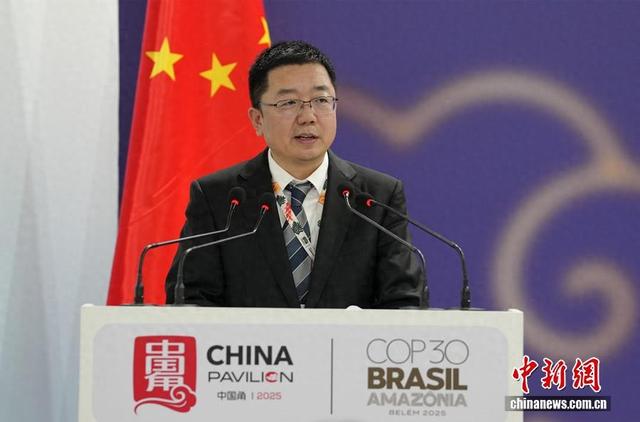
胡军:“绿水青山就是金山银山”为全球可持续发展贡献东方智慧
Zhong Guo Xin Wen Wang· 2025-11-12 02:27
Core Points - The conference titled "Ecological Civilization and Beautiful China Practice" was held at COP30, where Hu Jun presented a report on the significance of ecological civilization in China and its global implications [1][3][10] Group 1: Concept and Philosophy - The concept of "Lucid waters and lush mountains are invaluable assets" has been rooted in China's traditional ecological culture and has emerged from the country's significant ecological civilization practices [4] - This philosophy emphasizes that a beautiful ecological environment is essential for people's happiness and addresses the relationship between development and protection as a dialectical unity [4][9] - The concept has evolved to integrate ecological governance with poverty alleviation, showcasing successful stories of transforming ecological benefits into economic gains [4][5] Group 2: Achievements and Contributions - Over the past 20 years, guided by this philosophy, China has made unprecedented efforts in ecological civilization construction, leading to historical changes in environmental protection [5][6] - In 2024, China is expected to contribute nearly 64% of the global new renewable energy capacity of 585 GW, maintaining its position as the world's leader in solar and wind power installations for the past decade [5][6] - China's exports of green low-carbon products account for approximately 60% of wind power equipment and 70% of solar components globally, significantly reducing carbon emissions for other countries [6] Group 3: Practical Models - The "Protect Green for Gold" model emphasizes that ecological protection and restoration can yield economic returns through government-led compensation and policy incentives [7] - The "Gather Green for Gold" model focuses on developing green industries through technological innovation and brand building, transforming ecological resources into sustainable economic advantages [8] - The "Borrow Green for Gold" model promotes the market circulation of ecological resources, achieving a win-win situation for ecological protection and economic benefits [8] Group 4: Global Recognition and Future Directions - The philosophy has gained international recognition, with global leaders acknowledging its poetic expression and positive impact on ecological protection [9] - China has transitioned from a participant to a leader in global environmental governance, contributing to projects like the Al Dhafra solar power station in the UAE and promoting the green "Belt and Road" initiative [9][10] - The report serves as a comprehensive summary of the philosophy and China's practices, aiming to collaborate with other countries for high-quality development and environmental protection [10]

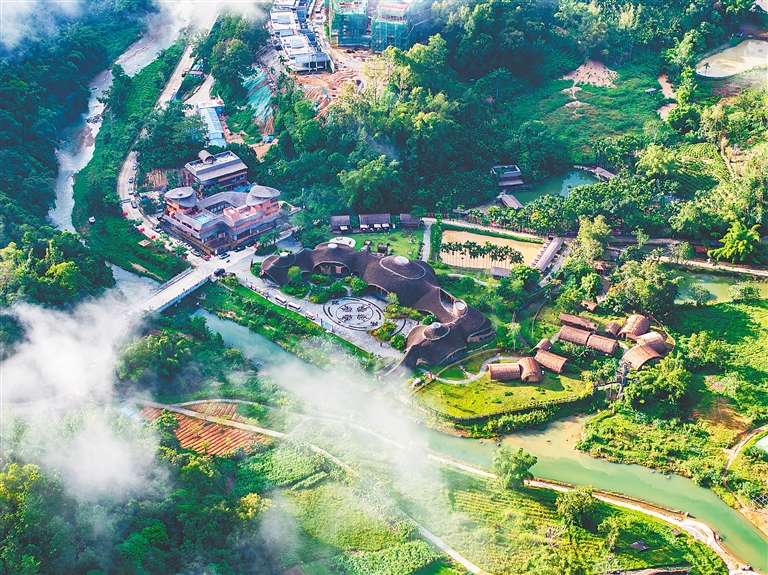
海南高质量建设国家生态文明试验区
Hai Nan Ri Bao· 2025-11-12 01:37
Core Viewpoint - The article emphasizes the commitment of Hainan to ecological civilization and sustainable development, highlighting the province's efforts to balance economic growth with environmental protection, aiming to become a model for ecological civilization in China [4][11][20]. Group 1: Ecological Achievements - Hainan has maintained an air quality good days ratio of 98.9%, exceeding the national target of 98% for five consecutive years [6] - The province has achieved significant improvements in water quality, with surface water quality good rate reaching 96.9%, the best level in nearly a decade [12] - The restoration of coral reefs and coastal wetlands has been notable, with 27.8 hectares of coral reefs and 240 acres of coastal wetlands restored [7] Group 2: Policy and Initiatives - The "No Waste Island" initiative aims to promote a circular economy and reduce waste, with a timeline set for implementation by 2030 [11] - Hainan has introduced a comprehensive "plastic ban" system, achieving an 80% replacement rate with biodegradable products [11] - The province is focusing on renewable energy, with over 85% of its power generation capacity coming from clean energy sources [11] Group 3: Economic Integration with Ecology - The development of the Hainan Tropical Rainforest National Park has led to increased tourism and local economic benefits, with community members participating in ecological protection [14] - Hainan is leveraging its ecological advantages to attract investment in green industries, with a focus on clean energy and sustainable construction practices [16] - The province is implementing a GEP (Gross Ecosystem Product) evaluation system to assess and enhance the ecological value of its resources [17]
广东大力传承弘扬“岳山造林”光荣传统:绿美南粤入画来
Ren Min Ri Bao· 2025-11-12 00:43
Core Viewpoint - The "Yueshan Afforestation" tradition in Guangdong has become a significant spiritual asset for ecological civilization construction, emphasizing the importance of tree planting and environmental protection in the region's development [1][2][3]. Group 1: Historical Context and Development - The "Yueshan Afforestation" movement began in the 1970s, where 25,000 people participated in large-scale tree planting, transforming barren mountains into a vast forest area [1][2]. - The movement was a response to severe ecological degradation caused by deforestation in the 1950s and 1960s, which led to soil erosion and impacted local livelihoods [2][3]. - The afforestation efforts spanned 143 days, resulting in the planting of 35,000 acres of trees, significantly improving the ecological conditions of the Yueshan area [3]. Group 2: Current Initiatives and Goals - The Guangdong provincial government has called for the continuation of the "Yueshan Afforestation" tradition, promoting community involvement in tree planting and environmental beautification [2][4]. - The 2022 provincial conference outlined six major actions for ecological construction, including enhancing forest quality and promoting urban-rural greening [4][5]. - The focus is on creating a harmonious relationship between humans and nature, with an emphasis on making ecological benefits a priority in development strategies [5][6]. Group 3: Ecological Restoration and Community Engagement - The "Green Beautiful Guangdong" initiative aims to enhance the ecological environment while also improving the quality of life for residents through community-driven greening projects [5][8]. - Various local projects, such as the "Joyful Forest," have transformed neglected areas into green spaces, fostering community engagement and environmental awareness [8][9]. - The construction of green corridors along transportation routes aims to integrate nature into urban settings, enhancing the aesthetic and ecological value of the region [9][10]. Group 4: Biodiversity and Heritage Conservation - The protection of ancient trees and biodiversity is a key focus, with over 85,000 ancient trees documented and monitored for conservation efforts [12]. - The Guangdong government has implemented measures to restore and protect mangrove ecosystems, which play a crucial role in maintaining ecological balance [12][13]. - The establishment of botanical gardens and conservation areas aims to enhance public access to green spaces and promote environmental education [14][15]. Group 5: Economic and Social Impact - The ecological improvements have led to increased tourism and economic opportunities in regions like the Jiangxia Village, which has transformed into a popular destination [13][14]. - The development of eco-tourism routes, such as the "Most Beautiful Tourist Road," aims to leverage natural resources for sustainable economic growth [14][15]. - The overall goal is to create a model for green development that balances economic growth with environmental sustainability, benefiting both the economy and the community [15][16].
以林草事业高质量发展助力美丽中国建设(深入学习贯彻习近平新时代中国特色社会主义思想·学习《习近平生态文明文选》第一卷专家谈)
Ren Min Ri Bao· 2025-11-11 22:40
Core Points - The development of forestry and grassland industries is essential for the construction of a beautiful China, as highlighted in the 20th Central Committee's Fourth Plenary Session [1][7] - Xi Jinping's ecological civilization thought emphasizes the importance of respecting, conforming to, and protecting nature, which is crucial for modern socialist construction [3][4] - The integration of various natural elements (mountains, water, forests, fields, lakes, grass, and sand) is necessary for effective ecological governance [4][10] Group 1: High-Quality Development of Forestry and Grassland - The forestry and grassland sector has achieved significant progress under Xi Jinping's ecological civilization thought, contributing to the foundation of a beautiful China [7][10] - The "Three North" project has completed the construction of 164 million acres, significantly enhancing China's ecological landscape [7] - The total output value of the national forestry and grassland industry is projected to reach 10.17 trillion yuan in 2024, with a year-on-year growth of 9.6% [10] Group 2: Ecological Protection and Governance - A comprehensive natural protection system centered on national parks is being established to safeguard biodiversity and natural resources [8][14] - The collective forest rights system reform has led to a threefold increase in output per acre of collective forest land [9] - The implementation of strict ecological protection laws and regulations is crucial for maintaining ecological balance and sustainability [4][11] Group 3: Economic and Social Benefits - The forestry and grassland industries are seen as vital for promoting green development and achieving common prosperity [16][19] - The integration of ecological benefits with economic growth is emphasized, with a focus on developing new industries and enhancing traditional sectors [10][16] - The promotion of green practices and community involvement is essential for fostering a culture of ecological responsibility [19]
“抓生态文明建设,既要靠物质,也要靠精神”(短评)
Ren Min Ri Bao· 2025-11-11 22:40
Core Points - The article emphasizes the importance of ecological civilization construction, highlighting the need for both material and spiritual support in this long-term and challenging endeavor [1][2] - It reflects on the historical context of the "Yueshan Afforestation" movement in Guangdong, showcasing the dedication and collective effort of local communities in transforming barren lands into lush forests [1] - The article advocates for the continuation of this spirit and tradition in the new era, aiming for high-quality green development and harmonious coexistence between humans and nature [2] Summary by Sections Historical Context - The "Yueshan Afforestation" campaign in the 1970s is noted for its success in converting barren mountains into a vast forest area, establishing a proud tradition in Guangdong [1] Current Initiatives - The ongoing "Hundred Thousand Project" aims to enhance the economic, social, and cultural benefits of ecological construction in Guangdong, reinforcing the principle that "lucid waters and lush mountains are invaluable assets" [1] Future Vision - The article calls for a persistent and collective effort in ecological civilization construction, emphasizing the need for a strong spiritual foundation and a commitment to long-term responsibilities [1][2]
生态治理与脱贫攻坚创造性结合,中国将“绿富同兴”方案带到世界
Zhong Guo Qing Nian Bao· 2025-11-11 12:25
Core Insights - The concept of "Lucid waters and lush mountains are invaluable assets" creatively combines ecological governance with poverty alleviation, contributing to global sustainable development with Chinese wisdom and solutions [1] - China has achieved the UN's 2030 sustainable development agenda poverty reduction goal ten years ahead of schedule, exploring various transformation paths for ecological poverty alleviation [1][2] Group 1: Ecological Compensation Mechanisms - China has established various ecological protection compensation mechanisms, including vertical fiscal compensation, horizontal inter-regional compensation, and market mechanism compensation [2] - Over 20 provinces in China have signed horizontal ecological protection compensation agreements for cross-province river basins, with a unified compensation mechanism for the Yangtze and Yellow Rivers expected by 2027 [2] Group 2: Financial Investments in Ecological Protection - From 2013 to 2023, the central government's transfer payment for key ecological function areas increased from 42.3 billion to 109.1 billion, with a total investment of 790 billion [2] - Water pollution prevention funding is projected to rise from 12.2 billion in 2015 to 26.7 billion by 2024 [2] Group 3: Green Economic Models - The "Green Development" model emphasizes the creation of wealth through the development of green industries, leveraging technological innovation and brand building [3] - The Daxing'anling region has halted commercial logging of natural forests, focusing on developing the under-forest economy and tourism, with projected carbon storage of 1.72 billion tons by 2024 [3] Group 4: Green Finance and Market Development - The "Borrowing Green to Create Wealth" model promotes the development of green markets and finance, facilitating the market circulation of ecological resources [3] - By the end of 2024, the balance of green loans in China is expected to reach 36.6 trillion, with green bonds issued exceeding 4.1 trillion [3] Group 5: Global Environmental Leadership - Under the guidance of the ecological civilization concept, China has transitioned from a participant to a leader in global environmental governance [4] - China has constructed the world's largest and fastest-growing renewable energy system, contributing nearly 64% of the global new installed capacity in 2024 [4]
太湖逐浪,无锡绘就游艇产业高质量发展新蓝图
Yang Zi Wan Bao Wang· 2025-11-06 14:42
Core Insights - The event "Taihu Chulang · Dingdong Future" marks the launch of high-quality development for the yacht industry in Wuxi, Jiangsu, with participation from government officials and industry representatives [1] Group 1: Development Advantages - Wuxi's geographical advantages, with 594 square kilometers of Taihu water area and 142 kilometers of coastline, provide a unique ecological foundation for the yacht industry [2] - The local government is committed to transforming ecological advantages into developmental advantages, aligning with provincial and municipal initiatives to accelerate the growth of water sports and leisure consumption [2][5] Group 2: Industry Growth and Innovation - The region has developed over 100 types of vessels, including the first large electric cruise ship "Yujian 77," which showcases advanced technologies such as low noise and vibration [3] - Wuxi has hosted numerous water sports events, attracting over 500,000 participants annually, indicating a growing public interest in water activities [3] Group 3: New Consumption Scenarios - Future plans include creating innovative water sports consumption experiences that combine culture and tourism, enhancing the synergy between sports and tourism [4] - The successful integration of dining experiences on boats has proven effective, with nearly 10,000 visitors during the National Day holiday, demonstrating the potential for increased tourism [4] Group 4: Strategic Vision - Wuxi's development of the yacht industry is seen as a step towards establishing a new benchmark for water transport in Jiangsu, contributing to the modernization of the region [5]
如何拓展水生态产品价值实现路径?
Zhong Guo Huan Jing Bao· 2025-11-06 01:45
Core Viewpoint - The report emphasizes the importance of establishing and implementing the concept that "lucid waters and lush mountains are invaluable assets," focusing on expanding the value realization channels for ecological products in a sustainable manner [1] Group 1: Ecological Product Value Realization - The average annual precipitation in China has generally increased since the 1960s, presenting a rare opportunity for the development of water ecological products, while facing challenges such as measurement, collateral, transaction, and monetization difficulties [1] - It is essential to innovate institutional mechanisms to broaden sustainable pathways for realizing the value of water ecological products, promoting the ecologicalization of the water ecological product industry and the industrialization of ecological products [1] Group 2: Watershed Management - Maintaining high-quality water resources is a prerequisite for realizing the value of water ecological products, necessitating strict ecological protection and regulatory systems [1] - A differentiated management system should be established, with targeted and precise measures for prevention, protection, supervision, and comprehensive governance of watersheds [1] Group 3: Asset Assessment and Trading - A comprehensive assessment of the water ecological products within a jurisdiction is necessary, categorizing and estimating their value based on characteristics, scale, and benefits [2] - The establishment of a dynamic list of water ecological products will support development by detailing indicators such as project watershed, function, characteristics, and value [2] - Third-party institutions should be commissioned to conduct value assessments of water ecological products, ensuring fair and transparent trading processes [3] Group 4: Legal Rights and Compliance - The exploration of land use rights to support the transfer and registration of water use rights is crucial for ensuring compliance in project operations [4] - Social capital investment in the development of water ecological products should be legally recognized, ensuring rational use and effective management of water resources [4] Group 5: Benefit Distribution - The distribution of benefits from the realization of water ecological product values should follow the principle of "who invests, who benefits; who owns, who benefits; who operates, who benefits," enhancing the sense of gain among all participants [5] - The revenue from the realization of water ecological products can be composed of storage transaction revenue and development re-transaction revenue, with a focus on benefiting local communities [5]
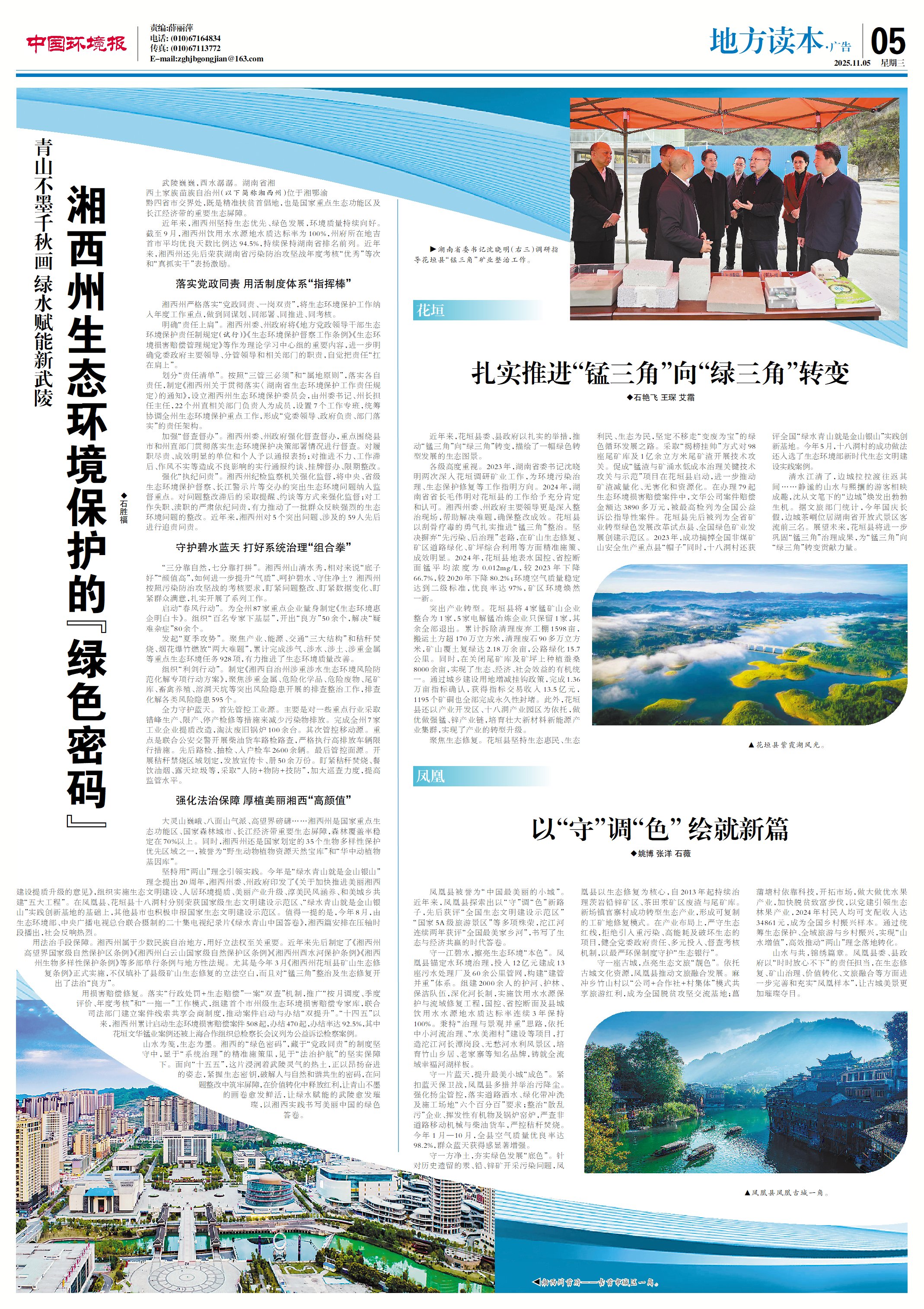
湘西州生态环境保护的“绿色密码”
Zhong Guo Huan Jing Bao· 2025-11-05 01:11
Core Viewpoint - Xiangxi Prefecture has prioritized ecological protection and green development, achieving significant improvements in environmental quality, including a 100% compliance rate for drinking water sources and a 94.5% average of good air quality days in the capital city, Jishou [1][8]. Group 1: Ecological Protection Initiatives - The local government has implemented a strict "Party and government responsibility" system, integrating ecological protection into annual work priorities and ensuring accountability at all levels [2][11]. - A comprehensive responsibility framework has been established, including the formation of the Xiangxi Ecological Environment Protection Committee, which coordinates key ecological protection efforts [2][11]. - Enhanced supervision and accountability measures have been put in place, with a focus on addressing significant ecological issues and holding responsible parties accountable for failures [3][12]. Group 2: Systematic Governance and Actions - Xiangxi has launched various initiatives such as the "Spring Breeze Action" to support 87 key enterprises with tailored ecological guidelines and expert assistance [4][14]. - The "Summer Offensive" targeted major pollution sources, completing 928 key ecological tasks related to air, water, and soil quality [4][14]. - The "Sword Action" focused on identifying and mitigating risks associated with heavy metals and hazardous materials, successfully addressing 595 risk points [4][14]. Group 3: Legal and Regulatory Framework - Xiangxi has enacted multiple local regulations to enhance ecological protection, including specific laws for nature reserves and biodiversity [16][17]. - The implementation of a dual mechanism for administrative penalties and ecological compensation has led to the initiation of 508 ecological damage compensation cases, with a resolution rate of 92.5% [17][18]. - The region's commitment to legal frameworks supports the ecological restoration efforts, particularly in areas affected by mining activities [17][18].
扩绿添景打造城市“后花园”
Liao Ning Ri Bao· 2025-11-04 01:03
Core Viewpoint - The transformation of the Haizhou Open-pit Mine into a national park exemplifies the integration of ecological restoration and urban development, aligning with the concept of "green mountains and clear waters are as valuable as mountains of gold and silver" [1][2] Group 1: Environmental Improvement - The Haizhou Open-pit Mine has been transformed into a vibrant ecological space, featuring a 7-kilometer asphalt path and lush greenery, attracting local residents for recreational activities [1] - The local government emphasizes the importance of ecological safety and sustainable development through the rehabilitation of abandoned mines [1] Group 2: Future Development Plans - Future plans for the Haizhou Open-pit Mine include the creation of a cultural and commercial complex, utilizing old industrial facilities and coal gangue for innovative purposes [2] - The area aims to develop into a multifunctional space that combines ecological agriculture, renewable energy projects, and industrial tourism, promoting a unique development path of "industrial history + ecological industry" [2]