固态电池

Search documents
高工锂电年会前瞻 | 硫化锂赛道接连抛出“上量”信号
高工锂电· 2025-10-04 09:41
Core Viewpoint - The lithium sulfide sector is experiencing significant growth, with companies ramping up production capabilities and advancements in solid-state battery technology, indicating a faster-than-expected demand increase for lithium sulfide in the coming years [4][10]. Group 1: Industry Developments - Tianqi Lithium announced the commencement of a pilot project for a 50-ton lithium sulfide production line in Sichuan, emphasizing low risk and rapid mass production capabilities [2]. - Enjie Co. reported the completion of a pilot line for high-purity lithium sulfide, with a capacity of 100 tons, and has established a 10-ton solid-state electrolyte production line [2]. - Shanghai Xiba has acquired relevant assets related to lithium sulfide and plans to expand production through joint ventures [2]. Group 2: Market Demand and Projections - The demand for lithium sulfide is projected to reach a hundred-ton level by 2025, with expectations of a shift to a thousand-ton level by 2026, indicating a faster growth trajectory than previously anticipated [4]. - The industry is witnessing a surge in interest in sulfide solid-state batteries, with multiple companies, including Yiwei Lithium Energy and Guoxuan High-Tech, disclosing advancements in their solid-state battery products [3]. Group 3: Production and Purity Challenges - Lithium sulfide constitutes 77% to 80% of the cost of solid-state electrolytes, with current market prices ranging from 3 million to 4 million yuan per ton, making cost reduction critical for the commercialization of solid-state batteries [6]. - High purity lithium sulfide is essential for producing high-performance solid-state electrolytes, with impurities adversely affecting ionic conductivity and posing safety risks [7]. - The current market purity levels for lithium sulfide range from 99.5% to 99.9%, with advancements being made towards achieving 99.99% purity by domestic companies [8]. Group 4: Technological Approaches - Different companies are adopting varied production methods for lithium sulfide, including the hydrogen sulfide neutralization method, which has achieved scale and is represented by Shanghai Xiba [12]. - The liquid-phase method is being pursued by companies like Tianqi Materials and Huasheng Lithium, leveraging their expertise in electrolyte and fine chemical production [14]. - The lithium-sulfur direct solid-phase method, favored by major lithium companies, is noted for its high purity output but faces challenges in scalability due to the high cost of lithium metal [15][16]. Group 5: Equipment and Process Challenges - The production of lithium sulfide is constrained by the need for specialized equipment that can handle its corrosive nature and sensitivity to moisture and oxygen [18]. - Current industry practices involve three main equipment solutions, with the hydrogen sulfide-hydroxide method leading in terms of engineering capabilities and cost reduction potential [18].


展商预告丨泰和科技 将携最新产品亮相CINE2025固态电池及钠电展,展位号:B14!
起点锂电· 2025-10-04 09:13
Group 1 - The CINE Solid-State Battery Exhibition and CINE Sodium Battery Exhibition is the first professional exhibition focusing on the entire industry chain of new battery technologies, scheduled for November 6-8, 2025, in Guangzhou, with over 200 exhibitors and 20,000 professional attendees expected [2] - The event will feature a new battery technology forum with nine specialized sessions and the prestigious Solid-State Battery Golden Ding Award ceremony [2] - Taihe Technology will showcase its latest products at the CINE Solid-State Battery Exhibition, with booth number B14 [3] Group 2 - Shandong Taihe Technology Co., Ltd. has over 20 years of experience in the research and production of fine chemicals, recently achieving success in the R&D and partial industrialization of lithium and sodium battery cathode materials, including lithium iron phosphate and sodium iron pyrophosphate [8] - The company also develops anode materials such as hard carbon and silicon-carbon anodes, as well as various electrolytes and electrolyte additives [8] - Taihe Technology's product range includes solid-state electrolytes and raw materials, such as high-purity lithium sulfide and sulfide solid electrolyte powders [8]

9月外资流入动向:科技等领域受关注
Huan Qiu Wang· 2025-10-04 04:42
Group 1 - Morgan Stanley reported that foreign net inflows into the Chinese stock market reached $4.6 billion in September, the highest monthly level since November 2024 [1] - Passive funds saw a net inflow of $5.2 billion in September, with a total net inflow of $18 billion year-to-date, significantly surpassing the full-year total of $7 billion in 2024 [1] - Semiconductor sector saw increased positions from active fund managers, while insurance, durable consumer goods, and apparel sectors experienced reduced positions [1] Group 2 - The Hang Seng Technology Index rose by 13.9% in September, leading global major indices [1] - Semiconductor stocks such as SMIC and Hua Hong Semiconductor reached historical highs, with SMIC closing at HKD 90.9 per share (up 1.39%) and Hua Hong at HKD 87.5 per share (up 2.1%), with year-to-date increases of 185.85% and 304.16% respectively [1] - Positive policy releases have significantly boosted confidence in both A-share and Hong Kong markets, with continued acceleration of southbound capital inflows into the Hong Kong market [1] Group 3 - Looking ahead to October, the A-share and Hong Kong markets are expected to benefit from long-term policy layouts, numerous industrial catalysts, and a relatively loose liquidity environment [2] - Opportunities in A-shares are likely to be concentrated in the technology growth sector, while Hong Kong benefits from its unique market structure and external liquidity expectations [2] - Key focus areas include AI computing power, semiconductor self-sufficiency, solid-state batteries, commercial aerospace, and controllable nuclear fusion, as highlighted by various securities reports [2]
市值重回1200亿!华友钴业,熬过“至暗时刻”
首席商业评论· 2025-10-04 04:16
Core Viewpoint - The article discusses the recovery of the non-ferrous metals sector, particularly focusing on Huayou Cobalt, which has emerged from a downturn due to rising prices of cobalt and nickel, driven by market demand and technological advancements in solid-state batteries [4][6]. Group 1: Market Performance - Huayou Cobalt's market capitalization has reached 125.1 billion yuan after a significant stock price increase, marking a recovery from a previous decline where its market value had shrunk by over 80% [4]. - The company reported a revenue of 372 billion yuan in the first half of the year, a year-on-year increase of 23.78%, and a net profit of 27.11 billion yuan, up 62.26% [13]. - The stock price of Huayou Cobalt has surged by 54.32% over the past three months, reflecting strong market performance [13]. Group 2: Historical Context - Huayou Cobalt was founded in 2002, initially focusing on cobalt resources, and has since expanded its operations internationally, becoming a major player in the cobalt refining industry [8]. - The company has experienced three significant cyclical fluctuations, with the first occurring from 2015 to 2017, where cobalt prices surged due to demand from the smartphone and electronics sectors, followed by a sharp decline [10]. - The second cycle from 2019 to 2022 saw a drastic drop in profits due to adjustments in the new energy battery industry, prompting Huayou Cobalt to diversify its operations [11]. Group 3: Price Dynamics - Cobalt prices have shown a clear cyclical pattern, with a notable recovery beginning in early 2023 after a significant drop earlier in the year, influenced by supply constraints from the Democratic Republic of Congo [13][15]. - Nickel, which has become a core revenue source for Huayou Cobalt, has also seen a substantial increase in revenue, with a reported 128.4 billion yuan in the first half of the year, accounting for 34.51% of total revenue [15]. - The development of solid-state battery technology is expected to further boost nickel demand, as it is a critical component in these advanced batteries, with commercial production anticipated between 2027 and 2030 [16].
机构聚焦9月外资流入动向,科技等领域受关注
Huan Qiu Wang· 2025-10-04 01:04
Group 1 - Morgan Stanley reported that foreign net inflows into the Chinese stock market reached $4.6 billion in September, marking the highest monthly level since November 2024 [1] - Passive funds saw a net inflow of $5.2 billion in September, with a cumulative net inflow of $18 billion for the year, significantly surpassing the full-year total of $7 billion in 2024 [1] Group 2 - Active fund managers notably increased their positions in the semiconductor sector while reducing holdings in insurance, durable consumer goods, and apparel sectors [3] - The Hang Seng Tech Index rose by 13.9% in September, leading global major indices, with stocks like SMIC and Hua Hong Semiconductor reaching historical highs [3] - SMIC's stock closed at HKD 90.9, up 1.39%, and Hua Hong Semiconductor at HKD 87.5, up 2.1%, with year-to-date increases of 185.85% and 304.16% respectively [3] Group 3 - Looking ahead to October, the A-share and Hong Kong markets are expected to benefit from long-term policy layouts, numerous industrial catalysts, and a relatively loose liquidity environment [4] - Opportunities in A-shares are likely to be concentrated in the technology growth sector, while Hong Kong may benefit from its unique market structure and external liquidity expectations [4] - Key focus areas include AI computing power, semiconductor self-sufficiency, solid-state batteries, commercial aerospace, and controllable nuclear fusion, as highlighted by various securities firms [4]
2元以下低价股数量为31只
Zhong Guo Zheng Quan Bao· 2025-10-03 14:45
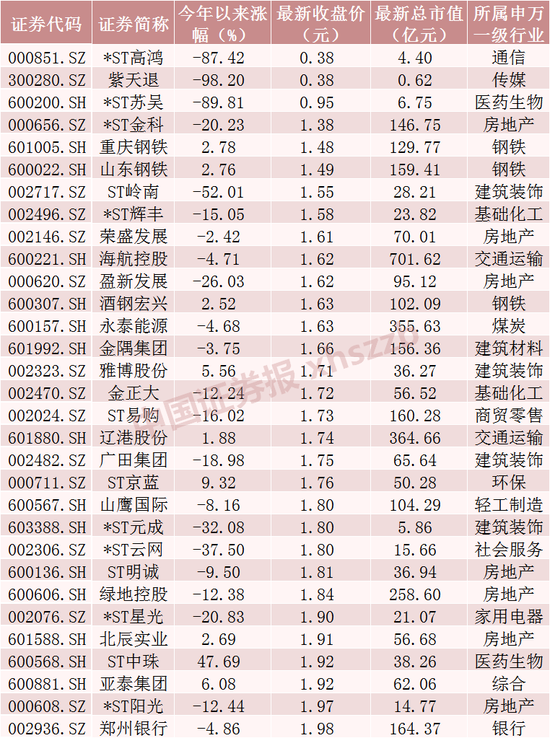
Core Points - The A-share market has shown strong performance in 2023, with the Shanghai Composite Index, Shenzhen Component Index, and ChiNext Index rising by 15.84%, 29.88%, and 51.20% respectively as of September 30 [1][2]. Group 1: Low-Priced Stocks - As of September 30, there are only 31 stocks with a closing price below 2 yuan, with the lowest being *ST Gao Hong at 0.38 yuan [2][4]. - Among the 31 low-priced stocks, the real estate sector has the highest number with 7 stocks, followed by construction decoration with 4, and steel with 3 [2]. - 19 of the 31 low-priced stocks have a market capitalization below 10 billion yuan, accounting for over 60% of the total [2]. Group 2: Stock Performance - Year-to-date, 22 of the 31 low-priced stocks have seen their prices decline, representing over 70% of this group [2]. - Overall, 21 of these low-priced stocks are expected to report losses in net profit for the first half of 2025, indicating poor performance [2]. Group 3: High-Growth Stocks - Excluding newly listed stocks, 4,356 A-shares have positive returns this year, with over 1,361 stocks rising by more than 50% and 446 stocks increasing by over 100% [5][6]. - The mechanical equipment and electronics sectors have the highest number of stocks with over 100% growth, with 74 and 52 stocks respectively [5][6]. Group 4: Sector Performance - The mechanical equipment sector has a year-to-date growth of 37.31%, while the electronics sector has grown by 53.51% [6]. - Other sectors with significant growth include electric power equipment (43.70%), automotive (28.42%), and basic chemicals (25.40%) [6]. Group 5: Top Performing Stocks - The top ten stocks with the highest growth this year include Shangwei New Materials, *ST Yushun, and Tianpu Co., with growth rates exceeding 390% [7]. - The highest growth stock, Shangwei New Materials, has increased by 1,891.60% with a market cap rising from 2.686 billion yuan to 53.284 billion yuan [7].


2元以下低价股,仅剩31只!
Zhong Guo Zheng Quan Bao· 2025-10-03 14:44
Group 1 - The Shanghai Composite Index, Shenzhen Component Index, and ChiNext Index have increased by 15.84%, 29.88%, and 51.20% respectively as of September 30 this year [1] - The number of low-priced stocks (closing price below 2 yuan) has decreased to 31, with the lowest being *ST Gao Hong at 0.38 yuan [2] - The real estate sector has the highest number of low-priced stocks at 7, followed by construction decoration with 4, and steel with 3 [2] Group 2 - A total of 446 stocks have increased by over 100% this year, with the majority coming from the machinery and electronics sectors [3] - The top ten stocks with the highest increase have all exceeded 390%, with significant representation from the basic chemical, electronics, automotive, light manufacturing, and machinery sectors [4][5] - Among the top ten stocks, three belong to the electronics industry, indicating strong performance in this sector [5]
帮主郑重聊10月行情:券商金股名单出炉,“红十月”该往哪踩油门?
Sou Hu Cai Jing· 2025-10-03 12:22
Group 1 - The article highlights the strong performance of the ChiNext index in September, prompting discussions on stock strategies for October [1] - Four stocks, Hikvision, Zhaoyi Innovation, Huayou Cobalt, and Luoyang Molybdenum, are identified as "golden stocks" for October, with Huayou Cobalt noted for a significant 37% increase in September [3] - The focus for October is on three main themes: technology, "anti-involution," and third-quarter earnings reports, with specific sectors like AI computing, semiconductor self-sufficiency, and solid-state batteries being emphasized [3] Group 2 - Investment strategies suggest avoiding blind chasing of stocks that have already surged, like Huayou Cobalt, and instead focusing on stocks with stable fundamentals that have not seen excessive price increases [4] - Investors are advised to concentrate on one main theme, either technology or "anti-involution," rather than diversifying too broadly across multiple sectors [4] - The third-quarter earnings reports are seen as a critical indicator, with recommendations to research stocks that are expected to exceed earnings expectations, particularly in the semiconductor and brokerage sectors [4]


“大电池”的天快塌了
虎嗅APP· 2025-10-03 11:48
Core Viewpoint - The article discusses the ongoing "arms race" in the electric vehicle (EV) sector, emphasizing that the competition is primarily focused on battery size and range rather than technology or safety [5]. Group 1: Battery Capacity and Market Dynamics - Several electric vehicle models now boast ranges exceeding 700 kilometers, with notable examples including Zeekr 009 at 900 km and Tesla Model 3 at 830 km [6]. - The price of lithium carbonate, a key raw material for EV batteries, surged to over 600,000 yuan per ton in 2022 but has since plummeted, with projections suggesting it could drop to around 60,000 yuan by mid-2025 [9][10]. - The decline in lithium prices has led to a significant reduction in battery material costs, prompting automakers to increase battery capacity to enhance vehicle competitiveness [9][11]. Group 2: Charging Infrastructure and User Experience - The article highlights the challenges of current charging infrastructure, noting that charging times can exceed an hour, making it less convenient compared to refueling gasoline vehicles [16][20]. - The introduction of "flash charging" technology, which allows for rapid charging, is expected to reshape consumer perceptions and improve the user experience [18][19]. - The government is pushing for the construction of high-power charging facilities, with a target of over 100,000 stations by the end of 2027, aligning with corporate strategies to enhance charging networks [24]. Group 3: Hybrid and Plug-in Hybrid Vehicles - Plug-in hybrid vehicles (PHEVs) are gaining traction as they address range anxiety while offering competitive fuel economy, with some models achieving as low as 2.6 liters per 100 km in fuel consumption [28]. - The article suggests that PHEVs may play a more significant role in the transition from traditional fuel vehicles to electric vehicles than pure electric models, due to their adaptability and lower dependency on charging infrastructure [30].



61家锂电上市公司财报分析:下游需求暴涨/上游分化加剧 进入新一轮增长周期
起点锂电· 2025-10-03 06:14
Core Insights - The solid-state battery industry is experiencing significant growth, with a major event scheduled for November 6-8, 2025, in Guangzhou, showcasing over 200 exhibitors and 20,000 professional attendees [1] - The lithium battery sector is characterized by strong downstream demand, with a total production of 480 GWh in the first half of 2025, marking a 20% year-on-year increase [2] - Leading companies like CATL and EVE Energy are operating at nearly 90% capacity utilization, while second-tier companies are generally at 60-70% [3][7] Group 1: Industry Performance - The overall performance of battery companies has improved compared to the previous year, with over half of the surveyed companies achieving both revenue and profit growth [5] - However, there is significant performance disparity among companies, with the "Matthew Effect" becoming more pronounced [5] - For instance, CATL reported a revenue of 178.89 billion yuan, a 7.27% increase, while EVE Energy's revenue grew by 30.06% to 28.17 billion yuan, but its net profit declined by 24.90% [6] Group 2: Market Dynamics - The lithium battery industry is witnessing a new wave of capacity expansion, driven by increased demand and significant orders from upstream suppliers [3][10] - The storage battery segment is particularly strong, with global shipments reaching 240 GWh in the first half of 2025, a 106% year-on-year increase [8] - Companies are diversifying their product offerings, with a focus on emerging markets and applications beyond traditional automotive batteries [11] Group 3: Phosphate Lithium Sector - The phosphate lithium sector is facing challenges, with a production increase of 66.6% to 163.2 million tons in the first half of 2025, but overall profitability remains low [13] - Companies like Hunan Youneng and Wanrun New Energy are experiencing revenue growth but still report losses due to low product prices and inventory issues [15][16] - High-pressure phosphate lithium products are gaining traction, with significant orders from major players like CATL, indicating a shift towards higher value-added products [20][21] Group 4: Lithium Carbonate and Mining - Lithium carbonate prices have fluctuated, impacting the profitability of lithium mining and salt enterprises [25][26] - Companies like Ganfeng Lithium reported a net loss of 531 million yuan, while salt lake companies like Zangge Mining and Salt Lake Co. showed profit growth due to cost advantages [28][29] - The overall market remains oversupplied, but recent demand improvements have led to a slight recovery in prices [30] Group 5: Separator and Electrolyte Markets - The separator industry is experiencing a decline in profit margins despite increased sales volumes, with many companies reporting losses [32][34] - The electrolyte market is also facing challenges, with a significant increase in production but ongoing supply-demand imbalances leading to price pressures [37][39] - Leading companies are focusing on international expansion and new product development to maintain competitive advantages [40] Group 6: Equipment Sector - The demand for lithium battery equipment is recovering, with leading companies like Xian Dao Intelligent and Hanke Technology reporting revenue growth [41][44] - Solid-state battery equipment is emerging as a new growth area, with several companies securing significant orders [46][47] - The global market for lithium battery equipment is projected to reach 141.9 billion yuan by 2027, indicating strong future growth potential [49][50]