
产能收储

Search documents
消息面影响有限,警惕多晶硅价格回落
Qi Huo Ri Bao· 2025-10-30 23:36
Core Viewpoint - Recent news regarding "storage" has stirred the photovoltaic market, with 17 leading companies reportedly forming a consortium to complete this initiative by the end of the year [1][2] Group 1: Market Reactions - The market appears to be largely unaffected by the news, as the main contract for polysilicon futures closed at 54,950 yuan/ton, down 0.15% [1] - Analysts suggest that the absolute price of polysilicon futures, which had already risen above 53,000 yuan/ton, limits the market's reaction to the news [1][2] Group 2: Supply and Demand Dynamics - The current polysilicon market is characterized by a supply-demand mismatch, with global production expected to slightly increase to 13.34 million tons in October [3] - After a surge in installations following the "5·31" policy, new photovoltaic installations have begun to decline, with September's figures showing a year-on-year decrease of 53.75% [3] Group 3: Future Outlook - Analysts predict that if the storage initiative progresses smoothly, it could lead to the clearance of 430,000 to 480,000 tons of capacity, with a total of over 1.4 million tons potentially being removed from the market [2] - Despite current weak fundamentals, the impact of the storage initiative may provide short-term support for polysilicon prices, although demand remains weak [4]
工业硅、多晶硅日报-20251030
Guang Da Qi Huo· 2025-10-30 05:28
Report Industry Investment Rating - There is no information provided regarding the report industry investment rating in the given content. Core Viewpoints of the Report - On October 29th, industrial silicon showed a fluctuating and strengthening trend. The main contract 2601 closed at 9,170 yuan/ton, with an intraday increase of 1.61%. The position increased by 8,992 lots to 221,000 lots. The spot reference price of industrial silicon from Baichuan remained stable at 9,554 yuan/ton compared to the previous trading day. The price of the lowest deliverable 421 remained stable at 8,850 yuan/ton, and the spot discount widened to 330 yuan/ton. Southwest production cuts are imminent, silicon factories are holding onto their goods and raising prices, and the costs of silicon coal and electricity are rising, causing the operating center of industrial silicon to move upward [2]. - Polysilicon also showed a fluctuating and strengthening trend. The main contract 2601 closed at 54,990 yuan/ton, with an intraday increase of 0.72%. The position increased by 3,498 lots to 118,000 lots. The price of N-type recycled polysilicon materials rose to 52,500 yuan/ton, and the price of the lowest deliverable silicon materials was 52,500 yuan/ton. The spot premium turned into a discount of 860 yuan/ton. Due to the quota arrangement of the industry association, silicon wafer production cuts after November are basically certain. The weekly silicon wafer production schedule has increased significantly. The current high output is more likely to be a stage of concentrated pre - quota production rush by enterprises, and it cannot be confirmed as a signal of actual demand improvement. The last week of October may be the sprint stage for industrial production rush. Recently, the industry has announced that 17 enterprises have signed the capacity storage platform, and combined with the fact that downstream purchases have exceeded upstream output for the first time, it supports the continued strong operation of polysilicon [2]. Summary by Relevant Catalogs Research Views - Industrial silicon and polysilicon both showed a fluctuating and strengthening trend on October 29th. The reasons for the upward movement of industrial silicon include production cuts in the Southwest, silicon factories holding onto goods and raising prices, and rising costs of silicon coal and electricity. For polysilicon, factors such as industry quota arrangements, production rush, and the capacity storage platform signing support its strong operation [2]. Daily Data Monitoring - **Industrial Silicon**: The futures settlement price of the main contract increased from 8,955 yuan/ton on October 28th to 9,170 yuan/ton on October 29th, an increase of 215 yuan/ton. Most of the spot prices remained stable, with only the price of oxygen - containing 553 silicon in Huangpu Port increasing by 50 yuan/ton. The current lowest deliverable price remained at 8,850 yuan/ton, and the spot discount widened by 200 yuan/ton. The industrial silicon warehouse receipts decreased by 706 tons, and the Guangzhou Futures Exchange inventory decreased by 8,935 tons. The total social inventory of industrial silicon increased by 400 tons [3]. - **Polysilicon**: The futures settlement price of the main contract increased from 54,355 yuan/ton on October 28th to 54,990 yuan/ton on October 29th, an increase of 635 yuan/ton. The price of N - type polysilicon dense materials and recycled materials decreased by 500 yuan/ton. The current lowest deliverable price decreased by 500 yuan/ton, and the spot premium turned into a discount, with a decrease of 1,015 yuan/ton. The polysilicon warehouse receipts decreased by 30 tons, and the Guangzhou Futures Exchange inventory increased by 24,000 tons [3]. - **Organic Silicon**: The DMC price in the East China market decreased by 200 yuan/ton, the price of dimethyl silicone oil increased by 1,700 yuan/ton, and the prices of raw rubber and 107 glue remained stable [3]. Chart Analysis - **Industrial Silicon and Cost - side Prices**: The charts show the prices of different grades of industrial silicon, price differences between grades and regions, electricity prices, silica prices, and refined coal prices [5][12]. - **Downstream Product Prices**: The charts display the prices of DMC, organic silicon products, polysilicon, silicon wafers, battery cells, and components [14][16][21]. - **Inventory**: The charts present the inventory of industrial silicon (including futures inventory, factory warehouse inventory, weekly industry inventory, and inventory changes), DMC weekly inventory, and polysilicon weekly inventory [22][26]. - **Cost - Profit**: The charts show the average cost and profit levels of main production areas, weekly cost - profit of industrial silicon, profit of the aluminum alloy processing industry, cost - profit of DMC, and cost - profit of polysilicon [30][32][37].
工业硅关注成本底,多晶硅消息扰动大
Dong Zheng Qi Huo· 2025-10-19 08:13
Report Industry Investment Rating - Industrial silicon: Oscillation; Polysilicon: Oscillation [4] Core Viewpoints of the Report - Industrial silicon prices have a more defined lower limit, and it is more cost - effective to go long at low prices. For polysilicon, the spot price in October is expected to remain flat, and it is not recommended to chase long positions, but rather consider going long when the futures price is at a discount to the spot price [3][17] Summary by Directory 1. Industrial Silicon/Polysilicon Industry Chain Prices - The Si2511 contract of industrial silicon decreased by 255 yuan/ton to 8430 yuan/ton. SMM spot prices of East China oxygen - blown 553 and Xinjiang 99 silicon decreased by 100 yuan/ton to 9350 yuan/ton and 8750 yuan/ton respectively. The PS2511 contract of polysilicon increased by 3375 yuan/ton to 52340 yuan/ton, and the average transaction price of N - type re -投料 of polysilicon was 53200 yuan/ton [9] 2. Industrial Silicon Focuses on Cost Floor, Polysilicon Subject to Large News - Driven Fluctuations - **Industrial Silicon**: The futures main contract weakened. Northern large factories resumed production, while some southern silicon factories cut production in advance. It is expected that there will be more significant production cuts at the end of October. The social inventory increased by 1.7 tons, and the sample factory inventory increased by 0.01 tons compared to before the holiday. It is difficult to reduce inventory in November, and 1.5 tons of inventory will be reduced in December [1][11] - **Organic Silicon**: The price increased slightly. Some devices were under maintenance, the overall enterprise operating rate was 69.99%, the weekly output was 4.63 tons (a decrease of 2.73% month - on - month), and the inventory was 4.18 tons (a decrease of 2.56% month - on - month). The price is expected to oscillate strongly [11][12] - **Polysilicon**: The futures main contract rose. The spot price of first - tier manufacturers' dense material remained at 55 yuan/kg, and that of second - and third - tier manufacturers was 52 - 53 yuan/kg. The new order price of granular material was 51 yuan/kg. The spot trading volume was low after the holiday. The production volume in October is expected to be about 13.8 tons, and it will significantly decrease from November to December. The factory inventory of polysilicon enterprises was 25.3 tons (an increase of 1.3 tons month - on - month), and the polysilicon inventory of silicon wafer enterprises was 22.2 tons (an increase of 1.4 tons month - on - month). The spot price is expected to remain flat [2][13] - **Silicon Wafers**: The prices of some models decreased slightly. The actual final output in October may be higher than expected. As of October 16, the inventory of silicon wafer factories was 17.31GW (an increase of 0.53GW month - on - month). The price is under pressure, and production cuts are needed to support it [14] - **Battery Cells**: The price trend was divided. The mainstream transaction prices of M10/G12 battery cells remained flat, while that of G12R battery cells decreased to 0.285 yuan/W. As of October 13, the inventory of Chinese photovoltaic battery export factories was 6.63GW (an increase of 0.66GW month - on - month). The production volume in October was 58.65GW (a decrease of 1.5GW month - on - month) [15] - **Components**: The price remained basically stable. As of October 13, the finished product inventory of Chinese photovoltaic components was 34.2GW (an increase of 0.6GW month - on - month). The production volume in October was 45.66GW (a decrease of 2.1GW month - on - month). The demand from November to December may not be optimistic. The price is expected to oscillate in the short term [16] 3. Investment Suggestions - **Industrial Silicon**: Due to weak fundamentals and poor macro - sentiment, the futures market weakened this week. After hedging, short - term price drops are unlikely to cause production cuts. It is more cost - effective to go long at low prices [3][17] - **Polysilicon**: It is maintained that the spot price will not fall in October. The market has rebounded significantly. It is not recommended to chase long positions. Consider going long when the futures price is at a discount to the spot price, and pay attention to the PS2511 - PS2512 reverse spread opportunity when the spread is around - 2000 yuan/ton [3][17] 4. Hot News Summary - GCL Technology achieved a profit in the third quarter of 2025, with a profit of about 960 million yuan, compared with a loss of 1.81 billion yuan in the same period last year [18] - In Gansu, the mechanism electricity prices for wind and solar power are the same at 0.1954 yuan/kWh, with a mechanism electricity volume of 830 million kWh [18] - In Xinjiang, the mechanism electricity price for wind power is 0.252 yuan/kWh with a mechanism electricity volume of 18.5 billion kWh, and for photovoltaic power is 0.235 yuan/kWh with a mechanism electricity volume of 3.6 billion kWh [19] 5. Industry Chain High - Frequency Data Tracking - **Industrial Silicon**: Includes data on spot prices, weekly production in different regions, social inventory, and sample factory inventory [20][24][30] - **Organic Silicon**: Covers data on DMC spot prices, weekly profits, factory inventory, and weekly production [31][32][33] - **Polysilicon**: Involves data on spot prices, weekly gross profits, factory weekly inventory, and enterprise weekly production [35][37][38] - **Silicon Wafers**: Contains data on spot prices, average net profits, factory weekly inventory, and enterprise weekly production [40][43][45] - **Battery Cells**: Includes data on spot prices, average net profits, export factory weekly inventory, and enterprise monthly production [46][49][52] - **Components**: Covers data on spot prices, average net profits, factory inventory, and enterprise monthly production [54][57][59]

多晶硅连涨三个月后,去产能的“大杀招”终于出现
投中网· 2025-09-28 09:16
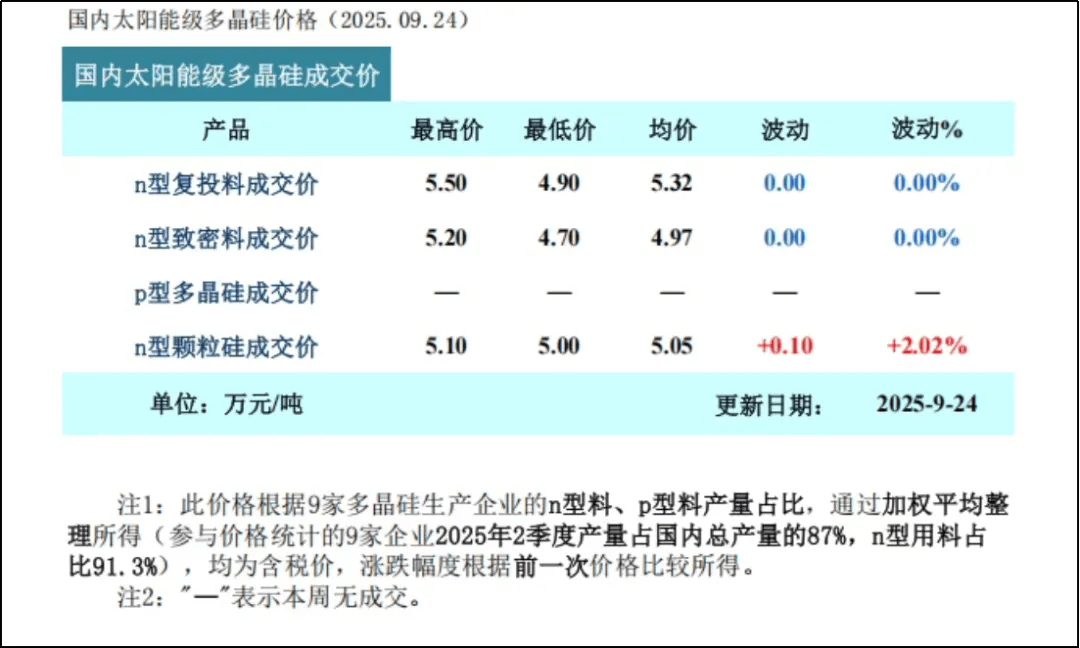
Core Viewpoint - The continuous rise in polysilicon prices signals a positive trend in the photovoltaic industry, driven by government "anti-involution" policies and industry consolidation efforts [6][9][10]. Group 1: Polysilicon Price Trends - As of September 24, polysilicon prices have surpassed 50,000 yuan per ton, with n-type re-investment material averaging 53,200 yuan per ton and n-type granular silicon at 50,500 yuan per ton [6][7]. - Polysilicon prices have increased for three consecutive months, with n-type re-investment material, n-type dense material, and n-type granular silicon seeing cumulative increases of 54.65%, 55.80%, and 50.75% respectively since June 25 [7][8]. Group 2: Government Policies and Industry Response - The government has consistently emphasized "anti-involution" since last year, with the Central Committee's meetings highlighting the need for industry self-discipline and the exit of inefficient production capacities [10][11]. - In 2025, the Ministry of Industry and Information Technology (MIIT) organized discussions with key enterprises to address low-price competition and promote the exit of outdated capacities [11][12]. Group 3: Industry Consolidation Efforts - Major polysilicon companies are reportedly planning to establish joint ventures for capacity consolidation, with rumors of a consortium involving traditional giants and new entrants to integrate approximately 700,000 tons of capacity [13]. - GCL-Poly Energy announced a strategic financing agreement to raise 5.446 billion Hong Kong dollars, part of which will be allocated for supply-side reforms and structural adjustments in polysilicon capacity [13][14]. Group 4: Energy Consumption Standards - New energy consumption standards for polysilicon production are expected to significantly impact capacity reduction, with the proposed limits set to be much stricter than current standards [15][16]. - The new standards aim to lower energy consumption levels, which could lead to a reduction in effective polysilicon capacity to approximately 2.4 million tons per year, a decrease of 16.4% from 2024 [19]. Group 5: Challenges Ahead - The successful implementation of "anti-involution" measures requires strong government action, as current policies lack enforceability and may not effectively curb overproduction [22]. - Industry consolidation efforts need governmental support to navigate the complexities of financing and stakeholder interests, as relying solely on market forces may prove insufficient [23]. - Addressing demand issues is crucial for the success of capacity reduction initiatives, as current demand remains weak, hindering price transmission to downstream sectors [27][28].



多晶硅连涨三个月后,去产能的“大杀招”终于出现
Sou Hu Cai Jing· 2025-09-27 10:13
Core Viewpoint - The continuous rise in polysilicon prices signals a positive trend for the photovoltaic industry, with prices surpassing 50,000 yuan per ton, indicating a potential recovery and consolidation in the market [1][3]. Price Trends - As of September 24, 2025, the average transaction prices for various types of polysilicon are as follows: n-type re-investment material at 53,200 yuan/ton, n-type dense material at 49,700 yuan/ton, and n-type granular silicon at 50,500 yuan/ton [2]. - Polysilicon prices have increased for three consecutive months, with cumulative increases of 54.65% for n-type re-investment material, 55.80% for n-type dense material, and 50.75% for n-type granular silicon since June 25 [3]. Government and Industry Actions - The government has been actively promoting a "de-involution" stance since last year, aiming to prevent vicious competition and facilitate the exit of inefficient production capacities [3][4]. - In 2025, the Ministry of Industry and Information Technology (MIIT) has intensified actions against disorderly competition in the photovoltaic industry, emphasizing the need for quality improvement and orderly exit of backward production capacities [4]. Capacity Storage and Integration - Leading polysilicon companies are reportedly planning to establish joint ventures for capacity storage, aiming to consolidate approximately 700,000 tons of production capacity through debt acquisition [5]. - GCL-Poly Energy Holdings has announced a strategic financing agreement to raise 5.446 billion Hong Kong dollars, part of which will be allocated for supply-side reforms and structural adjustments in polysilicon capacity [5][6]. Energy Consumption Standards - New energy consumption standards for polysilicon production are expected to significantly impact capacity clearance and support long-term price increases [7][8]. - The proposed standards will lower energy consumption limits for polysilicon production, with the first level set at 5 kgce/kg, which is significantly stricter than current standards [9]. Challenges Ahead - The successful implementation of capacity storage and integration requires substantial national support and cannot rely solely on voluntary industry actions [13]. - There are concerns regarding the potential for companies to lower product quality to meet energy consumption standards, which could undermine the effectiveness of the regulations [12]. - The photovoltaic industry faces a demand shortage, which complicates the transmission of price increases downstream, indicating that without addressing demand, capacity reduction efforts may not yield the desired results [16].
工业硅、多晶硅日报-20250905
Guang Da Qi Huo· 2025-09-05 05:04
Group 1: Report Industry Investment Rating - There is no information about the report industry investment rating in the provided content. Group 2: Core View of the Report - On September 4th, industrial silicon showed a fluctuating and strengthening trend. The main contract 2511 closed at 8,515 yuan/ton, with an intraday increase of 0.12%. The position decreased by 2,437 lots to 277,000 lots. The spot reference price of industrial silicon from Baichuan was 9,369 yuan/ton, remaining unchanged from the previous trading day. The price of the lowest deliverable 421 product回调 to 8,600 yuan/ton, and the spot premium narrowed to 40 yuan/ton. Polysilicon also showed a fluctuating and strengthening trend. The main contract 2511 closed at 52,195 yuan/ton, with an intraday increase of 0.55%. The position decreased by 3,260 lots to 146,000 lots. The price of N-type recycled polysilicon material rose to 49,000 yuan/ton, and the price of the lowest deliverable silicon material dropped to 49,000 yuan/ton. The spot discount widened to 3,410 yuan/ton. The resumption of production in the north and south of industrial silicon and the increase in crystalline silicon production have become marginal drivers, and the overall operating center is expected to rise slightly. After the previous anti-involution news was fully priced in, the trading center of polysilicon has gradually shifted to fundamental logic. Due to the limitation of the terminal power station's rate of return, the acceptance of price increases in the component sector has reached its peak, and the silicon material market has cooled down following the downstream market sentiment. Before the introduction of specific policy measures, the market is still in a game between policy support and fundamental drag. Polysilicon has entered a range mode with obvious top and bottom levels, and policy dynamics have a phased disturbance effect on the market. Attention should be paid to the results of the Ministry of Industry and Information Technology's energy-saving special inspection on September 30th and the inventory clearance situation in the industrial chain. [2] Group 3: Summary by Relevant Catalog 1. Research View - On September 4th, industrial silicon and polysilicon both showed a fluctuating and strengthening trend. The main factors affecting the market include the resumption of production in the north and south of industrial silicon, the increase in crystalline silicon production, the limitation of the terminal power station's rate of return, and the cooling of the downstream market sentiment. The market is currently in a game between policy support and fundamental drag, and policy dynamics have a phased disturbance effect on the market. [2] 2. Daily Data Monitoring - **Industrial Silicon**: The futures settlement price of the main contract remained unchanged at 8,505 yuan/ton. The price of the near-month contract increased by 75 yuan/ton to 8,560 yuan/ton. The spot prices of most grades of industrial silicon remained unchanged, except for the price of oxygenated 553 silicon in Tianjin Port, which decreased by 50 yuan/ton to 9,000 yuan/ton. The current lowest deliverable price was 8,600 yuan/ton, and the spot premium decreased by 75 yuan/ton to 40 yuan/ton. The industrial silicon warehouse receipts decreased by 276 to 50,072, and the total social inventory increased by 7,000 tons to 442,900 tons. [3] - **Polysilicon**: The futures settlement price of the main contract increased by 35 yuan/ton to 52,195 yuan/ton, and the price of the near-month contract increased by 80 yuan/ton to 52,410 yuan/ton. The spot prices of most grades of polysilicon remained unchanged. The current lowest deliverable price was 49,000 yuan/ton, and the spot discount increased by 80 yuan/ton to 3,410 yuan/ton. The polysilicon warehouse receipts remained unchanged at 6,870, and the total social inventory decreased by 30,000 tons to 245,000 tons. [3] - **Organic Silicon**: The spot prices of most organic silicon products remained unchanged, except for the price of dimethyl silicone oil, which increased by 2,500 yuan/ton to 14,000 yuan/ton. [3] 3. Chart Analysis - **Industrial Silicon and Cost Side Prices**: The charts show the prices of different grades of industrial silicon, the price differences between grades, the regional price differences, the electricity prices, the silicon stone prices, and the refined coal prices. [4][6][10] - **Downstream Product Prices**: The charts show the prices of DMC, organic silicon products, polysilicon, silicon wafers, battery cells, and components. [13][16][18] - **Inventory**: The charts show the inventory of industrial silicon futures, industrial silicon warehouses, industrial silicon weekly industry inventory, industrial silicon weekly inventory changes, DMC weekly inventory, and polysilicon weekly inventory. [22][23][25] - **Cost and Profit**: The charts show the average cost levels and average profit levels of the main production areas, the weekly cost and profit of industrial silicon, the profit of the aluminum alloy processing industry, the cost and profit of DMC, and the cost and profit of polysilicon. [28][30][34]
光大期货工业硅日报-20250815
Guang Da Qi Huo· 2025-08-15 05:03
1. Report Industry Investment Rating No relevant content provided. 2. Core Views of the Report - On August 14, industrial silicon fluctuated weakly. The main contract 2511 closed at 8,675 yuan/ton, with an intraday decline of 1.14%. The open interest decreased by 5,465 lots to 279,000 lots. The spot reference price of industrial silicon from Baichuan was 9,540 yuan/ton, remaining stable compared to the previous trading day. The price of the lowest deliverable 421 grade rebounded to 8,950 yuan/ton, and the spot premium narrowed to 315 yuan/ton [2]. - Polysilicon also fluctuated weakly. The main contract 2511 closed at 50,430 yuan/ton, with an intraday decline of 3.08%. The open interest decreased by 4,706 lots to 128,000 lots. The price of N-type recycled polysilicon material rose to 47,000 yuan/ton, while the price of the lowest deliverable silicon material dropped to 44,500 yuan/ton. The spot discount narrowed to 5,270 yuan/ton [2]. - The north and south of China's industrial silicon production areas continued to resume production, and the downstream crystalline silicon production increased significantly. The supply and demand showed a pattern of double - growth, and in the short term, it continued to fluctuate following the sentiment of coal and coke [2]. - Recently, industrial silicon industry associations in multiple provinces put forward a joint initiative against "involution." In the short term, relevant news may become an important driver for the industrial silicon futures market [2]. - After the polysilicon futures market showed a premium again, it attracted an increase in warehouse receipts. The market was trading on a series of news such as capacity storage. In the short term, the range pattern of polysilicon with a clear upper and lower limit was relatively obvious [2]. - Attention should be paid to the resumption progress of industrial silicon production, the impact of the association's initiative, and the policy promotion of polysilicon [2]. 3. Summary by Relevant Catalogs 3.1 Daily Data Monitoring Industrial Silicon - Futures settlement price: The main contract decreased from 8,775 yuan/ton on August 13 to 8,695 yuan/ton on August 14, a decrease of 80 yuan/ton. The near - month contract increased from 8,575 yuan/ton to 8,635 yuan/ton, an increase of 60 yuan/ton [4]. - Spot prices of various grades remained stable, with no change in the prices of non - oxygenated 553 silicon, oxygenated 553 silicon, and 421 silicon in different regions [4]. - The current lowest deliverable price remained at 8,950 yuan/ton, and the spot premium decreased from 375 yuan/ton to 315 yuan/ton [4]. Polysilicon - Futures settlement price: The main contract decreased from 51,290 yuan/ton on August 13 to 50,430 yuan/ton on August 14, a decrease of 860 yuan/ton. The near - month contract decreased from 51,290 yuan/ton to 49,770 yuan/ton, a decrease of 1,520 yuan/ton [4]. - Spot prices: The price of N - type polysilicon dense material increased from 44,000 yuan/ton to 46,000 yuan/ton, an increase of 2,000 yuan/ton. The price of N - type recycled polysilicon material increased from 45,500 yuan/ton to 47,000 yuan/ton, an increase of 1,500 yuan/ton. The price of N - type granular silicon material increased from 34,000 yuan/ton to 44,000 yuan/ton, an increase of 10,000 yuan/ton. The prices of P - type polysilicon dense material and P - type recycled polysilicon material remained unchanged [4]. - The current lowest deliverable price remained at 44,500 yuan/ton, and the spot discount narrowed from 6,790 yuan/ton to 5,270 yuan/ton [4]. Organic Silicon - Spot prices: The DMC price in the East China market decreased from 12,000 yuan/ton to 11,500 yuan/ton, a decrease of 500 yuan/ton. The prices of raw rubber, 107 glue decreased by 500 yuan/ton, while the price of dimethyl silicone oil increased by 1,800 yuan/ton [4]. Inventory - Industrial silicon: The daily industrial silicon warehouse receipts remained at 50,701. The weekly inventory of the Guangzhou Futures Exchange decreased by 880 tons to 251,700 tons. The weekly inventory at Huangpu Port remained at 55,000 tons, and the weekly inventory at Tianjin Port and Kunming Port remained unchanged. The industrial silicon factory inventory increased by 4,100 tons to 272,500 tons, and the total social inventory increased by 4,100 tons to 444,000 tons [4]. - Polysilicon: The daily polysilicon warehouse receipts remained at 5,150. The weekly inventory of the Guangzhou Futures Exchange increased by 13,000 tons to 108,600 tons. The weekly polysilicon factory inventory decreased by 2,000 tons to 273,400 tons, and the total social inventory decreased by 2,000 tons to 273,000 tons [4]. 3.2 Chart Analysis Industrial Silicon and Cost - end Prices Charts show prices of different grades of industrial silicon, grade spreads, regional spreads, electricity prices, silica prices, and refined coal prices [5][7][10]. Downstream Product Prices Charts present prices of DMC, organic silicon products, polysilicon, silicon wafers, solar cells, and solar modules [13][14][16]. Inventory Charts display industrial silicon futures inventory, factory inventory, weekly industry inventory, weekly inventory changes, DMC weekly inventory, and polysilicon weekly inventory [19][20][22]. Cost - profit Charts show average cost levels, average profit levels of main production areas, weekly cost - profit of industrial silicon, aluminum alloy processing industry profit, DMC cost - profit, and polysilicon cost - profit [25][27][32]. 3.3 Team Introduction - Zhan Dapeng, a master of science, is the director of non - ferrous research at Everbright Futures Research Institute, a senior researcher in precious metals, a medium - level investment analyst in gold, an excellent metal analyst of the Shanghai Futures Exchange, and the best industrial product futures analyst of Futures Daily and Securities Times. He has more than ten years of experience in commodity research, serves many leading spot enterprises, and has published dozens of professional articles in public newspapers and magazines. His team has won awards such as the 15th and 16th Best Metal Industry Futures Research Team Awards of Futures Daily and Securities Times and the title of Excellent Non - ferrous Metal Industry Team of the Shanghai Futures Exchange in 2016 [34]. - Wang Heng, a master of finance from the University of Adelaide in Australia, is a non - ferrous researcher at Everbright Futures Research Institute, mainly focusing on aluminum and silicon research [34]. - Zhu Xi, a master of science from the University of Warwick in the UK, is a non - ferrous researcher at Everbright Futures Research Institute, mainly focusing on lithium and nickel research [35].
工业硅&多晶硅日报(2025年8月13日)-20250813
Guang Da Qi Huo· 2025-08-13 06:25
Group 1: Research View - On August 12, industrial silicon fluctuated weakly. The main contract 2511 closed at 8,840 yuan/ton, with an intraday decline of 1.12%. The position increased by 6,917 lots to 279,000 lots. The spot reference price of industrial silicon by Baichuan was 9,540 yuan/ton, remaining stable compared to the previous trading day. The price of the lowest deliverable 421 grade rebounded to 8,950 yuan/ton, and the spot premium widened to 150 yuan/ton [2]. - Polysilicon fluctuated strongly. The main contract 2511 closed at 51,800 yuan/ton, with an intraday increase of 0.69%. The position decreased by 3,684 lots to 136,000 lots. The price of N-type recycled polysilicon materials dropped to 44,500 yuan/ton, and the price of the lowest deliverable silicon materials also dropped to 44,500 yuan/ton. The spot discount narrowed to 6,005 yuan/ton [2]. - The north and south of industrial silicon continued to resume production, and the downstream crystalline silicon production increased significantly. The supply and demand showed a double - increase pattern, and it will continue to fluctuate following the sentiment of coking coal in the short term. Recently, industrial silicon industry associations in many provinces put forward a joint initiative against involution. In the short term, relevant news may become an important driver for the industrial silicon futures market [2]. - After the polysilicon futures market showed a premium again, it attracted an increase in warehouse receipts. The market traded on a series of news such as capacity storage. In the short term, the range pattern of polysilicon with a clear upper and lower limit is relatively obvious. Attention should be paid to the resumption progress of industrial silicon production, the impact of the association's initiative, and the policy promotion of polysilicon [2]. Group 2: Daily Data Monitoring Industrial Silicon - The futures settlement price of the main contract decreased from 8,940 yuan/ton on August 11 to 8,905 yuan/ton on August 12, a decrease of 35 yuan/ton. The near - month contract decreased from 8,860 yuan/ton to 8,800 yuan/ton, a decrease of 60 yuan/ton [4]. - The spot prices of most grades of industrial silicon remained stable, except for some minor price increases in the 421 grade in certain regions. The current lowest deliverable price was 8,950 yuan/ton, and the spot premium widened from 90 yuan/ton to 150 yuan/ton [4]. - The industrial silicon warehouse receipts decreased by 102 to 50,658 (daily), and the Guangzhou Futures Exchange inventory decreased by 880 to 251,700 tons (weekly). The total social inventory of industrial silicon increased by 4,100 tons to 444,000 tons [4]. Polysilicon - The futures settlement price of the main contract decreased from 52,985 yuan/ton on August 11 to 51,800 yuan/ton on August 12, a decrease of 1,185 yuan/ton. The near - month contract decreased from 52,985 yuan/ton to 50,505 yuan/ton, a decrease of 2,480 yuan/ton [4]. - The prices of some polysilicon materials increased, while the prices of P - type polysilicon materials remained stable. The current lowest deliverable price was 44,500 yuan/ton, and the spot discount narrowed from 8,485 yuan/ton to 6,005 yuan/ton [4]. - The polysilicon warehouse receipts increased by 240 to 4,940 (daily). The Guangzhou Futures Exchange inventory increased by 13,000 tons to 108,600 tons (weekly), and the factory inventory decreased by 2,000 tons to 273,400 tons. The total social inventory of polysilicon decreased by 2,000 tons to 273,000 tons [4]. Organic Silicon - The DMC price in the East China market remained stable at 12,500 yuan/ton. The prices of raw rubber and 107 glue remained stable, while the price of dimethyl silicone oil increased by 1,500 yuan/ton to 14,500 yuan/ton [4]. Group 3: Chart Analysis Industrial Silicon and Cost - end Prices - Charts show the prices of different grades of industrial silicon, grade spreads, regional spreads, electricity prices, silica prices, and refined coal prices [5][7][10]. Downstream Product Prices - Charts display the prices of DMC, organic silicon products, polysilicon, silicon wafers, battery cells, and components [13][14][16]. Inventory - Charts present the industrial silicon futures inventory, factory inventory, weekly industry inventory, weekly inventory changes, DMC weekly inventory, and polysilicon weekly inventory [19][20][22]. Cost and Profit - Charts show the average cost and profit levels in major production areas, the weekly cost - profit of industrial silicon, the profit of the aluminum alloy processing industry, the cost - profit of DMC, and the cost - profit of polysilicon [25][27][28]. Group 4: Team Introduction - The non - ferrous metals team includes Zhan Dapeng, Wang Heng, and Zhu Xi. Zhan Dapeng is the director of non - ferrous research at Everbright Futures Research Institute, with more than a decade of commodity research experience. Wang Heng focuses on aluminum and silicon research, and Zhu Xi focuses on lithium and nickel research [33][34].
库存依旧在高位运行 多晶硅期货短期预计高位震荡
Jin Tou Wang· 2025-08-12 07:03
Core Viewpoints - The main contract for polysilicon futures experienced a rapid increase, reaching a peak of 53,400.0 yuan, with a current price of 52,980.0 yuan, reflecting a rise of 2.98% [1] Group 1: Market Analysis - Everbright Futures indicates a clear range pattern for polysilicon in the short term, with significant influences from recent industry associations advocating against excessive competition [1] - Donghai Futures notes a cooling market sentiment, predicting a high-level fluctuation for polysilicon in the short term, supported by lower spot prices and successful price increases in downstream silicon wafers and battery cells [2] - Minmetals Futures advises cautious participation from both bulls and bears, highlighting the expected increase in polysilicon production in August, while noting that downstream silicon wafer production increases are limited [3] Group 2: Industry Dynamics - The recent joint initiative by multiple provincial industrial silicon associations is expected to drive the polysilicon market, with a focus on the recovery progress of industrial silicon and the impact of policy advancements [1] - The increase in warehouse receipts indicates a shift in market dynamics, with a potential for high-level fluctuations due to the uncertain transmission of price increases along the supply chain [2][3] - The ongoing narrative around capacity consolidation policies adds to the uncertainty in the market, suggesting that price volatility may increase [3]
工业硅、多晶硅周报:工业硅驱弱,多晶硅宽幅震荡-20250802
Wu Kuang Qi Huo· 2025-08-02 14:18
Report Industry Investment Rating No relevant content provided. Core Viewpoints - The industrial silicon market continues to face issues of oversupply and insufficient effective demand, with short - term prices tending to be weak, but the possibility of price fluctuations due to new narratives needs to be watched [15]. - The polysilicon market is expected to see production increases in August, with downstream production scheduling also increasing to a certain extent. However, the inventory may slightly accumulate, and the short - term price may fluctuate widely [17]. Summary by Directory 01. Week - ly Assessment and Strategy Recommendation Weekly Key Points Summary - Demand: The weekly polysilicon production was 27,700 tons, showing an obvious rebound but still lower than the same period in 2024. The DMC production was 47,800 tons, a week - on - week increase of 2,200 tons [13]. - Price: The spot price of 553 (non - oxygenated) industrial silicon in the East China region was 9,550 yuan/ton, a week - on - week decrease of 300 yuan/ton; the 421 industrial silicon spot price was 10,150 yuan/ton, with a converted futures price of 9,350 yuan/ton, a week - on - week decrease of 200 yuan/ton. The futures main contract (SI2509) closed at 8,500 yuan/ton, a week - on - week decrease of 1,225 yuan/ton [14]. - Cost: The average cost in Xinjiang was 8,325 yuan/ton, remaining unchanged; in Yunnan, it was 9,533.3 yuan/ton, also unchanged; in Sichuan, it was 9,178.6 yuan/ton, a week - on - week decrease of 21.4 yuan/ton [14]. - Supply: The weekly industrial silicon production was 78,600 tons, a week - on - week increase of 3,500 tons. From January to June, the cumulative aluminum alloy production was 9.097 million tons, a cumulative year - on - year increase of 1.089 million tons or 13.6%. The cumulative net export of industrial silicon from January to June was 335,500 tons, a cumulative year - on - year decrease of 15,800 tons or 4.49% [14]. - Inventory: The industrial silicon inventory was 696,600 tons, a week - on - week increase of 510 tons, remaining at a high level. Among them, the factory inventory was 272,500 tons, a week - on - week increase of 110 tons; the market inventory was 171,500 tons, remaining unchanged; the registered warehouse receipt inventory was 252,600 tons, a week - on - week increase of 400 tons [14]. Fundamental Assessment - The industrial silicon market has a complex situation. The basis shows a premium, the cost is basically stable, the supply has increased this week, the demand has marginally improved, and the inventory remains high. The short - term price is expected to be highly volatile, and it is recommended to wait and see [15]. - The polysilicon market is affected by capacity integration expectations and corporate price - holding strategies. The price is in a high - level shock. The production is expected to increase in August, and the inventory may slightly accumulate. The short - term price may fluctuate widely, and cautious participation is advised [17]. 02. Spot and Futures Market Industrial Silicon - As of August 1, 2025, the spot price of 553 (non - oxygenated) industrial silicon in the East China region was 9,550 yuan/ton, a week - on - week decrease of 300 yuan/ton; the 421 industrial silicon spot price was 10,150 yuan/ton, with a converted futures price of 9,350 yuan/ton, a week - on - week decrease of 200 yuan/ton. The futures main contract (SI2509) closed at 8,500 yuan/ton, a week - on - week decrease of 1,225 yuan/ton [22]. Polysilicon - As of August 1, 2025, the average price of N - type re -投料 polysilicon was 47 yuan/kg, a week - on - week increase of 0.5 yuan/kg; the average price of N - type dense material was 46 yuan/kg, a week - on - week increase of 0.5 yuan/kg. The futures main contract (PS2509) closed at 49,200 yuan/ton, a week - on - week decrease of 1,825 yuan/ton. The basis of the main contract was - 2,200 yuan/ton, with a basis rate of - 4.68% [25]. 03. Industrial Silicon Total Production - As of August 1, 2025, the weekly industrial silicon production was 78,600 tons, a week - on - week increase of 3,500 tons. In June 2025, the industrial silicon production was 331,000 tons, a month - on - month increase of 26,000 tons. From January to June, the cumulative year - on - year decrease was 321,000 tons or 14.74% [30]. Main Production Areas' Production - The report shows the production trends of industrial silicon in main production areas such as Sichuan, Yunnan, Xinjiang, Inner Mongolia, and Gansu through charts [32][34][37]. Production Cost - As of August 1, 2025, the electricity price and silica price in main production areas remained unchanged. The price of refined coal in main production areas also remained unchanged. The average cost in Xinjiang was 8,325 yuan/ton, remaining unchanged; in Yunnan, it was 9,533.3 yuan/ton, also unchanged; in Sichuan, it was 9,178.6 yuan/ton, a week - on - week decrease of 21.4 yuan/ton [43][46]. Visible Inventory - As of August 1, 2025, the industrial silicon inventory was 696,600 tons, a week - on - week increase of 510 tons, remaining at a high level. Among them, the factory inventory was 272,500 tons, a week - on - week increase of 110 tons; the market inventory was 171,500 tons, remaining unchanged; the registered warehouse receipt inventory was 252,600 tons, a week - on - week increase of 400 tons [49]. 04. Polysilicon Production - As of August 1, 2025, the weekly polysilicon production was 27,700 tons, showing an obvious rebound but still lower than the same period in 2024. In July, the polysilicon production was 106,300 tons, a month - on - month increase of 5,300 tons. From January to July, the cumulative polysilicon production was 679,400 tons, a year - on - year decrease of 41.03% [54]. Operating Rate and Scheduling - As of August 1, 2025, the operating rate of polysilicon in July was 39.23%, a month - on - month increase of 3.91 percentage points. The expected production in August was 130,500 tons, with the operating rate continuing to rise [57]. Inventory - As of August 1, 2025, the polysilicon inventory was 275,800 tons according to Baichuan Yingfu's statistics and 229,000 tons according to SMM's statistics, remaining at a high level compared to the same period [60]. Cost and Profit - As of August 1, 2025, the polysilicon production cost was 41,333.25 yuan/ton, a week - on - week slight decrease; the gross profit was 3,416.75 yuan/ton, a week - on - week continuous improvement [63]. Silicon Wafer - The weekly silicon wafer production was 11GW, a week - on - week slight decrease. In July, the silicon wafer production was 52.75GW, a month - on - month decrease of 6.09GW. From January to July, the silicon wafer production was 373.08GW, a year - on - year decrease of 10.31%. The silicon wafer inventory was 18.15GW, a week - on - week slight increase. The predicted production in August was 53.29GW, a month - on - month slight increase [66][69]. Battery Cell - In July, the battery cell production was 57.26GW, a month - on - month increase of 1.07GW. The operating rate of photovoltaic batteries in July was 62.4%, a month - on - month increase of 3.32 percentage points. From January to July, the cumulative battery cell production was 385.79GW, a year - on - year increase of 0.33%. The inventory of photovoltaic battery export factories was 5.33GW, a week - on - week continuous decrease. The expected production in August was 59.15GW, a month - on - month slight increase [74][77]. Module - In July, the module production was 47.1GW, a month - on - month increase of 0.8GW. The operating rate of modules in July was 45.92%, a month - on - month increase of 0.72 percentage points. From January to July, the cumulative module production was 330.4GW, a year - on - year increase of 1.47%. The finished product inventory of photovoltaic modules was 33.5GW, a week - on - week continuous increase. The expected production in August was 46.82GW, a decrease compared to July [82][85]. 05. Organic Silicon Production - As of August 1, 2025, the DMC production was 47,800 tons, a week - on - week increase of 2,200 tons. In July, the DMC production was 206,600 tons, a month - on - month increase of 6,300 tons. From January to July, the cumulative DMC production was 1.4334 million tons, a year - on - year increase of 18.17% [92]. Price and Profit - As of August 1, 2025, the average price of organic silicon was 12,400 yuan/ton, a week - on - week decrease of 50 yuan/ton. The DMC gross profit was - 215.63 yuan/ton, remaining unchanged [95]. Inventory - As of August 1, 2025, the DMC inventory was 46,800 tons, a week - on - week increase of 1,100 tons [99]. 06. Silicon - Aluminum Alloy and Exports Aluminum Alloy - As of August 1, 2025, the price of primary aluminum alloy A356 was 20,920 yuan/ton, a week - on - week decrease of 320 yuan/ton; the price of recycled aluminum alloy ADC12 was 19,970 yuan/ton, a week - on - week decrease of 190 yuan/ton. From January to June, the cumulative aluminum alloy production was 909,700 tons, a cumulative year - on - year increase of 108,900 tons or 13.6%. The operating rate of primary aluminum alloy was 54.6%, and that of recycled aluminum alloy was 53.1% [104][107]. Exports - From January to June, the cumulative net export of industrial silicon in China was 335,500 tons, a cumulative year - on - year decrease of 15,800 tons or 4.49% [110].