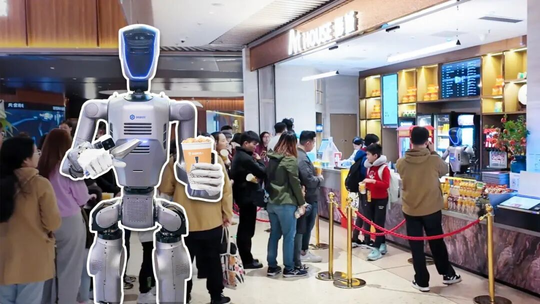
人形机器人商业化

Search documents
Optimus 或于 2027 年底前开售,关注机器人产业进展
Changjiang Securities· 2026-01-30 05:02
Investment Rating - The industry investment rating is "Positive" and maintained [7] Core Insights - Tesla's humanoid robot Optimus is expected to be available for public sale by the end of 2027, marking a significant step towards commercialization in the humanoid robotics sector [2][4] - The report suggests focusing on the entire robotics supply chain, particularly on 1) suppliers of the robot "brain," 2) software-related companies for robot operating systems, and 3) suppliers of components for Tesla's Optimus [2][11] Summary by Sections Event Description - On January 22, during the World Economic Forum, Tesla CEO Elon Musk announced that the humanoid robot Optimus will be available for public sale by the end of 2027 [4] Market Performance - Tesla's Optimus V3 is anticipated to be released in Q1 of this year, with plans for mass production to begin by the end of 2026, aiming for an annual production capacity of 1 million units, eventually scaling up to 10 million units [11] - The domestic humanoid robot industry in China is also expected to see significant growth, with over 140 companies and more than 330 humanoid robot products expected by 2025 [11] Commercialization Progress - The humanoid robot industry is at a critical turning point for commercialization, with Tesla's Optimus already performing basic tasks in factories and expected to complete complex assembly and quality inspection tasks by the end of 2026 [11] - The production line for Optimus has begun operations, with the mass-produced version potentially priced as low as $20,000, which could enhance its application in more complex scenarios [11]

A股三大指数开盘集体下跌,沪指跌0.63%
Feng Huang Wang Cai Jing· 2026-01-30 01:40
Group 1: Market Overview - A-shares opened lower with all three major indices declining: Shanghai Composite Index down 0.63%, Shenzhen Component Index down 0.6%, and ChiNext Index down 0.09% [1] Group 2: Robotics Industry Insights - CITIC Securities indicates that humanoid robots are currently in the technology validation phase, but the commercialization timeline is expected to be shorter compared to that of electric vehicles [2] - The report emphasizes focusing on high-value, clear-structure, and high-certainty segments within the robotics industry, as these areas exhibit the greatest earnings elasticity [2] - Key segments identified include platform companies (integrating software and hardware), high-performance SOC chips, dexterous hands, actuators, and precision sensors, which are considered high-value and high-barrier areas in the humanoid robotics sector [2] Group 3: Carbon Market Developments - Huatai Securities forecasts a revaluation of carbon prices and green certificate markets driven by policy changes, transitioning from "soft constraints" to "hard constraints" by 2027 [3] - The report anticipates that carbon prices could rise to the range of 150-200 yuan per ton before 2030, supported by tightening quota distributions and increasing compliance costs [3] - A mechanism for exchanging green certificates for carbon quotas is expected to be established, enhancing the economic viability of green electricity [3] Group 4: Lithium Market Projections - Galaxy Securities predicts that lithium prices will experience a mid-year bifurcation in 2025, with the first half continuing to reflect an oversupply and prices dropping near cash costs [4] - The second half is expected to see a market turnaround driven by dual storage demand and regulatory impacts on mining licenses, leading to a bullish trend [4] - By the end of the year, lithium carbonate prices are projected to have more than doubled from their lows, with ongoing upward momentum despite regulatory challenges [4] - Lithium is identified as a critical mineral for energy transition, with a long-term positive outlook despite short-term supply surplus expectations [4]



中信证券:人形机器人处于技术验证期 商业化落地时间相比新能源汽车将缩短
Di Yi Cai Jing· 2026-01-30 00:21
(文章来源:第一财经) 中信证券研报表示,目前人形机器人处于技术验证期,但商业化落地时间相比于新能源汽车将缩短;建 议重点关注机器人产业中价值最厚、格局最清、确定性最高环节,因为业绩弹性最大,同时我们认为龙 头在产业趋势投资阶段最为核心,因此我们建议积极寻找机器人细分环节中非标、技术、成本、扩产壁 垒高的龙头企业,因为这类企业能够穿越产业周期。整体上,我们认为机器人公司本身(软硬一体的平 台型企业)、高算力SOC芯片(大脑端侧驱动)、灵巧手(软硬件一体的小机器人)、执行器、精密传 感器(软硬件一体)等环节属于人形机器人产业高价值、高壁垒环节。 ...
我们不需要100万台“跳舞机器人”
3 6 Ke· 2026-01-28 02:56
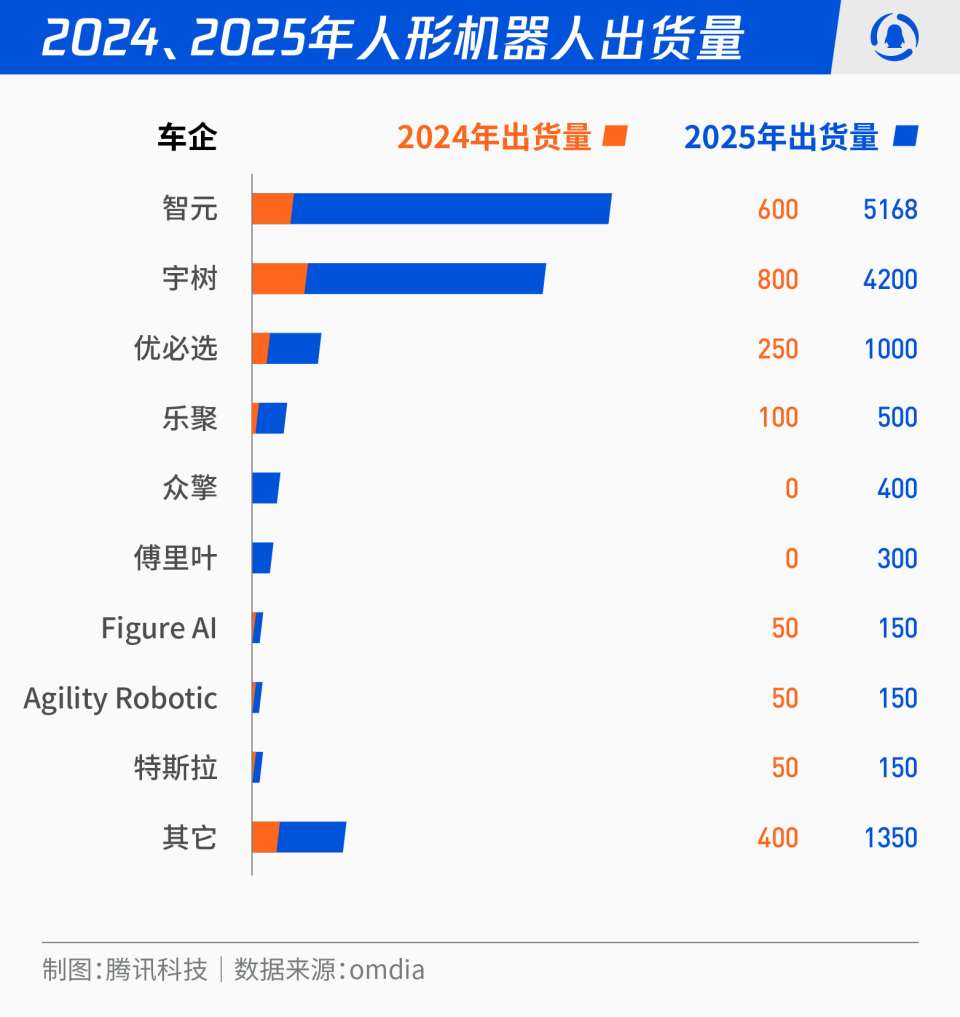
Core Viewpoint - The article discusses the competitive landscape of humanoid robots, highlighting the discrepancies in projected shipment volumes and market share among leading companies, particularly focusing on Yuzhu Technology's response to Omdia's data on humanoid robot shipments for 2025 [1][3][6]. Group 1: Market Data and Company Responses - Yuzhu Technology claims that its actual shipment volume for humanoid robots in 2025 will exceed 5,500 units, countering Omdia's report which listed it at 4,200 units [6][26]. - Omdia's report ranks the top three humanoid robot manufacturers by shipment volume as Zhiyuan Robotics (5,168 units), Yuzhu Technology (4,200 units), and Ubtech (1,000 units) [1][3]. - Counterpoint's data corroborates the market share of the top three companies, with Zhiyuan at 30.4%, Yuzhu at 26.4%, and Ubtech at 5.2% [3]. Group 2: Industry Growth and Challenges - The humanoid robot industry is expected to see a significant increase in shipments, with a total of over 10,000 units projected for 2025, compared to less than 2,000 units in 2024, indicating a substantial year-on-year growth [6][26]. - Despite the optimistic projections, the industry faces challenges, including the fact that over 140 companies are entering the humanoid robot market, with more than 330 products launched, suggesting that many companies have yet to realize substantial production capabilities [6][26]. - The article emphasizes that the humanoid robot sector is still in its early exploratory phase, with many products lacking practical applications beyond entertainment [12][20]. Group 3: Application and Market Perception - The perception of humanoid robots is largely limited to entertainment, such as dancing, which raises concerns about their practical applications in real-world scenarios [8][9]. - Industry experts suggest that while entertainment applications are currently popular, the future of humanoid robots will depend on their ability to perform more complex tasks and integrate into various sectors [12][20]. - The article notes that the current market for humanoid robots is primarily focused on developers and research institutions, with consumer adoption hindered by the lack of "out-of-the-box" usability [18][20]. Group 4: Future Outlook and Production Challenges - The article discusses the ambitious production goals set by companies like Tesla, which aims for 1 million units of its Optimus robot, contrasting this with the current low shipment figures [23][24]. - The industry is characterized by a significant gap between ambitious production targets and actual output, with many companies still struggling with hardware stability and practical applications [26][28]. - The potential for scaling production exists, but it is contingent on market demand and the ability of humanoid robots to solve specific problems effectively [28][29].


马斯克达沃斯官宣Optimus开售,人形机器人从概念走向商业化,全球科技风口迎来全新拐点
Xin Lang Cai Jing· 2026-01-23 13:09
Core Insights - Elon Musk announced three major developments at the Davos Forum: the public sale of the Optimus humanoid robot by the end of 2027, AI potentially surpassing human intelligence by the end of this year or next, and the launch of Tesla's Robotaxi service in Austin without a safety driver [1][7] Group 1: Optimus Project - Tesla's value is projected to derive approximately 80% from the Optimus project, which is expected to be publicly available by the end of 2027, contingent on reliability, safety, and functionality [2][8] - Currently, Optimus is performing simple tasks at Tesla's factory, with plans to handle more complex tasks by the end of 2026 [2][8] - Musk predicts that the number of robots will exceed the human population, suggesting that everyone will want one [2][8] Group 2: Market Impact - Following Musk's announcements, Tesla's stock surged by 4.15%, recovering much of its losses for the year, demonstrating the "Musk effect" on global capital [1][7] - The automotive sector is under pressure, with Tesla's sales projected to decline by 8.6% in 2025, marking two consecutive years of decline, while BYD has overtaken Tesla as the largest electric vehicle seller [3][9] Group 3: Industry Dynamics - The announcement of Optimus has ignited the humanoid robot sector, transitioning it from a niche to a mainstream market, with significant growth expected across the entire supply chain [4][10] - The supply chain for humanoid robots includes critical components such as servo motors, reducers, sensors, and chips, which are anticipated to see explosive demand [3][9] - The integration of AI algorithms and human-machine interaction will define the functionality and user experience of these robots, with high technical barriers in the midstream sector [3][9]
人形机器人企业积极规划产能扩张
Zheng Quan Ri Bao· 2026-01-21 16:29
Core Insights - The humanoid robot industry is transitioning from technology demonstration to large-scale commercialization, with significant growth expected in 2026 [1][3][4] Group 1: Market Growth and Orders - The humanoid robot market is projected to experience strong order growth in 2025, with companies like Qingbao Robot and Zhiyuan Robot reporting substantial increases in order volumes [1][2] - Qingbao Robot's sales exceeded 50 million yuan in 2025, with a notable order of 7 million yuan from South China and 1,000 intention orders from various industries [3] - Omdia's report indicates that Zhiyuan Robot's shipments surpassed 5,100 units in 2025, while Yushu Technology's shipments exceeded 5,500 units, highlighting a competitive landscape [2] Group 2: Production Capacity and Strategy - Companies are ramping up production capacity in anticipation of a significant demand surge in 2026, marking the beginning of a capacity competition [4][5] - Qingbao Robot plans to enhance production scale to optimize costs and facilitate the commercialization of products across various scenarios [4] - Industry experts predict that global shipments of humanoid robots could exceed 50,000 units in 2026, representing a year-on-year increase of over 700% [3][4] Group 3: Industry Outlook - 2026 is seen as a critical year for assessing the commercialization capabilities of the humanoid robot industry, with leading companies beginning to secure substantial orders [3][4] - The industry is still in its early stages, and companies must balance capacity expansion with technological advancements to maintain competitive advantages [5][6]
1月16日主题复盘 | 半导体全线爆发,智能电网、机器人走强
Xuan Gu Bao· 2026-01-16 09:01
Market Overview - The market opened high but closed lower, with the three major indices experiencing slight declines. The semiconductor industry chain saw a surge, with stocks like Tianyue Advanced and Tongfu Microelectronics hitting the daily limit. The robotics sector also performed well, with companies such as Wuzhou Xinchun and Fangzheng Electric reaching their daily limit. In contrast, AI application stocks collectively adjusted, with companies like Yili Media and Vision China hitting the daily limit down. Overall, around 3,000 stocks in the Shanghai and Shenzhen markets declined, with a total transaction volume of 3.06 trillion yuan [1]. Key Sectors Semiconductor Sector - The domestic semiconductor sector experienced a significant increase, with stocks like Shenghui Integrated, Kangqiang Electronics, and Jinhai Tong hitting the daily limit. TSMC reported a 35% year-on-year increase in net profit for Q4, reaching a historical high, and is expected to generate revenue between $34.6 billion and $35.8 billion in Q1 2026, a 38% year-on-year growth [4][5]. Smart Grid Sector - The smart grid concept saw a substantial rise, with stocks such as Senyuan Electric and Hancable hitting the daily limit. The State Grid announced that fixed asset investment during the 14th Five-Year Plan period is expected to reach 4 trillion yuan, a 40% increase compared to the previous plan, aimed at accelerating the construction of new power systems and enhancing transmission capacity by over 30% [7][9]. Robotics Sector - The robotics sector showed strong performance, with stocks like Xinquan Co. and Henghui Security hitting the daily limit. OpenAI is reportedly seeking suppliers for robotics and AI devices, indicating a growing demand in this area [12][14]. Investment Insights - Analysts from Kaiyuan Securities noted that TSMC's acceleration in 2nm production and the release of capacity from U.S. wafer fabs indicate a continued strong demand for advanced processes. TSMC plans to raise wafer foundry prices for four consecutive years from 2026 to 2029, highlighting a clear supply-demand imbalance in the industry [6]. - Huaxin Securities pointed out that the semiconductor industry's prosperity is on the rise, with global semiconductor equipment sales expected to reach $133 billion by 2025, with mainland China leading the market. Domestic wafer foundries are seizing recovery opportunities through counter-cyclical expansion, with SMIC's 8-inch wafer monthly capacity reaching 1.023 million pieces [6]. - The smart grid investment is projected to be around 1 trillion yuan annually during the 14th Five-Year Plan, with significant investments expected from both the State Grid and Southern Grid [9][10].


人形机器人冲刺资本市场:融资铺路量产,“自我造血”仍是大考
机器人圈· 2026-01-08 10:13
Core Viewpoint - The humanoid robot industry in China is experiencing a surge in IPO activities, driven by policy support and market confidence, but faces challenges in technology and application scenarios [2][6]. Group 1: IPO Activities - Companies like Yushu Technology, Leju Robotics, and Yundongchu Technology are actively pursuing IPOs, with Yushu Technology being a frontrunner expected to submit its listing application between October and December 2025 [3][4]. - Yushu Technology has completed 10 rounds of financing, with a post-investment valuation exceeding 12 billion yuan, and reported revenue surpassing 1 billion yuan in 2025 [3][4]. - Leju Robotics and Yundongchu Technology are also advancing their IPO processes, with Leju planning to complete its advisory work by mid-2025 and Yundongchu having launched its IPO advisory in December 2025 [4][5]. Group 2: Industry Challenges - Despite the push for IPOs, the humanoid robot industry faces significant challenges, including limited technological breakthroughs and insufficient core application scenarios [2][6]. - The industry is expected to cross a critical production milestone by 2026, but mass production is hindered by technical and supply chain issues, necessitating substantial funding for ongoing development [7][8]. - Companies must focus on achieving stable order volumes, reducing costs, and improving profitability to navigate through market cycles successfully [9][10]. Group 3: Market Dynamics - The market is witnessing a shift towards commercial viability, with an increase in verifiable application scenarios and real orders in sectors like industrial and service applications [6][10]. - Companies are exploring diverse commercial pathways, particularly in standardized sectors such as commercial services and smart retail, to accumulate real-world data and validate their business models [11][12]. - The success of humanoid robots in achieving large-scale production is contingent upon aligning customer demand, core technology, and cost control [11][12].

机器人ETF(562500) 早盘V型反转,成交额破4.6亿
Mei Ri Jing Ji Xin Wen· 2026-01-07 02:51
Group 1 - The Robot ETF (562500) has shown strong resilience with a 0.10% increase, indicating a recovery after a dip, supported by active trading with a turnover exceeding 4.64 billion [1] - Key holdings in the ETF include companies like Hongxun Technology, which has seen a strong performance, and others such as Dazhong Laser and Bojie Co., which have risen over 3% [1] - The automated driving technology company Mobileye announced a deal to acquire Israeli humanoid robot startup Mentee Robotics for a total value of $900 million, consisting of $612 million in cash and up to 26.23 million shares of Mobileye Class A common stock, expected to close in the first quarter of this year [1] Group 2 - The Robot ETF (562500) is the only robot-themed ETF in the market with a scale exceeding 20 billion, covering various segments including humanoid robots, industrial robots, and service robots, facilitating investors' access to the entire robot industry chain [2]
人形机器人电影院“上班”!工作14小时不累,卖了1000杯还零失误
Sou Hu Wang· 2026-01-06 09:17
Core Insights - The humanoid robot Atom from Yujian Robotics has successfully completed the world's first public commercial demonstration, selling 1,000 cups of popcorn daily and generating over 20,000 yuan in revenue [1][7] Group 1: Technology and Implementation - The demonstration showcases the robot's capability as a "fully autonomous reliable workforce" in a real commercial environment, with popcorn selling serving as a high-frequency, standardized task to test the robot's operational effectiveness [3][4] - Atom's operation involves complex tasks requiring high levels of perception, decision-making, and execution, including recognizing customers, handling cups, and managing various environmental interferences [4][5] - The robot operates without relying on pre-set trajectories or remote control, utilizing an end-to-end Visual Language Action (VLA) model for real-time environmental perception and task execution [4][9] Group 2: Performance and Results - The robot achieved a record of 14 hours of continuous operation with zero errors, demonstrating its long-duration task execution capability and the reliability of its mechanical structure and control systems [12][16] - The successful sale of popcorn not only meets market demand but also illustrates the potential for robots to enhance efficiency, extend service hours, and maintain service consistency, providing quantifiable commercial value [7][16] Group 3: Future Implications - The success in the cinema environment opens opportunities for humanoid robots in other service sectors such as restaurants, cafes, hotels, and retail, addressing labor shortages in these industries [16] - The practical validation of the VLA model indicates a shift towards integrated intelligent architectures that are better suited for handling complex tasks in open environments, guiding the future development of humanoid robots [16]