价值投资

Search documents
中国人寿(601628):财报点评:规模价值双升,数智赋能高质量发展
East Money Securities· 2026-03-27 03:48
Investment Rating - The report maintains a "Buy" rating for the company, indicating a positive outlook for its stock performance relative to the market index [2][6]. Core Insights - The company achieved simultaneous growth in scale, value, and efficiency in 2025, with total premiums exceeding 700 billion yuan, marking a record in the industry. Revenue reached 615.68 billion yuan, a year-on-year increase of 16.5%, and net profit attributable to shareholders was 154.08 billion yuan, up 44.1% year-on-year [4][6]. - The company's new business value (NBV) reached 45.75 billion yuan, a 35.7% increase year-on-year, showcasing its strong value creation capabilities [4]. - The company has effectively optimized its business structure, with a balanced distribution of new premiums across life, annuity, and health insurance segments, each contributing approximately one-third to the total [4]. - The investment segment showed robust performance, with total investment assets reaching 7.42 trillion yuan, a 12.3% increase year-on-year, and total investment income of 387.69 billion yuan, up 25.8% year-on-year [4][6]. - The company has made significant strides in digital transformation, enhancing operational efficiency and customer experience through AI and digital services [4][6]. Financial Performance Summary - Total revenue for 2025 was 615.68 billion yuan, with a projected growth rate of 5.8% for 2026 [7]. - Net profit attributable to shareholders for 2025 was 154.08 billion yuan, with forecasts of 165.50 billion yuan for 2026, reflecting a year-on-year growth of 7.4% [7]. - The company's return on equity (ROE) for 2025 was 25.9%, with a projected decline to 24.0% by 2026 [12]. Asset and Liability Overview - As of December 31, 2025, total assets amounted to 7.59 trillion yuan, with total liabilities at 6.98 trillion yuan [11][13]. - The company's equity attributable to shareholders was 595.21 billion yuan, with projections of 688.88 billion yuan for 2026 [11][13].

证监会发声,事关中长期资金入市
证券时报· 2026-03-27 03:36
Core Viewpoint - The China Securities Regulatory Commission (CSRC) aims to strengthen the legal framework of the capital market, promoting rational, value, and long-term investments while enhancing the market environment for these investment strategies [1][3][6]. Group 1: Strengthening Legal Framework - The CSRC is committed to improving the legal basis for rational, value, and long-term investments through various legislative measures and policy reforms [3][5][7]. - A recent draft of the financial law emphasizes support for long-term capital entering the market, enhancing the inherent stability of the capital market [3][5]. Group 2: Policy Implementation and Market Environment - In 2025, various long-term funds, including social security, insurance, and public funds, are expected to significantly increase their market participation, with net purchases of A-shares exceeding 800 billion yuan, contributing to an overall market entry of over 1 trillion yuan [1][2]. - The total dividend payout from profitable listed companies reached a historical high of 2.55 trillion yuan, with 97% of eligible companies implementing dividends [1]. Group 3: Regulatory Actions and Investor Protection - The CSRC, in collaboration with judicial authorities, has intensified enforcement against securities violations, with 701 cases of securities and futures violations handled in 2025, resulting in penalties totaling 15.474 billion yuan [4][8]. - The CSRC is enhancing investor protection by strictly penalizing fraudulent activities and improving the quality of information disclosure to support rational investment decisions [8].


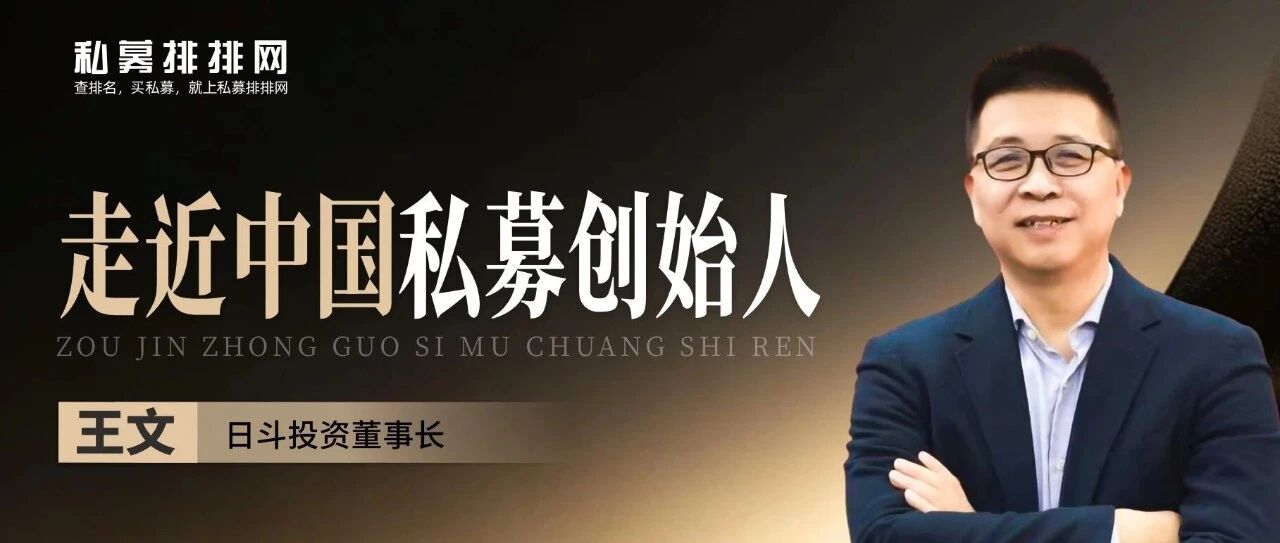
从农大走出的百亿私募掌门人,“万倍叔”王文的“价值狩猎”之路 | 走近中国私募创始人
私募排排网· 2026-03-27 03:32
Core Viewpoint - The article highlights the journey and investment philosophy of Wang Wen, the founder of Dayou Investment, who transformed an initial capital of 40,000 yuan into over 10 billion yuan in returns over 30 years, showcasing the evolution of China's private equity industry and the significance of deep value investing [2][26]. Group 1: Background and Early Career - Wang Wen graduated from China Agricultural University in 1990, which laid a solid foundation for his economic theories [4]. - After graduation, he worked at the Ministry of Agriculture, participating in drafting the first Agricultural Law and conducting extensive field research, enhancing his understanding of macro policies [4][5]. Group 2: Investment Milestones - Wang's investment career began in 1993 when he borrowed funds to enter the A-share market, marking the start of his journey in finance [5][10]. - Significant milestones include: - 1995: Transitioned from the Ministry of Agriculture to the financial sector, working for various investment firms [11]. - 1995-1997: Invested in Sichuan Changhong, turning 40,000 yuan into 400,000 yuan, marking his first major success [12]. - 1999-2004: Focused on B-shares, particularly Guangdong Electric B, achieving a fivefold return [19]. - 2004-2012: Invested in Yitai B, resulting in a total return of 100 times [22]. - 2013-2014: Invested in Guotou Electric, realizing a profit of 1 time as the company transitioned to profitability [24]. - 2013-2021: Long-term investment in Kweichow Moutai, achieving a cumulative return of 360.10% [25]. Group 3: Investment Philosophy - Wang's investment philosophy is encapsulated in the principle of "two highs and one low," focusing on companies with high cash flow, high dividends, and low valuations [31]. - He emphasizes the importance of thorough research before making investment decisions, advocating for a hands-on approach to understanding companies [32]. - Industry cycles play a crucial role in identifying investment opportunities, with a focus on sectors in an upward trend [34]. Group 4: Latest Insights and Market Outlook - In a recent investment strategy meeting, Wang expressed optimism for the 2026 market, predicting a continuation of the bull market and a potential for valuation recovery [36]. - He highlighted financial sectors, particularly insurance, banks, and brokerages, as key areas for investment [37][38][40]. - Wang's investment themes include "wealth, health, and enjoyment," focusing on internet companies, pharmaceuticals, and new consumer sectors [41][42]. Group 5: Investment Mindset - Wang advises investors to maintain a long-term perspective and not be swayed by market fluctuations or trends, emphasizing the importance of sticking to fundamental values [45][46]. - He warns against the distractions of market hype and encourages a focus on sustainable investment practices [47].
证监会:2025年中长期资金新增入市规模超1万亿
21世纪经济报道· 2026-03-27 03:10
Core Viewpoint - The China Securities Regulatory Commission (CSRC) emphasizes the importance of long-term value investment and the legal foundation supporting it, with a projected increase of over 1 trillion yuan in medium to long-term funds entering the market by 2025 [1][2][3]. Group 1: Medium to Long-term Funds - By 2025, various medium to long-term funds, including social security, insurance, pension, public funds, and brokerage proprietary trading, are expected to net buy over 800 billion yuan in A-shares, leading to a total market entry exceeding 1 trillion yuan [2]. - Among profitable listed companies that meet dividend criteria, 97% have implemented dividend distributions, with a total dividend payout reaching 2.55 trillion yuan, marking a historical high [2]. Group 2: Legal Framework and Regulations - The recent financial law draft aims to support medium to long-term funds entering the market, enhancing the inherent stability of the capital market and solidifying the legal basis for rational, value, and long-term investments [3]. - Since the introduction of the new "National Nine Articles" over two years ago, the CSRC has issued and revised more than 50 regulatory documents, including guidelines for improving the quality of listed companies and protecting small investors [3]. Group 3: Investor Protection and Enforcement - The CSRC has intensified regulatory enforcement, addressing numerous cases of fraud, financial misconduct, market manipulation, and insider trading, with 701 securities and futures violations investigated in 2025, resulting in penalties totaling 15.474 billion yuan [4]. - Future efforts will focus on strict law enforcement to protect investors, including enhancing the application of advance compensation systems and improving investor education [5]. Group 4: Market Supervision and Governance - The CSRC plans to strengthen daily regulatory guidance, ensuring high-quality securities products for investors and conducting a new round of corporate governance initiatives [6][7]. - There will be increased oversight of market activities such as share reductions and algorithmic trading to create a fair trading environment and enhance the role of securities firms in supporting rational and long-term investments [7].

证监会:2025年中长期资金新增入市规模超一万亿
财联社· 2026-03-27 02:45
Group 1 - The core viewpoint of the article emphasizes the significant increase in medium to long-term capital entering the A-share market, with net purchases exceeding 800 billion yuan in 2025, leading to a total actual new market entry of over 1 trillion yuan [1] - 97% of listed companies that are profitable and meet dividend conditions have implemented dividends, with a total dividend amount reaching a historical high of 2.55 trillion yuan [1] - The legal foundation for rational, value, and long-term investment in the capital market is being further solidified, with recent financial law drafts supporting the entry of medium to long-term funds [2] Group 2 - The National Social Security Fund has consistently maintained a strategic focus on long-term, value, and responsible investment since its establishment, creating a diversified global asset allocation system [3] - This investment structure allows the National Social Security Fund to withstand short-term market fluctuations and achieve relatively stable returns over the long term [3]

社保基金315亿持仓曝光
21世纪经济报道· 2026-03-26 13:13
Core Viewpoint - The article discusses the recent holdings of the social security fund in the A-share market, highlighting its role as a stabilizing force and its investment strategies, including long-term holdings and a focus on companies with strong governance and growth potential [2][5][11]. Group 1: Social Security Fund Holdings - As of March 25, 2026, the social security fund appeared in the top ten shareholders of 77 companies, holding a total of 193 million shares valued at 31.54 billion yuan [2][4]. - The social security fund's total assets reached 3.32 trillion yuan by the end of 2024, with an average annual return of 7.39% since its establishment, accumulating over 1.9 trillion yuan in investment returns [5][11]. - In the fourth quarter of the previous year, the fund initiated positions in 25 stocks, increased holdings in 22 stocks, and reduced holdings in 15 stocks, maintaining its position in 15 stocks [5][9]. Group 2: Notable Stock Performances - Among the newly acquired stocks, Chongqing Rural Commercial Bank saw the highest number of shares purchased, with 93.83 million shares bought, valued at over 600 million yuan [5]. - The stock with the highest net profit growth among the newly held stocks was Shouhua Gas, which reported a net profit of 169.32 million yuan, a year-on-year increase of 123.82% [6]. - The social security fund's largest holdings include China Fortune Land Development, Nanshan Aluminum, and others, with significant share quantities exceeding 100 million shares [7][9]. Group 3: Long-term Investment Strategy - The social security fund has a long-term holding strategy, with 15 stocks held for over two years and three stocks held for more than five years, including China Giant Glass and Nanshan Aluminum [9]. - The fund's investment characteristics include a focus on stable companies, a diversified portfolio, and a preference for industry leaders, aiming for sustainable returns to support social security initiatives [9][11]. - Analysts suggest that while the fund's holdings can provide valuable insights for investors, caution is advised due to potential delays in information and the inherent risks of individual stock investments [11].




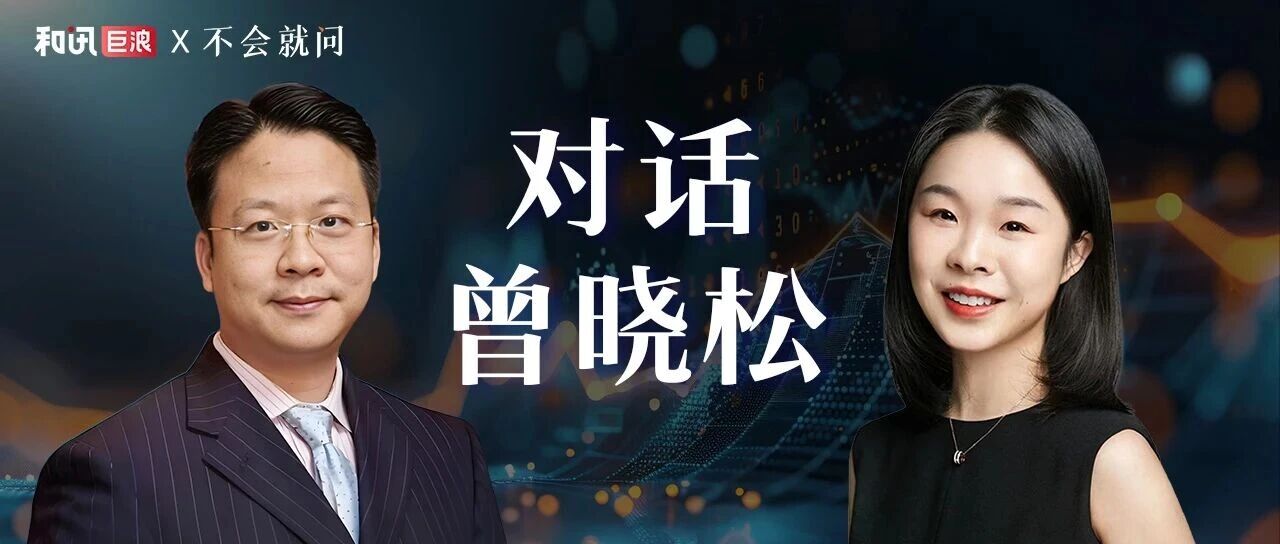
恒生科技回调近30%,见底了吗|不会就问x曾晓松
和讯· 2026-03-26 09:47
Group 1 - The Hang Seng Technology Index has experienced a significant decline of nearly 30% since its peak last year, with major companies like Tencent and Alibaba leading the downturn [2][7] - The current market environment raises questions about the viability of value investing and whether AI investments represent a bubble or an opportunity [4][6] - The performance of hard technology stocks, particularly in AI and robotics, has outpaced traditional internet platform stocks, indicating a shift in investor focus [8][9] Group 2 - The decline in Hong Kong technology stocks is attributed to macroeconomic factors, including concerns over the pace of interest rate changes by the Federal Reserve, which has led to increased foreign selling [7][8] - The traditional internet companies face significant uncertainty in their fundamentals, exacerbated by intensified competition and price wars, leading to skepticism about their growth models [8][10] - The Hang Seng Technology Index's heavy reliance on traditional internet companies has contributed to its overall decline, while hard technology stocks have shown resilience [9] Group 3 - The Hong Kong stock market has not transitioned into a long-term bull market due to various factors, including policy environment differences between the U.S. and China, revenue structure disparities, and challenges in intellectual property protection [12][13][14] - The income stability of Chinese tech companies is lower compared to their U.S. counterparts, primarily due to a greater reliance on consumer-facing business models [12][13] - The geopolitical landscape and macroeconomic influences from both China and the U.S. contribute to the volatility of Hong Kong stocks [14] Group 4 - Despite the challenges, there are still significant value investment opportunities in the Hong Kong market, but misconceptions about value investing can lead to losses [15] - The performance of IPOs in the Hong Kong market has been mixed, with a focus on hard technology and consumer sectors, and a need for selective stock picking in the current volatile environment [16] - The sentiment among foreign investors towards the Chinese market remains cautious, with a low allocation to Chinese stocks compared to other Asian markets [19] Group 5 - The current AI landscape is viewed as being in the "mid-game," with significant advancements in AI models from both the U.S. and China, but concerns about valuation bubbles persist [20][21] - Chinese AI companies have lower absolute valuations compared to their U.S. counterparts, but their relative valuations can be high, indicating a complex investment landscape [21][29] - The market's perception of AI companies is influenced by their technological barriers and commercialization capabilities, which are critical for attracting investment [24][25] Group 6 - The recent downturn in both U.S. and Hong Kong tech stocks is attributed to the impact of AI on various industries and the need for investors to reassess their portfolios [31] - The emergence of new technologies often brings economic pressures, leading to significant workforce reductions in companies that fail to adapt [33] - The investment philosophy emphasizes the importance of understanding both macroeconomic conditions and individual company fundamentals to make informed decisions [42][46]
全年大赚1540亿背后,中国人寿四季度为何突现亏损?
第一财经· 2026-03-26 09:36
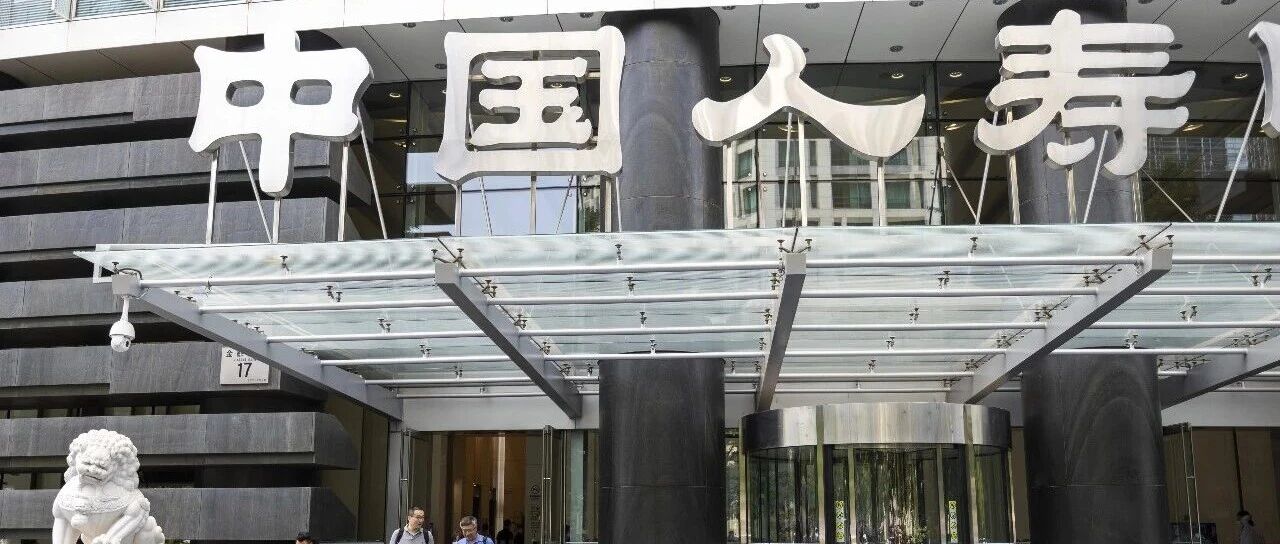
Core Viewpoint - China Life Insurance Company reported a net profit growth of 44.1% year-on-year for 2025, but experienced a net loss in the fourth quarter, attributed to structural adjustments in the capital market affecting its stock and fund holdings. The management emphasized that these fluctuations are mostly temporary and do not reflect the company's long-term operational trends [3][4]. Group 1: Financial Performance - For the first three quarters of 2025, China Life achieved a net profit attributable to shareholders of 167.8 billion yuan, a year-on-year increase of 60.5%. The total net profit for the year was 154.1 billion yuan, reflecting a growth of 44.1% [3]. - The total investment income for 2025 reached 387.7 billion yuan, an increase of 79.4 billion yuan compared to the same period in 2024. The total investment return rate was 6.09%, up by 59 basis points from the previous year [4]. Group 2: Investment Strategy - As of December 31, 2025, China Life's investment assets amounted to 7.42 trillion yuan, representing a growth of 12.3% from the end of 2024. The allocation ratio of stocks and funds (excluding money market funds) increased from 12.18% at the end of 2024 to 16.89%, indicating a strategic increase in equity investments [4]. - The company is closely monitoring global geopolitical risks, particularly those arising from the US-Iran conflict, although the impact on its overall assets is minimal due to the small scale of its overseas asset allocation. The company plans to leverage its long-term capital stability to dynamically adjust its asset allocation strategy [4].
泡泡玛特,拿到英伟达的剧本
3 6 Ke· 2026-03-26 09:32
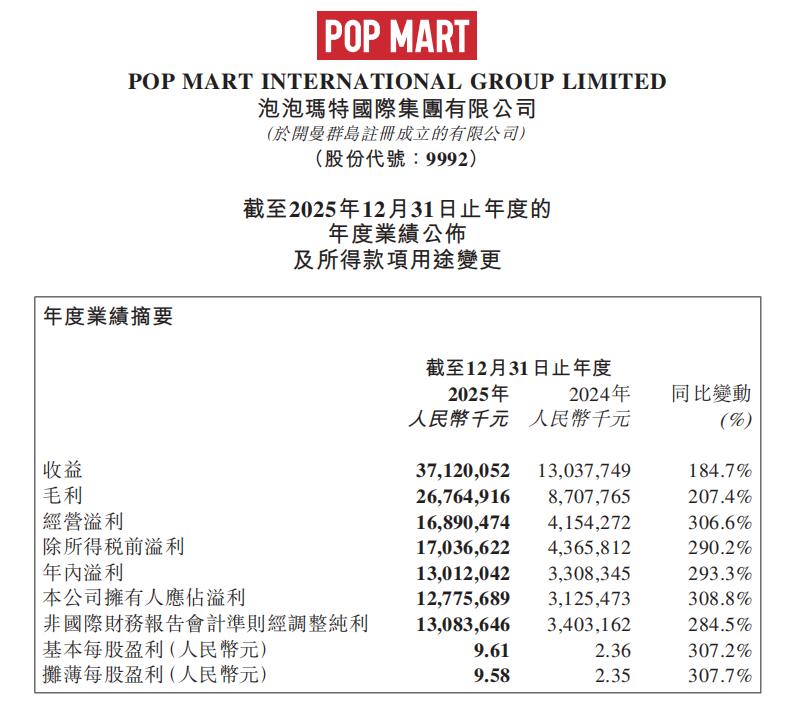
Core Viewpoint - Both Nvidia and Pop Mart experienced outstanding performance in 2025, yet their stock prices faced significant volatility, highlighting a disconnect between market expectations and actual results [1][2]. Group 1: Financial Performance - In 2025, Pop Mart achieved a revenue of 37.12 billion RMB, a year-on-year increase of 184.7% compared to 2024 [3][5]. - The net profit for Pop Mart reached 13.01 billion RMB, reflecting a 293.3% year-on-year growth [3][5]. - The adjusted net profit was 13.08 billion RMB, with a 284.5% increase year-on-year, and an adjusted net profit margin of 35.2% [3][5]. Group 2: Market Reaction and Expectations - Despite strong financial results, Pop Mart's stock price dropped by 22.51% on the day of its earnings announcement, indicating that market expectations had already factored in high performance [2][3]. - Investors are increasingly concerned about the company's reliance on a few key IPs, leading to a reassessment of valuation and growth expectations [7][10]. Group 3: Business Model and Growth Potential - Pop Mart's core competency lies in its platform operation capabilities, which allow it to continuously attract high-quality resources and maintain growth without solely depending on any single IP [16][19]. - The company has expanded its international presence, with nearly 50% of its revenue coming from overseas markets, indicating potential for sustained high growth [22][26]. - Pop Mart aims for a growth rate of no less than 20% in the coming year, reflecting a strategic shift towards healthier growth amidst high expectations [26].


跌麻了才明白:真正能拿住的收益,长这样……
聪明投资者· 2026-03-26 07:03
Core Viewpoint - The article discusses the current market conditions and emphasizes the importance of understanding what level of returns can be sustained by investors, highlighting that high risk does not necessarily equate to high returns [3][4]. Group 1: Investment Strategies and Fund Performance - Yang Peihong's analysis indicates that funds with a maximum drawdown between 15% and 30% over the past six years achieved an average return of 72.25%, translating to an annualized return of approximately 9.6% [4]. - A selection of active equity funds with a maximum drawdown of less than -20% and an annualized return exceeding 8% over the past five years resulted in 11 qualifying products [5]. - Among the funds analyzed, eight products are highlighted for their performance under the specified criteria [7]. Group 2: Fund Managers and Their Strategies - Fund managers Jiang Cheng, Xu Yan, and Yang Xinxin have been consistently tracked, with each achieving annualized returns exceeding 10% under the maximum drawdown condition of 20% [9]. - Jiang Cheng's fund, Zhongtai Xingyuan, has a return of 190.23% since its management began in December 2018, with an annualized return of 15.69% [10]. - Xu Yan's fund, Dachen Competitive Advantage, has a return of 125.24% since December 2019, with an annualized return of 13.89% [15]. Group 3: Risk Management and Investment Philosophy - Xu Yan emphasizes safety as the primary discipline in fund management, stating that avoiding bubbles leads to smaller drawdowns, albeit with potential performance pressures during certain periods [19]. - The article notes that Jiang Cheng's drawdown control is a result of his stringent valuation criteria, which helps maintain a balance between risk and return [14]. - Fund manager Yu Bo focuses on risk identification and employs a systematic approach to manage positions, adjusting equity exposure based on market conditions [44][48]. Group 4: Sector and Asset Allocation - The funds analyzed predominantly invest in sectors such as banking, chemicals, construction, and real estate, with a focus on high capital adequacy and low-cost debt [13]. - The article highlights the importance of selecting undervalued stocks with strong fundamentals, as emphasized by fund manager Wu Xuan, who has consistently outperformed the market over the past nine years [26][27]. - The investment strategies of fund managers involve a mix of top-down and bottom-up approaches, focusing on valuation and market conditions to guide asset allocation [35].