企业家IP

Search documents
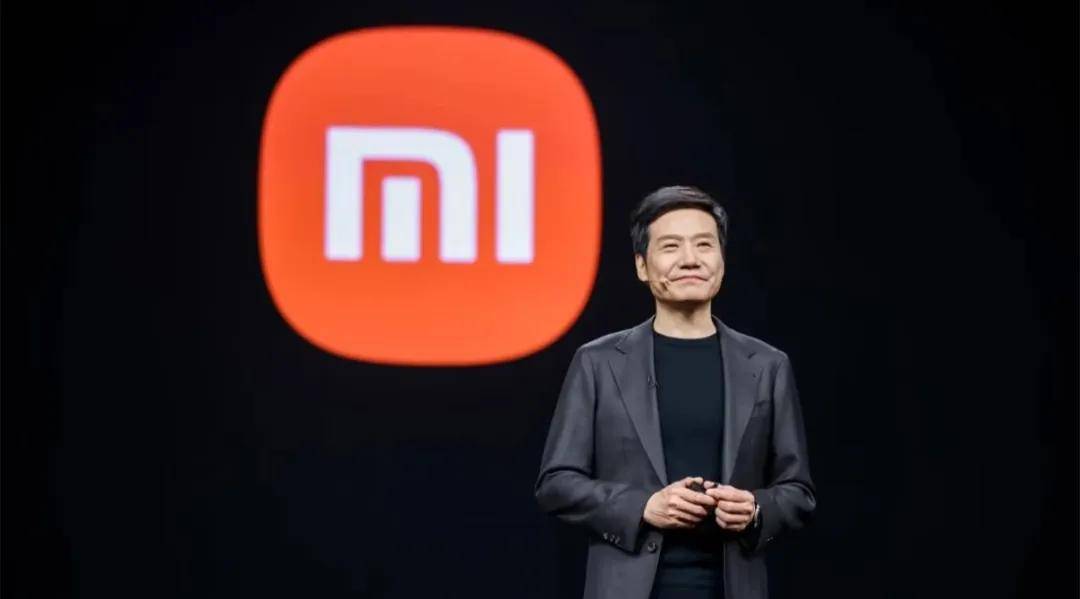
雷军IP,小米的“降维打击”:企业家的个人魅力如何成为千亿市值的护城河?
Sou Hu Cai Jing· 2025-11-21 10:18
Core Insights - The article highlights the unique synergy between Lei Jun's personal brand and Xiaomi's product identity, which has led to significant commercial success, particularly with the SU7 vehicle, surpassing Tesla Model 3 sales in December 2024 [1][5] - Lei Jun's personal image has become a core asset for Xiaomi, transforming from a "brand amplifier" to a key factor in capital pricing, as evidenced by the substantial market trust reflected in his shareholding value [5][11] Group 1: Lei Jun's Personal Brand Development - Lei Jun has cultivated a strong personal brand over the past decade, deeply integrating his image with Xiaomi's corporate identity, which serves as a competitive moat for the company [3][4] - His background as a programmer and entrepreneur has established him as a credible figure in the tech industry, enhancing user trust and engagement [4][10] - By leveraging social media, Lei Jun has amassed a significant following, with over 38 million followers on Douyin and 25 million on Weibo, reinforcing his influence [4][10] Group 2: Business Performance and Impact - The SU7's launch saw over 50,000 pre-orders on its first day, with total deliveries reaching 135,000 units in 2024, showcasing strong market demand [5][11] - Xiaomi's automotive business contributed 18% to its revenue in 2024, driven by Lei Jun's personal brand and the resulting user trust [5][11] - The content generated around Lei Jun's activities has led to over 7 billion exposures on platforms like Douyin, creating a positive feedback loop of user trust, order conversion, and capital recognition [5][11] Group 3: Comparative Analysis of Entrepreneurial IP - The success of Lei Jun's personal brand can be contrasted with other tech entrepreneurs like Luo Yonghao and Yu Chengdong, highlighting the importance of aligning personal brand value with core business capabilities [6][7] - Luo Yonghao's experience with Smartisan Technology illustrates the pitfalls of an IP that outstrips the company's operational capabilities, leading to its eventual decline [6][7] - Yu Chengdong's Huawei persona, while strong, is heavily reliant on the company's technological prowess, lacking the personal brand resilience seen in Lei Jun's approach [9][10] Group 4: Risks and Challenges - Despite the advantages of Lei Jun's personal brand, there are inherent risks, such as potential brand image issues stemming from personal controversies, which could impact Xiaomi's market perception [11][12] - The challenge of "IP over-reliance" is evident as Xiaomi navigates high-end market segments, where pricing strategies may conflict with the established brand narrative [11][12] - The need for Xiaomi to develop a decentralized IP strategy is crucial for long-term sustainability, especially as the company faces leadership transitions in the future [12][14] Group 5: The Essence of Entrepreneurial IP - The article posits that Lei Jun's journey exemplifies the "capitalization of trust" in the social media era, where users prefer relatable and credible figures over traditional brand messaging [13][14] - The balance between personal charisma and corporate capability is essential for building a sustainable competitive advantage in the tech industry [13][14] - The future challenge for Xiaomi lies in ensuring that Lei Jun's personal brand evolves into a lasting asset for the company, transcending individual leadership [14]

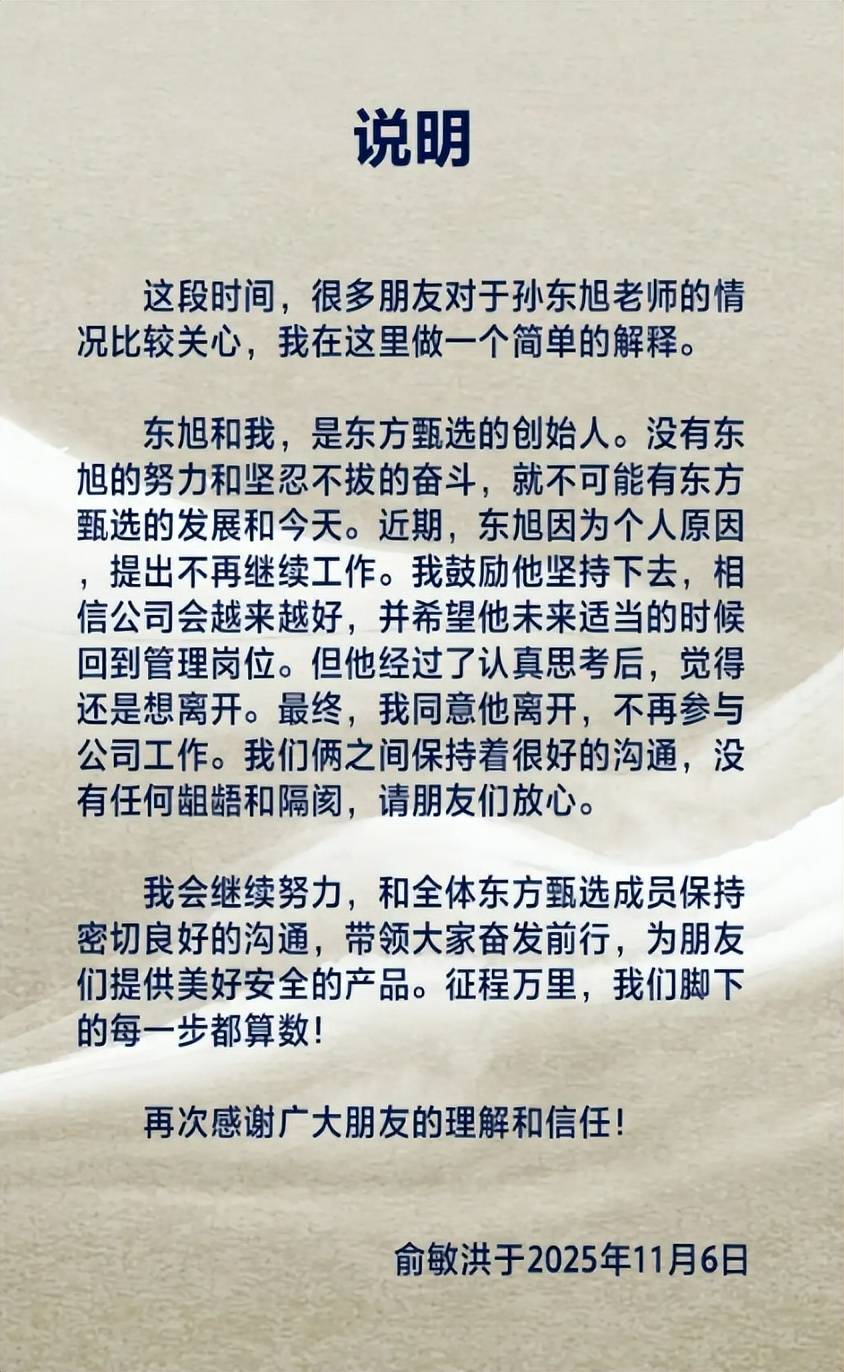
俞敏洪“南极信”风波后续:明年支持新东方、东方甄选基层优秀员工到南极
Zhong Guo Jing Ying Bao· 2025-11-20 06:51
Core Points - The core issue revolves around the controversy sparked by the founder of New Oriental, Yu Minhong, sending a letter from Antarctica to employees on the company's 32nd anniversary, which was perceived as disconnected from the employees' realities [1][3][4] Group 1: Company Background and Events - New Oriental celebrated its 32nd anniversary on November 16, with Yu Minhong reflecting on the company's journey and future plans in a letter themed "Perseverance in the Ice and Snow" [1] - The letter, intended to motivate employees, instead led to backlash as many employees felt unable to empathize with the founder's experience while they were working overtime [1][3] - Following the controversy, Yu Minhong responded in a video on November 18, stating that his trip to Antarctica was to discuss the future of natural education for Chinese children, announcing plans to establish a youth exploration center [1][3] Group 2: Employee Sentiment and Public Reaction - The letter's content, which emphasized Yu Minhong's personal experiences in Antarctica, was criticized for lacking acknowledgment of employee pressures, leading to a perception of a disconnect between management and staff [3][4] - Social media reactions highlighted the stark contrast between the founder's luxurious trip and employees working during the anniversary, coining the phrase "boss in Antarctica, employees working" [3][4] - The public interest in Yu Minhong surged, with the WeChat index for his name rising from around 150,000 on November 16 to nearly 20 million by November 18 [1] Group 3: Financial Performance and Business Strategy - New Oriental has been facing challenges in its business transformation, particularly after the departure of key personnel, which has affected the performance of its subsidiary, Oriental Selection [6][7] - Financial reports indicate that for the fiscal year 2025, Oriental Selection's revenue, profit, and gross merchandise volume (GMV) are expected to decline significantly, with net profit projected at only 6.2 million [7] - New Oriental's overall revenue for the fourth quarter of fiscal year 2025 was reported at $1.243 billion, a year-on-year increase of 9.4%, but it also faced an operating loss of $8.674 million, a significant decline compared to the previous year [7] Group 4: Future Directions and Challenges - New Oriental aims to explore the tourism sector as a third growth curve, with plans for a separate IPO for its tourism business, which has yet to show significant results in financial performance [8][9] - The company has established numerous subsidiaries under its tourism brand and invested in various travel-related ventures, indicating a strategic shift towards diversifying its business model [10] - Experts suggest that while the tourism direction is promising, the company must innovate its offerings and build a comprehensive service system to differentiate itself in the competitive market [10]
每经热评|刘强东俩月炒仨菜 他到底在炒什么
Xin Lang Cai Jing· 2025-11-18 16:13
Core Viewpoint - Liu Qiangdong's kitchen philosophy is reshaping JD's strategic logic, emphasizing emotional connections and cultural narratives through food [1][2][3] Group 1: Emotional and Cultural Connection - Liu Qiangdong promotes his hometown specialties, enhancing consumer emotional engagement with products [2][3] - The successful launch of "Shu Qian Huang Gou Zhi Tou Rou" during Double 11 indicates the effectiveness of the "emotion + commerce" model [3] Group 2: Personal Branding and Corporate Image - Liu Qiangdong's cooking livestreams are a strategic move to build a relatable personal brand, moving away from purely financial discussions [5][6] - His personal stories and humor create a warmer image, resonating with consumers and enhancing brand loyalty [6][8] Group 3: Business Strategy and Expansion - The launch of JD's independent delivery app and the focus on quality through "Qi Xian Xiao Chu" signify a strategic shift towards lifestyle services [1][8] - JD's new business revenue grew by 214% year-on-year, reflecting the company's ongoing transformation and investment in supply chain capabilities [9][10] Group 4: Integration of Technology and Daily Life - Liu Qiangdong's cooking showcases JD's supply chain strengths, linking technology with everyday experiences [9][10] - The emphasis on "human warmth" in JD's strategy illustrates the company's commitment to expanding from retail to comprehensive lifestyle services [10][11]


一个真正的企业家IP:俞敏洪,确实是一个好人啊!
Sou Hu Cai Jing· 2025-11-08 06:27
Core Viewpoint - The article discusses the character and leadership style of Yu Minhong, highlighting his unique approach to entrepreneurship and the criticisms he faces from former employees and peers [2][5][12]. Group 1: Leadership Style - Yu Minhong is portrayed as a leader who is open to criticism from employees and willing to reward constructive feedback, contrasting with the typical aggressive leadership style [6][12]. - The article suggests that Yu Minhong's success is built on a foundation of integrity and a non-exploitative relationship with partners and employees, which is rare among successful entrepreneurs [5][12]. Group 2: Comparison with Other Entrepreneurs - The article compares Yu Minhong to other entrepreneurs, noting that while he may not fit the mold of a "first-class entrepreneur," his approach is more humane and less ruthless than many of his peers [3][6]. - It mentions that Yu Minhong's character and intellectual depth set him apart from other business leaders, making him more suitable as a personal brand or "entrepreneur IP" [7][10]. Group 3: Entrepreneur IP vs. Internet Celebrities - The distinction between "entrepreneur IP" and internet celebrities is emphasized, with the former representing long-term influence and integrity, while the latter is seen as fleeting and superficial [10][11]. - Yu Minhong is characterized as a strong personal brand that withstands the test of time, unlike many who may gain temporary fame without substantial value [10][11].

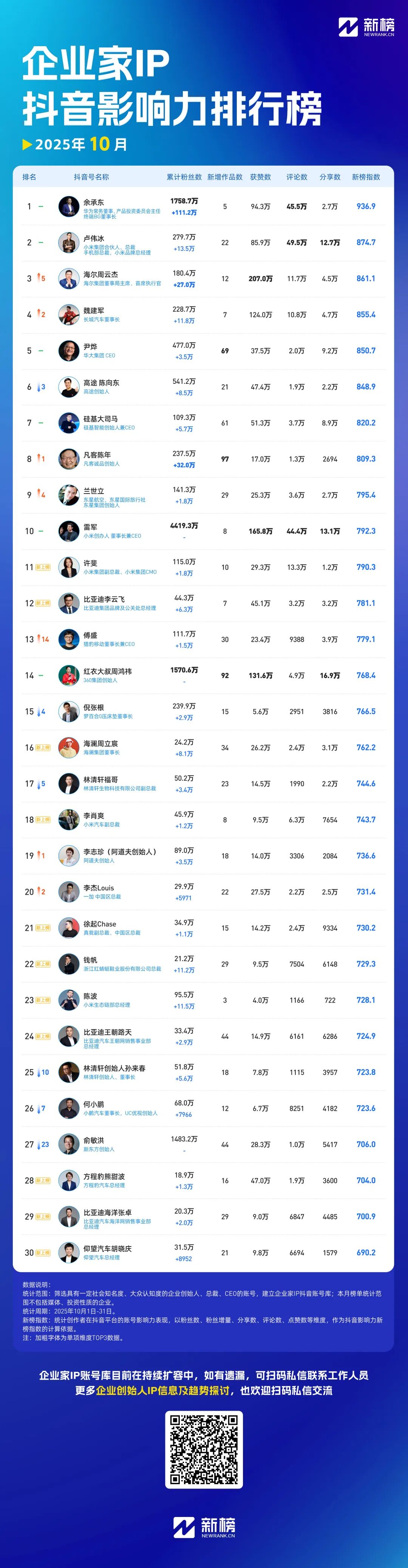
10月企业家IP榜单发布:卢伟冰为红米站台,周云杰机场自拍,谁排第一?
3 6 Ke· 2025-11-07 10:14
Core Insights - The article discusses the significance of entrepreneur IP in corporate online promotion and presents a ranking of entrepreneur influence on Douyin based on various metrics such as follower count, engagement, and content performance [1] Group 1: Entrepreneur IP Rankings - The top-ranked entrepreneur is Yu Chengdong from Huawei, with 17.587 million followers, gaining 1.112 million new followers in October, and receiving 943,000 likes on his content [2][7] - Lu Weibing from Xiaomi ranks second, with 2.797 million followers, adding 135,000 new followers and achieving 859,000 likes through 22 posts focused on the REDMI K90 series [2][9] - Zhou Yunjie from Haier ranks third, with 1.804 million followers, gaining 270,000 new followers and receiving over 2.07 million likes across 12 posts [2][11] Group 2: Content Performance and Engagement - Yu Chengdong's content primarily revolves around technology education and product promotion, with a notable video on noise-canceling headphones receiving over 250,000 likes [7] - Lu Weibing's most engaging post featured a product showcase and a lottery, which attracted over 270,000 participants [9] - Zhou Yunjie's content combines humanistic themes with technological strength, including a viral Mid-Autumn Festival video that garnered over 700,000 likes [11] Group 3: New Entrants and Trends - New entrants to the ranking include Xu Fei from Xiaomi, who gained 18,000 followers and received 293,000 likes on 10 posts [3] - The article notes a trend of entrepreneurs leveraging social media to enhance brand visibility and engage with audiences through storytelling and product promotion [18]


马斯克为啥学不会?他前妻一句话点破关键,很有启发性
Sou Hu Cai Jing· 2025-11-07 02:01
Group 1 - The article discusses the challenges faced by Chinese entrepreneurs in emulating Elon Musk's success, highlighting a lack of authenticity and confidence among them [1][3] - It emphasizes the importance of the younger generation of entrepreneurs, particularly those born in the 1990s and 2000s, who are less inclined to imitate others and more focused on innovation [1][3] - The article critiques the traditional business mindset of older entrepreneurs, who prioritize marketing and fame over genuine product and technological innovation, contrasting it with Musk's disdain for superficial marketing tactics [1][3] Group 2 - The concept of "one person determining success or failure" is criticized, advocating for a mature organization that relies on systems, teams, and culture rather than individual brilliance [5] - It points out that the American environment is more accepting of genius, allowing figures like Musk and Jobs to thrive despite their flaws, which is not the case for many Chinese entrepreneurs [5][6] - The article highlights Musk's sincerity and focus as qualities that are often overlooked by Chinese business leaders, suggesting that these traits are essential for true success [5][8] Group 3 - Musk's extreme success is attributed to his unique personality traits, including a strong focus and the ability to make sacrifices, as noted by his ex-wife [8] - The article discusses Musk's willingness to take risks, exemplified by his decision to invest in the space industry despite skepticism from peers, showcasing his commitment to visionary goals rather than mere financial gain [10] - It concludes that aspiring entrepreneurs should not aim to become Musk but rather to discover and embrace their own unique paths to success [10]

中国最火企业家,困在IP里
3 6 Ke· 2025-10-28 09:41
Group 1 - The core argument of the article revolves around the dual nature of social media platforms, which can serve as both a stage for personal branding and a battleground for reputational risks, particularly for entrepreneurs and their companies [1][4] - The controversy initiated by the incident involving Xiaomi's SU7 Ultra has led to a significant backlash against the personal brand of Xiaomi's CEO, Lei Jun, highlighting the risks associated with personal branding in the corporate world [1][5] - The article emphasizes that the value and risks of entrepreneur personal branding are intertwined, suggesting that the success of an entrepreneur's personal brand can directly impact the company's reputation and performance [1][4] Group 2 - Entrepreneur personal branding can facilitate direct communication with customers, reducing advertising costs and enhancing marketing efficiency compared to traditional methods [2] - The narrative of a brand can be humanized through storytelling, making it more relatable and emotionally engaging for consumers, which is essential in the age of social media [3] - Entrepreneurs are seen as scarce resources in market competition, and their personal branding can serve as a powerful tool for differentiation and competitive advantage [3] Group 3 - The motivations behind entrepreneurs pursuing personal branding include gaining visibility, attracting talent, and fulfilling personal desires for recognition [4] - The risks associated with entrepreneur personal branding include potential backlash from public scrutiny, discrepancies between personal image and corporate actions, and the impact of competitive actions targeting the entrepreneur's reputation [5][8] - The article discusses the psychological dynamics of social media as a battleground for consumer perception, emphasizing the importance of maintaining a consistent and positive personal brand [6][7] Group 4 - The article outlines four primary risks associated with entrepreneur personal branding: the collapse of the personal brand, the contrast effect between personal image and corporate behavior, competitive attacks on the personal brand, and the potential negative impact of overly zealous fans [9][10] - It suggests that entrepreneurs should focus on innovation and genuine contributions rather than merely performing for public approval, advocating for a more authentic approach to personal branding [11][12] - Recommendations for managing personal branding include aligning the personal brand with professional expertise, respecting basic ethical standards, and maintaining a long-term perspective rather than seeking immediate gains [12][13]
昔日超级大白马,掉队了
Ge Long Hui A P P· 2025-09-07 08:11
Group 1 - Gree Electric Appliances has shown signs of growth fatigue in recent years, with its market share in the online air conditioning segment being challenged by competitors like Xiaomi and Aux [2][3] - In the first half of 2025, Gree's revenue declined, contrasting with the overall growth in the home appliance market, which saw a retail sales increase of 9.2% year-on-year [5][36] - Gree's net profit for the second quarter dropped by 10.07% to 8.508 billion yuan, and the company announced it would not distribute cash dividends, a significant shift from its previous practices [7][57] Group 2 - The air conditioning market is becoming increasingly competitive, with Gree's pricing strategy leading to a decline in market share, now around 18% [11][12] - Xiaomi's air conditioning business has become a key growth driver, with a revenue increase of 38.2% year-on-year, while Gree's core air conditioning business has seen a negative growth of 5.09% [8][10] - Gree's reliance on a single product line (air conditioning) and its limited overseas market presence (only about 15% of revenue) are significant challenges compared to competitors like Midea and Haier [34][37] Group 3 - Gree's traditional dealer system is becoming a hindrance in the evolving market landscape, as online sales channels gain prominence [18][19] - The company's recent rebranding efforts to "Dong Mingzhu Health Home" aim to diversify its product offerings, but the effectiveness of this strategy remains uncertain [39][40] - Gree's valuation is currently low at 7 times earnings, despite stable profits and a high dividend yield, indicating a lack of investor confidence in its future [57]


魏建军做长城35周年演讲,雷军介绍车载猫包,7月企业家IP榜单发布,谁
Sou Hu Cai Jing· 2025-08-29 01:37
Group 1: Entrepreneur IP Influence - The influence of entrepreneur IP has become a significant part of corporate online promotion, with a focus on metrics such as fan count, fan growth, shares, comments, and likes [1][2][3] - New rankings for entrepreneur IP on Douyin (TikTok) were released, highlighting the top influencers based on their performance in July 2025 [1] Group 2: Key Performers - Yu Chengdong ranked first with a fan increase of nearly 1.26 million in July, accumulating 1.8 million likes across 15 posts, with notable peaks on July 23 and July 25 due to engaging content [1] - Wei Jianjun secured the second position with a fan increase of 271,000, driven by impactful content such as a speech addressing career anxiety and a promotional video for a new vehicle [2][4] - Pang Donglai's account saw a fan increase of 223,000, largely attributed to live streaming events that attracted over a million viewers [3][5] Group 3: Content Strategy and Engagement - Haier's Zhou Yunjie utilized a dual content strategy focusing on cultural insights and practical product usage tips, resulting in significant engagement and a rise in ranking [7][8] - Lei Jun's account, while experiencing slower fan growth, maintained high-quality content with over 3.66 million likes and effective product promotion strategies [10][11][13]


我们需要什么样的企业家IP?
36氪· 2025-08-11 09:48
Core Viewpoint - The article discusses the evolution of entrepreneur IP (intellectual property) in China, highlighting the shift from a focus on substantial business achievements to a more personality-driven approach in the digital age, where media plays a crucial role in shaping public perception [6][25]. Group 1: Historical Context of Entrepreneur IP - In the past, entrepreneur IP was closely tied to tangible business achievements, with figures like Yu Zhi Jian and Zhang Ruimin being remembered for their contributions to industry and quality [10][12]. - The early IP logic was "business success leads to personal recognition," where entrepreneurs were defined by their business accomplishments and resilience [14]. Group 2: The Impact of Digital Media - The advent of the internet has transformed the way entrepreneur IP is constructed, allowing for rapid dissemination of information and a more interactive relationship between entrepreneurs and the public [17]. - New media platforms enable entrepreneurs to create dynamic narratives around their personal brands, as seen with figures like Jack Ma and Lei Jun, who have effectively utilized social media to enhance their public personas [18]. Group 3: Risks and Challenges - The rapid nature of media can lead to quick elevation and equally swift downfall of entrepreneur IP, as exemplified by figures like Zhou Hongyi, whose public image has fluctuated with changing media narratives [19][24]. - There is a common misconception that personal charisma alone can sustain brand value, which can lead to a superficial approach to IP that lacks depth and authenticity [20][21]. Group 4: The Essence of Sustainable IP - True entrepreneur IP should be rooted in value creation rather than merely leveraging media for visibility; it must address real societal needs and demonstrate genuine contributions to industry [25][26]. - Entrepreneurs who focus on substantive achievements and value creation tend to avoid the pitfalls of negative public perception, as illustrated by figures like Liang Wenfeng, who prioritize technical depth over media presence [26].