伽马挤压

Search documents
沃什提名引爆金银“血洗”!盘中白银创纪录跌超35%、黄金跌超10%
Hua Er Jie Jian Wen· 2026-01-30 19:55
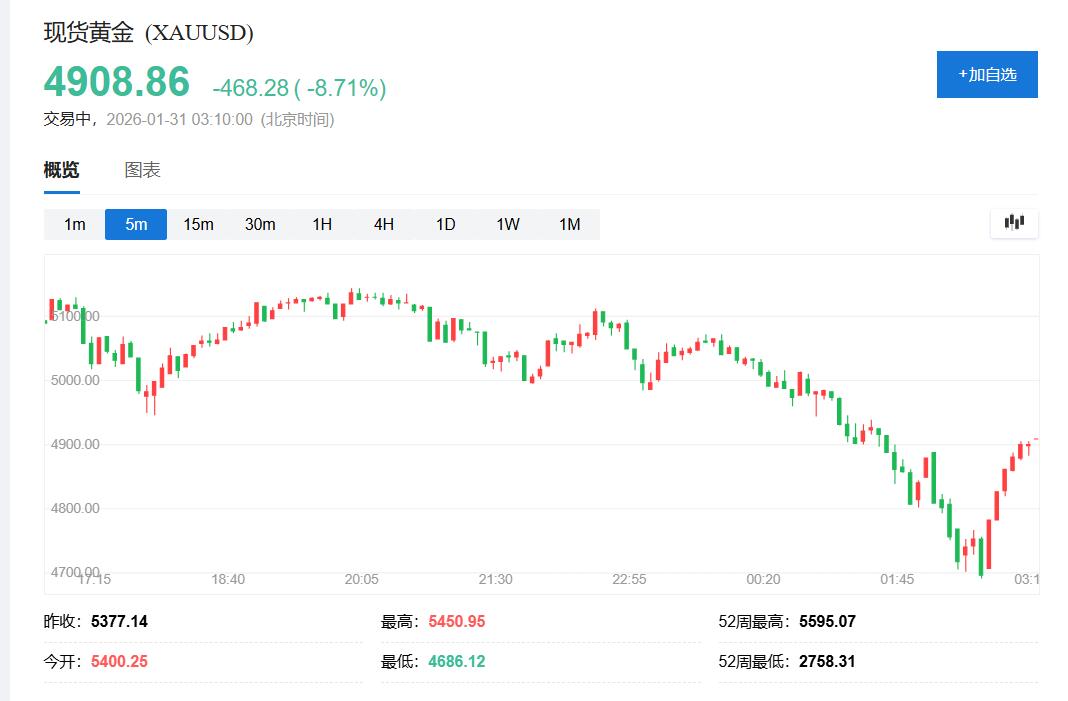
Core Viewpoint - The nomination of Kevin Warsh as the Federal Reserve Chairman by President Trump triggered a historic sell-off in precious metals, marking one of the most severe declines in decades [1][9]. Group 1: Market Reaction - Gold prices fell sharply after the announcement, with spot gold dropping nearly 13%, the largest intraday decline since the early 1980s, and falling below $5,000 per ounce [1][7]. - Silver, which had previously surged past $120, plummeted over 35%, marking its largest recorded drop [3][7]. - The sell-off affected the entire metals market, with copper also experiencing a significant decline of nearly 6% from its record high [3][7]. Group 2: Investor Sentiment - The market attributed the sell-off to a sudden shift in investor expectations regarding Federal Reserve policy, as Warsh is perceived as more hawkish compared to other candidates [6][9]. - Analysts noted that Warsh's nomination alleviated concerns about the loss of Federal Reserve independence, which had previously driven investors to seek refuge in precious metals [6][9]. Group 3: Technical Factors - The extreme volatility and high leverage in the precious metals market contributed to the sell-off, with crowded long positions and record call option purchases creating a precarious situation [11][12]. - Technical indicators had already signaled that gold and silver were overbought, suggesting a correction was due [13]. Group 4: Impact on Mining Stocks - The sharp decline in precious metals prices led to significant losses for major mining companies, with stocks like Newmont and Barrick Mining dropping over 10% [14]. - Silver ETFs faced even greater losses, with some funds experiencing declines of over 60%, marking their worst single-day performance [14]. Group 5: Future Outlook - Despite the recent downturn, some analysts believe that the correction could be healthy for the market, suggesting that buying opportunities may arise as prices stabilize [14]. - The dramatic price movements in silver and gold have raised questions about whether this marks a turning point in the precious metals market, although it is too early to draw definitive conclusions [15].

【UNFX财经事件】做市商被动回补叠加趋势资金 黄金攻势延续
Sou Hu Cai Jing· 2026-01-27 05:11
UNFX 1月27日讯 在成功突破5000美元这一关键心理门槛后,黄金市场并未出现惯常意义上的高位兑现 行为,反而展现出更为激进的资金博弈特征。周一交易日,现货黄金与COMEX黄金期货价格同步企稳 于5000美元上方,盘中最高触及5100美元附近,持续刷新历史高点区间。值得关注的是,价格持续抬升 的同时,衍生品市场的风险偏好并未明显降温。期权端数据显示,主导资金正提前围绕更高价格区间展 开布局。大量行权价集中在5500—6000美元区间的远期看涨期权持续获得买盘支持,显示交易员并未选 择在高位离场,而是通过组合化策略延续并放大多头敞口,为后续行情预留空间。 支撑本轮金价持续走强的核心逻辑,已逐步脱离单一的通胀或利率框架。当前,市场对黄金的定价正在 转向对全球主权信用、财政可持续性以及货币体系稳定性的系统性评估。近期,美国在关税政策、盟友 关系以及地缘事务上的不确定性上升,持续削弱市场对美元资产长期稳定性的信心。美元指数自年初以 来维持承压态势,为非美元投资者配置黄金创造了更有利的外部环境。同时,围绕去美元化的讨论升 温,也进一步强化了黄金作为中性储备资产的战略属性。在这一背景下,黄金逐渐被视为对冲主权债务 扩 ...
【UNforex财经事件】突破5000美元后期权资金加速进场 黄金迈入新一轮定价阶段
Sou Hu Cai Jing· 2026-01-27 05:11
期权端的激进行为并非孤立现象,现货及类现货资金的流向同样释放出一致信号。全球最大黄金ETF ——SPDR黄金份额(GLD)近期出现明显的资金净流入。数据显示,1月美国上市黄金ETF合计吸引约 47亿美元资金,其中超过一半配置至GLD。 在ETF期权市场中,机构投资者更倾向于通过成本可控、风险边界清晰的结构延续多头仓位。9月到期 的590/595美元价差以及3月到期的510/515美元价差成交活跃。相关测算显示,在价格进一步抬升的情 景下,此类策略具备较为突出的杠杆特性。道富投资管理方面指出,该阶段的资金行为既包含资产管理 机构的战略性配置需求,也反映出做市商在关键价格区间附近主动调整风险敞口的结果。 支撑本轮金价持续走强的核心驱动,已逐渐超越传统的通胀与利率周期框架。市场对黄金的定价重心, 正在转向对全球主权信用、财政可持续性以及货币体系稳定性的再评估。 近期,美国在关税政策、盟友关系及地缘事务上的不确定性上升,加剧了市场对美元资产长期稳定性的 担忧。美元指数自年初以来持续承压,为非美元投资者配置黄金提供了相对有利的窗口。同时,去美元 化相关讨论升温,也进一步强化了黄金作为中性储备资产的战略属性。在这一背景下 ...
黄金期权市场掀起逼空豪赌
Jin Tou Wang· 2026-01-27 04:01
今日周二(1月27日)亚盘时段,黄金首破5000美元大关后,期权交易员正加码押注涨势延续。周一金价 盘中飙升至5100美元上方,受益于"货币贬值交易"重启——投资者抛售主权债券与货币,转向黄金、白 银等硬资产避险。随着特朗普持续冲击二战后国际秩序,市场预计投资者将加速分散配置,进一步削减 美国资产敞口,推动贵金属涨势延续。 随着金价逼近关键行权点位,期权做市商面临巨大的"伽马挤压"风险。为对冲风险,做市商被迫持续买 入期货合约,这种被动的买盘可能进一步推升金价,形成逼空循环。与此同时,投资者也在疯狂买入 GLD的看涨价差,例如锁定9月590/595美元及3月510/515美元的价差,以低成本博取数倍收益。分析师 测算,若GLD再涨10%,部分杠杆策略的回报可高达本金的4.2倍。 打开APP,查看更多高清行情>> 【最新黄金期货行情解析】 【要闻速递】 技术面来看,2月黄金期货自10月28日低点3886.46美元稳步上涨,并自12月31日低点4274.02美元加速上 行,而从1月16日低点4536.49美元以来更是呈现抛物线式走势。这是强势和强劲买盘的信号,但一旦买 家开始获利了结,市场也容易出现大幅回调。其他 ...
黄金破5000美元后,交易员还在疯狂买入看涨期权?
Jin Shi Shu Ju· 2026-01-27 01:36
黄金价格首次飙升至5000美元上方,引发市场强烈反应。期权交易员正通过一系列复杂策略押注贵金属将继续走 强。分析指出,市场波动率骤升与做市商对冲行为可能形成"伽马挤压",进一步推高金价。 黄金波动性飙升 期权市场涌现大量看涨价差策略交易。其中,4月到期的Comex黄金期货5500美元/5600美元看涨价差合约成交近 5000手;而4月到期、采用1x3x2比例结构的5500美元/6000美元/6500美元看涨期权组合也成交了1000次。 随着金价逼近关键行权价水平,交易员正将持仓向上滚动。在市场持续上涨过程中,卖出看涨期权的做市商可能 需要买入更多期货合约以平衡风险敞口,这可能引发由"伽马效应"驱动的逼空行情,从而进一步推高价格。 黄金价格首次突破每盎司5000美元大关后,期权交易员正押注这轮贵金属涨势还将延续。 在一轮广泛的大宗商品涨势中,黄金价格周一盘中飙升至5100美元上方。这部分得益于所谓的"货币贬值交易"重 启——投资者正规避主权债券与货币,转而投向黄金、白银等硬资产。随着特朗普持续挑战二战后的规则主导秩 序,预计投资者将继续分散配置、减少对美国资产的敞口。 黄金、白银ETF看涨偏斜度加剧 纽约商品交 ...
“伽马挤压”引爆金市:突破5000美元后,交易员疯狂买入5500-6000看涨期权
智通财经网· 2026-01-27 01:11
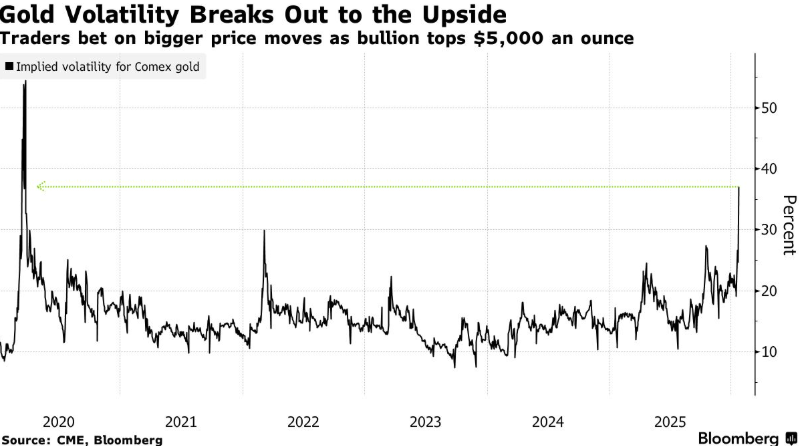
Core Viewpoint - The global commodity market reached a milestone on January 26, 2026, as both spot gold and COMEX gold futures prices surpassed the psychological threshold of $5,000 per ounce, marking the highest record in financial history. This breakout has led to aggressive buying in the options market, indicating strong consensus among market players for a "bull market second half" in gold [1]. Group 1: Market Dynamics - On the day of the price surge, gold prices increased by 2.5%, surpassing the $5,100 mark, which also boosted the entire metal sector. This rally is partly attributed to the resumption of "fiat currency devaluation trades," as investors shift from sovereign bonds and currencies to hard assets like gold and silver for safety [1]. - The breakthrough of the $5,000 level triggered a rare "gamma squeeze" effect in the options market, forcing many volatility sellers to cover their positions in both spot and futures markets, further driving up gold prices [4]. - The implied volatility of gold futures on the New York Mercantile Exchange has reached its highest level since the onset of the global pandemic in March 2020, with significant activity in call spreads indicating bullish sentiment among traders [4]. Group 2: Investment Strategies - Investors are actively buying call spreads on SPDR Gold Shares, including approximately 70,000 contracts for the September 590/595 spread and 37,000 contracts for the March 510/515 spread, indicating a low-cost strategy to position for further price increases in the coming months [5]. - According to analysts, if the ETF price rises by 10.1%, the potential return on the March position could reach 420% [5]. Group 3: Institutional Inflows - In January, the U.S. listed gold ETF sector saw a total inflow of $4.7 billion, with over half directed towards SPDR Gold Shares, reflecting strong institutional inflows and proactive long positions by market makers in anticipation of the $5,000 breakthrough [6]. - The ongoing geopolitical risks and expectations of dollar depreciation are driving demand for gold, as institutional investors increase their allocation to gold in their asset portfolios to historical highs [9]. Group 4: Future Outlook - Major Wall Street banks have quickly raised their price targets for gold in 2026, with Goldman Sachs indicating that the $5,000 breakthrough signifies a "sovereign value revaluation" phase, raising its year-end target to $5,400. Bank of America is even more optimistic, predicting that gold could reach $6,000 if geopolitical tensions do not ease [9]. - Despite the bullish sentiment, analysts caution that entering the "vacuum zone" above $5,000 may lead to increased volatility, necessitating vigilance against potential high-level fluctuations driven by momentum trading [9].
黄金与风险资产同步波动,Wmax解读多重变量下市场避险逻辑生变
Sou Hu Cai Jing· 2025-11-17 08:23
Core Viewpoint - Recent global financial markets have shown an unusual pattern where gold, traditionally viewed as a safe-haven asset, has declined alongside risk assets like U.S. stocks and Bitcoin, indicating a potential restructuring of investor behavior towards traditional safe-haven logic [2] Group 1: Asset Correlation and Market Dynamics - Last Friday, international spot gold fell over 3%, nearing $4030 per ounce, while the S&P 500 index dropped 1.3%, and Bitcoin fell below $95,000, breaking the traditional pattern where gold would attract safe-haven funds during risk asset declines [3] - The Wmax analysis team identified short-term liquidity demand as the primary driver of this unusual correlation, as investors liquidate gold positions to raise cash amid stock market sell-offs [3][5] - The rolling correlation between the most active gold futures and the S&P 500 index was 0.22, indicating a slight positive correlation, with an overall mild positive correlation maintained from October to November [5] Group 2: Federal Reserve Policy and Economic Uncertainty - Hawkish comments from the Federal Reserve have significantly altered market expectations for interest rate cuts, which has been a key factor suppressing gold prices [6] - The probability of a 25 basis point rate cut in December has dropped to 49%, down from 64% earlier in the week, reflecting a shift in market sentiment [6][8] - The recent U.S. government shutdown has disrupted the release of key economic data, further increasing uncertainty around policy expectations, which is critical for gold as a non-yielding asset [8] Group 3: Market Liquidity and Technical Factors - Recent fluctuations in gold prices have been influenced by liquidity conditions and technical factors, including a "gamma squeeze" where traders are forced to buy gold futures to hedge risks [9] - Weak physical demand for gold in major Asian markets has also contributed to limiting upward momentum, with Indian market discounts reaching their highest level in five months [9] Group 4: Long-term Outlook and Investment Strategy - Despite short-term volatility, the long-term outlook for gold remains positive, with historical data showing that gold tends to recover faster than equities after downturns [12] - Gold has risen nearly 60% year-to-date, potentially marking its best annual performance since 1979, underscoring its long-term investment value [12] - Wmax advises investors to focus on asset diversification and to monitor signals from the Federal Reserve, economic data recovery, and changes in global market risk appetite [12]

“黑色星期五”!美联储鹰爪重创全球股市,黄金狂泻逾100美元
Jin Shi Shu Ju· 2025-11-14 13:34
Core Viewpoint - Gold prices are experiencing volatility due to hawkish comments from Federal Reserve officials, impacting the outlook for a rate cut in December, yet economic uncertainty continues to support gold prices for a weekly gain [1][3]. Group 1: Gold Market Dynamics - Spot gold reached a peak of $4,211.06 per ounce before falling below $4,070, with a daily decline exceeding $100 and a drop of over 2% [1]. - The market is facing skepticism regarding the Fed's potential rate cuts, limiting upward movement in gold prices, as highlighted by ActivTrades analyst Ricardo Evangelista [3]. - The recent U.S. government shutdown disrupted the release of key economic data, contributing to the cautious sentiment in the market [3]. Group 2: Broader Market Impact - Global stock markets experienced significant declines, with the European Stoxx 600 index dropping 1.5%, and major indices in Germany, France, and the UK also falling [3]. - Increased volatility in the forex market was noted, with investors flocking to safe-haven currencies amid stock sell-offs [4]. Group 3: Cryptocurrency and Inflation Concerns - The cryptocurrency market also faced sharp declines, with Bitcoin dropping 5% and Ethereum falling below $3,100 [5]. - Despite two rate cuts by the Fed this year, concerns about inflation and a stable labor market have weakened expectations for further cuts, with the probability of a 25 basis point cut in December now at 49% [5]. Group 4: Physical Demand and Technical Factors - Physical demand for gold in major Asian markets has weakened, with high prices suppressing purchasing activity, particularly in India where gold discounts reached a five-month high [5]. - The recent rise in gold prices may have been amplified by a "gamma squeeze," a technical phenomenon where sellers of low-priced options are forced to buy gold futures for hedging [5][6]. - Daniel Ghali from TD Securities noted that the recent rebound in gold aligns with this dynamic, as reduced trading volumes make the market more susceptible to shocks [6].

高盛罗列出了25只股,是散户们成为支撑美股的重要力量!
美股研究社· 2025-08-20 12:28
Core Viewpoint - The article highlights the shift in the U.S. stock market dynamics, where retail investors are increasingly becoming a significant force, supporting the market with their buying behavior, particularly during downturns [5][10]. Group 1: Retail Investor Influence - Retail investors have emerged as a crucial support for the S&P 500 and Nasdaq indices, as indicated by a recent Goldman Sachs report [5]. - The buying activity of retail investors has expanded from niche stocks in sectors like cryptocurrency and AI to well-known companies such as Palantir, AMD, and TransDigm [8]. - Retail trading volume accounted for over 28% of the total trading volume in the S&P 500 over the past year, altering market structure and redefining trading rules [10]. Group 2: Sector Preferences - Retail investors show a clear preference for non-essential consumer goods and technology stocks, while sectors like real estate and utilities are less favored [13]. - The Technology Select Sector SPDR Fund (XLK) has seen nearly one-fifth of its trading volume coming from retail investors, significantly surpassing historical levels [13]. Group 3: Market Sentiment and Speculation - Goldman Sachs' Speculative Trading Indicator has reached a reading of 114, indicating a strong trend in speculative sentiment driven by retail investors [14]. - The current market environment is characterized by a resonance between retail and institutional investors, suggesting potential opportunities for retail investors in high-volume, high-market-cap stocks [16]. Group 4: Future Outlook - The macroeconomic environment suggests that if the Federal Reserve initiates interest rate cuts in the second half of the year, the resonance between retail and institutional investors could further amplify stock market gains [17]. - However, the rising speculative index also indicates increased market volatility, which could pose risks for retail investors engaging in short-term trading [17].

高盛:散户资金涌入大盘科技股,25只热门股或迎“伽马挤压”行情
Huan Qiu Wang· 2025-08-17 02:55
Core Viewpoint - Goldman Sachs reports that retail investors in the U.S. are shifting their trading activities from niche stocks in cryptocurrency, AI, retail, and quantum computing to more influential large-cap stocks like Palantir, AMD, and TransDigm [1][3] Group 1: Retail Investor Activity - Retail trading volume accounted for over 28% of the total trading volume in the S&P 500 index over the past year, highlighting the significant influence of retail investors in the market [3] - The speculative trading sentiment among retail investors is increasing, as indicated by Goldman Sachs' Speculative Trading Indicator rising to 114 [3] Group 2: Focus Stocks - The 25 S&P 500 stocks with the highest net buying volume from retail investors in the past month are expected to become market focal points, with Palantir, AMD, and TransDigm being specifically mentioned [3] - The report suggests that investors should pay attention to call options on these stocks, as concentrated buying by retail investors may trigger a Gamma Squeeze, leading to further price increases [3] Group 3: Market Trends - Retail investors show a clear preference for technology and consumer discretionary stocks, while real estate and utilities sectors are being neglected [4] - Approximately 20% of the trading volume in the Technology Select Sector SPDR Fund (XLK) comes from retail investors, significantly above historical levels [4] Group 4: Professional Investor Behavior - Professional investors are increasing their positions driven by fear of missing out (FOMO), utilizing futures, swaps, and options [3] - Expectations of a potential interest rate cut by the Federal Reserve in September and a moderate rise in financing spreads are seen as additional catalysts for further gains in U.S. equities [3]