低波动

Search documents
银行板块单边上扬,关注红利低波动ETF(563020)、红利价值ETF(563700)等产品配置价值
Mei Ri Jing Ji Xin Wen· 2025-11-20 05:52
Core Insights - The Hang Seng High Dividend Low Volatility ETF tracks the Hang Seng Stock Connect High Dividend Low Volatility Index, which consists of 50 stocks with good liquidity, continuous dividends, and moderate dividend payout ratios [3] - The index reflects the overall performance of Hong Kong Stock Connect listed companies with high dividend levels and low volatility, with over 65% of its composition from the financial, industrial, and energy sectors [3] Summary by Category Index Composition - The index is composed of 50 high dividend yield stocks with prominent value characteristics, reflecting the overall performance of stocks with high dividend levels [5] - The banking, coal, and transportation sectors collectively account for over 75% of the index [5] Performance Metrics - As of the latest trading session, the index experienced a change of 0.2% with a rolling price-to-earnings ratio of 7.8 times, indicating a valuation percentile of 89.8% and a dividend yield of 5.8% since its inception in 2017 [3] - The index also showed a change of 0.9% with a rolling price-to-earnings ratio of 8.1 times, reflecting a valuation percentile of 76.6% and a dividend yield of 4.0% since its inception in 2014 [5]


每日钉一下(什么是红利指数呢?)
银行螺丝钉· 2025-11-05 14:03
Group 1 - Funds are suitable investment products for ordinary people [2] - New investors should consider what type of funds are appropriate for them [2] - There is a free course available to help new investors understand fund investment from scratch [2] Group 2 - Dividend indices are a common type of strategy index [5] - Strategy indices are based on specific investment strategies and cover a wide range of industries [6] - There are four main types of indices: broad-based indices, strategy indices, industry indices, and thematic indices [6] Group 3 - The core strategy of dividend indices is to select stocks with high dividend yields [8] - Dividend yield is calculated by dividing the total cash dividends by the company's market capitalization [8] - For example, a company with a market cap of 10 billion and annual dividends of 500 million has a dividend yield of 5% [8]

港股红利板块震荡上行,恒生红利低波ETF(159545)全天获近8000万份净申购
Mei Ri Jing Ji Xin Wen· 2025-10-30 12:23
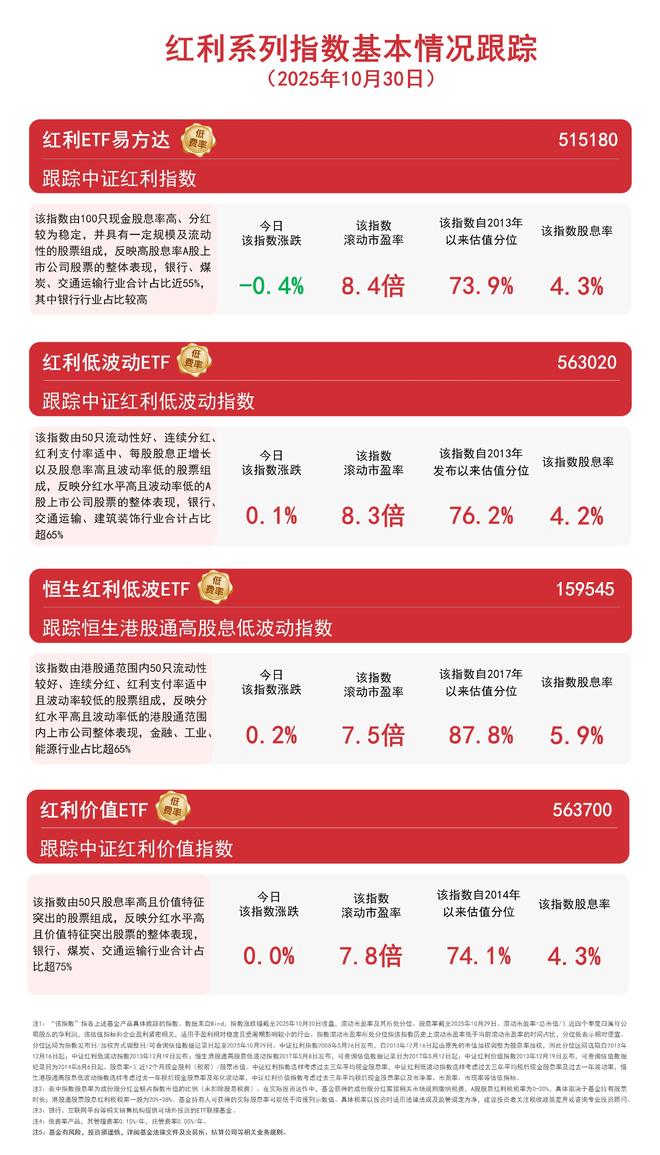
Core Viewpoint - The performance of various dividend-focused indices and ETFs in the Chinese and Hong Kong markets shows a mixed trend, with some indices experiencing slight increases while others have declined, indicating varying investor sentiment and market conditions. Group 1: Index Performance - The Hang Seng High Dividend Low Volatility Index increased by 0.2% [1] - The CSI Dividend Low Volatility Index rose by 0.1% [1] - The CSI Dividend Value Index saw a slight increase of 0.04% [1] - The CSI Dividend Index decreased by 0.4% [1] Group 2: ETF Subscription Activity - The Hang Seng Dividend Low Volatility ETF (159545) recorded a net subscription of nearly 80 million units throughout the day [1] Group 3: Index Composition and Characteristics - The CSI Dividend Index consists of 100 stocks with high cash dividend yields and stable dividends, with significant representation from the banking, coal, and transportation sectors, accounting for nearly 55% [3] - The CSI Dividend Low Volatility Index is composed of 50 stocks with good liquidity and continuous dividends, with over 65% representation from the banking, transportation, and construction sectors [3] - The Hang Seng Dividend Low Volatility ETF tracks an index made up of 50 stocks within the Hong Kong Stock Connect that have high dividend levels and low volatility, with over 65% representation from the financial, industrial, and energy sectors [3] - The CSI Dividend Value Index includes 50 stocks with high dividend yields and value characteristics, with over 75% representation from the banking, coal, and transportation sectors [3]
红利资产“避风港”效应升温
Jing Ji Guan Cha Wang· 2025-10-24 10:01
Core Insights - The A-share market has experienced increased volatility since October, with previously strong technology sectors showing significant fluctuations, while defensive dividend sectors have started to strengthen [2][3] - Agricultural Bank's stock price has risen continuously for several trading days, achieving a cumulative increase of over 20%, significantly outperforming the broader market [2] - Investors are shifting towards low-volatility, high-dividend funds, with many funds in this category achieving positive returns, contrasting with the decline in technology-themed funds [3][4] Market Trends - Technology sectors such as batteries, semiconductors, and electronic chemicals have seen declines, impacting technology-themed funds, with over a hundred funds dropping more than 7% since October [3] - In contrast, most dividend funds have reported positive returns, with several funds exceeding 5% returns as of October 23 [3][4] - There has been a notable shift in market sentiment towards dividend funds, with recent inflows reversing previous outflows, indicating a growing preference for these assets [4] Investment Strategies - A balanced investment approach is being adopted, with a significant portion allocated to large-cap dividend funds, while also considering smaller-cap growth funds and Hong Kong dividend funds for diversification [5][6] - The appeal of Hong Kong dividend funds is increasing due to their higher dividend yields compared to A-share counterparts, with some indices showing yields above 6% [5] - Investors are advised to consider A-share dividend funds as core assets for stability, while using Hong Kong dividend funds as satellite assets to enhance overall portfolio returns [6] ETF Market Dynamics - In Hong Kong, dividend strategy ETFs have gained popularity among institutional investors, with significant inflows observed [7][8] - The rise in these ETFs is attributed to their ability to provide risk diversification and stable income, especially in a volatile market environment [8] - Investors are encouraged to focus on key features of dividend ETFs, such as dividend frequency, underlying asset quality, and operational convenience, to align with their investment goals [9]

红利风向标 | A股市场探底回升,红利风格或占优
Xin Lang Ji Jin· 2025-10-24 01:15
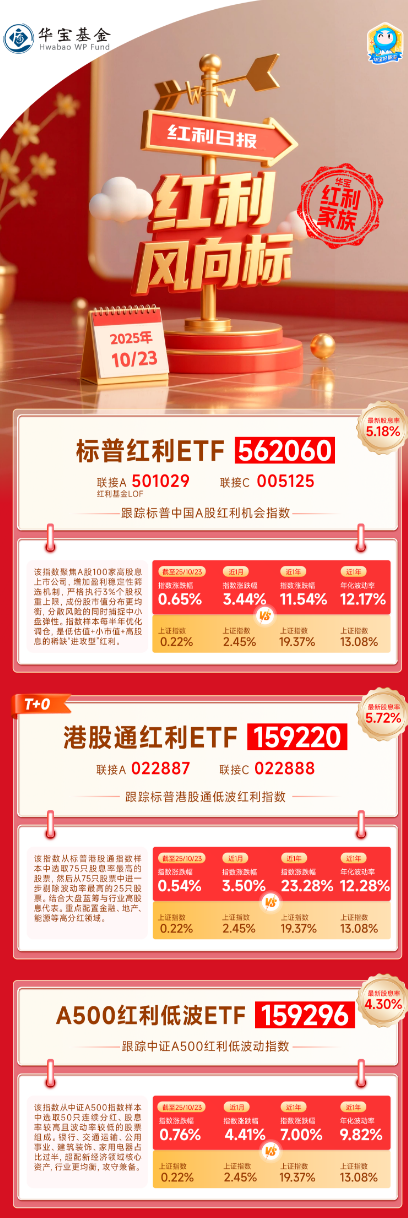
Core Insights - The article discusses various dividend-focused ETFs and indices, highlighting their performance and investment strategies [1][2]. Group 1: Dividend ETFs - The S&P Dividend ETF has a recent yield of 5.18% and tracks the S&P China A-Shares Dividend Opportunity Index, which focuses on 100 high-dividend A-shares [1]. - The S&P Hong Kong Stock Connect Low Volatility Dividend Index selects 75 stocks with the highest dividend yields, emphasizing sectors like finance and real estate [1]. - The A500 Dividend Low Volatility ETF tracks the CSI A500 Dividend Low Volatility Index, aiming to provide stable returns through low volatility stocks [1]. Group 2: Performance Metrics - The S&P Dividend ETF has shown a 1-year return of 11.54% and an annualized volatility of 12.17% [1]. - The S&P Hong Kong Stock Connect Low Volatility Dividend Index has a 1-year return of 23.28% with an annualized volatility of 12.28% [1]. - The A500 Dividend Low Volatility ETF has a 1-year return of 4.30% [1].
市场缩量调整,红利指数一枝独秀
Mei Ri Jing Ji Xin Wen· 2025-10-22 04:22
Core Viewpoint - The A-share market is experiencing a broad decline in core indices, with only a few dividend indices showing positive performance, indicating a shift in market sentiment towards low-volatility, high-dividend assets [1] Market Performance - The overall market has seen reduced trading volume, continuing the trend of last week's volume contraction, which was characterized by widespread declines in major indices [1] - Last week, the banking and coal indices ranked among the top eight in terms of returns, contrasting sharply with previously leading sectors such as copper, nickel, and lithium battery materials, reflecting a market style shift from high-growth to stable income [1] Investment Trends - During periods of market volume contraction, there is a tendency for funds to migrate towards low-volatility and high-dividend assets, which has led to the outperformance of dividend indices [1] - The dividend low-volatility ETF (159547) tracks the CSI Dividend Low Volatility Index and has the lowest fee rate among all ETFs in the market, making it suitable for long-term core allocation [1]
红利板块集体上涨,关注红利ETF易方达(515180)、恒生红利低波ETF(159545)等投资价值
Sou Hu Cai Jing· 2025-08-21 05:44
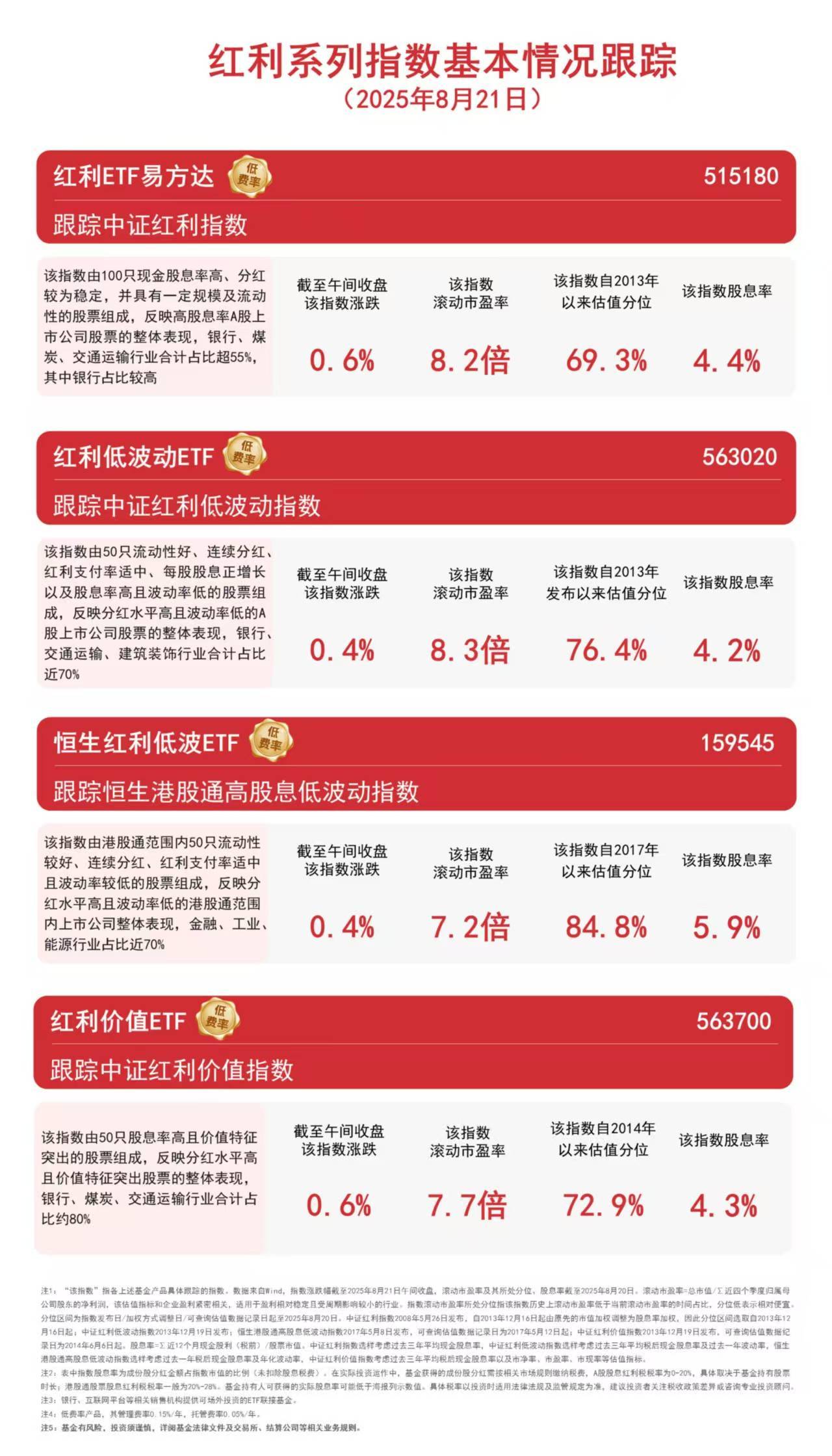
Group 1 - The article discusses various dividend-focused ETFs, including the E Fund Dividend ETF, which tracks the CSI Dividend Index composed of 100 high cash dividend yield stocks, primarily from the banking, coal, and transportation sectors, accounting for over 55% of the index [2] - The E Fund Low Volatility Dividend ETF tracks the CSI Low Volatility Dividend Index, consisting of 50 stocks with good liquidity and stable dividend payments, with a significant representation from the banking, transportation, and construction sectors, making up about 70% of the index [2] - The Hang Seng Low Volatility Dividend ETF tracks the Hang Seng High Dividend Low Volatility Index, which includes 50 stocks from the Hong Kong Stock Connect with low volatility and stable dividends, with nearly 70% of the index from the financial, industrial, and energy sectors [2] Group 2 - The CSI Dividend Value Index, tracked by the Dividend Value ETF, consists of 50 high dividend yield stocks with notable value characteristics, with banking, coal, and transportation industries representing approximately 80% of the index [3] - As of the latest data, the rolling price-to-earnings (P/E) ratio for the CSI Dividend Index is 8.21, with a valuation percentile of 69.3% since its inception in December 2013 [2] - The rolling P/E ratio for the CSI Low Volatility Dividend Index is 8.3, with a valuation percentile of 76.4% since its launch in December 2015 [2]
首批A500红利低波ETF(159296)今起开售!
Sou Hu Cai Jing· 2025-08-18 07:55
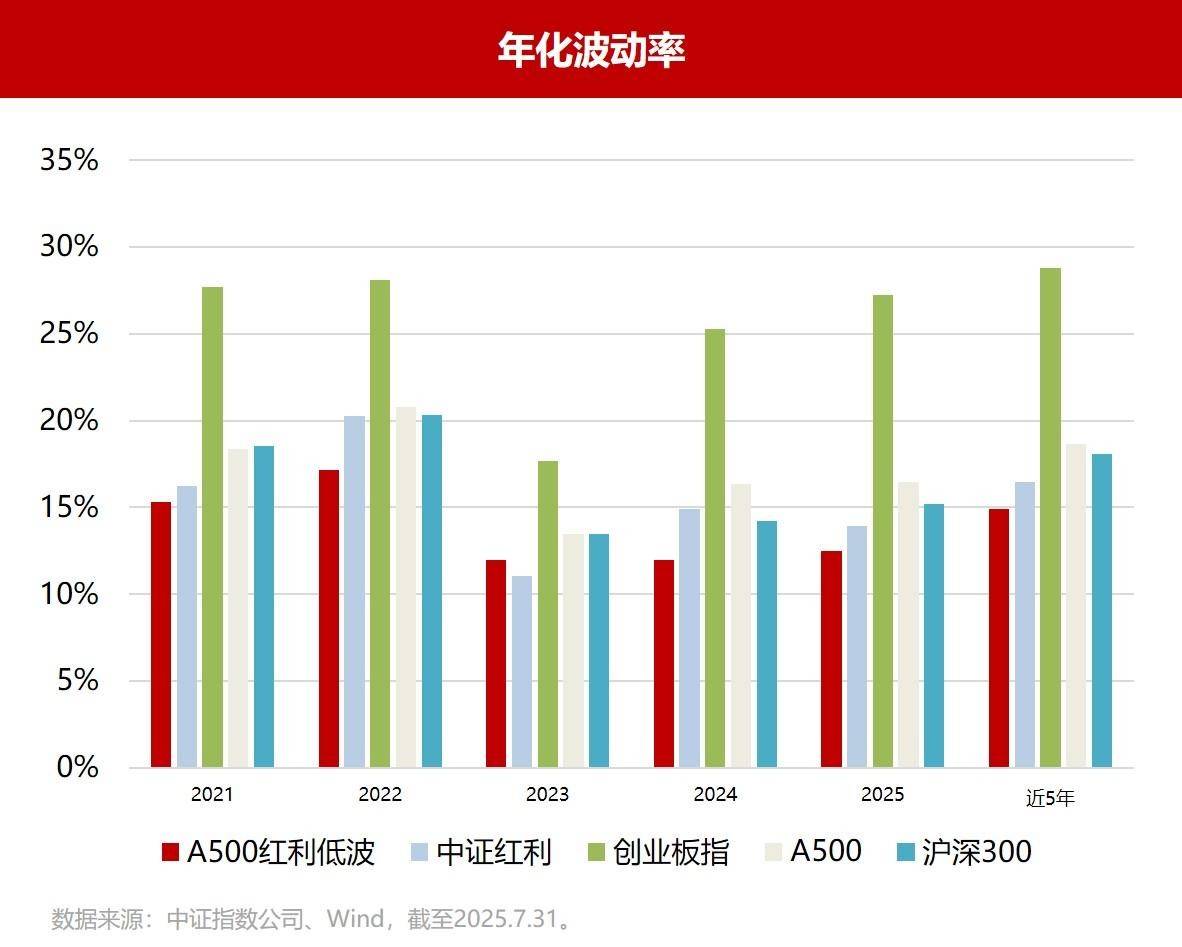
Core Viewpoint - The launch of the Huabao CSI A500 Dividend Low Volatility ETF (A500 Dividend Low Vol ETF) marks a significant development in the A-share market, which is experiencing a strong recovery, with the CSI A500 index being referred to as the "hottest index" for 2024 [1][3][4]. Group 1: Product Overview - The A500 Dividend Low Vol ETF is the first ETF in the market to track the CSI A500 Dividend Low Volatility Index, which selects 50 securities from the CSI A500 index based on high dividend yield and low volatility [1][5][4]. - The index aims to enhance risk-return levels by combining high dividend and low volatility factors, potentially achieving a "1+1>2" Smart Beta effect [4][6]. Group 2: Performance Metrics - The CSI A500 Dividend Low Volatility Index boasts a trailing twelve months (TTM) dividend yield of 4.17% and a TTM payout ratio of 30.97%, outperforming similar indices [6]. - Since its base date of December 31, 2013, the index has seen a cumulative increase of 393.12% with an annualized return of 15.21%, significantly exceeding the performance of the CSI Dividend Index and the CSI A500 Index [11]. Group 3: Market Position and Strategy - The A500 Dividend Low Vol ETF is a strategic addition to Huabao Fund's product line, which has recently surpassed 100 billion yuan in total assets under management for equity ETFs, solidifying its position in the market [14]. - The ETF includes a quarterly dividend assessment mechanism, enhancing investor engagement and aligning with the current bullish sentiment in the A-share market [14].
红利ETF还值得买吗?盘一盘几个有代表性的红利ETF
2 1 Shi Ji Jing Ji Bao Dao· 2025-07-23 08:02
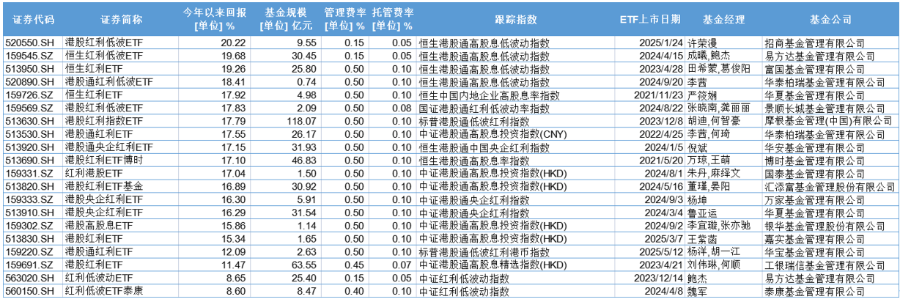
Core Viewpoint - Dividend strategies have gained market attention since last year, characterized by their defensive attributes and high dividend yields, making them attractive to investors. However, with the rise of technology and pharmaceutical sectors in 2025, growth stocks have overshadowed dividend assets, despite institutional investments still favoring dividend-related sectors, particularly in Hong Kong stocks [1]. Group 1: Market Performance and Trends - As of July 18, 2025, the total scale of listed dividend-themed ETFs has exceeded 150 billion, with 58 out of 61 ETFs achieving positive returns this year [1]. - The Hang Seng Hong Kong Stock Connect High Dividend Low Volatility Index has shown a year-to-date increase of 17.52%, benefiting the ETFs that track it [3]. - The largest ETF by scale, the E Fund Hang Seng Dividend Low Volatility ETF, has surpassed 30 billion in assets, demonstrating significant growth since its inception in April 2024 [3]. Group 2: ETF Characteristics and Performance - The top-performing ETFs are primarily those tracking the Hang Seng Hong Kong Stock Connect High Dividend Low Volatility Index, which selects stocks based on high dividend yields and low volatility [3][4]. - The China Securities Dividend Low Volatility Index, tracked by the largest dividend ETF, has maintained a consistent performance with a year-to-date return of 8.21% [9]. - The Morgan Hong Kong Dividend Index ETF, the first cross-border strategy ETF to exceed 10 billion in scale, has a year-to-date return of 17.79% [11]. Group 3: Sector Allocation and Composition - The financial sector accounts for over 30% of the index composition, followed by energy, real estate, and industrial sectors, each exceeding 10% [4]. - The index maintains a diversified approach, with no single stock exceeding 5% weight, ensuring a balanced exposure to various companies [4]. Group 4: Future Outlook and Valuation - Despite concerns over high relative valuations, the absolute valuations of major dividend low volatility indices remain around 7 times, indicating potential for long-term investment [14]. - The current market dynamics suggest a valuation recovery rather than a bubble, with stable dividend assets expected to retain their allocation value in the long term [14].

[6月23日]指数估值数据(啥时候站上3400点;月薪宝发薪日;黄金星级更新)
银行螺丝钉· 2025-06-23 13:58
Core Viewpoint - The article discusses the performance of the A-share market, particularly the challenges of the Shanghai Composite Index reaching 3400 points, and emphasizes the importance of looking beyond this index to understand the overall market dynamics and investment opportunities. Market Performance - The A-share and Hong Kong markets showed resilience despite regional conflicts, with the Shanghai Composite Index and the CSI 300 experiencing slight increases [2][3][4]. - The article notes that the Shanghai Composite Index has fluctuated around key levels, with historical references to its struggles to surpass 2000 and 3000 points in the past [5][8]. Index Significance - The Shanghai Composite Index began around 100 points in 1990, and its value is driven by earnings growth over time [9]. - The article highlights that the Shanghai Composite Index is not representative of the overall A-share market performance, as it does not capture the full spectrum of returns available to investors [10][12]. Investment Strategies - The article mentions that the CSI 300 and other indices like the CSI 500 are more reflective of the broader market, with the CSI 300 index fund exceeding 1 trillion yuan in scale [14][15]. - It discusses the performance of various strategy indices, such as dividend and value strategies, which have outperformed the Shanghai Composite Index [18]. Future Outlook - The article suggests that discussions may soon shift to when the Shanghai Composite Index will reach 4000 or 5000 points, indicating a long-term bullish outlook [9]. - It emphasizes the need for investors to consider a wider range of indices and strategies to fully capture the investment potential in the A-share market [18].