医药

Search documents
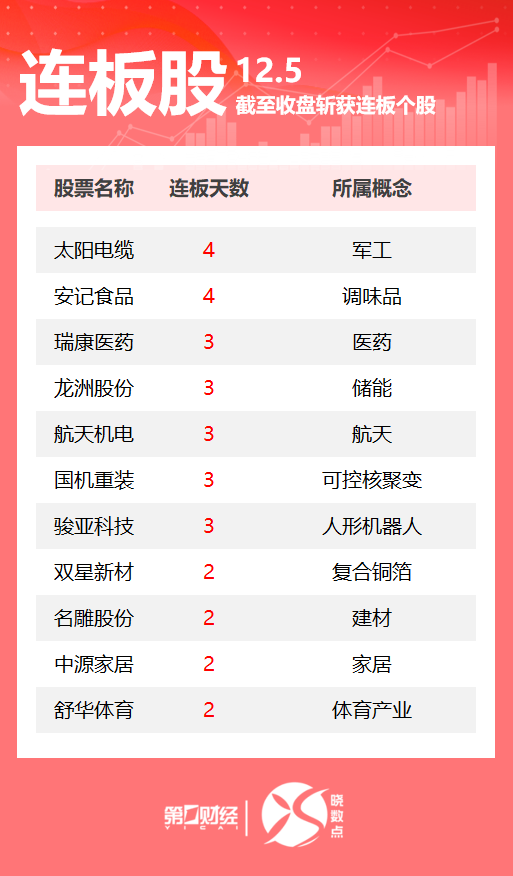
连板股追踪丨A股今日共80只个股涨停 这只可控核聚变概念股3连板
Di Yi Cai Jing· 2025-12-05 08:18
Core Viewpoint - The A-share market experienced significant activity with 80 stocks hitting the daily limit up, highlighting strong investor interest in specific sectors such as military and nuclear fusion concepts [1] Group 1: Military Sector - Solar Cable has achieved a four-day consecutive limit up, indicating strong market performance and investor confidence in the military sector [1] Group 2: Nuclear Fusion Concept - State Machine Heavy Equipment has recorded a three-day consecutive limit up, reflecting growing interest in nuclear fusion technology stocks [1] Group 3: Other Notable Stocks - Anji Food and Ruikang Pharmaceutical both achieved four consecutive limit ups, indicating robust performance in the food and pharmaceutical sectors respectively [1] - Longzhou Co., Aerospace Electromechanical, and Junya Technology each recorded three consecutive limit ups, showcasing strong investor interest in energy storage, aerospace, and humanoid robotics [1] - Other stocks such as Double Star New Materials, Mingdiao Co., Zhongyuan Home, and Shuhua Sports achieved two consecutive limit ups, indicating positive market sentiment in composite copper foil, building materials, home furnishings, and sports industries [1]


陈果:关注人民币升值预期下的机会
Sou Hu Cai Jing· 2025-11-30 11:08
Core Viewpoint - The market is currently experiencing a recovery phase, led by technology growth sectors, but with low trading volumes indicating high investor caution. Key macro events in December, including the Federal Reserve's interest rate decision and the Central Economic Work Conference, are expected to be the main focus for the market [1][3][5]. Market Performance and Trends - The market has shown a rapid rotation among sectors in November, with technology and defensive sectors alternating in performance. The leading sectors for the month included banking, light industry, telecommunications, and media, while computing, automotive, electronics, non-banking financials, and pharmaceuticals lagged [5][6]. - Historical patterns suggest that accelerated sector rotation does not necessarily lead to systemic market adjustments, as market performance is more influenced by valuation levels and the ability of leading sectors to maintain momentum [6][8]. Currency and Foreign Investment - The Chinese yuan has shown a stable and slightly strong trend against the US dollar since November, driven by expectations of a Federal Reserve rate cut, stable China-US relations, and increased demand for currency settlement from export companies. This appreciation is expected to lower costs for import-dependent industries and improve conditions for companies with dollar-denominated debt [2][16]. - The appreciation of the yuan enhances the relative attractiveness of RMB-denominated assets, potentially accelerating foreign capital inflows into the A-share market. Recent data indicates a significant increase in foreign investment in technology growth sectors, reflecting a growing recognition of China's technological capabilities [2][18]. Policy and Economic Outlook - The upcoming Central Economic Work Conference in December is anticipated to provide critical guidance for the market, particularly if it introduces new policy directions related to specific industries. The last five years of cross-year market trends indicate that macro policy is a key driver of market movements, often leading to a shift from value to growth styles [3][15]. - The market is currently positioned for a potential cross-year/spring rally, with expectations of policy support for economic growth. However, the timing of this rally may be delayed due to the need for consensus building among investors [12][15]. Sector Focus - Key sectors to watch include semiconductors, energy storage, robotics, AI applications, and pharmaceuticals, as these areas are likely to benefit from policy support and market interest [3][15].
创业板指26日涨超2% 算力、医药领涨
Shang Hai Zheng Quan Bao· 2025-11-26 18:35
Market Performance - The A-share market showed mixed results with the Shanghai Composite Index down by 0.15%, while the Shenzhen Component and ChiNext Index rose by 1.02% and 2.14% respectively [1] - The total trading volume in the Shanghai and Shenzhen markets was 1.7972 trillion yuan, a decrease of 29 billion yuan compared to the previous trading day [1] CPO and AI Sector - The CPO sector continued to perform strongly, with Changguang Huaxin hitting a 20% limit up and Zhongji Xuchuang rising over 13% [2] - Alibaba Group reported a revenue of 247.795 billion yuan for Q2 of FY2026, exceeding market expectations, with a year-on-year growth of 15% after excluding sold businesses [2] - Alibaba Cloud's revenue reached 39.824 billion yuan, marking a 34% year-on-year increase, driven by strong AI demand and public cloud revenue growth [2] - The CEO of Alibaba stated that the demand for GPUs is currently at full capacity, indicating a supply-demand imbalance in AI resources for the next three years [2] - CITIC Securities reported that Alibaba's capital expenditure for the quarter was 31.5 billion yuan, with a total of approximately 120 billion yuan spent on AI and cloud infrastructure over the past four quarters [2] Pharmaceutical Sector - The pharmaceutical sector showed strong performance, driven by the flu season, with companies like Yuyuan Health and Huaren Health hitting a 20% limit up [3] - The Chinese CDC reported that flu activity is currently at a rising stage, with the H3N2 subtype accounting for over 95% of cases [3] - Companies like Zhenbaodao have responded to investor inquiries regarding their flu treatment drugs and vaccines, indicating ongoing production and sales [3] - Everbright Securities noted that the global interest rate cut cycle benefits innovative assets, and the aging population is driving increased healthcare spending, expanding global demand for pharmaceuticals [3] Foreign Investment Sentiment - Foreign investment sentiment remains positive towards Chinese assets, with Morgan Asset Management forecasting a 7.7% annualized return for A-shares over the next 10 to 15 years [4] - The report cites three main drivers: long-term economic resilience, stronger shareholder return policies, and potential valuation upside due to improved corporate governance and increased international investment [4] - Morgan Stanley's chief equity strategist expressed cautious optimism, highlighting investor focus on positive signals for the Chinese market while being wary of rising market volatility [5]

道达涨停复盘:涨停热点轮动较快,流感活动上升,相关医药股频涨停
Mei Ri Jing Ji Xin Wen· 2025-11-26 08:19
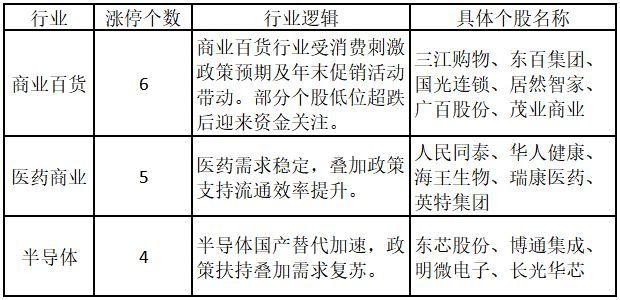
Market Overview and Sector Characteristics - The A-share market saw a total of 67 stocks hitting the daily limit up, a decrease of 10 from the previous day, while 2 stocks hit the limit down, unchanged from the previous day [2] - The Shanghai Composite Index fell by 0.15%, while the Shenzhen Component Index rose by 1.02% [1] Industry Characteristics - The sectors with the most limit-up stocks today were commercial retail, pharmaceutical retail, and semiconductor industries [3] - In the commercial retail sector, 6 stocks hit the limit up, driven by consumption stimulus policies and year-end promotional activities [4] - The pharmaceutical retail sector had 5 stocks hitting the limit up, supported by stable demand and policies enhancing distribution efficiency [4] - The semiconductor sector saw 4 stocks limit up, with accelerated domestic substitution and supportive policies [4] Concept Characteristics - The most prominent concepts among limit-up stocks included large consumption, pharmaceuticals, and domestic chips [5] - In the large consumption category, 11 stocks hit the limit up, driven by ongoing consumption stimulus policies and enhanced economic recovery expectations [5] - The pharmaceutical concept had 10 stocks limit up, supported by policy backing and industry demand release [5] - The domestic chip concept had 8 stocks hitting the limit up, driven by accelerated domestic substitution and policy support [5] Limit-Up Stock Rankings - Among the limit-up stocks, 2 reached historical highs: Tianpu Co., Ltd. at 140.36 yuan and Yongding Co., Ltd. at 17.29 yuan [6] - A total of 17 stocks reached near one-year highs, indicating significant breakout trends [6] Main Capital Inflows - The top 5 stocks with the highest net capital inflow included Dongxin Co., Ltd. (727 million yuan), Fenda Technology (528 million yuan), and CIMC (474 million yuan) [8] - The stocks with the highest net capital inflow as a percentage of market value included Kaichun Co., Ltd. (5.80%), Huaren Health (5.52%), and Hai Xin Food (5.51%) [9] Limit-Up Stock Funding - The stocks with the highest funding for limit-up included Xinhua Du (483 million yuan), Luoping Zinc (467 million yuan), and Shida Group (419 million yuan) [10] Continuous Limit-Up Stocks - There were 47 stocks hitting the limit up for the first time today, with 13 stocks achieving a second consecutive limit up, and 7 stocks achieving three or more consecutive limit ups [11]
金禾实业(002597.SZ):公司现有氯化亚砜产能为8万吨/年
Ge Long Hui· 2025-11-19 00:50
Core Viewpoint - The company, Jinhe Industrial, has a current production capacity of 80,000 tons/year for thionyl chloride, which is expected to strengthen its leading position in the niche market and support high-growth industries such as new energy and pharmaceuticals. The company is confident about the market prospects for the new capacity [1]. Group 1 - The existing production capacity of thionyl chloride is 80,000 tons/year [1]. - The project aims to consolidate the company's leading advantage in the niche sector [1]. - The new capacity will provide strong support for downstream high-growth industries, including new energy and pharmaceuticals [1].

能源仍是涨停热点板块!医药商业逆势崛起,补涨行情来了?
Mei Ri Jing Ji Xin Wen· 2025-11-14 12:55
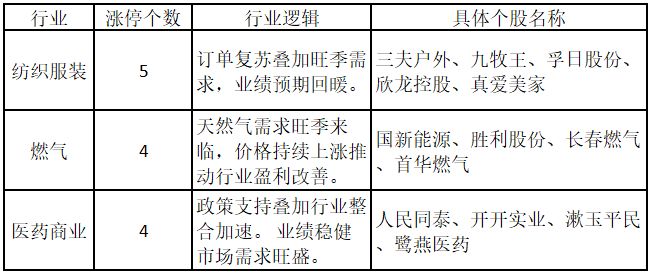
Market Overview and Sector Characteristics - The Shanghai Composite Index decreased by 0.97%, and the Shenzhen Component Index fell by 1.93%, with the median decline of A-shares at 0.44% [1] - A total of 70 stocks hit the daily limit, a decrease of 15 from the previous day, while 6 stocks hit the lower limit, an increase of 6 [2] Sector Performance - The sectors with the most limit-up stocks included textiles and apparel, gas, and pharmaceutical commerce [3] - In the textile and apparel sector, 5 stocks reached the limit due to order recovery and peak season demand, improving performance expectations [4] - The gas sector saw 4 stocks limit up, driven by the peak demand for natural gas and rising prices, enhancing industry profitability [4] - The pharmaceutical commerce sector also had 4 limit-up stocks, supported by policy backing and accelerated industry consolidation, with strong market demand [4] Conceptual Characteristics - The most limit-up stocks were in the pharmaceutical, lithium battery, and Fujian Free Trade/Haixi concepts [5] - In the pharmaceutical sector, 11 stocks reached the limit due to policy support and recovering demand [5] - The lithium battery sector had 9 limit-up stocks, driven by policy support and increasing demand from the new energy vehicle market [5] - The Fujian Free Trade/Haixi concept saw 8 limit-up stocks, propelled by favorable policies and enhanced regional economic vitality [5] Limit-Up Stock Rankings - 5 stocks reached historical highs among limit-up stocks, including Furi Shares, Zhenai Meijia, and Zhongyi Technology [6] - 31 stocks reached near one-year highs, including Pingtan Development and Victory Shares [6] Main Capital Inflows - The top 5 stocks by net capital inflow as a percentage of market value included Zhongfutong, Rishang Group, and Jingneng Thermal Power [7] - The top 5 stocks by net capital inflow included Yongtai Energy and Aerospace Development [8] Limit-Up Stock Funding - The top 5 stocks by limit-up funding included Furi Shares and Pingtan Development [10] Continuous Limit-Up Stocks - There were 49 first-time limit-up stocks, 11 with two consecutive limit-ups, and 10 with three or more [11] - The top 5 stocks by consecutive limit-ups included Furi Shares and Sanmu Group [11]
数据回暖!大消费板块个股批量涨停——道达涨停复盘
Sou Hu Cai Jing· 2025-11-10 12:24
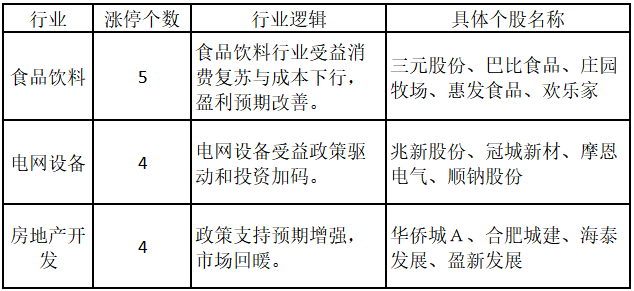
Market Overview and Sector Characteristics - The Shanghai Composite Index rose by 0.53%, and the Shenzhen Component Index increased by 0.18%, with the median change in A-shares being an increase of 0.53% [1] - A total of 71 stocks hit the daily limit up, an increase of 18 from the previous day, while 7 stocks hit the limit down, an increase of 4 [2] - The sectors with the most limit-up stocks included food and beverage, electric grid equipment, and real estate development [2] Industry Highlights - In the food and beverage sector, five stocks reached their daily limit due to improved profit expectations driven by consumer recovery and declining costs [3] - The electric grid equipment sector benefited from policy support and increased investment [3] - The real estate development sector saw enhanced policy support expectations and market recovery [3] Conceptual Trends - The large consumption sector had 16 stocks hitting the limit up, supported by policy backing and seasonal demand, indicating a recovery in the sector [4] - The lithium battery sector had 7 stocks reaching their daily limit, driven by sustained demand and robust production and sales of new energy vehicles [4] - The pharmaceutical sector had 5 stocks hitting the limit up, supported by policy backing and improved performance expectations [4] Key Stocks and Performance - The stock with the highest net inflow of main funds was China Duty Free Group, with a net inflow of 11.38 billion yuan [7] - Other notable stocks with significant net inflows included Qingshan Paper Industry and Yingxin Development, with net inflows of 5.41 billion yuan and 5.07 billion yuan, respectively [7] - The stock with the highest closing price that reached a historical high was Huasheng Lithium Battery [5] Limit-Up Stock Rankings - The top five stocks by limit-up funds included Hongxing Co., China Duty Free Group, and Weilin Co., indicating strong market interest [10] - The stocks with the most consecutive limit-ups included Moen Electric and Hongxing Co., suggesting ongoing investor enthusiasm [11]

资金回流!创业板50ETF(159949)近10个交易日吸金2.6亿 机构:布局年末行情双主线
Xin Lang Ji Jin· 2025-11-05 04:46
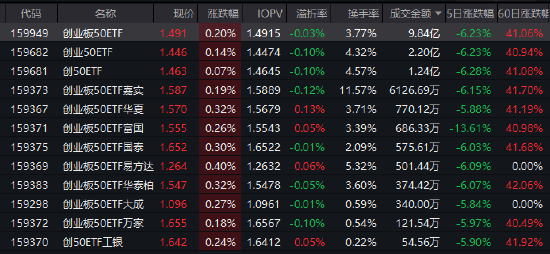
Group 1 - The core viewpoint of the news is that the ChiNext 50 ETF (159949) has recently shifted from net outflows to net inflows, indicating a positive change in investor sentiment towards this fund [1][3]. - Over the past 60 trading days, the ChiNext 50 ETF experienced a net outflow of 6.57 billion CNY, but in the last 10 trading days, it turned into a net inflow of 260 million CNY [1]. - As of November 4, 2025, the circulating scale of the ChiNext 50 ETF is 26.405 billion CNY [1]. Group 2 - On November 5, A-shares opened lower but rose throughout the day, with the ChiNext 50 ETF closing at 1.491 CNY, up 0.20%, and achieving a trading volume of 984 million CNY, leading among similar ETFs [3]. - The latest quarterly report shows that most of the top ten holdings of the ChiNext 50 ETF saw price increases, with notable gains from companies like Ningde Times (up 1.10%) and Sungrow Power (up 3.75%) [4]. - The report also indicates significant decreases in the holdings of several stocks, with Ningde Times seeing a reduction of 27.58% in its holding value [4]. Group 3 - The China Securities Regulatory Commission announced plans to deepen reforms in the ChiNext market, aiming to provide more tailored financial services for innovative enterprises in emerging industries [5]. - Institutional views suggest focusing on technology growth sectors such as AI applications and pharmaceuticals, while also considering cyclical sectors like steel and chemicals as the economy shows signs of recovery [6]. - The ChiNext 50 ETF is highlighted as a convenient investment tool for those optimistic about the long-term growth of China's technology sector, being the largest and most liquid ETF tracking the ChiNext 50 Index [7].





突发利好,000620,超500万手封涨停!
Zheng Quan Shi Bao· 2025-10-22 05:06
Group 1 - The A-share market showed strong fluctuations with the Shanghai Composite Index down 0.44% and the ChiNext Index down 0.89% as of the morning close [1] - The technology sector saw significant gains, with leading stocks like Tianfu Communication rising nearly 10% and Zhongji Xuchuang increasing nearly 4%, reaching historical highs [1] - Over 30 stocks hit the daily limit up, with Yingxin Development (000620) experiencing a massive surge due to a sudden positive announcement [1][2] Group 2 - Yingxin Development announced a cash acquisition of 81.8091% of Changxing Semiconductor, which specializes in memory chip packaging and testing, leading to a 10.1% increase in its stock price [2] - Changxing Semiconductor has a strong technological foundation with 76 valid patents and is recognized as a national high-tech enterprise [2] - The stock of Yingxin Development reached a price of 2.18 yuan per share, with a trading volume exceeding 318 million shares [2] Group 3 - The optical module index has been rebounding, with Zhongji Xuchuang's stock price hitting a historical high and its market capitalization surpassing 500 billion yuan [3] - Despite a general pullback in A-share technology assets, the fundamentals in high-growth areas like PCB, AI chips, and storage remain strong, suggesting continued investment opportunities [3] - The AI industry has seen a phase of adjustment, but major companies are accelerating product updates, which is expected to create new application scenarios and investment opportunities in upstream sectors [3] Group 4 - Over 60 technology stocks have seen a price decline of over 20% since their September highs, with significant representation in AI, new energy, pharmaceuticals, and robotics sectors [4] - Some stocks, like Yifang Bio, have experienced a substantial pullback of nearly 39%, despite having over 110% gains year-to-date [4] - Certain stocks, such as Transsion Holdings and Runze Technology, have seen their prices decline despite overall market trends [4]


湖北“三化”,为何此时提出并放大?| 1021 张博划重点
Hu Xiu· 2025-10-21 23:15
Market Performance - On October 21, the market experienced a rebound, with the ChiNext Index rising over 3% and the Shanghai Composite Index increasing by 1.36%, returning to the 3900-point level [1] - The total trading volume in the Shanghai and Shenzhen markets reached 1.87 trillion, an increase of 136.3 billion compared to the previous trading day [1] - By the market close, the Shanghai Composite Index rose by 1.36%, the Shenzhen Component Index increased by 2.06%, and the ChiNext Index gained 3.02% [1] Industry Insights - The article highlights various sectors, including the Apple supply chain, consumer goods, domestic chips, solid-state batteries, and robotics, indicating a focus on major consumption and technology sectors [3] - Specific stocks are noted for their performance, such as Dayou Energy in coal, and Xianfeng Electronics in gas meters and sensor chips, reflecting trends in energy and technology [4] Economic Commentary - A commentary from the Learning Times emphasizes the importance of stabilizing the stock market to enhance the financial income channels for urban and rural residents [6] - The article references a strategic plan aimed at boosting consumption and highlights the role of the stock market as a barometer for economic development [6]