即时零售

Search documents
2026年中国闪电仓模式深度解析:即时零售赛道新变量,分钟级消费时代来临
Qin Ce Xiao Fei Yan Jiu· 2026-03-27 12:35
Investment Rating - The report indicates a positive investment outlook for the lightning warehouse model in the instant retail sector, highlighting significant growth potential and market opportunities [3][4]. Core Insights - The lightning warehouse model is reshaping China's instant retail infrastructure, with Meituan's lightning warehouses expected to exceed 50,000 by 2025 and reach over 100,000 by 2027, generating a GMV of over 200 billion yuan [3][4]. - The industry is characterized by a "one strong, many strong" pattern, with Meituan's lightning purchase holding a 70% market share, followed by Taobao and JD [3][4]. - The report emphasizes the shift from emergency consumption to daily consumption, driven by a 30-minute delivery experience [3][4]. Summary by Sections Industry Overview and Current Development - The instant retail market is entering a "minute-level" era, supported by over 50,000 lightning warehouses, contributing to a market size exceeding 1 trillion yuan [8][14]. - The lightning warehouse model, launched by Meituan in 2020, operates purely online with flexible site selection, 24-hour service, and a wide range of SKUs [9][10]. Key Data Overview - As of 2023, the instant retail market is valued at 650 billion yuan, with lightning warehouses contributing 60 billion yuan, representing 9.2% of the market [15]. Investment Logic - Short-term focus on leading brands like Huiyixuan and Xiaochai Purchase, which benefit from supply chain barriers [7]. - Mid-term potential for vertical sectors (alcohol, maternal and infant, pharmaceuticals) to produce niche leaders, with SKU depth and fulfillment efficiency being critical [7]. - Long-term growth expected in instant retail penetration, with a market size projected to exceed 2 trillion yuan by 2030 [7]. Competitive Landscape - The competitive landscape shows Meituan's lightning purchase leading with 70% market share, followed by Taobao and JD [13][24]. - The report notes a concentration of top brands, with only three brands consistently ranking over the past three years [26][27]. Regional Distribution and Brand Ecosystem - Eastern and Southern regions are mature markets, while Central and Western regions present significant growth opportunities, particularly in county markets [96][97]. - The county market has seen a 54% year-on-year growth in orders, becoming a new growth engine for the industry [100][101]. Future Outlook and Trends - By 2027, the number of lightning warehouses is expected to exceed 100,000, with a GMV of 200 billion yuan, indicating a shift towards refined operations [129][130]. - Key trends include increased concentration among top brands, expansion into high-ticket categories, and the rise of official brand warehouses [134].
大行评级丨高盛:有信心美团保持本地服务领域领导地位,维持“买入”评级
Ge Long Hui· 2026-03-27 07:00
高盛发表报告指,美团2025年第四季度业绩整体符合早前预告。在即时零售扩大潜在市场空间的背景 下,该行对美团在仍快速成长的本地服务市场中的整体领导地位保持信心。该行维持美团"买入"评级, 目标价112港元。 ...

美团业绩改善的背后:收缩、省钱,等待阿里犯错
晚点LatePost· 2026-03-27 03:35
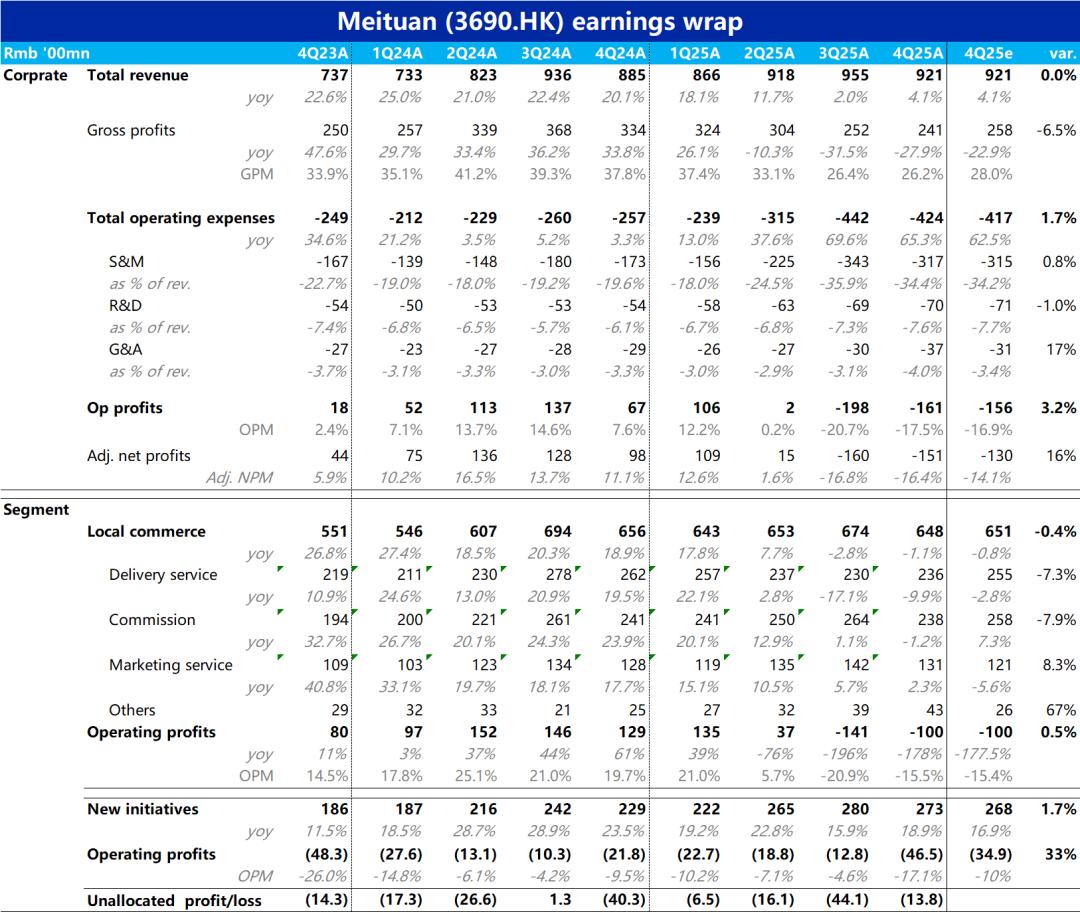
Core Viewpoint - Meituan is facing stronger and more determined competitors in the market, particularly Alibaba, which has significantly more cash reserves and is committed to increasing its market share in the instant retail and food delivery sectors [2][3]. Group 1: Competitive Landscape - Meituan's core local business segment reported a loss of approximately 10 billion yuan in Q4, a 30% reduction in losses compared to Q3, indicating a strategic shift to improve efficiency and reduce subsidies [3][4]. - Alibaba's cash reserves are four times greater than Meituan's, allowing it to invest heavily in its Taobao Flash Purchase platform, aiming to surpass Meituan's market share by 2026 [3][4]. - Competitors like Pinduoduo and Douyin are rapidly increasing their e-commerce business, posing additional challenges to Meituan's market position [4][5]. Group 2: Market Dynamics - The food delivery market has entered a consumption war, with Meituan's employees experiencing increased workloads as they attempt to regain lost market share from Alibaba [5][6]. - Meituan has adjusted its subsidy strategy, reducing costs while increasing delivery fees for merchants, which has led to a slight recovery in market share [5][6]. - The competition has intensified, with both Meituan and Alibaba focusing on high-value orders, leading to a shift in market dynamics where Meituan's share of high-value orders has decreased from 70% to approximately 60% [6][9]. Group 3: Strategic Adjustments - Meituan is shifting its focus from third-party flash purchase models to more controlled self-operated retail formats, such as its own supermarkets and convenience stores, to enhance efficiency and profitability [10][11]. - The company has significantly reduced subsidies for third-party flash purchase merchants, leading to a decline in their performance and a strategic pivot towards self-operated models [10][11]. - Meituan's acquisition of Dingdong Maicai's China business for $717 million aims to prevent competitors from gaining access to valuable infrastructure and to strengthen its own instant retail capabilities [12][13]. Group 4: Cost Management - Meituan is undergoing a comprehensive review of its business operations, focusing on cost-cutting measures and efficiency improvements across various departments [14][16]. - The company has scaled back its hotel business expansion plans and community group buying initiatives, reallocating resources to more promising areas [14][15]. - The emphasis on profitability has shifted the focus of various business units from growth to achieving sustainable earnings within a specified timeframe [16].



美团:三山压顶,外卖“老登”要长跪不起?
3 6 Ke· 2026-03-27 02:01
Core Viewpoint - Meituan's latest quarterly earnings report reflects a mixed performance, with significant losses in new business segments overshadowing slight improvements in core local commerce operations. The overall results align closely with prior profit warnings, indicating a challenging environment for the company [6][20]. Financial Performance - The core local commerce segment reported an operating loss of approximately 10 billion RMB, consistent with previous warnings. The total loss from the home delivery business exceeded 14 billion RMB, with a reduction in losses of less than 5 billion RMB compared to the previous quarter [20][24]. - The overall operating expenses for the quarter reached about 42 billion RMB, with a year-on-year increase of 65%. Marketing expenses accounted for 31.7 billion RMB, reflecting a reduction in delivery subsidies [4][26]. - The gross profit margin for the quarter was 26.2%, down by approximately 0.2 percentage points from the previous quarter, indicating ongoing pressure on profitability [24][26]. Business Segments - The home delivery business saw a slight improvement in loss per order, decreasing from 2.5 RMB to 2 RMB, while Alibaba's loss per order decreased from over 5 RMB to around 3.5 RMB, narrowing the gap between the two companies [20][24]. - Revenue from the home delivery and flash purchase segments declined by 10% year-on-year, a slight improvement from the previous quarter's 17% decline, suggesting a trend towards reduced investment and losses in the delivery sector [14][18]. - The new initiatives segment, primarily driven by Keeta's expansion in overseas markets, reported a revenue growth rate of 19%, indicating strong performance despite overall losses in this area [18][20]. Competitive Landscape - Meituan faces intensified competition in the dine-in segment, with a slowdown in revenue growth and a decline in commission and advertising revenues. The company is experiencing pressure from Douyin's aggressive entry into the market, which has seen significant growth in gross transaction value [3][12]. - The overall revenue for the core local commerce segment was 64.8 billion RMB, a year-on-year decline of 1.1%, aligning with market expectations despite the challenges faced [3][14]. Future Outlook - The ongoing competition in instant retail suggests that all players are optimizing their subsidies and unit economics, with a general trend towards reduced losses expected to continue. However, the pace and method of achieving these reductions remain uncertain [8][10]. - Regulatory bodies may influence the competitive landscape, but it is unlikely that they will impose strict measures to halt competitive subsidies entirely, allowing for continued competition among major players [9][10].
即时配送年订单量首超600亿,行业竞争转向何方?
第一财经· 2026-03-26 15:52
Core Insights - The core viewpoint of the article is that the instant retail industry in China is experiencing rapid growth, with the order volume expected to exceed 60 billion by 2025, driven by a 25% increase in instant retail orders and approaching a market size of nearly 1 trillion yuan [3][5]. Group 1: Industry Growth - The instant retail sector is expanding beyond food delivery to include supermarkets, fresh produce, pharmaceuticals, and non-standard products like electronics and clothing [3][5]. - The demographic of delivery personnel is shifting, with over half of the riders being local residents, indicating a growing social acceptance of this profession [3]. Group 2: Market Dynamics - The fastest growth in instant retail is observed in non-food categories such as pharmaceuticals, beauty products, 3C accessories, beverages, and pet supplies, with demand driven by younger consumers, the elderly, and lower-tier markets [5]. - Major players like Meituan, Alibaba, JD.com, and Douyin are increasing their investments in instant retail, shifting competition from price wars to supply chain and operational capabilities [5]. Group 3: Challenges and Future Outlook - The industry faces significant challenges, including high fulfillment costs, inconsistent supply and quality control, and pressure on profitability [5]. - Despite the growth in instant retail, the sustainability of this growth as a driver for e-commerce remains uncertain, necessitating deeper focus on supply chain management, refined fulfillment processes, and overall collaboration [5].


美团(03690)电话会: “坚决反对内卷” “绝不急于成为‘token’工厂” Keeta沙特盈利在望
智通财经网· 2026-03-26 14:22
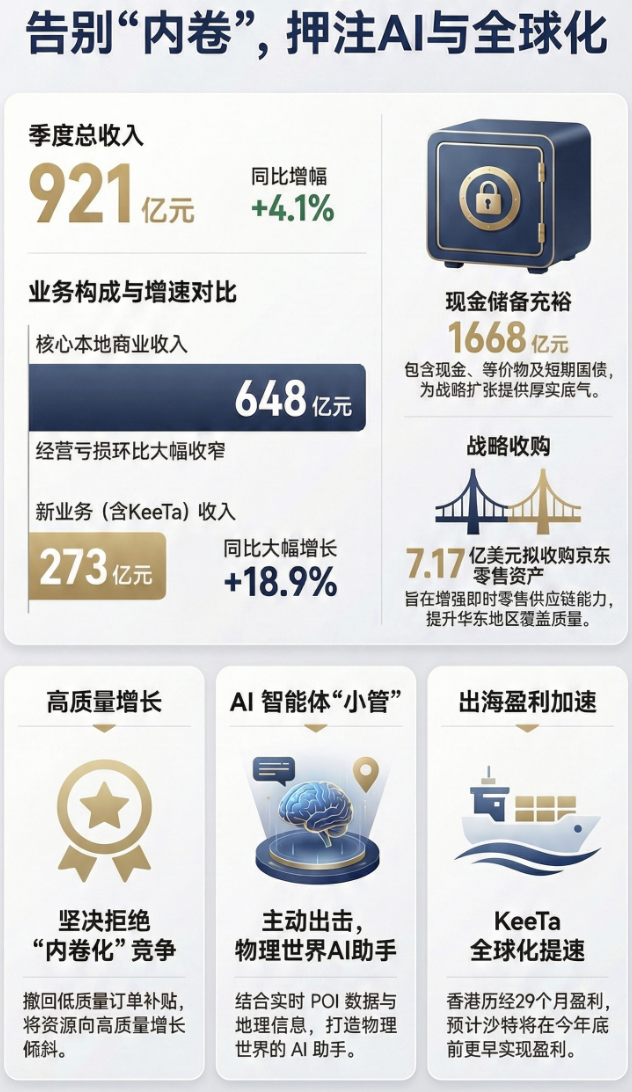
Core Insights - Meituan is focusing on stabilizing its core business while rejecting industry "involution" and betting on AI reconstruction in the physical world and the globalization of Keeta [1][2][3] - The company reported a total revenue of 92.1 billion yuan for Q4 2025, a year-on-year increase of 4.1%, with cash and cash equivalents totaling 166.8 billion yuan by the end of 2025 [1][17] - The core local commerce segment generated 64.8 billion yuan in revenue for Q4, while the new business segment, driven by Keeta and retail expansion, reached 27.3 billion yuan, growing by 18.9% year-on-year [1][20] Competition and Regulatory Environment - Meituan's CEO, Wang Xing, firmly opposes "involution" in the industry, emphasizing the need for a healthy and orderly market, particularly in the face of irrational competition driven by subsidies and pricing wars [2][3] - The company is reallocating resources from low-quality orders to defend market share and promote high-quality growth, with expectations of significant improvement in delivery losses in Q1 2026 compared to Q4 2025 [3][32] AI Strategy - AI is a major focus for Meituan, with Wang stating that the company will not rush to become a "token factory" but will actively engage in the AI revolution [3][24] - The company has launched its AI assistant "Xiaoguan" to all users, aiming to create a user-centered local service AI agent that can understand natural language queries [4][15][26] Retail and Global Expansion - Meituan plans to acquire Dingdong's retail business in mainland China for $717 million, which is expected to enhance its supply chain capabilities and service quality in the East China region [5][40][41] - Keeta is accelerating its globalization, with expectations of profitability in Saudi Arabia by the end of 2026, following successful operations in Hong Kong [5][46][47] Financial Performance - In Q4 2025, Meituan's total revenue was 92.1 billion yuan, with a cost of revenue rate increasing by 11.6 percentage points to 33.8% due to higher consumer incentives and rider incentives [17][18] - The core local commerce segment reported an operating loss of 10 billion yuan, significantly narrowing from previous quarters, while the new business segment's operating loss expanded to 4.6 billion yuan due to strategic investments [20][21]
美团王兴:Keeta沙特有望在26年底前实现单月的UE转正
Xin Lang Cai Jing· 2026-03-26 14:11
"Keeta在沙特有望在26年底前实现单月的UE转正。"3月26日晚,在美团2025年第四季度及全年业绩电 话会上,CEO王兴谈及美团国际化进展。王兴表示,长期来看,美团会坚定投入国际化,但投入方向将 更加聚焦在能发挥出核心优势的即时零售赛道。除中国香港地区外,美团Keeta已完成了中东海湾地区 主要国家的覆盖,并且在巴西展业。 ...
美团电话会: “坚决反对内卷”,“绝不急于成为‘token’工厂”,KeeTa沙特盈利在望
Hua Er Jie Jian Wen· 2026-03-26 12:50AI Processing
面对前所未有的激烈竞争,美团在稳住核心商业底盘的同时,正明确拒绝行业"内卷化",并将未来的想 象空间全面押注于物理世界的AI重构与KeeTa的全球化提速。 在今晚举行的美团2025年第四季度及全年业绩电话会议上,美团董事长兼CEO王兴与CFO陈少晖向市场 交出了一份在复杂环境下稳健前行的答卷,并详细披露了公司在核心本地商业、AI战略、零售并购以 及出海业务上的最新动向。 财报数据显示,美团2025年第四季度总收入达到921亿元,同比增长4.1%。截至2025年底,公司持有的 现金及现金等价物和短期国债投资总计高达1668亿元。在各业务板块中,核心本地商业四季度收入为 648亿元;而由KeeTa和零售业务扩张驱动的新业务板块表现亮眼,四季度收入达到273亿元,同比增长 18.9%。 面对市场高度关注的竞争格局、业绩指引与未来增长引擎,美团管理层在会上给出了明确的回应。 直面竞争与监管:"我们坚决反对内卷化" 针对近期市场关心的餐饮外卖价格战与监管部门的行业调查,王兴在会上给出了非常坚决的态度。他指 出,主管部门希望培育健康有序的市场,而外卖行业中补贴驱动或价格驱动的竞争是"非常典型的非理 性竞争"。 "我们坚决 ...
美团公布外卖大战后全年业绩
Di Yi Cai Jing· 2026-03-26 12:47
Core Insights - Meituan reported a total revenue of 364.9 billion RMB for the year 2025, reflecting an 8% year-on-year growth [2] - The company experienced a net loss of 23.4 billion RMB in 2025, a significant shift from a profit of 35.8 billion RMB in 2024, primarily due to intense competition in the instant retail sector [2][3] Financial Performance - The core local business segment generated revenue of 260.8 billion RMB in 2025, marking a 4.2% year-on-year increase, but incurred an operating loss of 6.9 billion RMB [3] - In Q4 2025, the core local business reported an operating loss of 10 billion RMB, which was a reduction compared to the previous quarter [3] Strategic Focus - Meituan's CEO emphasized a dual focus on opportunities and challenges, stating a commitment to "anti-involution" and prioritizing the right strategies for sustainable growth [3] - The company maintained over 60% market share in Gross Transaction Value (GTV) while holding a dominant position in the mid-to-high price segment of the dining market [3] Growth Drivers - New business segments, including grocery retail and international operations, contributed significantly to revenue, with new business income reaching 104 billion RMB, a 19% year-on-year increase [5] - The "Xiaoxiang Supermarket" and overseas business expansions were highlighted as key growth areas, with the supermarket entering 39 cities by the end of 2025 [5] International Expansion - Meituan's international business, Keeta, has expanded its presence in the Middle East and Brazil, with strong growth reported in new markets [5] - The CEO indicated a cautious approach to international expansion, advocating for selective investments and model refinement before broader rollout [5] AI Development - The company is investing in AI technologies, with plans to develop proprietary models and enhance logistics through innovations like drones and autonomous vehicles [6] - Meituan has launched several AI products, including the "Tabbit AI" browser and user assistants "Xiao Mei" and "Xiao Tuan," which have seen significant user engagement [7][8]

美团公布外卖大战后全年业绩
第一财经· 2026-03-26 12:37
Core Viewpoint - Meituan reported a revenue of 364.9 billion RMB for the year 2025, marking an 8% year-on-year growth, but transitioned from profit to a net loss of 23.4 billion RMB due to intense competition in the instant retail sector [3][4]. Financial Performance - The significant change in financial performance was attributed to two main factors: the shift from profit to loss in the core local business and increased investment in overseas operations [4]. - The core local business segment generated revenue of 260.8 billion RMB, a 4.2% year-on-year increase, but incurred an operating loss of 6.9 billion RMB [4]. - In Q4, the core local business reported an operating loss of 10 billion RMB, which was a reduction compared to Q3 [4]. Strategic Focus - Meituan's CEO Wang Xing characterized 2025 as a year of "coexisting opportunities and challenges," emphasizing a commitment to "anti-involution" and focusing on doing the right things [5]. - The company maintained over 60% market share in Gross Transaction Value (GTV) while holding a dominant position in the mid-to-high-end dining market [5]. Growth Drivers - New business segments became a key driver for Meituan's growth, with the grocery retail and overseas operations achieving strong performance, contributing 104 billion RMB in revenue, a 19% year-on-year increase [7]. - The "Xiaoxiang Supermarket" and international business accelerated expansion, with Xiaoxiang entering 39 cities by the end of 2025 [7]. International Expansion - Meituan's international business, Keeta, has expanded its global footprint, covering major countries in the Middle East and Brazil, with a focus on selective investment rather than broad expansion [7]. - Keeta achieved positive user engagement in Hong Kong and demonstrated strong growth in new markets like Saudi Arabia and Qatar [7]. AI Development - AI is a significant focus for Meituan, with plans to invest in proprietary foundational models and low-inference-cost models, alongside advancements in logistics and robotics [8]. - The company has launched several AI products, including the Tabbit AI browser and user-facing AI assistants, which have seen substantial user engagement [9]. Operational Achievements - By the end of 2025, Meituan's drone delivery network had established 70 routes and completed over 780,000 orders [9]. - The company upgraded its food safety governance model, leveraging AI for real-time verification and monitoring processes [9].