双赤字

Search documents
为何美国无法通过所谓“对等关税”解决“双赤字”难题?
Di Yi Cai Jing· 2025-04-24 09:21
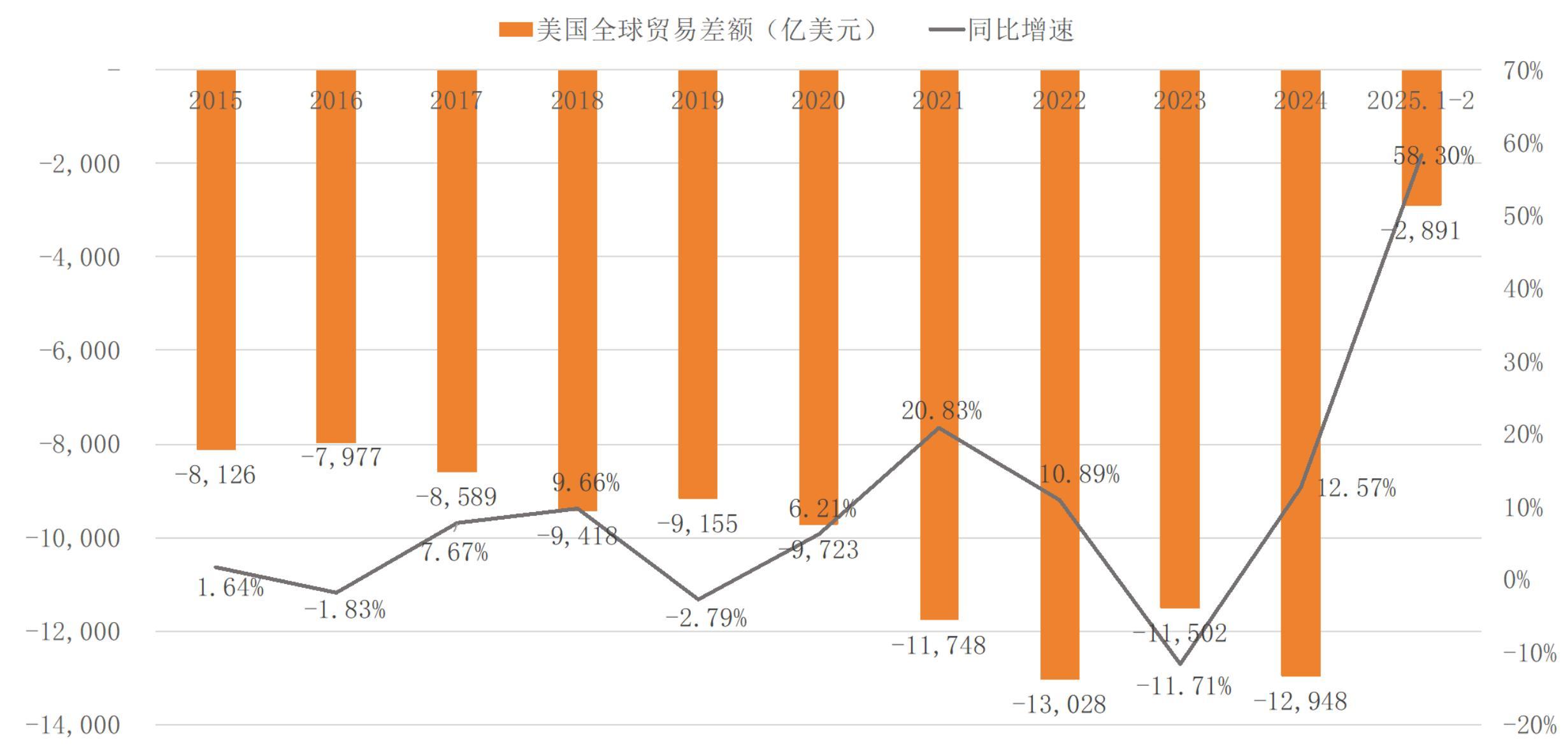
Core Viewpoint - The long-term U.S. tariff policy cannot fundamentally resolve the "twin deficits" issue, which includes both trade and fiscal deficits [1][22]. Trade Deficit - The U.S. trade deficit reached a historical high of $1.3 trillion in 2022, with a year-on-year increase of 10.89%, and is projected to be $1.29 trillion in 2024, up 12.57% [3]. - The trade deficit with China remains significant, with a surplus of $319 billion in 2024, only a decrease of $76.7 billion from 2017 [2]. - The U.S. has maintained a trade deficit exceeding $1.1 trillion since 2021, with a deficit of $289.1 billion in the first two months of 2025, marking a year-on-year increase of 58.3% [3]. Fiscal Deficit - The federal budget deficit is projected to reach $1.781 trillion in 2025, accounting for 23.9% of the total budget and 5.9% of GDP, indicating a worsening trend compared to 2019 [5][7]. - Interest payments on national debt are expected to rise from $363 billion in 2019 to $965 billion in 2025, driven by a historic federal debt exceeding $36 trillion and rising interest rates [6][7]. Tariff Policy and Revenue - The U.S. government anticipates an average annual tariff revenue of $290 billion over the next decade, which is only 15.6% of the projected $1.859 trillion fiscal deficit in 2024 [2][21]. - The proposed tariffs, including a 145% tariff on China, are expected to generate $9.8 trillion in revenue from $27.7 trillion in imports over ten years, but the actual revenue may decline due to increased prices leading to reduced demand [20][21]. Structural Issues - The U.S. trade deficit is primarily a result of structural economic imbalances and the global reserve currency status of the dollar, which encourages high consumption and low savings [16][17]. - The U.S. has a high consumption rate of 67.9% of GDP, significantly above other developed countries, which contributes to the persistent trade deficit [14][16]. Impact on Competitiveness - Tariff barriers may increase global supply chain costs, potentially weakening the competitiveness of U.S. companies [22]. - The monopolistic position of U.S. tech companies allows them to generate substantial profits overseas, which may be threatened by retaliatory tariffs from other countries [11][12]. Conclusion - The "reciprocal tariffs" policy may yield short-term negotiation benefits and localized adjustments to the trade deficit, but it lacks the structural reforms necessary to address income inequality, savings rates, and fiscal sustainability [22].

开年财政的四个特征和启示——1-2月财政数据点评
一瑜中的· 2025-03-27 15:16
Core Viewpoint - The article discusses the characteristics of the fiscal situation at the beginning of the year, highlighting a "low income" and "high deficit" environment, which may lead to a "technology stock-friendly" fiscal policy throughout the year [3][4][5]. Group 1: Low Income - The public fiscal revenue experienced a rare negative growth of -1.6% at the beginning of the year, with a budget target of 0.1% [4][12]. - The revenue from land sales continued to decline significantly by -15.7%, contributing to a double-digit drop in secondary account revenue of -10.7% [4][12]. - If the income side remains under pressure, it may force incremental policies that further elevate the "high deficit" and support "medium expenditure," reinforcing the "technology stock-friendly" fiscal approach [4][12]. Group 2: High Deficit - The public fiscal deficit recorded in January-February was 124 billion, marking the first occurrence of a narrow deficit at the start of the year in nearly 30 years [5][15]. - The broad fiscal deficit reached 621.7 billion, the highest for the same period in recent years, indicating a strong subjective willingness to stimulate the economy [5][15]. - The dual deficit pattern suggests that the fiscal policy continues to support risk appetite, reflecting an increase in local government activity since October of the previous year [6][15][17]. Group 3: Medium Expenditure - The growth rate of broad fiscal expenditure was 2.9%, slightly above the previous year's rate of 2.7%, indicating limited fiscal strength [7][21]. - Expenditure focused on technology (+10.6%) and social welfare (social security +6.7%, education +7.7%), while infrastructure spending was under pressure, with declines in community and agricultural spending [7][21]. - The budget arrangements for the year show that growth rates for technology and social welfare expenditures are significantly higher than the nominal GDP growth rate, while infrastructure growth is only around 1% [7][21]. Group 4: Debt Issuance - The issuance of deficit bonds has been rapid, indicating a fiscal preference for supporting consumption, with net financing of government bonds reaching nearly 1.5 trillion in Q1, the highest for the same period in recent years [9][22]. - In contrast, the issuance of new special bonds has been slow, suggesting that investment may be accelerated in the second quarter, with plans for significant special bond issuance already disclosed [9][23]. - The issuance of long-term special bonds is expected to start in the second quarter, potentially leading to more substantial physical investment [9][23]. Group 5: Fiscal Data Review - The fiscal revenue for January-February showed a rare negative growth of -1.6%, with significant contributions from sectors like rail and ship manufacturing, and computer technology [25][29]. - The expenditure growth rate for January-February was 3.4%, with a focus on technology and social welfare, reflecting the characteristics of the annual budget [46]. - The broad fiscal situation remains supported by a new high in deficits, with land sales continuing to be weak, indicating a challenging fiscal environment ahead [51][52].

再跳水!印尼股市一度暴跌4%,四年来首次跌破6000点
华尔街见闻· 2025-03-24 11:37
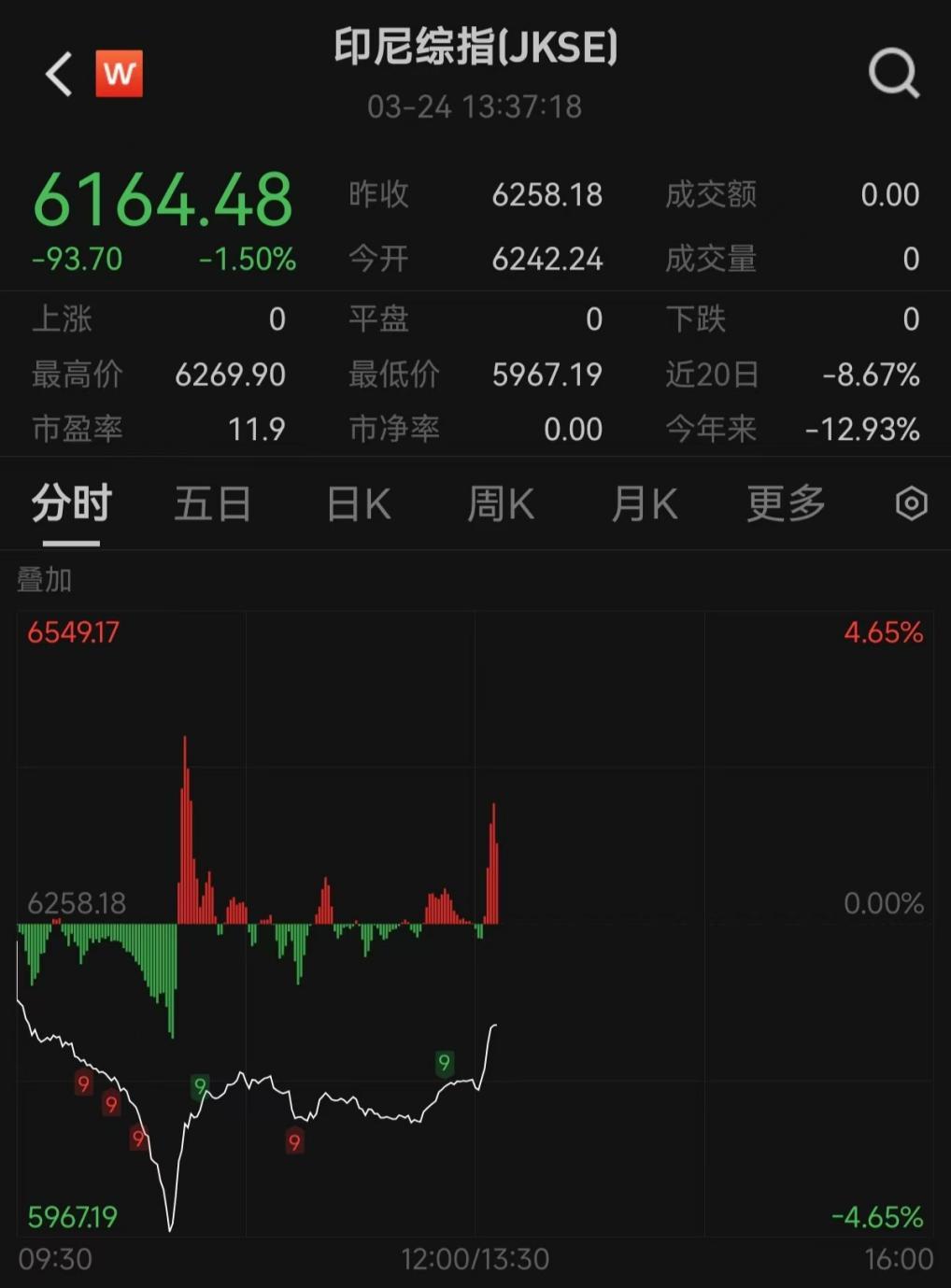
Core Viewpoint - The Indonesian stock market has experienced significant declines, with the Jakarta Composite Index dropping over 4% and falling below 6000 points for the first time since 2021, reflecting investor concerns over the new government's fiscal policies and external uncertainties [1][2][3]. Group 1: Market Performance - The Jakarta Composite Index has cumulatively decreased by approximately 17% over the past year, making it one of the worst-performing markets globally [2]. - The Indonesian Rupiah has also depreciated against the US dollar, with a decline of about 2% this year [2]. Group 2: Investor Sentiment - Investor sell-offs are primarily driven by strong concerns regarding the fiscal plans of the new President Prabowo Subianto and uncertainties stemming from Trump's tariff policies [3][4]. - The establishment of a new sovereign wealth fund, Danantara, which involves transferring state-owned enterprise shares, has raised investor fears about the loss of fiscal discipline established during the previous administration [4]. Group 3: Economic Conditions - There are growing concerns about weak consumer spending, which has historically been a strong driver of Indonesia's economic growth [7][8]. - Recent deflationary data has heightened worries, with the consumer price index showing a year-on-year decline for the first time in 25 years, and consumer confidence indices dropping for two consecutive months [9]. Group 4: Government Fiscal Policies - President Prabowo has introduced an ambitious nationwide free meal program for schoolchildren and pregnant women, expected to cost around $28 billion annually, which places significant pressure on the already strained fiscal budget [10][11]. - The implementation of this program has led to extensive austerity measures across various sectors, with national revenue reportedly declining by one-fifth in the first two months of the year [11]. Group 5: Political Stability - There are speculations regarding the potential resignation of Finance Minister Sri Mulyani Indrawati, which has added to market anxiety despite government denials [12].

创四年新低!特朗普关税大棒干废印尼股市?
Feng Huang Wang Cai Jing· 2025-03-24 08:16
Core Viewpoint - The Indonesian stock market has experienced significant declines, reaching a four-year low, primarily due to foreign capital withdrawal and concerns over economic stability amid rising geopolitical tensions and domestic fiscal challenges [1][4][6]. Group 1: Market Performance - The Indonesian Composite Index fell sharply, dropping 4.65% on March 24, 2023, and briefly falling below 6000 points for the first time since 2021, before closing down 1.5% at 6164 points [1]. - Since reaching a historical high of 7910 points on September 20, 2022, the Indonesian stock market has declined by 22% over the past six months, making it one of the worst-performing markets globally [4]. Group 2: Foreign Investment Withdrawal - There has been a collective withdrawal of foreign capital from Southeast Asia, with the MSCI ASEAN Index dropping 10% from its peak last year. Indonesia has seen nearly $1.8 billion in capital outflows this year alone [6]. - The withdrawal is attributed to specific issues within each Southeast Asian country, which have become more apparent as investors reassess their expectations [6]. Group 3: Economic Concerns - The threat of increased tariffs from the U.S. under Trump's administration has heightened risk perceptions for emerging markets like Indonesia, which is part of the "Fragile Five" countries sensitive to foreign capital flows [7]. - Recent deflationary trends have raised concerns about consumer spending, with Indonesia experiencing its first deflation in 25 years as the consumer price index fell year-on-year [8]. - The government's ambitious free meal program, costing an estimated $28 billion annually, has led to significant fiscal strain, resulting in a 20% year-on-year decline in national revenue in the first two months of the year [8]. Group 4: Analyst Ratings - Morgan Stanley has downgraded Indonesia's MSCI rating to "underweight," while Goldman Sachs has lowered its rating from "overweight" to "hold," further undermining investor confidence [9].