
美国资产

Search documents
美元头寸达到14年多来最负面水平
Sou Hu Cai Jing· 2026-02-16 14:24
Core Viewpoint - The latest survey by Bank of America indicates that the sentiment towards the US dollar has reached its most negative level in over 14 years, with significant bearish positions being recorded [1] Group 1: Dollar Positioning - In February, the size of short positions on the dollar, which bets on its decline, reached the largest level since January 2012, marking a notable shift in investor sentiment [1] - Fund managers' exposure to the dollar has fallen below the lows seen in April of the previous year, indicating a lack of confidence in the currency [1] Group 2: Market Sentiment and Risks - Concerns regarding the independence of the Federal Reserve have diminished following President Trump's nomination of Kevin Warsh as Fed Chair, yet this has not translated into increased demand for the dollar or renewed optimism for US assets [1] - Respondents of the survey identified further signs of weakness in the US labor market as a primary risk contributing to the dollar's decline [1]
家族办公室用真金白银站队 遭遇空前拷问的美国资产吸金力依旧不减
Ge Long Hui A P P· 2026-01-28 14:26
Core Viewpoint - Family offices are actively investing in various asset classes in the U.S., despite some investors avoiding the market due to geopolitical and economic concerns [1] Group 1: Investment Activities - Indian billionaires Azim Premji and Uday Kotak's private wealth institutions have invested in a Silicon Valley tech startup and a snack brand in the Chicago area [1] - YZi Labs, managing funds for Binance co-founder Zhao Changpeng, has invested in BitGo Holdings Inc.'s IPO in the U.S. [1]
市场消息:北欧大型投资者表示,对持有美国资产愈发谨慎。
Jin Rong Jie· 2026-01-22 18:25
Group 1 - Major Nordic investors are increasingly cautious about holding U.S. assets [1] - This sentiment reflects a broader trend among international investors regarding U.S. market stability [1]
分析师:多元化配置资产属合理 但不会放弃美国资产
Jin Rong Jie· 2026-01-22 03:45
Core Viewpoint - There is a general sentiment among investors that a significant withdrawal from the U.S. stock market is unlikely, despite some considerations for diversifying assets outside the U.S. [1] Group 1 - Michael Rosen, CIO of Angeles Investments, believes that while diversifying into non-U.S. markets is reasonable, the strong profitability of U.S. companies makes it unwise to abandon U.S. assets [1] - Concerns exist that if foreign investors begin to sell off U.S. stocks, it could exert downward pressure on the market [1] - Alex Morris, CEO and CIO of F/m Investments, indicates that while the situation could worsen, it has not reached a critical point yet [1]
美银:明年初新兴市场或迎资金大举流入
Sou Hu Cai Jing· 2025-09-13 02:09
Core Viewpoint - Emerging markets are expected to see a significant inflow of funds in early next year, driven by signs of resilience in these economies and a shift of capital away from U.S. assets [1] Group 1: Economic Indicators - There are increasing signs that emerging economies are resilient, which is likely to boost investor confidence [1] - The impact of trade tensions on the economy is expected to be limited, leading to a more optimistic outlook for early next year [1] Group 2: Market Dynamics - The emerging market asset class is anticipated to benefit from a weaker dollar and the potential for further interest rate cuts by central banks [1] - Global funds are currently underweight in emerging markets, indicating a historical low allocation that could change with the anticipated inflow [1]

法律战可能旷日持久,美资产或许遭遇重创,美总统史上首次解雇美联储理事
Sou Hu Cai Jing· 2025-08-26 23:21
Core Viewpoint - The unprecedented dismissal of Federal Reserve Governor Lisa Cook by President Trump raises concerns about the independence of the Federal Reserve and could lead to significant legal battles and market disruptions [1][2][3]. Group 1: Dismissal of Lisa Cook - President Trump announced the dismissal of Federal Reserve Governor Lisa Cook, marking the first time a sitting president has removed a Fed governor in its 111-year history [1][2]. - Trump cited allegations of fraud related to Cook's mortgage applications as justification for her dismissal, claiming it undermines her credibility as a financial regulator [2][3]. - Cook, appointed by President Biden, has stated that Trump lacks the legal authority to dismiss her and has no intention of resigning [2][3]. Group 2: Implications for Federal Reserve Independence - Trump's actions are seen as a significant challenge to the independence of the Federal Reserve, with potential implications for its decision-making and credibility [2][3]. - If successful in removing Cook, Trump could appoint another governor, potentially shifting the balance of power within the Federal Reserve [3]. - Legal experts suggest that Trump's dismissal may face challenges in federal court, as Federal Reserve governors can only be removed for "just cause" under U.S. law [3]. Group 3: Market Reactions and Economic Context - The dismissal comes amid Trump's ongoing pressure on the Federal Reserve to lower interest rates, which he believes is necessary for economic growth [4]. - Recent comments from Fed Chair Jerome Powell indicate that a rate cut may be forthcoming, which has led to market speculation about upcoming monetary policy changes [4]. - The situation has drawn criticism from political figures, who argue that Trump's actions are an attempt to deflect blame for economic challenges facing the country [4].
印尼央行行长:资本流动已从美国资产转向避险资产和新兴市场资产。
news flash· 2025-06-18 07:12
Core Viewpoint - The Governor of Bank Indonesia stated that capital flows have shifted from U.S. assets to safe-haven assets and emerging market assets [1] Group 1 - The shift in capital flows indicates a changing investment landscape, with investors seeking stability in uncertain economic conditions [1] - Emerging markets are becoming more attractive as investors diversify their portfolios away from traditional U.S. assets [1] - The trend reflects broader global economic dynamics, where geopolitical tensions and economic uncertainties influence investment decisions [1]
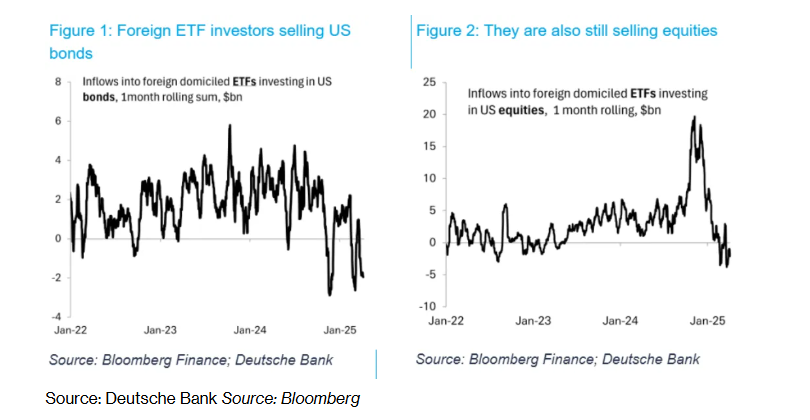
美国资产惨遭冷眼,德银:海外买家还在“罢工”!
Jin Shi Shu Ju· 2025-04-29 01:35
Core Viewpoint - Deutsche Bank indicates that despite a recent recovery in the U.S. market, foreign investors are still "refusing to buy U.S. assets" [1] Group 1: Foreign Investment Trends - Deutsche Bank's foreign exchange strategist George Saravelos analyzed fund flows from overseas into U.S. stocks and bonds, revealing a "sharp stagnation" in purchases by foreign buyers over the past two months [1] - The report concludes that the current capital inflow into the U.S. is likely to slow down significantly, posing a challenge for the dollar, which is already facing dual deficit issues [1] Group 2: ETF and Fund Activity - Foreign ETF investors are simultaneously selling U.S. Treasuries and equities, with a notable shift in sentiment from bullish to bearish on the dollar since February [3] - The report highlights that European investors' holdings of U.S. assets have increased from approximately 5% in 2010 to 20% in 2024, while Japanese investors' holdings have doubled to 16% [3] - Saravelos has been tracking around 400 overseas-registered ETFs focused on the U.S. market, finding that investors are actively selling stocks and bonds, with a halt in new purchases of U.S. equities [3] Group 3: Dollar Forecast - Saravelos has revised down his expectations for the dollar, citing that Trump's policies are diminishing foreign investors' willingness to finance U.S. trade and budget deficits [4] - The strategist predicts that by 2027, the dollar-to-euro exchange rate will decline from approximately 1.14 to 1.30, and the dollar-to-yen rate will drop from 142 to 115 [4]

全球资本配置新动向:机构撤离美股,提升中国资产权重
2 1 Shi Ji Jing Ji Bao Dao· 2025-04-22 13:38
Core Insights - A significant number of QDII funds have reduced their holdings in US stocks while increasing their allocation to Chinese assets, indicating a shift in investment strategy among global investors [1][2][3] QDII Fund Adjustments - QDII funds such as GF Global Select and GF Global Technology have notably decreased their US stock allocations, with GF Global Select reducing its US stock position from 70.25% to 60.98% and increasing its Hong Kong stock position from 1.43% to 11.36% [2] - GF Global Technology's US stock allocation fell from 52.93% to 46.4%, while its Hong Kong stock allocation rose from 5.17% to 9.41% [2] - E Fund Global Growth Select also significantly cut its US stock allocation from 48.26% to 12.05%, while increasing its Hong Kong stock allocation from 11.82% to 38.37% [2] Market Performance - From April 3 to April 21, all 14 major global stock indices experienced declines, with the US indices suffering the largest drops, exceeding 9% [4] - In contrast, the Shanghai Composite Index saw a smaller decline of 1.75%, indicating stronger performance relative to US markets [4][5] Investment Sentiment - There is a growing divergence in investment sentiment, with most foreign capital favoring Chinese assets while reducing exposure to US assets [6][7] - The current global trade environment's uncertainty has led to a cautious approach towards risk assets, with long-term overseas funds maintaining their positions in Chinese assets [6][7]
美国前财长耶伦:特朗普政策削弱了对美国和美元资产的信任
news flash· 2025-04-14 21:20
Core Viewpoint - Former U.S. Treasury Secretary Yellen expressed concerns that Trump's tariffs and policies are undermining allies' trust in the U.S. commitment, leading some investors to avoid U.S. assets [1] Group 1: Trust in U.S. Assets - Yellen indicated that the recent surge in U.S. Treasury yields is alarming, raising questions about the safety of U.S. Treasuries, which are traditionally viewed as a safe-haven asset [1] - She noted that some investors are beginning to question the reliability of U.S. assets due to the current political and economic climate [1] Group 2: Treasury Bond Issuance Strategy - Yellen expressed satisfaction with the recent successful auctions of 10-year and 30-year Treasuries but advised against shifting to more short-term bond issuances in response to rising long-term yields [1] - She emphasized the importance of regularly and predictably issuing bonds to meet market demand, suggesting that a strategy focused solely on short-term bonds due to concerns over long-term rates is not wise [1]