可负担性

Search documents
美报告:买相同东西,美国家庭去年多花2120美元
Huan Qiu Shi Bao· 2026-02-01 22:54
【环球时报驻美国特约记者 冯亚仁】生活开支的持续上涨引发了美国消费者对于总统特朗普在竞选期 间"终结通胀"承诺的重新审视。美国《财富》杂志1月30日报道称,根据美国参议院银行、住房和城市 事务委员会的伊丽莎白·沃伦参议员团队提供的最新报告,若美国家庭在2025年购买的商品与服务和 2024年相同,每户家庭平均要多支出2120美元。 数据显示,相较于2024年,去年美国家庭的电费账单增加123美元,食品杂货增加150美元。报道称,围 绕究竟是谁推高了开支的讨论焦点集中在白宫的政策上。去年4月,美国政府宣布对几乎所有贸易伙伴 加征所谓"解放日关税",即便随后与多国重新谈判,最终税率低于最初水平,但关税负担仍然上升。白 宫方面强调,价格并未出现市场曾担忧的剧烈飙升,而批评者则指出,通胀在去年4月至9月持续走高, 至今仍处于高位。 特朗普政府将由关税引发的价格变化描述为"一次性调整"。但沃伦团队的政策顾问直言,混乱的关税和 失败的经济政策推高了价格,即使这些价格上涨在数据中是"一次性的",但对于已经捉襟见肘的家庭来 说,它们是永久的。 在此背景下,美国舆论界围绕"可负担性"的讨论不断升温。《纽约时报》上周三报道称,该 ...
列国鉴|记者观察:细究美国“斩杀线”的三笔账
Xin Hua She· 2026-01-30 05:38
Core Viewpoint - The term "kill line," originating from the Chinese internet gaming community, has become a unique lens to observe the pressure on American livelihoods, indicating that once household income or savings fall below a certain threshold, families may struggle to return to their previous living standards [1] Historical Account: Deterioration of Government, Labor Movements, and Social Consensus - By 2025, middle-income families in the U.S. may face an annual net loss of approximately $2,250 in actual purchasing power due to the cumulative effects of various policies [2] - As of 2023, about one-third of the U.S. middle class cannot afford basic necessities such as food, housing, and childcare, with "middle class" defined as those earning between $30,000 and $153,000 annually [2] Reality Account: Three Layers of Squeeze - The wealth and cost "scissors gap" shows that by Q3 2025, the top 10% of U.S. households will hold over two-thirds of the nation's wealth, while the middle 40% will see their wealth share shrink from about 36% to less than 30% [7] - The "ALICE" families, defined as "Asset Limited, Income Constrained, Employed," live on the edge of the "kill line," earning above the official poverty line but unable to cover essential expenses [9] - Economic pressures have created a "K-shaped" recovery, where middle-class dining establishments struggle while discount retailers thrive, driven by food inflation and increased use of short-term credit tools [10] Political Account: Fragmented Consensus and Blame Game - Many Americans believe that the cost of living is unbearable, yet responses from both major political parties highlight institutional challenges, with Democrats focusing on subsidies and Republicans attributing issues to government inefficiencies [15] - The federal structure exacerbates divisions, making nationwide solutions difficult and resulting in a fragmented social safety net [15] - The dismantling of institutional buffers has shifted risks directly onto individuals, making the restoration of these buffers a pressing political challenge in the U.S. [15]

列国鉴丨记者观察:细究美国“斩杀线”的三笔账
Xin Hua Wang· 2026-01-30 02:45
Core Viewpoint - The term "slaughter line," originating from the Chinese internet gaming community, has become a unique lens to observe the pressure on American livelihoods, indicating that once household income or savings fall below a certain threshold, families may face a chain reaction leading to hardship, making it difficult to return to previous living standards [1] Historical Account - The assessment of tariffs, tax, and spending policies suggests that by 2025, the actual purchasing power of middle-income families in the U.S. may face an annual net loss of approximately $2,250 [2] - As of 2023, about one-third of the American middle class cannot afford basic necessities such as food, housing, and childcare, with the middle class defined as those earning between $30,000 and $153,000 annually [2] Reality Account - The dismantling of the "risk buffer" has led to visible consequences for ordinary families, manifesting in three layers of pressure [7] - The first layer is the "scissors gap" between wealth and costs, where the top 10% of households hold over two-thirds of national wealth, while the middle 40% has seen its wealth share shrink from about 36% to less than 30% [8] - The second layer involves "K-shaped" economic differentiation, where middle-income service sectors face pressure while low-cost dining and discount retail thrive, driven by food inflation [10] - The third layer highlights reverse distribution in policies, where current tax and tariff policies impose a net burden on median households, compressing disposable income [12] Political Account - Economic pressure has transformed affordability from a livelihood issue into a highly politicized topic [13] - Polls indicate that most Americans find living costs unbearable and have a negative view of the government's ability to control costs, with both major parties failing to address the structural roots of the problem [13] - The fragmented nature of welfare and public services across states complicates the formation of nationwide solutions, leading to a fragmented social safety net [13]
记者观察:细究美国“斩杀线”的三笔账
Xin Lang Cai Jing· 2026-01-29 14:40
Core Viewpoint - The concept of "kill line" has emerged as a unique lens to observe the pressure on American livelihoods, indicating that the affordability crisis has transformed from a temporary issue to a structural one [1][3] Historical Account: Deterioration of Government, Labor Movements, and Social Consensus - The cumulative effects of various policies may lead to an annual net loss of approximately $2,250 in real purchasing power for middle-income families by 2025 [3] - About one-third of the American middle class is unable to afford basic necessities such as food, housing, and childcare as of 2023 [3] - The historical context shows that the middle class was once supported by tax incentives, strong labor unions, and active social investments, which have since deteriorated [6] - The decline of union membership from 20.1% in 1983 to 10% in 2023 has contributed to rising income inequality and reduced government redistribution capabilities [6] Real Account: Three Layers of Squeeze - The first layer is the "scissors gap" between wealth and costs, where the top 10% of households hold over two-thirds of national wealth, while the middle 40% has seen its wealth share shrink from about 36% to less than 30% [8] - The second layer reflects a "K-shaped" economic divergence, where middle-class service sectors are under pressure while low-cost dining and discount retail thrive [10] - The third layer involves reverse distribution in policies, where current tax and tariff policies create a net burden on median families, further compressing disposable income [12] Political Account: Fragmented Consensus and Blame Game - Economic pressures have turned affordability into a highly politicized issue, with most Americans believing that the cost of living is unbearable [13] - The Democratic Party tends to propose subsidies and tax credits, while the Republican Party attributes the issue to government inefficiencies and avoids addressing structural roots [15] - The fragmented nature of the federal system complicates nationwide solutions, leading to a fragmented social safety net [15] - The current political discourse reflects a tendency to shift blame rather than address the underlying issues of the "kill line" crisis [15]
美国人对医疗成本的担忧远超汽油和食品杂货
Xin Lang Cai Jing· 2026-01-29 12:57
Group 1 - The core concern among American citizens regarding the economy is the high cost of healthcare, surpassing worries about groceries, utilities, gasoline, and housing expenses [1][4] - Over half of adults reported an increase in their personal healthcare costs this year, and a majority believe that Congress's decision not to extend the Affordable Care Act's insurance subsidy deduction policy was a "mistake" [1][4] - More than 40% of voters plan to prioritize healthcare bills as a key voting factor in the upcoming November elections, particularly after the expiration of the ACA subsidy policy on January 1, which has led to significant premium increases [1][4] Group 2 - The termination of the tax credit policy is expected to result in 7.3 million people losing ACA coverage by 2026, with 4.8 million becoming uninsured [1][5] - Insurance companies have raised ACA-related premiums by nearly 22% for 2026, while employer-sponsored private insurance premiums have also seen consistent increases of 6% or more over the past three years [5] - Congressional members are leveraging public concern over healthcare costs, with Democrats previously attempting to extend subsidies through a 43-day government shutdown, which ultimately failed [2][5] Group 3 - President Donald Trump's new proposal, termed the "Great Healthcare Plan," suggests direct government funding to individuals for purchasing healthcare services instead of providing subsidies, which has faced criticism for potentially reducing available funds in many Americans' healthcare savings accounts [2][5] - Public opinion is divided on government actions regarding healthcare; 89% of Democrats and 72% of independents oppose the termination of the ACA tax credit policy, while nearly two-thirds of Republicans support it [2][5] - The Kaiser Family Foundation suggests that the widespread concern over healthcare costs may provide a competitive advantage to Democrats in the upcoming elections [6] Group 4 - Polls indicate that Democrats hold a double-digit advantage over Republicans in public trust regarding the future development of Medicaid programs for the poor, as well as in managing ACA-related matters and overall healthcare costs [3][6] - However, there is a significant divide in public trust regarding which party can effectively control prescription drug prices, a key issue for Trump's second term [3][6]
特朗普周二造访爱荷华州谈能源和经济,场外抗议已提前集结
Jin Shi Shu Ju· 2026-01-27 10:18
Core Points - Former President Trump is scheduled to visit Iowa on January 27, focusing on energy and economic issues, with a speech planned at the Horizon Event Center in Clive [2] - The White House aims to shift focus to "affordability" issues ahead of the midterm elections, with plans for Trump to travel weekly to address the cost of living pressures faced by ordinary Americans [2] - Recent events, including fatal shootings involving federal immigration enforcement, have created controversy and protests against Trump's immigration policies [3] - Trump's previous visit to Iowa was in July, where he celebrated a tax bill, and the upcoming visit is seen as a way to refocus public attention on tax reforms [3][4] - Iowa has shifted politically towards the Republican Party, with Trump winning the state by a 13-point margin in 2024, although two congressional districts remain competitive [4] - The upcoming elections in Iowa are notable as both the governor and U.S. Senate seats are open for the first time since 1968, creating opportunities for both parties [4][5] - Democratic candidate Rob Sand is seen as a potential strong contender for the governorship, with significant campaign funds and appeal to moderate and conservative voters [5]
中金 | 选举的另一面:行政干预、资本让利与政策风险
Sou Hu Cai Jing· 2026-01-20 23:57
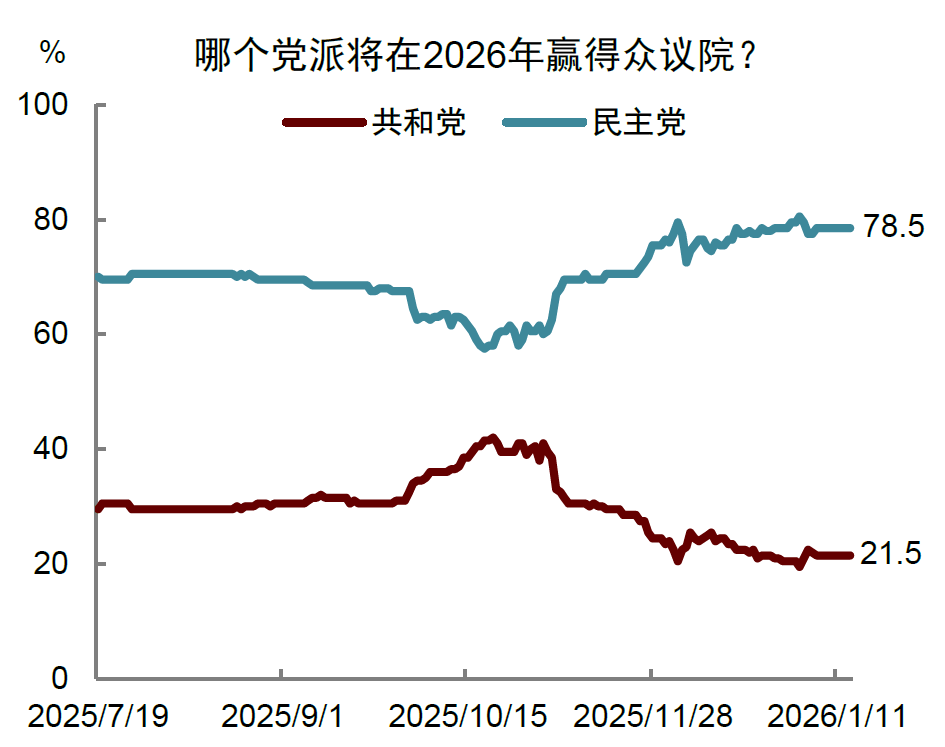
Core Insights - The 2026 midterm elections are crucial for Trump and the Republican Party, with a focus on affordability issues due to high prices, interest rates, and housing costs [1][3][5] - Voter sentiment is shifting towards immediate economic pressures rather than traditional growth metrics, indicating a need for policy responses that address affordability [2][5] Economic Context - High inflation has persistently affected low- and middle-income households, particularly in housing, where affordability has significantly declined since 2022 [1][10] - The rising mortgage rates, which increased from approximately 3% in 2021 to around 6% currently, have exacerbated housing affordability issues [10][14] - Consumer debt pressures are also rising, with significant increases in overdue payments on credit cards, auto loans, and student loans [11][15] Policy Implications - As affordability becomes a central policy goal, there is a shift towards more direct interventions in pricing, interest rates, and corporate behavior [20][21] - Recent actions by Trump include proposals to limit credit card interest rates to 10% and push for legislative measures to prevent large institutional investors from buying single-family homes [21][22] - The administration's focus on affordability may lead to more aggressive policies that could disrupt markets, as seen in historical precedents [29][27] Market Reactions - The market's perception of election-year policies is cautious, with concerns that aggressive affordability measures could lead to volatility in asset prices [2][29] - Sectors with strong pricing power and high profit margins may face increased policy risks as the narrative shifts towards wealth redistribution [29][30] - Conversely, cost-benefit industries may become more favorable for investment as they align with the affordability focus [30]
中金:2026年核心主题或并非“刺激经济过热” 而是缓解生活成本压力——对美投资的三点启示
Zhi Tong Cai Jing· 2026-01-20 23:57
Group 1 - The 2026 midterm elections in the U.S. are crucial for Trump, with public sentiment shifting towards affordability issues due to high prices, interest rates, and housing costs [1][2] - The focus on affordability indicates that economic growth or asset price increases are no longer the top priorities; addressing the public's financial pressures is now more critical [2][3] - The rising cost of living has significantly impacted low- and middle-income households, particularly in housing, where rising home prices and mortgage rates have decreased affordability since 2022 [2][3] Group 2 - As affordability becomes a central goal, policy approaches may shift towards more direct interventions affecting prices, interest rates, and corporate behavior [3] - Historical trends suggest that when affordability dominates the agenda, policies may become more aggressive, potentially disrupting markets [3] - The investment outlook for the U.S. market indicates limited expansion in index valuations, increased volatility, higher policy risks for monopolistic sectors, and a favorable position for cost-benefit industries [3]
中金 | 选举的另一面:行政干预、资本让利与政策风险
中金点睛· 2026-01-20 23:37
Core Viewpoint - The 2026 midterm elections are crucial for Trump and the Republican Party, with affordability becoming the central issue for voters, overshadowing traditional economic growth metrics [2][5][7]. Group 1: Political Context - The Republican Party holds a slim majority in the House of Representatives, and losing it could lead to a divided government, limiting Trump's ability to implement policies [5][6]. - Historical trends indicate that the party of the sitting president often loses seats in midterm elections, increasing the risk of impeachment for Trump if the Republicans fail [6][7]. Group 2: Affordability Crisis - High inflation has significantly impacted middle and low-income households, particularly in housing, where affordability has sharply declined since 2022 [2][12]. - The median income required to afford a typical home has increased by 43% compared to the median household income, exacerbated by rising mortgage rates [12][14]. - The burden of debt repayment is rising, with delinquency rates on credit cards and loans nearing previous highs, indicating increased financial stress among households [13][18]. Group 3: Policy Implications - As affordability becomes a primary goal, policy measures may shift towards more direct interventions in pricing and corporate behavior, moving away from traditional macroeconomic policies [3][22]. - Recent actions by Trump include proposals to limit credit card interest rates and push for legislative changes in housing, reflecting a focus on alleviating cost pressures for voters [24][25]. Group 4: Market Impact - The focus on affordability may limit the expansion of index valuations and increase market volatility, as the government prioritizes voter concerns over asset price growth [32]. - Sectors with strong pricing power and high profit margins may face increased policy risks, while cost-benefit industries could become more favorable for investment [32][33]. - Historical examples suggest that aggressive policy interventions can lead to market disruptions, as seen in the 1970s, raising caution among investors regarding potential policy risks [30][31].
纽约联储调查:美国消费者通胀预期持稳 对就业前景看法有所改善
智通财经网· 2025-12-08 23:53
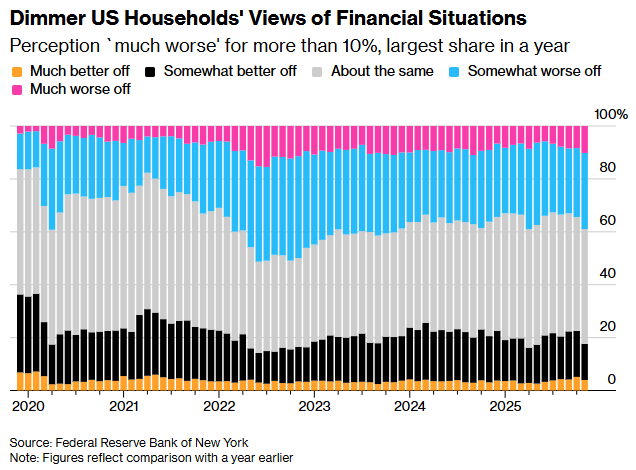
Group 1 - The core viewpoint of the articles highlights the stability of consumer inflation expectations in the U.S. for November, with a maintained one-year inflation expectation of 3.2% and a three to five-year expectation of 3% [1] - The New York Fed's survey indicates an improvement in consumer sentiment regarding the job market, with the probability of unemployment decreasing to 13.8%, the lowest level this year [1] - Despite the positive outlook on employment, a significant portion of households reported worsening financial conditions, with 39% stating their financial situation is worse than a year ago, the highest level in two years [1] Group 2 - Senior aides to former President Trump are urging him to address inflation and economic issues more effectively, as concerns over living costs are impacting his presidency and the Republican Party [4] - Trump has dismissed the focus on "affordability" as a Democratic narrative, claiming it is a misleading term that does not resonate with the public [5] - There are plans for Trump to shift his public engagements to focus more on economic issues, especially in light of the upcoming midterm elections, with a particular emphasis on addressing inflation [5][6]