地方政府债券

Search documents
财政收入稳增长基础牢固 支出延续“早发快用”
Zheng Quan Shi Bao· 2025-12-28 17:56
Group 1 - The core viewpoint emphasizes the continuation of a more proactive fiscal policy in 2026, aiming to enhance precision and effectiveness in fiscal spending [1] - The expansion of total spending requires higher demands for the effective use of available financial resources, with experts predicting a larger fiscal spending scale in 2026, maintaining an "early start and quick use" approach [1][4] - Fiscal revenue is expected to recover due to stable economic growth, with tax revenue accounting for approximately 68% of total fiscal revenue in the first eleven months of 2025, driven by domestic consumption and improved corporate profits [2][3] Group 2 - The fiscal expenditure for 2026 is projected to maintain a front-loaded approach, with local government bond issuance plans indicating a scale of nearly 1.2 trillion yuan for the first quarter [4][5] - The issuance of replacement bonds and special bonds is expected to follow a sequence that prioritizes debt relief before investment, with a focus on balancing the issuance of various types of bonds [5] - To enhance local financial capacity, there is a need to increase transfer payment scales and improve their effectiveness, particularly in underdeveloped regions [6][7]


明年一季度地方计划发债超万亿
Sou Hu Cai Jing· 2025-12-22 13:30
Core Viewpoint - Local governments are set to issue over 1 trillion yuan in bonds in early 2024 to support major project construction, reflecting a proactive fiscal policy aimed at stabilizing the economy and addressing hidden debt risks [1][2][4]. Group 1: Bond Issuance Plans - As of December 22, at least 14 provinces and municipalities have announced plans to issue local government bonds, with a cumulative issuance scale nearing 1.2 trillion yuan for the first quarter of 2024 [1][2]. - Jiangsu province plans to issue a total of 1,056 billion yuan in government bonds in the first quarter, including 700 billion yuan in new bonds and 356 billion yuan in refinancing bonds [2][4]. - The actual bond issuance scale for the first quarter is expected to exceed the currently disclosed 1.2 trillion yuan as more provinces announce their plans [5]. Group 2: Debt Management and Policy - The National People's Congress requires approval for the total amount of new local government debt each year, which typically leads to concentrated bond issuance in the second half of the year [2]. - The State Council has been authorized to advance the issuance limits for the following year, allowing local governments to receive part of the new debt issuance quota early [2][3]. - The 2026 new local government debt limit is expected to be set at 60% of the previous year's limit, which would be approximately 3.12 trillion yuan based on the 2025 limit of 5.2 trillion yuan [3]. Group 3: Economic Impact and Investment - The central government has emphasized the need for a more proactive fiscal policy in 2026 to stabilize investment, especially as fixed asset investment has seen a decline [4]. - Early bond issuance is anticipated to facilitate the commencement of significant projects, laying a solid foundation for economic growth in 2026 [4]. - The issuance of refinancing bonds is expected to be larger than new bonds, aimed at repaying old debts and alleviating hidden debt risks [6]. Group 4: Optimization of Bond Management - The Chinese government plans to optimize the management of local government special bonds to enhance their effectiveness and efficiency [7]. - A pilot program for "self-examination and self-issuance" of special bond projects has been implemented in several provinces, allowing local governments more flexibility in issuing bonds without national approval [7].
明年一季度地方计划发债超万亿,积极财政政策靠前发力
Di Yi Cai Jing· 2025-12-22 12:48
Core Viewpoint - Local governments are planning to issue government bonds early next year to support major project construction, which will lay a solid foundation for economic growth in 2026 and ensure a good start for the "14th Five-Year Plan" [1][4] Group 1: Bond Issuance Plans - At least 14 provinces and cities have publicly disclosed plans to issue government bonds in the first quarter of next year, with a cumulative issuance scale nearing 1.2 trillion yuan [1][2] - Jiangsu plans to issue a total of 105.6 billion yuan in government bonds in the first quarter, including 70 billion yuan in new bonds and 35.6 billion yuan in refinancing bonds [2] - Ningbo is set to issue 32.6 billion yuan in new special bonds and 1 billion yuan in new general bonds in early January [5] Group 2: Debt Management and Risk Mitigation - The issuance of new bonds is primarily for project construction, while refinancing bonds are used to repay old debts, alleviating hidden debt risks [6] - The Ministry of Finance plans to issue 2 trillion yuan in refinancing bonds in 2026 to replace 2 trillion yuan of existing hidden debts, aiming to ease local government debt pressure [6] - The early issuance of local government debt limits is expected to follow a 60% ratio of the previous year's new debt limit, which for 2025 is set at 5.2 trillion yuan, meaning the 2026 limit cannot exceed 3.12 trillion yuan [3] Group 3: Policy Support and Strategic Focus - The Central Economic Work Conference emphasized the need for a more proactive fiscal policy in 2026 to stabilize investment and support major projects [4] - The Ministry of Finance will continue to guide local governments in accelerating project preparation and optimizing the review mechanism for special bond projects [8] - The pilot program for "self-examination and self-issuance" of special bonds will be expanded, allowing local governments more flexibility in issuing bonds without national review [7][8]
前11月财政数据最新发布,财政收入延续低增长态势
Di Yi Cai Jing· 2025-12-17 09:11
Core Viewpoint - The overall fiscal performance in China for the first eleven months of 2025 shows stable growth in major tax categories, despite low growth in total fiscal revenue and challenges in the real estate sector [2][3]. Revenue Performance - Total general public budget revenue reached approximately 20.1 trillion yuan, with a year-on-year growth of 0.8%, consistent with the previous ten months [2] - Tax revenue, a key economic indicator, amounted to about 16.5 trillion yuan, reflecting a year-on-year increase of 1.8% [2] - In November, tax revenue was approximately 1.15 trillion yuan, showing a growth of 2.8% compared to the same month last year [2] - Major tax categories, including domestic VAT, corporate income tax, domestic consumption tax, and personal income tax, experienced stable growth rates of 3.9%, 1.7%, 2.5%, and 11.5% respectively [2] - The significant growth in personal income tax is attributed to an active capital market and increased income from dividends [2] Real Estate Impact - The real estate sector continues to negatively impact related tax revenues, with contract tax declining by 14.3% and land value-added tax decreasing by 17.3% year-on-year [3] Non-Tax Revenue - Non-tax revenue for the first eleven months was approximately 3.6 trillion yuan, reflecting a year-on-year decrease of 3.7% [4] - The decline in non-tax revenue is linked to stricter regulations on penalty income and limited growth potential from previously enhanced asset management [4] Government Fund Revenue - Government fund budget revenue, primarily from land sales, was about 4 trillion yuan, down 4.9% year-on-year, with land sale income decreasing by 10.7% [5] - The decline in land sale revenue has widened compared to previous months, indicating ongoing challenges in the real estate market [5] Fiscal Expenditure - General public budget expenditure reached approximately 24.9 trillion yuan, with a year-on-year growth of 1.4% [5] - Government fund budget expenditure was about 9.2 trillion yuan, showing a significant increase of 13.7% [5] - Expenditure on social security, health, and education has outpaced the average growth rate, with increases of 8.1%, 4.7%, and 4.4% respectively [5] Policy Measures - To maintain fiscal spending strength and stabilize economic operations, the Ministry of Finance allocated 500 billion yuan from local government debt limits for effective investment [6] - A total of 500 billion yuan in new policy financial tools has been fully deployed, supporting over 2,300 projects with a total investment of approximately 7 trillion yuan [6]
经济大省发债图谱:GDP前五拿了全国三分之一发债额度
Di Yi Cai Jing· 2025-12-11 13:09
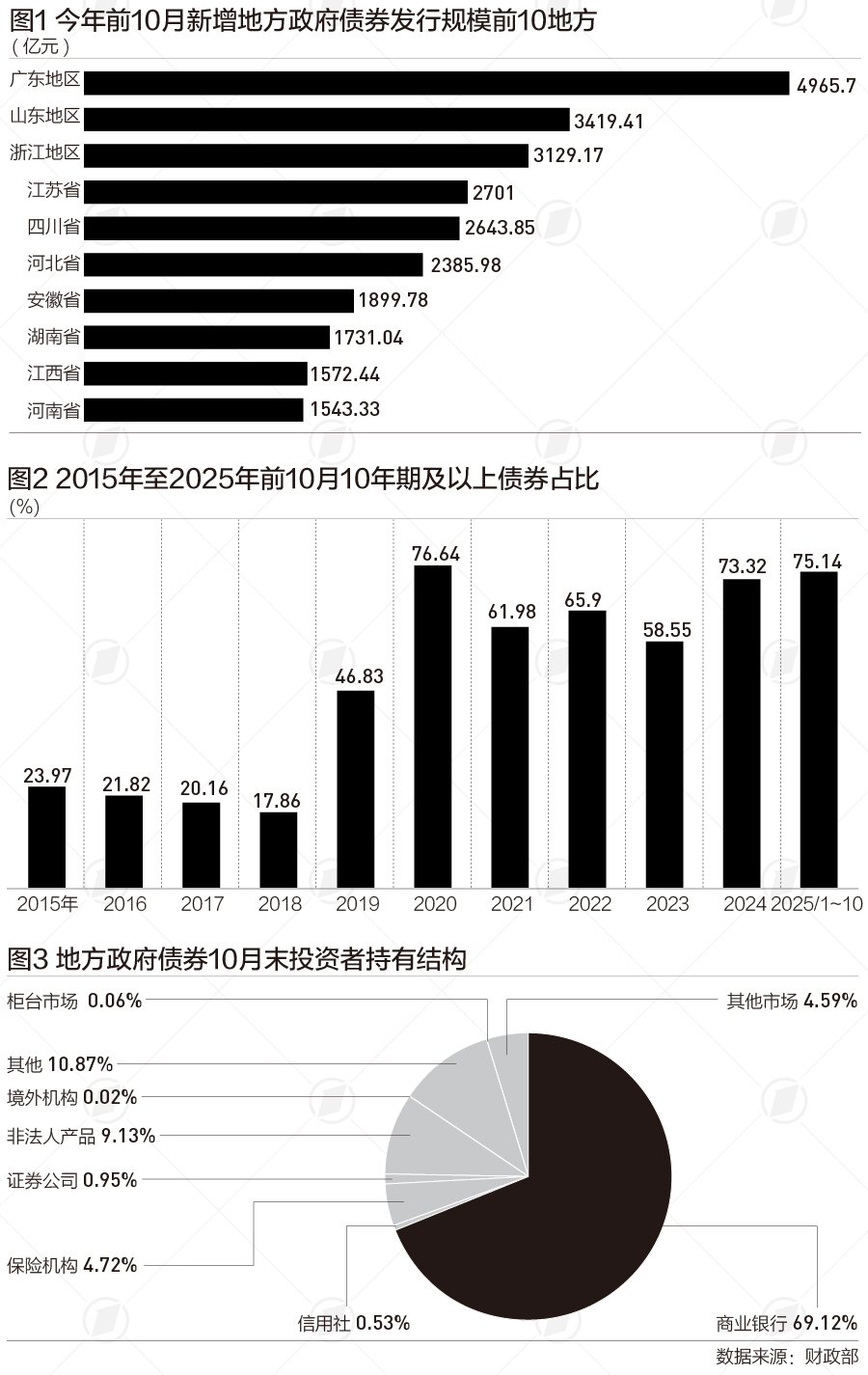
Group 1 - The core viewpoint of the articles highlights the significant issuance of local government bonds in China, with a total of approximately 4.7 trillion yuan issued in the first ten months of the year, and an expected total issuance of about 5.4 trillion yuan for the entire year [2][3] - The top five provinces in terms of bond issuance are Guangdong, Shandong, Zhejiang, Jiangsu, and Sichuan, which collectively account for about 34% of the total newly issued bonds [2][3] - Local government bonds are primarily used for project construction, serving as a crucial funding source for local governments amid fiscal challenges [3][9] Group 2 - The issuance of refinancing bonds is also significant, primarily aimed at repaying old debts, with provinces having higher debt repayment needs receiving more refinancing bond quotas [3] - As of December 11, the total issuance of local government bonds, including refinancing bonds, reached approximately 10.2 trillion yuan, with Jiangsu and Guangdong leading in total issuance [9] - New regulations allow ten provinces to conduct "self-examination and self-issuance" of special bonds, streamlining the bond issuance process [9] Group 3 - The average issuance term of local government bonds has increased to 15.56 years, reflecting a trend towards longer-term financing [9] - As of the end of October, the total local government debt balance was approximately 54.01 trillion yuan, remaining within the approved debt limit of about 57.99 trillion yuan [10] - The investor base for local government bonds is diversifying, with a notable increase in non-bank investors, although banks still hold the majority of these bonds [10]
多省公开 5000亿增量债务所获额度
Sou Hu Cai Jing· 2025-12-10 16:53
Group 1 - The central government has allowed local governments to issue an additional 500 billion yuan in bonds in the fourth quarter to stabilize the economy and mitigate risks [1] - As of December 10, at least 18 provinces and municipalities have adjusted their budgets in response to the allocation of the 500 billion yuan bond limit [1][2] - The distribution of the bond limit has been clarified, with Jiangsu, Zhejiang, Sichuan, Shenzhen, Qingdao, Xinjiang, and Jilin receiving significant portions of the total [1][3] Group 2 - As of the end of October, the total balance of local government bonds in China was approximately 54.01 trillion yuan, with a debt limit of 57.99 trillion yuan approved by the National People's Congress [2] - The 500 billion yuan allocation from the debt limit includes 300 billion yuan to support local governments in resolving existing project debts and 200 billion yuan for project construction in major economic provinces [2] - Local governments have begun issuing bonds aggressively since November, with total issuance exceeding 1 trillion yuan, driven by the new bond limits [3][4] Group 3 - Jiangsu province received 53.5 billion yuan from the bond limit, with 23.5 billion yuan allocated for refinancing and 30 billion yuan for specific project support [3] - The adjustment of budgets in provinces like Jiangsu has led to increased public budget revenues and expenditures, reflecting the impact of the new bond issuance [4] - Experts suggest that the rapid issuance of the 500 billion yuan bond limit will alleviate fiscal pressures and promote effective investment, aiding economic stability [4]
今年10万亿元地方政府债券资金花哪儿了?|财税益侃
Di Yi Cai Jing· 2025-12-04 13:12
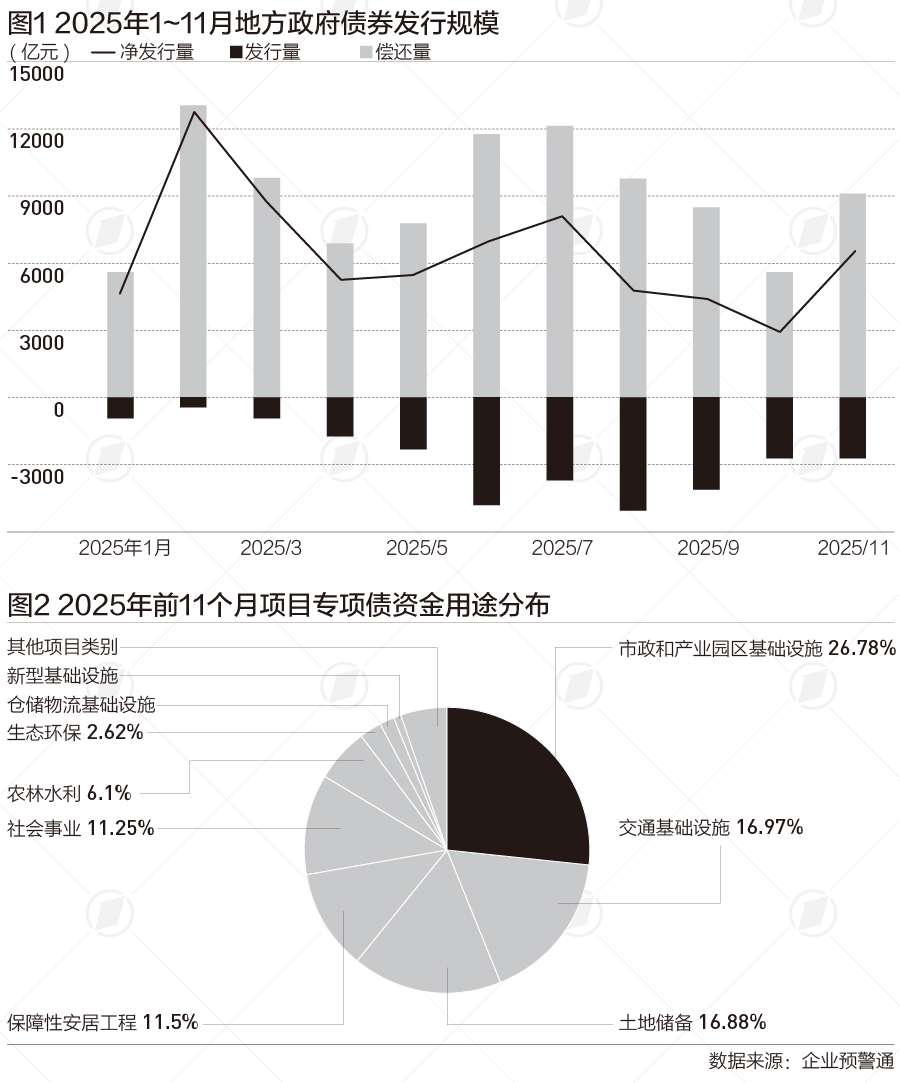
Core Viewpoint - The issuance of local government bonds in China has reached a historic high this year, with a significant portion of the funds allocated for debt repayment rather than new projects [2][3]. Group 1: Local Government Bond Issuance - In the first 11 months of this year, approximately 10 trillion yuan of local government bonds were issued, surpassing last year's total of about 9.8 trillion yuan [2]. - The issuance of refinancing bonds accounted for about 4.8 trillion yuan, a year-on-year increase of approximately 20%, while new bond issuance was about 5.2 trillion yuan, up about 11% year-on-year [2][3]. - Approximately 62% of the bond funds issued were used for repaying old debts, including refinancing existing hidden debts and settling overdue payments to enterprises [3][6]. Group 2: Allocation of Funds - Of the funds allocated for project construction, about 27% was directed towards municipal and industrial park infrastructure, 17% towards transportation infrastructure, and 12% towards affordable housing projects [6]. - This year, the scope of special bonds has significantly expanded, allowing for allocations towards land reserves, which previously were restricted, with over 500 billion yuan directed to such projects [6]. - Special bonds have also been allocated for government investment funds, exceeding 80 billion yuan, aimed at supporting early-stage technology enterprises and hard technology sectors [6]. Group 3: Debt Management and Risks - As of September 2025, the total local government debt is projected to be around 53.7 trillion yuan, remaining within the limit of approximately 57.9 trillion yuan [8]. - The average remaining maturity of local government bonds is 10.5 years, with an average interest rate of 2.86% [8]. - There is a need for careful management of local government debt growth to ensure long-term fiscal sustainability, with suggestions to optimize the debt structure between central and local governments [8].
地方政府发债首次突破10万亿元
第一财经· 2025-12-02 07:16
2025.12. 02 本文字数:1373,阅读时长大约2分钟 作者 | 第一财经 陈益刊 根据数据平台机构企业预警通数据,截至12月2日,全国地方政府债券发行规模约为10.1万亿元。 长期关注地方债的中央财经大学教授温来成告诉第一财经,地方政府债券发行规模首次突破10万亿 元具有里程碑式意义。总体来看,近些年地方政府债券发行规模增长较快,目前地方政府债务余额已 经超过50万亿元,但债务余额控制在限额之内,总体来说债务风险安全可控,但需要警惕债务过快 增长对中长期地方财政可持续性的挑战。 第一财经记者查阅中国人民银行及财政部发布的官方数据发现,这是年度地方政府债券发行规模历史 上首次突破10万亿元。 根据财政部数据,截至2025年9月末,全国地方政府债务余额约53.7万亿元,这控制在债务限额之内 (57.9万亿元)。 此前财政部公开表示,目前从国际比较来看,中国政府负债率(2024年底为68.7%)显著低于主要 经济体和新兴市场国家。从举债用途看,我国地方政府债务形成了大量有效资产。我国地方政府债务 主要用于资本性支出,支持建设了一大批交通、水利、能源等项目,很多资产正在产生持续性收益, 既为经济高质量发展提 ...
地方政府发债首次突破10万亿元
Di Yi Cai Jing· 2025-12-02 06:35
Core Insights - The issuance of local government bonds in China has surpassed 10 trillion yuan for the first time, marking a significant milestone in the history of local government financing [2][4] - The total local government debt has exceeded 50 trillion yuan, but remains within the set limits, indicating that overall debt risk is manageable [2][4] - The rapid growth of local government debt poses challenges to the long-term sustainability of local finances, necessitating caution [2][4] Summary by Sections Local Government Bond Issuance - As of December 2, the total issuance of local government bonds reached approximately 10.1 trillion yuan, a historic first [2] - The issuance has shown a consistent upward trend since the implementation of the new budget law in 2015, which granted provinces the authority to issue bonds [2][3] Historical Context - Prior to 2015, local government bond issuance was limited, with only 0.4 trillion yuan issued in 2014 [2] - The issuance surged to 3.8 trillion yuan in 2015 due to debt replacement plans, and continued to rise, reaching over 6 trillion yuan in 2020 and 7 trillion yuan in 2021 [3] Current Debt Levels and Management - By September 2025, the total local government debt was approximately 53.7 trillion yuan, well within the debt ceiling of 57.9 trillion yuan [4] - China's government debt ratio is significantly lower than that of major economies, with a projected ratio of 68.7% by the end of 2024 [4] Future Directions - The government plans to optimize the structure of debt issuance to ensure fiscal sustainability and economic health [5] - There is a call for better management of local government bond growth and enhanced performance management to improve the efficiency of fund usage [5]
一次性取得跨年度租金收入如何缴纳增值税?
蓝色柳林财税室· 2025-11-24 01:04
Group 1 - The article discusses the tax exemption policy for small-scale taxpayers with monthly sales below 100,000 yuan, which is effective until December 31, 2027 [12] - It highlights that individuals purchasing newly issued government bonds, local government bonds, and financial bonds can benefit from the VAT exemption policy as per the announcement by the Ministry of Finance and the State Taxation Administration [12] - The relevant announcement (Announcement No. 19 of 2023) specifies that interest income from these bonds will be eligible for the small-scale taxpayer exemption [11][12]