
对台军售

Search documents
美对台军售创历史之最 台舆论批赖“卖台引战”玩火自焚
Yang Shi Wang· 2025-12-26 08:17
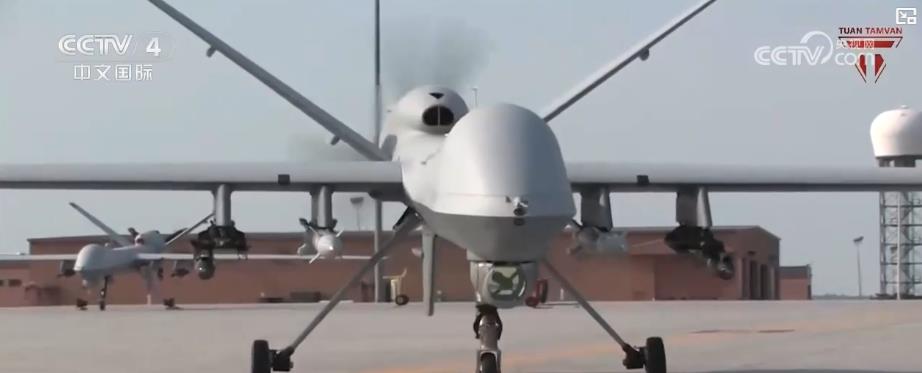
Group 1 - The U.S. government has approved a record-breaking arms sale to Taiwan, amounting to $11 billion, which has sparked criticism in Taiwan regarding the implications of being used as a pawn in strategic games [1][3][7] - The arms package includes advanced weaponry such as the HIMARS rocket system, suicide drones, Javelin and TOW anti-tank missiles, and M109A7 self-propelled howitzers, emphasizing a shift towards lightweight and precision "anti-landing" capabilities [3][5] - The approval process for this arms sale was unusual, as it occurred without a formal request from Taiwan's government or legislative approval, indicating a significant shift in the dynamics of U.S.-Taiwan relations [5][7] Group 2 - The increasing frequency and scale of arms sales to Taiwan highlight the U.S.'s strategic opportunism, raising concerns that Taiwan is being sacrificed in broader geopolitical conflicts [7][9] - Criticism has been directed at Taiwan's leadership for escalating tensions and promoting a state of near-war, with some officials attempting to normalize the massive military expenditures as necessary for defense [7][9] - The Chinese government has responded by urging the U.S. to cease its military support for Taiwan and to adhere to the One China principle, warning against any actions that could provoke a strong response [9]

军事专家:美对台军售力度越大 解放军应战能力越强
Xin Lang Cai Jing· 2025-12-26 05:41
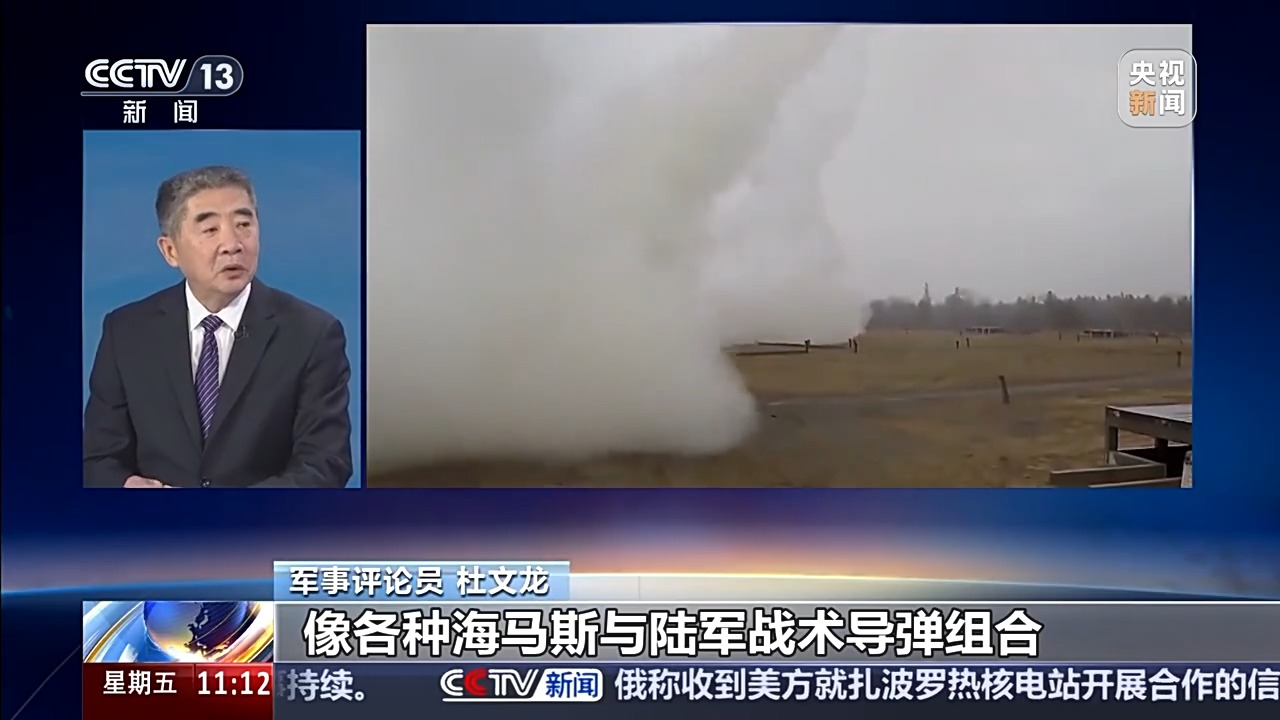
Group 1 - The U.S. announced a sale of weapons and equipment to Taiwan worth up to $11.1 billion, which China views as an attempt to hinder its reunification efforts [1] - The Chinese Ministry of Defense emphasized that no amount of advanced weapon sales to Taiwan can prevent China's eventual reunification and that the People's Liberation Army (PLA) will continue to strengthen its training and preparedness [1] - The PLA's training actions around Taiwan will now have new standards and requirements due to the U.S. arms sale [1] Group 2 - Military commentator Du Wenlong stated that the combination of various systems like HIMARS and army tactical missiles will elevate the PLA's air defense and missile defense capabilities [3] - The focus will shift to simulating the characteristics and strike effects of tactical missiles, enhancing the PLA's operational readiness [3] - The PLA will adapt its training and operational plans dynamically based on changes in the battlefield and the development of combat capabilities [3][5] Group 3 - Du Wenlong highlighted the need for increased combat readiness in the Taiwan Strait, indicating that the strategic level has reached a state of actual combat [5] - The PLA aims to enhance its operational capabilities in response to the evolving strategic situation in the Taiwan Strait [5] - The stronger the U.S. arms sales to Taiwan, the more robust the PLA's response and combat capabilities will become [5]
央视披露:美对台超110亿美元军售包括“海马斯”火箭炮、自杀无人机、反坦克导弹、自行榴弹炮;专家:美国“出兵协防”可能性越来越小
Mei Ri Jing Ji Xin Wen· 2025-12-25 00:51
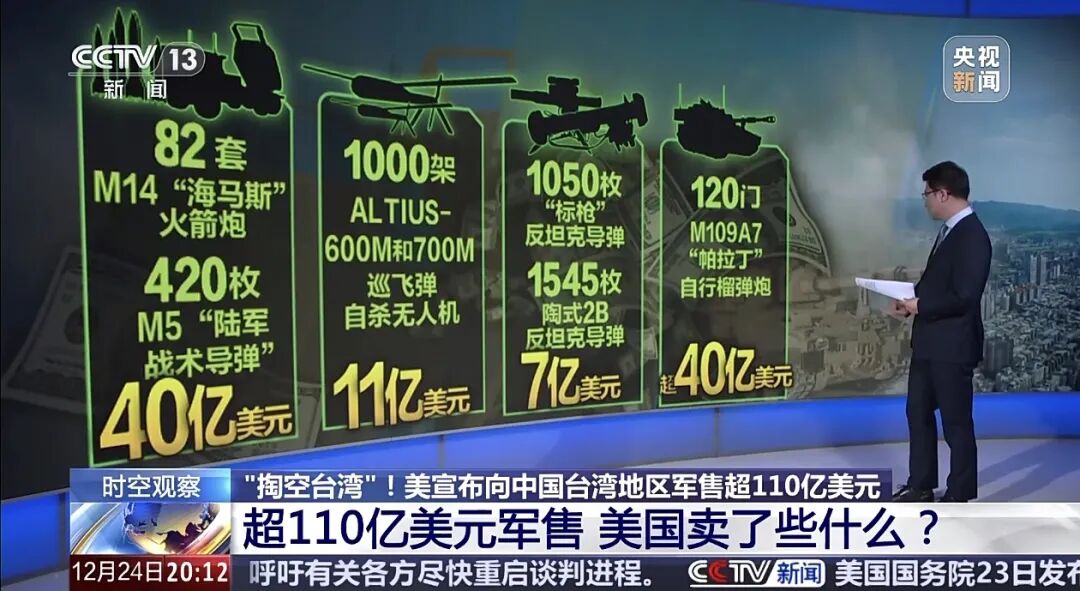
Group 1 - The core point of the article is the announcement of a record-breaking arms sale from the United States to Taiwan, totaling over $11 billion, which is the largest in history for such transactions [1][10]. - The arms sale includes four main components: 82 sets of M142 "HIMARS" rocket systems and 420 M57 "Army Tactical Missiles" valued at $4 billion, 1,000 ALTIUS-600M and 700M suicide drones worth $1.1 billion, 1,050 "Javelin" anti-tank missiles and 1,545 TOW 2B anti-tank missiles totaling $700 million, and 120 M109A7 "Paladin" self-propelled howitzers valued at over $4 billion [3][5][4]. Group 2 - The military analyst Shao Yongling noted that the choice of these specific weapons aims to enhance Taiwan's defense capabilities, particularly against potential land invasions [3][7]. - The article highlights concerns within Taiwan regarding the financial implications of such a large military expenditure, with fears that it may deplete Taiwan's economic resources and impact social welfare and education budgets [10][12]. - There is a prevailing sentiment among Taiwanese scholars that the arms sale may ultimately be detrimental to Taiwan, as it positions the island as a pawn in U.S. strategic interests without direct military support from the U.S. [12][14]. Group 3 - The article discusses the broader implications of U.S. actions on Taiwan's economy, including increased military spending that could lead to a significant portion of Taiwan's budget being allocated to defense, thereby affecting other sectors [16][18]. - The ongoing U.S. strategy is perceived as a method to extract economic value from Taiwan, particularly in the semiconductor industry, which is crucial for Taiwan's competitive edge [13][14]. - The potential for increased economic disparity in Taiwan, referred to as "Taiwan disease," is highlighted, suggesting that the arms sale and related economic policies could exacerbate existing inequalities [18].
超111亿美元,对台军售美国究竟意欲何为?军事专家犀利点评
Yang Shi Wang· 2025-12-24 07:06
Group 1 - The core viewpoint of the article emphasizes that no amount of advanced weapon sales to Taiwan can prevent China's eventual reunification, and China will take necessary measures to safeguard its sovereignty and territorial integrity [1] - The recent arms sale from the U.S. to Taiwan amounts to over $11.1 billion, marking the largest arms sale in history to Taiwan, with a focus on anti-landing combat equipment [3] - The arms package includes 82 sets of M142 "HIMARS" rocket launchers and 420 M57 "Army Tactical Missiles," valued at $4 billion, which will increase Taiwan's total HIMARS to 111 sets [5] Group 2 - The arms sale also features 1,000 ALTIUS-600M and 700M suicide drones, valued at $1.1 billion, capable of targeting armored land vehicles and surface ships [5] - Additionally, the package includes 1,050 "Javelin" anti-tank missiles and 1,545 TOW-2B anti-tank missiles, totaling $700 million, aimed at post-landing heavy armored targets [5] - The sale further comprises 120 M109A7 "Paladin" self-propelled howitzers, valued at over $4 billion, which will complement the HIMARS systems [5] Group 3 - The U.S. strategy appears to focus on enhancing Taiwan's anti-landing capabilities while reducing the likelihood of direct military intervention, indicating a shift towards accelerating Taiwan's armament [7] - This approach aims to maximize the costs for China in pursuing reunification, while also suggesting that the U.S. is preparing for a potential abandonment of Taiwan by profiting from arms sales [7]
蓝白弹劾赖清德,美国武装赖清德
经济观察报· 2025-12-22 10:26
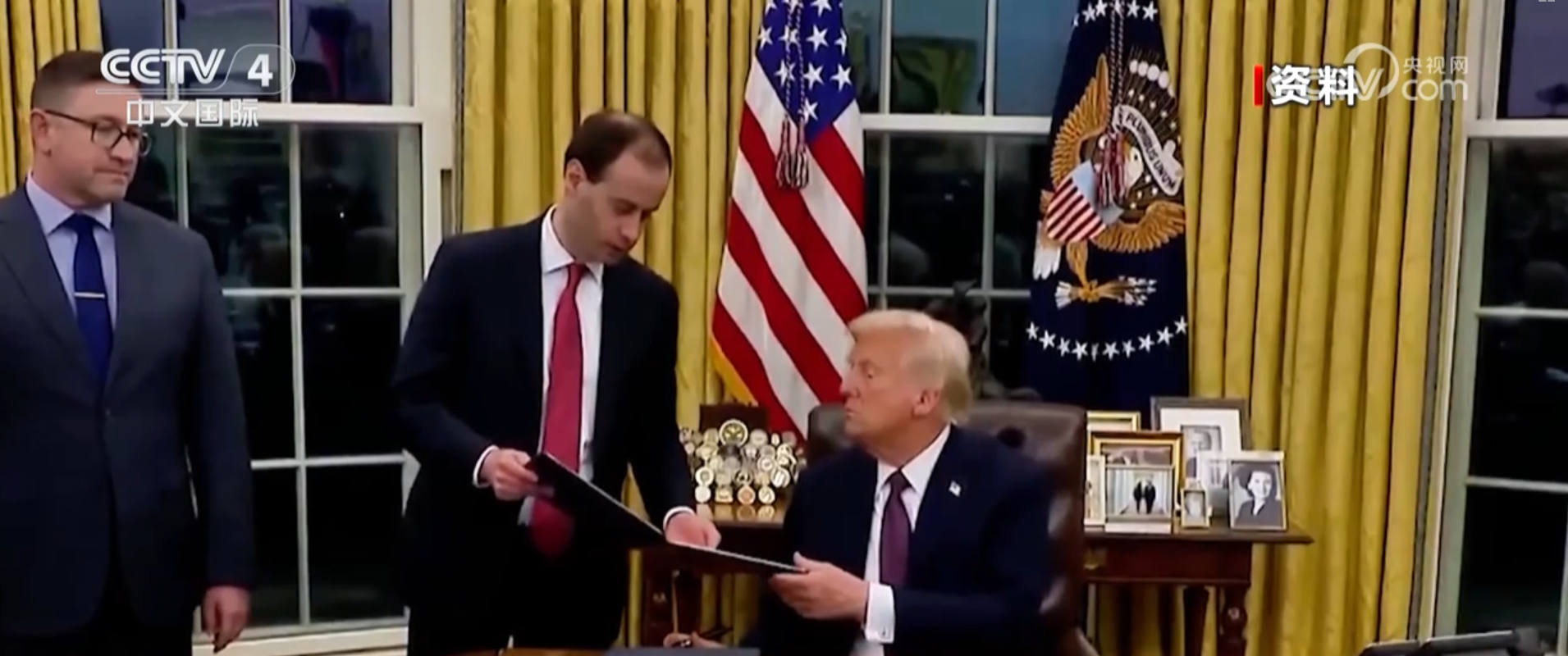
Group 1 - The core viewpoint of the article suggests that the Kuomintang (KMT) and the Taiwan People's Party (TPP) should take more aggressive actions against Lai Ching-te, rather than merely initiating an impeachment process that is unlikely to succeed [1][9] - The KMT and TPP have launched an impeachment procedure against Lai Ching-te in the Legislative Yuan, with over 6 million signatures collected in support from the public within 24 hours, reflecting significant public sentiment [3][4] - The impeachment process requires more than half of the Legislative Yuan members to propose it, which the KMT and TPP can achieve, but they lack the necessary two-thirds majority to pass the resolution [4][5] Group 2 - The article highlights that the impeachment process is more of a publicity campaign aimed at raising awareness of Lai Ching-te's actions and boosting the KMT and TPP's political standing, rather than a feasible legal action [7] - A significant arms sale from the U.S. to Taiwan, amounting to approximately $11.1 billion, is noted as the largest military sale to Taiwan to date, which the Lai administration has welcomed as a sign of strong U.S.-Taiwan relations [8] - The article emphasizes the importance of understanding China's potential countermeasures in response to U.S. arms sales to Taiwan, as well as the implications for cross-strait military dynamics [10][11]
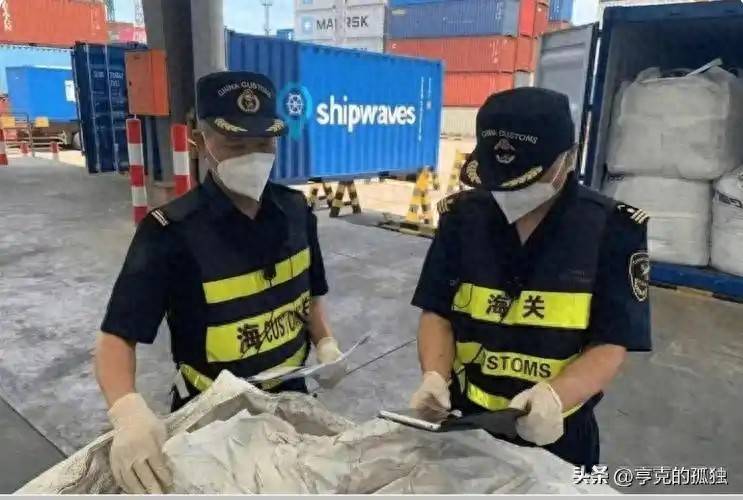
中方追回96吨锑锭,13万吨订单被消除!终于破案,要跟美国算总账
Sou Hu Cai Jing· 2025-12-20 06:13
Group 1 - The core issue revolves around China's response to U.S. actions, specifically the smuggling of antimony and the cancellation of a significant wheat order, indicating a strategic defense of national resources [1][6][18] - A major smuggling case involving 166 tons of antimony was uncovered, with 96 tons successfully seized by customs, highlighting the importance of this strategic resource in military and semiconductor applications [3][5][6] - The U.S. has a limited supply of antimony, relying heavily on imports, which has led to increased illegal activities to secure this resource, particularly for military purposes [6][12] Group 2 - The U.S. recently approved a record $11.154 billion arms sale to Taiwan, which has raised concerns about escalating tensions in the Taiwan Strait and the implications for U.S.-China relations [8][12] - The arms sale is perceived as a political maneuver by the U.S. to exploit Taiwan economically while simultaneously supporting pro-independence sentiments, further complicating the geopolitical landscape [12][13] - Following the arms sale announcement, China canceled a wheat order of 132,000 tons from the U.S., valued at over $24 million, signaling the economic repercussions of U.S. military actions [17][18]
外交部例行记者会 / MFA Regular Press Conference (2025年12月19日)
Xin Lang Cai Jing· 2025-12-20 05:46
Group 1 - The U.S. has approved large-scale arms sales to Taiwan, which China views as a serious interference in its internal affairs and a threat to its sovereignty and territorial integrity [5][6][9] - China has lodged a strong protest against the U.S. arms sales, emphasizing that any actions to arm Taiwan will face serious consequences and disrupt peace in the Taiwan Strait [7][10] - The Chinese government asserts that the real threat to peace in the Taiwan Strait comes from Taiwan's independence movements and external interference, not from China's actions [8][9] Group 2 - The "National Defense Authorization Act for Fiscal Year 2026" signed by the U.S. includes negative content regarding China, which China strongly opposes and has protested [15][16] - China urges the U.S. to adopt a rational view of China's development and to refrain from implementing negative provisions in the Act, warning of strong measures if the U.S. continues its current course [17] Group 3 - Reports indicate that Japan is considering acquiring nuclear weapons, which China views as a dangerous ambition that undermines international law and stability [18][19] - China criticizes Japan's militaristic tendencies and urges Japan to reflect on its historical actions and adhere to international commitments regarding nuclear non-proliferation [20][23] Group 4 - China expresses concern over the situation in Bangladesh ahead of its parliamentary elections, wishing for a safe and stable electoral process [31] - The Chinese government emphasizes the importance of maintaining national unity and stability in Bangladesh during this critical period [31]
超110亿美元!特朗普为何推出史上最高金额对台军售?
Bei Jing Ri Bao Ke Hu Duan· 2025-12-19 23:39
Core Viewpoint - The U.S. State Department approved a record arms sale to Taiwan worth up to $11.1054 billion, marking the highest single arms sale since the Taiwan Relations Act in 1979, reflecting a significant shift in U.S. military support for Taiwan under the Trump administration [1][4]. Group 1: Scale and Frequency of Arms Sales - The recent arms sale is unprecedented in scale, surpassing the previous record of $6.4 billion set in 2010 during the Obama administration [5]. - Under Biden's administration, there have been 19 rounds of arms sales to Taiwan totaling approximately $8.4 billion, with the largest single sale being $1.988 billion in October 2024 [5]. - The current sale of $11.1054 billion is 5.6 times larger than the largest sale during Biden's term and represents 107% of the total arms sales from 2020 to 2024 [5]. Group 2: Nature and Content of Arms Sales - The arms sale includes a mix of defensive and offensive weaponry, indicating a shift from "ambiguous defense" to "clear armament" aimed at enhancing Taiwan's military deterrence capabilities [6][8]. - Key components of the sale include 82 High Mobility Artillery Rocket Systems (HIMARS), 420 Army Tactical Missile Systems, and 60 self-propelled howitzers, which can strike targets hundreds of kilometers away [6]. - The sale also focuses on enhancing Taiwan's anti-armor capabilities with additional orders for Javelin and TOW-2B anti-tank missiles, as well as over $1 billion in anti-armor drones [6][7]. Group 3: Systematic Military Empowerment - The arms sale reflects a systematic shift in U.S. military support for Taiwan, moving from "scattered supplements" to "systemic empowerment" of Taiwan's military capabilities [8]. - The inclusion of Taiwan Tactical Network (TTN) and Tactical Awareness Kit (TAK) aims to enhance real-time battlefield awareness and connectivity among combat units [8]. Group 4: Political and Economic Calculations - The timing of the arms sale is influenced by domestic political needs, economic interests, and regional strategic considerations, particularly as the U.S. midterm elections approach [9][10]. - The arms sales serve as a tool for U.S. administrations to gain political capital and support from conservative voters while benefiting the military-industrial complex [10][12]. Group 5: Strategic Implications - The arms sale is part of a broader strategy to strengthen Taiwan's military capabilities amid escalating U.S.-China tensions, with a clear tilt towards offensive weaponry [14][15]. - The U.S. aims to create a heavily armed "combat fortress" in the Taiwan Strait, which could significantly alter the regional security landscape [15].
国防部:已向美方提出严正交涉
证券时报· 2025-11-17 15:00
Core Viewpoint - The article discusses the U.S. arms sale to Taiwan, valued at approximately $330 million, and China's strong opposition to this action, emphasizing the violation of the One China principle and the potential negative impact on Sino-U.S. relations [2]. Group 1: U.S. Arms Sale to Taiwan - The U.S. State Department has approved an arms sale to Taiwan, including "non-standard aircraft parts" and maintenance services, totaling around $330 million [2]. - This arms sale is seen as a serious violation of China's sovereignty and security interests, as well as an interference in China's internal affairs [2]. Group 2: China's Response - China expresses strong dissatisfaction and resolute opposition to the arms sale, having lodged a formal protest with the U.S. [2]. - The Chinese government warns that "arming Taiwan" will only lead to self-harm and that attempts to use Taiwan to contain China will not succeed [2]. - The article emphasizes that the Taiwanese authorities' reliance on foreign support for independence is destined to fail, and China will take all necessary measures to safeguard its sovereignty and territorial integrity [2].

早报国常会重磅部署!事关两重”建设、促消费;三星部分内存芯片提价60%
Sou Hu Cai Jing· 2025-11-14 23:26
Industry News - The China Securities Regulatory Commission held a report meeting to promote the spirit of the 20th National Congress, emphasizing the need for a more resilient and robust market, more inclusive and attractive regulations, higher quality and better value listed companies, and more effective regulatory enforcement [4] - The Shanghai Municipal Cyberspace Administration, in collaboration with various departments, has launched a special campaign to regulate online real estate information dissemination, focusing on combating false information and market manipulation related to the Shanghai real estate market [4] - The Financial Regulatory Bureau reported that by the end of Q3 2025, the total assets of China's banking financial institutions reached 474.3 trillion yuan, reflecting a year-on-year growth of 7.9% [5] - The Ministry of Commerce announced further measures to strengthen the management of second-hand car exports, including stricter controls on new cars exported under the guise of second-hand vehicles, effective from January 1, 2026 [5] Company News - Hezhong China announced a cumulative increase of 256% over 14 trading days, significantly outperforming the industry and the Shanghai Composite Index, and will be suspended for verification starting next week [6] - Industrial Fulian responded to rumors regarding order or outlook downgrades, stating that it has not released any related statements and that the progress and delivery pace of existing customer projects are normal [6] - Dazhihui announced that the plaintiff Wang Gongwei has withdrawn the lawsuit [7] - Zhongdian Port announced that the National Integrated Circuit Fund has reduced its shareholding in the company, reaching a threshold of 1% [8] - Putailai announced plans to invest 2.5 billion yuan in a film coating integrated project [9] - Changchun High-tech announced that its subsidiary Jin Sai Pharmaceutical has received approval for clinical trials of GS3-007a dry mixed suspension, with no similar products currently on the market [9] - Yiyuan Lithium Energy stated on an interactive platform that orders for energy storage batteries are robust, and it has taken the lead in mass production of 600Ah+ cells [12]