强者恒强

Search documents
楼市进入筑底关键期:改善性需求成为新房市场支撑
Mei Ri Jing Ji Xin Wen· 2025-10-25 00:42
Core Insights - The Chinese real estate market is entering a critical bottoming phase due to intensive policy measures since the second half of 2021, with a projected cumulative sale of approximately 5 billion square meters of new residential properties during the "14th Five-Year Plan" period [1][2]. Policy Signals - The real estate market has been in a continuous adjustment phase since the second half of 2021, with a decline in new residential property sales. Policies aimed at stabilizing the market have been implemented, including a focus on stopping the decline and promoting recovery [3][6]. Market Performance - From January to September 2025, the sales area of new residential properties was 6.58 million square meters, a year-on-year decrease of 5.5%, but the decline has narrowed by 11.6 percentage points compared to the previous year. The sales revenue was 6.3 trillion yuan, down 7.9% year-on-year, indicating a clear improvement trend despite remaining in negative territory [6][10]. Secondary Market Resilience - The secondary housing market has shown greater resilience, with a 10% year-on-year increase in transaction volume in 30 key cities from January to July 2025. By July, the proportion of secondary housing transactions reached 68%, a record high [6][10]. Market Segmentation - A clear "stronger stronger" market segmentation is emerging, with first-tier cities experiencing price increases in new homes, while second and third-tier cities face price declines. For instance, new home prices in first-tier cities rose by 6.87% year-on-year in September 2025, marking 27 consecutive months of increases [11][13]. Investment Focus - Real estate companies are increasingly focusing their investments on core cities, with significant land acquisition activity in cities like Shanghai, Beijing, and Chengdu, leading to record land prices. For example, a land parcel in Shanghai was sold for 34.135 billion yuan, setting a new record for total land price in the country [13][15]. Demand Shift - The demand structure in the new housing market is shifting towards improvement needs, with larger units (120-144 square meters) accounting for 30% of transactions in key cities from January to July 2025. In Beijing, units over 120 square meters made up 42% of sales [16][20]. High-End Market Dynamics - The high-end market is performing well, with significant sales in luxury properties. For instance, over 25 "sunshine plates" (properties sold out on the first day) were recorded in Shanghai, most priced above 100,000 yuan per square meter. However, this segment may face demand exhaustion due to limited overall transaction volume [19][20]. Upcoming Report - The "Prospects for the 15th Five-Year Plan" report will be officially released on October 30, 2025, providing further insights into the real estate industry [21].

楼市进入筑底关键期:改善性需求成为新房市场支撑,“强者恒强”分化格局愈发清晰
Sou Hu Cai Jing· 2025-10-24 17:11
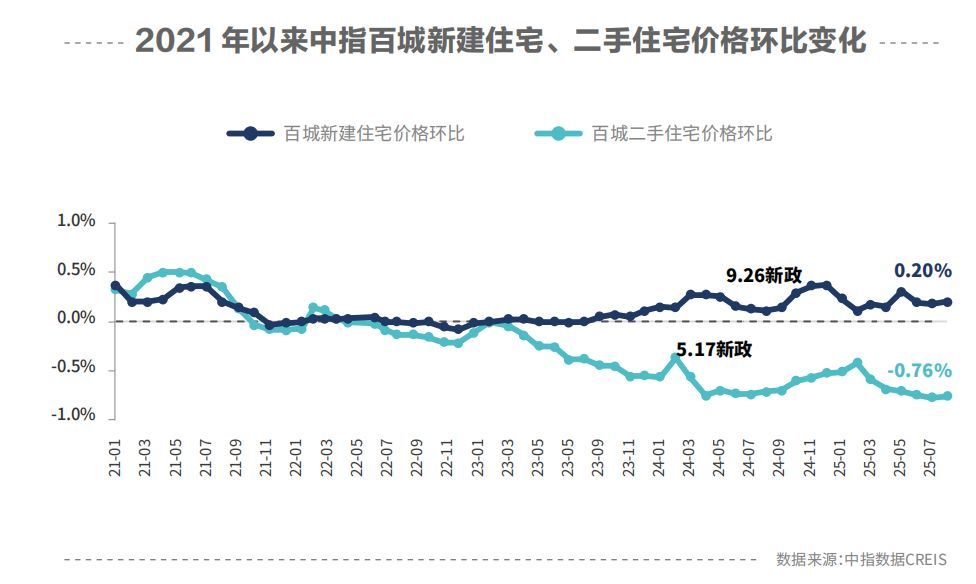
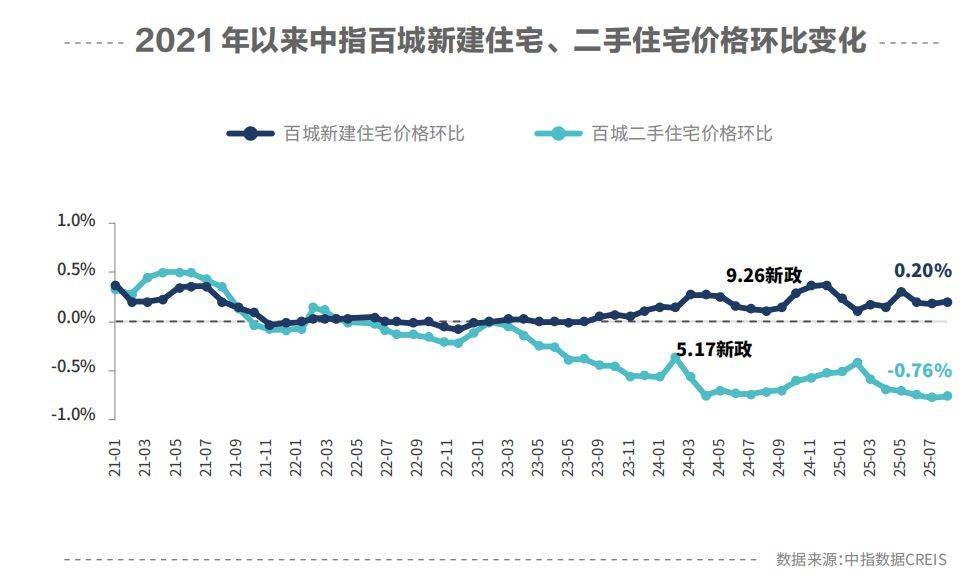
Core Insights - The Chinese real estate market has entered a critical bottoming phase since the second half of 2021, driven by intensive policy measures aimed at stabilizing the market [1][3] - The cumulative sales of new residential properties during the "14th Five-Year Plan" period are projected to reach approximately 5 billion square meters [1][2] Market Changes - The supply-demand relationship in the real estate market has shifted, with a significant increase in the stock of existing homes, leading to first-time buyers predominantly opting for second-hand homes, while new homes are increasingly catering to improvement needs [2][5] - The sales area of new residential properties from January to September 2025 was 6.58 million square meters, a year-on-year decrease of 5.5%, but the decline has narrowed by 11.6 percentage points compared to the previous year [5] Policy Impact - Since the second half of 2021, the real estate market has been in a continuous adjustment phase, with a decline in new residential property sales. However, recent policies have aimed to stabilize the market [3][5] - The government has emphasized stabilizing the real estate market in its work report for the 2025 National Congress, indicating a sustained commitment to policy support [3] Market Resilience - The second-hand housing market has shown greater resilience, with a 10% year-on-year increase in transaction volume in key cities from January to July 2025, and second-hand home transactions accounted for 68% of total transactions by July, a record high [5][9] - Despite the increase in transaction volume, second-hand home prices have been on a downward trend for 41 consecutive months [5] Market Segmentation - A clear "stronger stronger" market segmentation is emerging, with first-tier cities experiencing a month-on-month increase in new home prices, while second and third-tier cities face price declines [10][12] - The investment strategies of real estate companies are increasingly focused on core cities, with significant competition for high-quality land parcels leading to record land prices in cities like Shanghai and Beijing [13][15] Demand Trends - Improvement demand has become the core support for the new home market, with larger unit types (120-144 square meters) accounting for 30% of transactions in key cities from January to July 2025 [16][20] - High-end market performance has been notable, with significant sales in luxury projects, indicating a release of demand from high-net-worth individuals [19][20] Future Outlook - The upcoming report titled "Exploring the 'Golden Pit' of the Non-Restricted Cycle Real Estate Market" is set to be released on October 30, 2025, providing further insights into the industry [20]
楼市进入筑底关键期:改善性需求成为新房市场支撑 “强者恒强”分化格局愈发清晰
Mei Ri Jing Ji Xin Wen· 2025-10-24 15:20
Core Insights - The Chinese real estate market has entered a critical bottoming phase since the second half of 2021, driven by intensive policy measures aimed at stabilizing the market [1][3]. Market Changes - The cumulative sales of new residential properties during the "14th Five-Year Plan" period are projected to reach approximately 5 billion square meters [1][2]. - The supply-demand relationship in the real estate market has shifted, with a significant portion of demand now being met through second-hand housing, while new housing is increasingly catering to improvement needs [2][6]. Policy Impact - Since the second half of 2021, the sales of new residential properties have been on a continuous decline, with a notable policy shift in September 2024 aimed at stabilizing the market [3][6]. - In the first nine months of 2025, the sales area of new residential properties was 6.58 million square meters, a year-on-year decrease of 5.5%, but the decline rate has narrowed compared to the previous year [6][10]. Market Resilience - The second-hand housing market has shown greater resilience, with transaction volumes in key cities increasing by 10% year-on-year in the first seven months of 2025, reaching a peak share of 68% in July [6][10]. - Despite the increase in transaction volume, second-hand housing prices have been on a downward trend for 41 consecutive months [6][10]. Market Segmentation - A clear "stronger stronger" market segmentation is emerging, with first-tier cities experiencing a rise in new housing prices, while second and third-tier cities face price declines [11][13]. - The investment focus of real estate companies has shifted towards core cities, with significant land auction prices being recorded in cities like Shanghai and Beijing [14][16]. Demand Trends - Improvement demand has become the core support for the new housing market, with larger unit types (120-144 square meters) accounting for 30% of transactions in key cities [17][21]. - High-end market performance has been notable, with significant increases in transactions for properties priced between 10 million to 20 million yuan in cities like Beijing and Chengdu [20][21]. Future Outlook - The upcoming report titled "Prospects for the 15th Five-Year Plan: Exploring the 'Golden Pit' of the Non-Restricted Cycle Real Estate Market" is set to be released on October 30, 2025, providing further insights into the industry [21][22].
私募机构“注销潮”迎来行业变局
2 1 Shi Ji Jing Ji Bao Dao· 2025-10-15 00:01
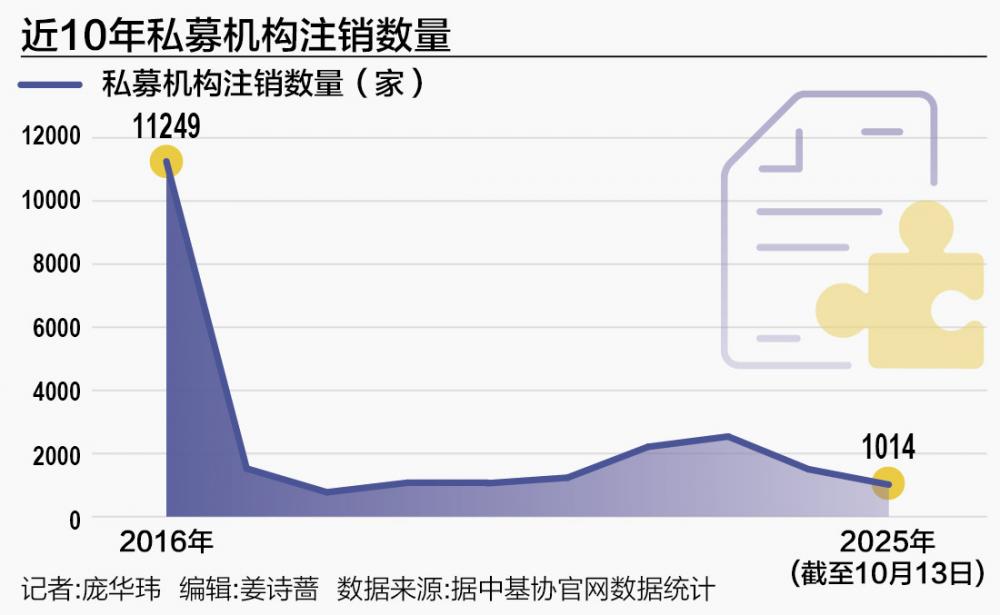
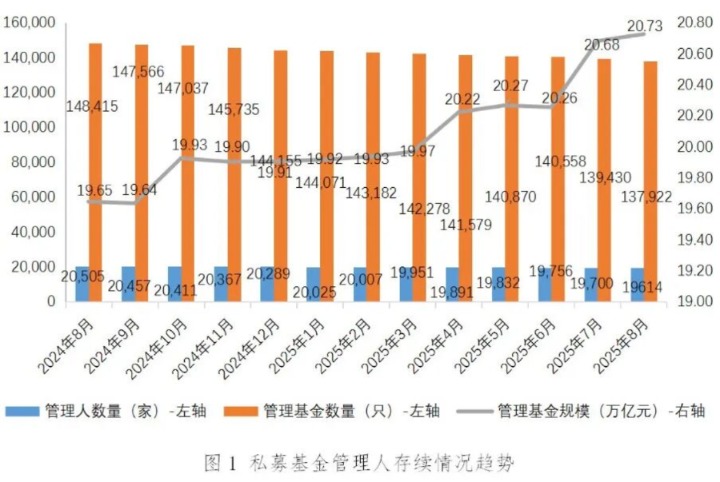
Core Viewpoint - The private equity industry in China is undergoing a significant cleansing process, with over 24,000 private fund managers having been deregistered in the past decade, marking a transition from a chaotic era to a more mature phase characterized by stronger players surviving and thriving [1][3][15]. Group 1: Industry Overview - As of October 13, 2023, there are 19,614 active private fund managers in China, including 7,684 private securities fund managers and 11,740 private equity and venture capital fund managers [3]. - The number of private fund managers has been steadily declining over the past decade, with 1,014 deregistrations occurring in 2023, a decrease of 22% compared to the previous year [4][7]. - The deregistration wave began in 2016, with a peak of 11,249 deregistrations that year, primarily due to the crackdown on "shell private equity" firms [5][8]. Group 2: Regulatory Environment - The recent deregistration trend is attributed to a combination of regulatory pressure and market conditions, with the introduction of stringent regulations raising compliance costs and operational thresholds for private fund managers [9][10]. - The new regulations, effective May 1, 2023, have significantly increased the capital and operational requirements for private equity firms, effectively elevating the bar to a level comparable to public funds [9][10]. - The regulatory environment has led to a systematic elimination of non-compliant and underperforming firms, with a focus on enhancing the quality of the remaining players in the industry [13][19]. Group 3: Market Dynamics - The current market conditions are described as a "frozen period," with significant challenges for private equity firms, particularly those in the equity sector, due to reduced IPO activity and increased exit difficulties [10][12]. - The operational costs for maintaining a private equity license have escalated, with annual expenses ranging from 1 million to several million yuan, further straining smaller firms [10][11]. - The industry is witnessing a trend where larger, more established firms are likely to dominate, while smaller firms face diminishing survival prospects, leading to increased market consolidation [15][17]. Group 4: Future Outlook - Experts predict that the trend of deregistration will continue, but at a slower pace, with estimates suggesting that the number of deregistrations may not reach the levels seen in previous years [14]. - The future competition in the private equity sector will focus on specialization, compliance, and brand strength, with larger firms likely to expand while smaller firms may struggle to survive [17][18].
10年 2.4万家!私募“注销潮”映射行业变局
2 1 Shi Ji Jing Ji Bao Dao· 2025-10-14 15:32
Core Insights - The private equity industry in China is undergoing a significant cleansing process, with over 24,000 private fund managers having been deregistered in the past decade, marking a shift from a one-time policy-driven cleanup to a normalized deep reshuffling influenced by both regulation and market dynamics [1][3][12] Industry Overview - As of August 2025, there are 19,614 active private fund managers in China, including 7,684 private securities fund managers and 11,740 private equity and venture capital fund managers [2] - The number of private fund managers has been steadily declining over the past decade, with 1,014 deregistrations reported in 2023, a decrease of 22% compared to the previous year [3][6] Historical Context - The first wave of deregistration began in 2016, with a dramatic increase from 51 deregistrations in 2015 to 11,249 in 2016, primarily due to the cleanup of "shell private equity" firms [5][6] - The second wave of deregistration started in 2022, with 2,210 firms deregistered that year, and a peak of 2,537 in 2023, reflecting ongoing market challenges [6][7] Regulatory Changes - Recent regulatory changes have significantly raised the entry barriers for private fund managers, with the minimum investment threshold for private equity products now set at 10 million yuan, a tenfold increase from the previous 1 million yuan [8][9] - The implementation of the "most stringent new regulations in private equity history" on May 1, 2023, has further tightened requirements regarding capital, personnel, and operational standards [7][9] Market Dynamics - The current deregistration wave is driven by a combination of market stagnation, self-purification within the industry, and stringent regulatory pressures [9][10] - Smaller private equity firms, particularly those reliant on IPO exits, are facing heightened challenges, leading to a higher deregistration rate compared to larger firms [9][10] Future Outlook - The trend of deregistration is expected to continue, but at a slower pace, with estimates suggesting that the number of deregistrations may not reach the levels seen in previous years [12] - The private equity industry is entering a phase characterized by "the strong getting stronger," with larger firms likely to dominate the market while smaller firms struggle to survive [13][14] Survival Strategies - Private equity firms are focusing on three main areas for survival: achieving sustainable performance, securing funding, and maintaining compliance with regulatory standards [14][15] - Different firms are adopting varied strategies, with some opting for a "boutique" approach while others are building comprehensive platforms to compete effectively in the market [14][15]
楼市现“强者恒强”格局,广佛万科8天揽金12.51亿元
Sou Hu Cai Jing· 2025-10-10 09:35
Core Insights - The "Golden Week" in Guangzhou saw a surge in the real estate market, with high-quality properties attracting significant buyer interest, leading to increased transactions and a vibrant sales atmosphere [1][3] - Vanke's projects, particularly Vanke Ideal Huadi, demonstrated strong sales performance, indicating a market trend where buyers are willing to invest in trustworthy and high-value properties [3][10] Market Performance - During the 8-day holiday, Vanke sold 535 units, generating revenue of 1.251 billion yuan, with Vanke Huangpu New Town leading sales with 92 units sold and 221 million yuan in revenue [1] - Vanke Ideal Huadi recorded 55 units sold, bringing in 283 million yuan, maintaining its position as the top seller in the Liwan District [1] Project Development and Community Engagement - Vanke Ideal Huadi has maintained steady sales since its launch in 2021, appealing to both first-time and upgrading homebuyers through its brand reputation and product quality [3][10] - The project employs a TOD (Transit-Oriented Development) model, integrating commercial and residential functions to create a mixed-use community that alleviates urban density issues [5][10] Urban Development and Future Vision - The location of Vanke Ideal Huadi in the Baige Tan area is highlighted for its historical significance and future potential, contributing to the development of a world-class waterfront area [4][10] - Vanke is committed to creating a vibrant, green, and smart living environment, aligning with global urban development trends [4][5] Community and Lifestyle Initiatives - Vanke has established a community brand, "Ideal Stodo," fostering neighborly interactions and organizing diverse activities to enhance community engagement [20][22] - The project has successfully connected with over 8,000 residents, creating 60 themed communities that promote a sense of belonging and community spirit [20][22] Product Delivery and Trust Building - Vanke Ideal Huadi emphasizes tangible delivery of promises, with recent completions including the commercial area and residential units, enhancing buyer confidence [10][12] - The project has received positive feedback from homeowners, indicating satisfaction with the quality and living experience provided [12][14] Long-term Value Creation - Vanke's approach combines hard and soft strengths, focusing on product quality and community culture to ensure sustainable long-term value [20][23] - The ongoing community activities and lifestyle enhancements across different projects contribute to a replicable competitive advantage in the real estate market [22][23]


散户追消息亏钱,机构看数据赚钱的真相
Sou Hu Cai Jing· 2025-09-22 15:55
Group 1 - The recent market behavior is perplexing, with the A-shares declining despite the Federal Reserve's interest rate cut, which is typically seen as a positive signal [3][5] - The brokerage sector has experienced a significant drop of 10% in a week, contributing to the overall market downturn [3] - Historical patterns show that markets often react negatively to anticipated good news, as seen in previous instances of "preemptive rate cuts" [3][5] Group 2 - The easing of U.S.-China relations, highlighted by a positive communication between the two leaders, should theoretically boost the market, yet stock prices remain stagnant [3] - A critical observation is the concept of "stronger getting stronger" and "extreme reversal," indicating that stocks in an upward trend will continue to rise with good news, while those at their peak may face corrections regardless of positive developments [5][15] - Institutions have an advantage over retail investors due to their access to trading data that is not visible to the average trader, allowing them to make informed decisions [7][9] Group 3 - The concept of "institutional inventory" shows that while stock prices may be declining or stagnant, institutional buying activity can remain high, indicating accumulation during market pessimism [9][15] - Examples of stocks with high institutional inventory during price corrections include a leading technology company, a consumer staple, and a new energy leader, all demonstrating that institutions are strategically building positions [11][13][15] - The current A-share market is at a pivotal moment where long-term positive factors like the Fed's rate cut and improved U.S.-China relations will eventually have an impact, despite short-term market reactions [15]
投资前瞻:8月国民经济运行数据将公布
Wind万得· 2025-09-14 22:58
Market News - The National Bureau of Statistics will release August economic data on September 15, including industrial added value, fixed asset investment, and retail sales [3] - The Federal Reserve is expected to announce a rate decision on September 18, with a 92% probability of a 25 basis point cut and an 8% probability of a 50 basis point cut [4] - China will implement a visa-free policy for Russian passport holders from September 15, 2025, to September 14, 2026, allowing stays of up to 30 days for business, tourism, and family visits [5] - Various economies will release important data next week, including the U.S. retail sales data for August and the U.K. employment data [6] Sector Events - Tencent's Global Digital Ecosystem Conference will be held from September 16 to 17, 2025, focusing on advancements in AI and cloud technology [10] - Huawei will hold a global product launch event in Paris on September 19, introducing new wearable products and smartphones [11] - Meta is expected to unveil its first consumer-grade smart glasses at the Connect conference on September 18 [12] Company-Specific News - Suhao Huihong announced plans for its subsidiary to increase capital in a related company in Changzhou, with a transaction value of approximately 98.84 million yuan [14] - Kehua Data reported a stock price deviation exceeding 20% over three consecutive trading days, confirming no undisclosed significant information affecting the stock price [15][17] - Tongpu Co. will hold a meeting on September 16 to discuss the transfer of control with investors [18] - *ST Guandao will face mandatory delisting due to significant violations of information disclosure regulations, with trading suspended from September 15 [19] - Bo Rui Data announced plans for shareholders to reduce their holdings by up to 5.4% of the company's shares [20] Lock-up Expiration - A total of 47 companies will have lock-up shares released from September 15 to 19, amounting to 3.073 billion shares with a total market value of approximately 79.75 billion yuan [22] - The peak lock-up expiration day is September 17, with eight companies releasing shares worth a total of 28.078 billion yuan, accounting for 35.21% of the total for the week [22] New Stock Calendar - Four new stocks will be available for subscription from September 15 to 19, including United Power on September 15 and Jianfa Zhixin on September 16 [27] Market Outlook - Huajin Securities suggests a potential short-term rotation between high and low-performing sectors, while maintaining a long-term bullish trend for strong sectors like technology [30] - AVIC Securities indicates that current market fluctuations may benefit the return to a slow bull market trend [31] - Zhongyou Securities emphasizes that recent market adjustments are not indicative of the end of the bull market, but rather a consolidation phase [32]

上市城商行新格局:“规模之王”易主、前三甲洗牌
Jing Ji Guan Cha Bao· 2025-09-13 09:19
Core Insights - The rise of Jiangsu Bank and Ningbo Bank reflects not only their governance and transformation capabilities but also the high-quality development of the regional economy [2][12] - The new banking landscape is expected to reinforce the trend of "the strong getting stronger" [2][12] Group 1: Jiangsu Bank's Performance - As of June 2025, Jiangsu Bank's total assets grew by 21.16% year-on-year to 4.79 trillion yuan, surpassing Beijing Bank [2][3] - Jiangsu Bank's operating income in the first half of 2025 was 448.64 billion yuan, a year-on-year increase of 7.78%, while net profit rose by 8.05% to 202.38 billion yuan [4] - The bank's total assets have consistently shown double-digit growth over the past five years, expanding from 2.34 trillion yuan to 3.95 trillion yuan [3] Group 2: Ningbo Bank's Growth - Ningbo Bank's total assets reached 3.47 trillion yuan as of June 2025, marking an 11.04% increase and surpassing Shanghai Bank [6][8] - In the same period, Ningbo Bank's operating income was 371.60 billion yuan, up 7.91%, and net profit increased by 8.23% to 147.72 billion yuan [7][8] - The bank's governance effectiveness and focus on small and medium-sized enterprises have contributed to its competitive edge [8][9] Group 3: Regional Economic Factors - The strong regional economic dynamics in the Yangtze River Delta, characterized by vibrant private enterprises and a complete industrial chain, support the growth of Jiangsu and Ningbo Banks [12][13] - The banks have effectively capitalized on the demand for corporate loans, with Jiangsu Bank's corporate loan growth reaching 23.30% [4][9] - The asset quality of both banks remains strong, with low non-performing loan ratios, enhancing their profitability [9][12] Group 4: Competitive Landscape - The competitive landscape among city commercial banks has shifted, with Jiangsu Bank and Ningbo Bank now leading in key financial metrics [2][10] - Other banks like Nanjing Bank also show robust growth, with total assets nearing 3 trillion yuan [10] - The trend of "stronger banks becoming stronger" is evident, as 14 out of 17 listed city commercial banks reported growth in both revenue and net profit in the first half of 2025 [13]


上市城商行新格局:“规模之王”易主、前三甲洗牌
经济观察报· 2025-09-13 08:55
Core Viewpoint - The rise of Jiangsu Bank and Ningbo Bank reflects not only their governance and transformation capabilities but also the high-quality development of the regional economy, supported by vibrant private enterprises, quality enterprise clusters, and innovative ecosystems, which provide solid backing for business growth, risk control, and profitability. This new pattern is expected to continue reinforcing the trend of "the strong getting stronger" [2][11][16]. Summary by Sections Jiangsu Bank's Growth - As of June 2025, Jiangsu Bank's total assets grew significantly by 21.16% year-on-year, reaching 4.79 trillion yuan, surpassing Beijing Bank's 4.75 trillion yuan, making it the new leader among city commercial banks [2][4]. - Jiangsu Bank's operating income and net profit exceeded those of Beijing Bank in 2022, with figures of 70.57 billion yuan and 25.39 billion yuan respectively, while Beijing Bank reported 66.28 billion yuan in revenue and 24.76 billion yuan in net profit [4][5]. - The bank's loan and advance balance increased by 16.38% year-on-year, with corporate loans growing by 23.30% [5]. Ningbo Bank's Performance - Ningbo Bank's total assets reached 3.47 trillion yuan as of June 2025, surpassing Shanghai Bank, which had total assets of 3.29 trillion yuan [8][9]. - In the same period, Ningbo Bank's operating income was 37.16 billion yuan, a year-on-year increase of 7.91%, and its net profit was 14.77 billion yuan, up 8.23% [9][10]. Comparison with Other Banks - The competitive landscape has shifted, with Jiangsu Bank and Ningbo Bank overtaking Shanghai Bank, which has fallen from second to fourth place in terms of asset size [9][14]. - The top five city commercial banks by operating income in the first half of 2025 were Jiangsu Bank (44.86 billion yuan), Ningbo Bank (37.16 billion yuan), Beijing Bank (36.22 billion yuan), Nanjing Bank (28.48 billion yuan), and Shanghai Bank (27.34 billion yuan) [10]. Regional Economic Factors - The robust regional economic development, particularly in the Yangtze River Delta, has been a crucial factor supporting the rapid growth of Jiangsu and Ningbo Banks, providing diverse customer bases and business opportunities [15][16]. - The banks' focus on corporate business has been a significant driver of growth, with both banks maintaining low non-performing loan ratios compared to their peers, enhancing their profitability [11][15]. Capital Adequacy - Despite rapid expansion, Jiangsu Bank's capital adequacy ratio faced pressure, standing at 12.36% as of June 2025, with declines in its tier one and core tier one capital ratios [6].