
房地产转型

Search documents
招商蛇口换帅!
Zhong Guo Jing Ying Bao· 2025-09-17 11:18
Core Viewpoint - The leadership transition at China Merchants Shekou Industrial Zone Holdings Co., Ltd. (招商蛇口) involves the resignation of Chairman Jiang Tiefeng and the appointment of Zhu Wenkai as the new Chairman, while Nie Liming is appointed as the new General Manager, indicating a stable leadership change within the company [2][6]. Leadership Changes - Jiang Tiefeng resigned from his positions as Chairman and Director due to work adjustments, with Zhu Wenkai elected as the new Chairman [2][6]. - Zhu Wenkai, born in 1967, has a diverse career background in marketing, regional management, and operations within the company [3][4]. - Nie Liming, born in 1971, also has extensive practical experience and has held various managerial roles within the organization [4]. Company Performance - Under Jiang Tiefeng's leadership, the company achieved a sales revenue of approximately 293.6 billion yuan in 2023, ranking fifth in the industry [7]. - In the first half of 2025, the company reported a revenue of 51.485 billion yuan, a year-on-year increase of 0.41%, and a net profit of 1.448 billion yuan, up 2.18% year-on-year [7]. Strategic Direction - The company is actively pursuing a transformation strategy focusing on three key shifts: balancing development and operations, transitioning from heavy asset reliance to a mixed asset approach, and moving from homogeneous competition to differentiation [7].



房企中报观察:盈利持续承压,经营性业务成增长盘、存量时代新模式隐现
Sou Hu Cai Jing· 2025-09-10 11:22
Core Viewpoint - The real estate industry is undergoing a significant transformation, with many companies facing increased profit pressure, while a few, like Longfor and China Resources, are successfully navigating this shift by focusing on operational business models and achieving positive profitability [2][9]. Industry Trends - The market is transitioning from a phase of large-scale expansion to one focused on improving existing assets, as indicated by recent government meetings [2]. - Companies are exploring new operational models to adapt to this systemic change, emphasizing the need for a shift from incremental to stock market strategies [2][8]. Company Strategies - Real estate firms are concentrating on three main transformation paths: enhancing stable income through property holdings, developing light asset businesses, and expanding into new business areas beyond traditional real estate development [2]. - Longfor's operational business revenue reached a historical high of 13.27 billion yuan, while China Resources achieved a core net profit of 6.02 billion yuan, contributing over 60% of its profits [5][6]. Operational Models - Longfor's operational business includes commercial investment, asset management, property management, and smart construction, with a focus on maintaining high occupancy rates and rental income growth [5]. - China Resources is adopting a large asset management model as a core strategy during the industry's transition, achieving regular income of 20.56 billion yuan [6]. Market Adaptation - The industry is encouraged to shift from investment-driven growth to service-driven revenue, focusing on operational and service enhancements [8]. - Companies like Poly Developments and China Merchants Shekou are actively pursuing new growth lines in commercial and property management [8]. Financial Stability - Moody's report highlights that increasing regular income enhances developers' profitability stability and financial resilience, with Longfor and China Resources showing higher operational income and profitability compared to peers [9].



美的置业四大业务协同净利增119% 总资产94.9亿首次宣派中期股息
Chang Jiang Shang Bao· 2025-08-31 22:23
Core Viewpoint - Midea Real Estate (03990.HK) demonstrates strong performance amidst industry adjustments, with significant revenue and profit growth in the first half of 2025, showcasing its robust business model and financial health [1][2][4]. Financial Performance - The company reported a revenue of 2 billion yuan, representing a year-on-year increase of 41%, outpacing industry growth [2][3]. - The core net profit attributable to shareholders reached 310 million yuan, marking a 119% increase compared to the previous year [1][2]. - The gross profit margin remained high at 30.8% [1][2]. Business Segments - Midea Real Estate operates four core business segments: development services, property management services, asset operation, and real estate technology, which collectively support overall performance [1][2][3]. - In the development services sector, the company focused on key cities, achieving a revenue of 500 million yuan in the first half of 2025 [2]. - The property management segment, led by Midea Services, generated 930 million yuan in revenue, accounting for 47% of total revenue, with a managed area of 79.46 million square meters [2][3]. - The asset operation segment, particularly Midea Commercial, achieved a revenue of 230 million yuan, with a self-owned project occupancy rate of 91% [3]. Financial Structure - The company maintains a strong financial structure with total assets of 9.49 billion yuan and net assets of 4.98 billion yuan [3]. - Operating cash flow stood at 440 million yuan, with no interest-bearing debt and a cash reserve of 1.27 billion yuan, indicating a high level of liquidity [3]. Dividend Policy - Midea Real Estate announced its first interim dividend of 0.15 HKD per share, reflecting its commitment to shareholder returns and confidence in future growth [4]. - Since its listing in 2018, the company has maintained a competitive dividend policy, with cumulative dividends of approximately 7.61 HKD per share [4]. Strategic Focus - Following a restructuring in 2024, Midea Real Estate is concentrating on its core business segments, with a particular emphasis on third-party construction services, aiming for this segment to exceed 20% of overall development services in the next 2-3 years [5][6]. - The management expressed a commitment to adapting to the industry's transition from "incremental expansion" to "quality improvement" and exploring new real estate models [6].
华润置地半年百亿利润 经常性业务占比超六成
3 6 Ke· 2025-08-28 02:20
Core Viewpoint - China Resources Land reported a 19.9% year-on-year increase in total revenue to 94.92 billion yuan for the first half of 2025, while net profit attributable to shareholders rose by 16.2% to 11.88 billion yuan. However, core net profit decreased by 6.6% to 10 billion yuan, marking a shift to a revenue growth without profit increase scenario since last year [1] Sales Business - The development and sales segment generated revenue of 74.36 billion yuan, up 25.8% year-on-year, but core net profit from this segment fell by 23.8% to 3.98 billion yuan, indicating a decline in sales profitability despite increased revenue [2][3] - The company acquired land worth 44.73 billion yuan in the first half of 2025, with a focus on high-value areas, as evidenced by a significant purchase in Beijing for 9.152 billion yuan [2][3] Market Position - China Resources Land ranked fourth in total sales with 110.3 billion yuan in the first half of 2025, showing a slight improvement in market position. The company has a strong presence in 15 cities and 45 projects ranked in the top ten locally [4] Transformation Strategy - The company is focusing on recurring income streams, with operational real estate revenue reaching 12.11 billion yuan, up 5.5%, and light asset management revenue at 6 billion yuan, up 1.1%. This shift is aimed at improving profit margins [6] - Shopping centers generated rental income of 10.4 billion yuan, a 9.9% increase, with an overall occupancy rate of 97.3% [7] REIT Expansion - China Resources Land's commercial REIT has announced two expansions in 2025, with a total market value exceeding 10 billion yuan. The company plans to maintain a regular expansion of 5 to 10 billion yuan annually [8]
地铁涨价背后:城市和地产的转型之困
Hu Xiu· 2025-08-14 11:06
Group 1 - Increasing subway ticket prices in various cities reflect not only the significant losses faced by subway companies but also the growing pains of urbanization and real estate transformation in China [1] - The issue of subway fare hikes appears to be an operational problem, yet it is deeply intertwined with macroeconomic trends related to urbanization and the real estate sector [1]
专家共论房地产转型:在气候风险应对与韧性城市建设中寻找新动能
2 1 Shi Ji Jing Ji Bao Dao· 2025-07-30 09:50
Group 1 - The global economic transformation, demographic changes, and climate crises are increasingly impacting urban, housing, and real estate issues, which are critical for sustainable economic and social development [1] - Climate risks have become a key factor affecting global socio-economic development, with extreme weather events causing significant losses, necessitating proactive measures [1] - From 1990 to 2019, 91.6% of major natural disasters, 67.6% of disaster-related deaths, 83.7% of economic losses, and 92.4% of insurance losses were attributed to meteorological and derived disasters [1] Group 2 - Research indicates that in China, low-lying and low-floor residences experience significant rent reductions during periods of heavy rainfall, while old neighborhoods and areas with weak infrastructure are particularly sensitive to flood risks [2] - In Italy, the negative impact of flood risks on property prices can be mitigated through public disaster investment, highlighting the positive role of policy intervention in the risk capitalization process [2] - The housing market must enhance its ability to identify and respond to climate risks, reinforcing urban resilience and institutional safeguards for sustainable and safe urban development [2] Group 3 - The recent Central Urban Work Conference identified "resilience" as a key goal for modern urban construction, emphasizing the need for safe and reliable resilient cities as a priority task [2] - Specific measures include advancing urban infrastructure safety projects, upgrading old pipelines, restricting super-tall buildings, and enhancing housing safety standards, all closely related to the real estate industry [2] - The Chinese real estate sector is undergoing deep market adjustments, industrial transformation, and institutional optimization, necessitating a scientific understanding of the interactions between real estate and various socio-economic factors for sustainable development [2][3] Group 4 - Key issues in the real estate industry include establishing a rational land transfer mechanism, stabilizing real estate price fluctuations, addressing expiring land lease issues, and exploring reasonable investment structures for commercial buildings [3] - The profound changes in the global landscape are expected to significantly influence the long-term trajectory of the real estate market [3]
销售代理费增两倍,西藏城投获大股东“输血”?
Mei Ri Jing Ji Xin Wen· 2025-07-14 10:07
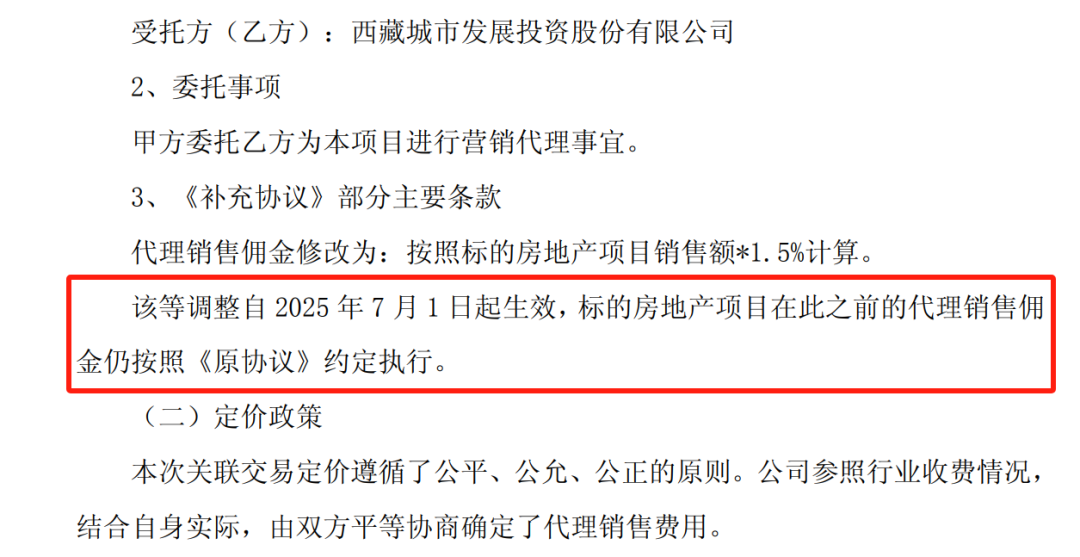
Core Viewpoint - Tibet City Investment (西藏城投) has announced an increase in the sales agency fee from 0.5% to 1.5% for a real estate project managed by its major shareholder's subsidiary, aiming to boost sales amid a challenging real estate market [1][4][11]. Financial Performance - In 2024, Tibet City Investment reported a net loss of 309 million yuan, with real estate sales dropping to 900 million yuan [1][8]. - For Q1 2025, the company achieved a revenue of 535 million yuan but incurred a net loss of 34.39 million yuan [1][8]. - The company's net profit has significantly declined from 117 million yuan in 2022 to 13 million yuan in 2024, marking a 596.55% decrease in net profit [5][8]. Real Estate Market Context - The increase in agency fees is a response to the ongoing downturn in the real estate market, characterized by rising sales pressure and competition [4][11]. - The project "Hongnan Mountain 240 Block" is positioned as a high-end residential community, with a total investment of approximately 11.5 billion yuan and an average price of 125,000 yuan per square meter [4][5]. Lithium Industry Transition - Tibet City Investment holds significant lithium resources, with verified reserves of 3.9 million tons of lithium carbonate [12][16]. - Recent developments include obtaining mining permits and initiating construction of a lithium hydroxide production line, with plans to achieve a production capacity of 130,000 tons over the next 4-5 years [16][12]. - Despite these advancements, the company faces challenges in converting lithium resources into substantial revenue due to the cyclical downturn in the lithium industry [16][12].

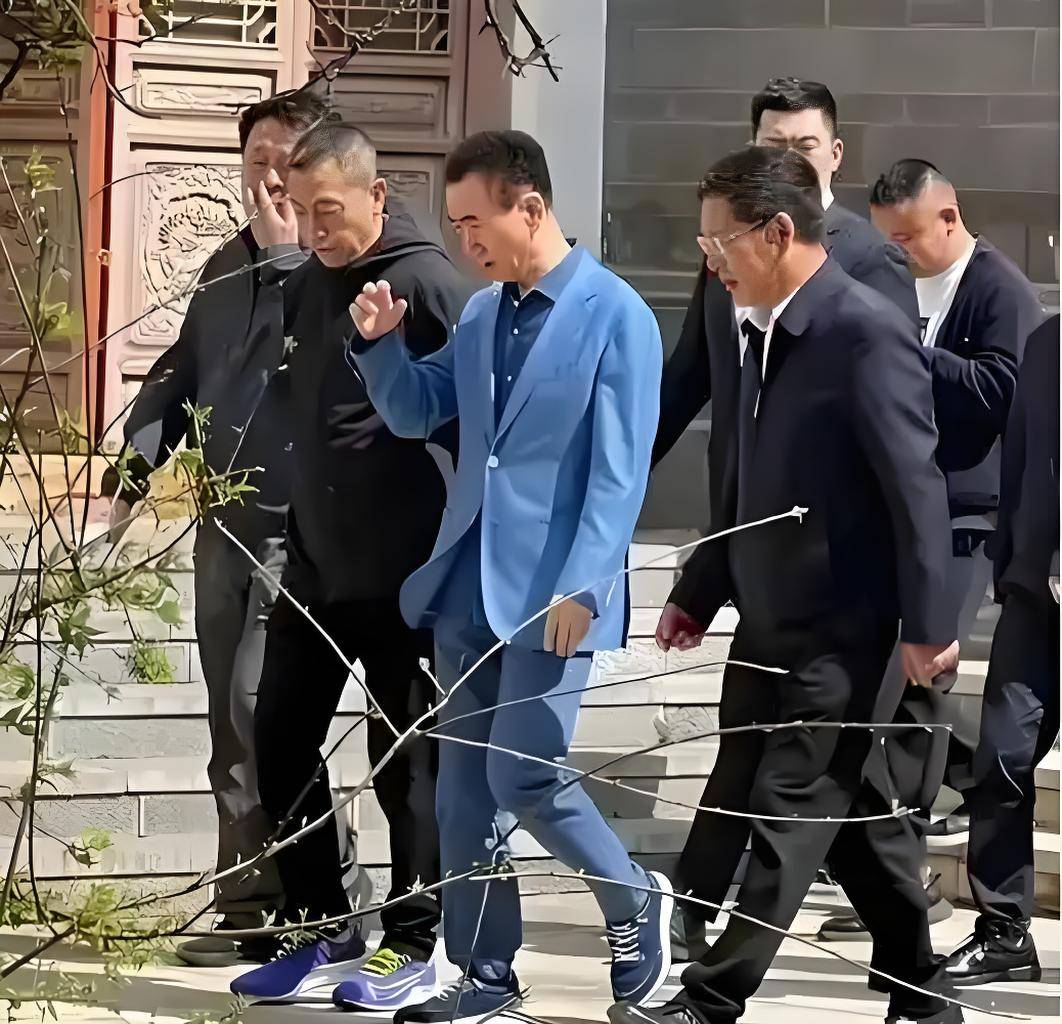
再卖48座万达广场!瘦到皮包骨头的王健林奏响房地产黄金时代挽歌
Sou Hu Cai Jing· 2025-05-27 11:54
Core Viewpoint - Wang Jianlin's decision to sell 48 Wanda Plaza projects is driven by significant debt pressure, with a rumored transaction value of approximately 50 billion yuan [2]. Group 1: Financial Situation - As of Q1 2025, Wanda's interest-bearing debt reached 280 billion yuan, with over 40 billion yuan due within the year, while cash on hand is only 11.6 billion yuan, indicating a substantial cash flow gap [2]. - The company previously faced a payment of approximately 38 billion yuan due to a triggered buyback clause from a betting agreement, further exacerbating its financial strain [2]. Group 2: Historical Context - Wang Jianlin's career began in 1986, and he transformed the real estate landscape in China by capitalizing on urban redevelopment and market opportunities, leading to the establishment of numerous Wanda Plazas [5]. - At its peak, Wanda operated 513 plazas nationwide, with the slogan "where there is a Wanda Plaza, there is the city center" becoming widely recognized [5]. Group 3: Business Transformation - Wanda's transition towards a lighter asset model has faced challenges, including failed attempts to list Wanda Commercial on the A-share market and subsequent efforts to list in Hong Kong [7]. - Despite significant asset shrinkage, Wang Jianlin has maintained a commitment to his responsibilities, including ensuring timely salary payments for 150,000 employees and prioritizing small creditors [7].
全面推行现房销售,为什么是信阳?
Sou Hu Cai Jing· 2025-05-26 00:57
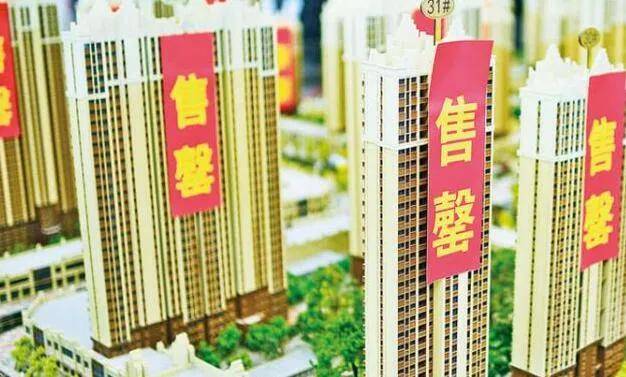
Core Viewpoint - The city of Xinyang in Henan has become the first in China to fully implement a "current housing sales" policy, which requires that properties must be completed and pass inspection before they can be sold, effectively overturning the traditional pre-sale model [1][3]. Group 1: Policy Changes - The new policy mandates that newly sold land must be sold as completed properties, meaning developers can only sell homes after they are built and inspected [3]. - Existing projects that have already started construction can still sell under the old pre-sale rules, creating a transitional phase for the market [3]. - This shift aims to reduce risks for homebuyers, as it minimizes the chances of unfinished projects and fraud [3]. Group 2: Market Conditions - Xinyang's real estate market is under significant pressure, with new home sales area expected to decline by 7.8% in 2024, and real estate investment plummeting by 16.2% [4]. - The city faces a severe population issue, with a net outflow of 2.79 million people, leading to a situation where one in three residents is leaving for work elsewhere [4]. - The number of newborns has drastically decreased from 89,000 in 2019 to just 37,000 in 2023, indicating a demographic crisis [4]. Group 3: National Trends - Over 30 provinces and cities across China have begun experimenting with current housing sales since late 2022, indicating a growing trend [6]. - The proportion of current housing sales nationwide has surged from 10% in 2020 to 32% by February 2025, marking a ten-year high [7]. - However, the transition to widespread current housing sales faces challenges, particularly due to the financial strain on developers, as construction timelines extend from two years to four or five years [7]. Group 4: Market Dynamics - The shift from a "seller's market" to a "buyer's market" is evident, with an increasing inventory of unsold homes leading to longer sales cycles [9]. - In Xinyang, the inventory turnover period is projected to be 20 months, with a significant increase in the number of second-hand homes listed for sale [9]. - The current housing sales model may lead to price differentiation, with premium properties in major cities seeing price increases, while weaker markets may experience accelerated market clearing [10].
业内表示房地产会在2026年趋稳,释放哪些信号?今年该不该买房?
Sou Hu Cai Jing· 2025-05-22 04:51
Policy Level - Continuous policy support has been observed since 2023, with multiple interest rate cuts and adjustments in mortgage rates, as well as the cancellation of purchase restrictions in various regions, indicating the government's commitment to stabilize the real estate market [1] - The government plans to build 2 million units of affordable housing over the next five years, further solidifying support for the real estate sector [1] Precision of Policies - Policies are not only focused on liquidity support for real estate companies but also on optimizing home purchase policies, such as lowering down payment ratios and increasing housing fund loan limits to stimulate demand [2] Market Supply and Demand - Demand remains supported by urbanization, with a projected urbanization rate of 66.16% in 2024, leaving room for over 200 million people to move to cities in the next decade, driving housing demand [3] - The inventory turnover period in first-tier cities is shortening, with a projected 30% increase in second-hand housing transactions in 2025, indicating a recovery in the market [3] Supply Side Improvement - By Q4 2024, national commercial housing sales area is expected to rise by 12% quarter-on-quarter, with first-tier city prices stabilizing [4] - The land auction premium rate is anticipated to rebound to 15% in 2025, reflecting improved developer confidence in the market [4] Industry Development - The industry is accelerating its transformation from high-leverage, high-turnover models to "light asset operations" and service-oriented real estate companies, diversifying into property management and long-term rentals [5] - Competition is intensifying in terms of housing quality, with increasing consumer demand for green buildings and smart communities [6] Market Outlook for Home Buyers - For first-time homebuyers, the stabilization of the market reduces the risk of significant price fluctuations, making it a suitable time to purchase homes, especially with supportive policies lowering costs [8] - However, caution is advised in lower-tier cities where price pressures and inventory issues may persist [9] Investment Considerations - The era of guaranteed profits in real estate investment is over, with potential declines in investment returns and increased risks, necessitating a more cautious approach [10] - Investors should closely monitor policy changes and market dynamics to identify valuable investment opportunities in emerging areas and prime locations [11]
