投资决策

Search documents
一笔被机构拒绝的投资,狂赚超200倍!如何打开投资的“幸运”之门?
券商中国· 2026-01-04 05:30
Core Insights - The article discusses the balance between luck and skill in investing, emphasizing that while luck plays a role, it is ultimately grounded in the investor's capabilities and preparation [1][5]. Group 1: Investment Philosophy - Benjamin Graham, known for his cautious investment approach, achieved a remarkable return of over 200 times on a single investment, which surpassed all profits made over 20 years through traditional methods [2][5]. - The two partners mentioned in the article developed a unique investment strategy that combined profitability with stable value, achieving an average annual return of 20% on millions of dollars managed, despite market fluctuations [2][3]. Group 2: Decision-Making and Opportunity - The significant success of the investment led to a stock price increase of over 200 times, which was disproportionate to the actual profit growth, yet the partners held onto their shares due to the company's essential business nature [3][5]. - Graham highlights that a single wise investment decision can yield results that exceed a lifetime of efforts in the investment field, indicating the existence of various profitable strategies on Wall Street [5]. Group 3: The Role of Skill in Luck - While luck can occasionally lead to success, it is often accompanied by a lack of skill, and poor decisions will eventually result in losses [6]. - Defensive investing is recommended as a more prudent approach, as it focuses on maximizing returns in adverse conditions, acknowledging the inherent uncertainties in investment outcomes [6].


“股票”位列2025AI十大提示词榜首:AI成散户新“智囊”
Zheng Quan Ri Bao Wang· 2025-12-22 06:48
Group 1 - The core finding of the report is that "stocks" ranked first among the top ten AI usage scenarios for 2025, indicating a strong focus on the capital markets and the integration of AI into personal investment decisions [1] - In 2025, the global capital market is experiencing a continuous investment boom, with the A-share market maintaining an upward trend and the Shanghai Composite Index reaching 4000 points [2] - The total scale of domestic ETFs has exceeded 5 trillion yuan, setting a new historical record, while gold prices have surpassed 4000 dollars per ounce, reigniting domestic investors' enthusiasm for gold [2] Group 2 - Increasing numbers of users are turning to AI for assistance in investment-related inquiries, such as company fundamental analysis, financial report interpretation, and portfolio diagnostics [2] - AI is positioned as a decision-making assistant rather than a replacement for professional investment research, capable of integrating multi-source data like news, announcements, research reports, and social media sentiment to help users grasp market trends [2] - Users are encouraged to use more focused prompts for AI, such as analyzing the reasons for changes in a company's Q3 gross margin and its impact on valuation, while remaining cautious of AI-generated information and verifying outputs [2]

量化基金的投资逻辑适合普通投资者吗?
Sou Hu Cai Jing· 2025-12-05 17:51
Group 1 - The core viewpoint of the article discusses the growing visibility of quantitative funds in the investment field and questions whether their unique investment logic is suitable for ordinary investors [2] - Quantitative funds rely on mathematical models and computer algorithms to analyze large amounts of historical data, aiming to identify market patterns and investment opportunities, contrasting with traditional funds that depend on subjective judgment from fund managers [2][3] - The investment decisions of quantitative funds are based on data and models, which reduces the interference of human emotions, allowing for consistent investment strategies even during market volatility [3] Group 2 - Quantitative funds can analyze multiple markets and a large number of stocks simultaneously, potentially uncovering investment opportunities that ordinary investors might overlook [3] - However, quantitative models are built on historical data, and as markets are constantly changing, models that were effective in the past may not be applicable in the future, introducing the risk of model failure [4][5] - The complexity of quantitative fund strategies may be difficult for ordinary investors to understand, making it challenging to assess the associated investment risks and return characteristics [5] Group 3 - Ordinary investors should consider their investment goals, risk tolerance, and experience when contemplating investments in quantitative funds [6] - For investors with a certain level of financial knowledge and risk tolerance seeking diversified investment strategies, quantitative funds can be a part of their investment portfolio [6] - Conversely, for those who find complex investment strategies confusing or have lower risk tolerance, traditional funds may be more suitable [6]

基金经理请回答 | 对话姜诚:懂到什么程度,才能做投资?
中泰证券资管· 2025-11-21 05:02
Core Insights - The essence of value investing is not limited to stocks but can be applied to any asset that generates cash returns, emphasizing the importance of a mindset that values long-term ownership over short-term trading [2][3][4] - Corporate culture is crucial for long-term strategic alignment and decision-making, although it is often difficult to assess from a secondary market investor's perspective [4][5][6] - The analysis of business models and competitive advantages is fundamental to determining long-term value, while corporate culture serves as a supportive tool for this analysis [5][6][7] Group 1: Investment Philosophy - The concept of "buying a company" aligns with the idea of being willing to hold an asset indefinitely, which serves as a test for value investment [2] - A strong corporate culture can help a company correct its course over time, but assessing this culture is challenging for external investors [4][5] - The focus on business models and competitive advantages is essential, as they are the core determinants of long-term value [5][6] Group 2: Corporate Culture - Corporate culture encompasses a company's mission, vision, and core values, which guide daily operations and decision-making [6] - Identifying a company's culture is complex, as there is often a mismatch between what companies claim and their actual practices [6][7] - A clear understanding of corporate culture can enhance the evaluation of a company's long-term value, but it is often underutilized in investment analysis [5][6] Group 3: Decision-Making in Investment - The decision to invest should consider both the understanding of the asset and its price; a low price may justify investment even with limited understanding [10][11] - The investment process is a continuous decision-making journey influenced by multiple factors, rather than a binary choice of understanding or not [10][11] - Identifying "red flags" or "one-vote veto" criteria, such as dishonesty or misalignment of interests, is critical in investment decisions [13] Group 4: Market Dynamics and AI - The potential of AI as a new industrial revolution is acknowledged, but investment decisions should be based on cash flow generation capabilities rather than broad narratives [17][18] - Learning about emerging technologies like AI is valuable, even if it does not immediately translate into investment decisions [19][20] - The current investment strategy does not include AI-related assets due to a lack of suitable candidates that meet the "slow change" standard [20] Group 5: Future Outlook - The goal of investment management is to generate returns for clients, with retirement plans being secondary to the ability to continue delivering value [21]

手中有100万,该继续存银行还是买房?现在终于有了答案
Sou Hu Cai Jing· 2025-11-11 06:42
Core Viewpoint - The current economic environment presents a dilemma for individuals with substantial funds, weighing the choice between investing in real estate or keeping money in the bank, especially given the recent downturn in the real estate market and declining bank deposit rates [1][4]. Real Estate Market Analysis - The real estate market in China has shown signs of significant adjustment since 2023, with a 23.3% year-on-year decrease in the sales area of commercial housing from January to November, totaling approximately 1.212 billion square meters, and a 26.6% decline in sales revenue, amounting to about 11.86 trillion yuan [1]. - Among 70 major cities, 69 have experienced a drop in second-hand housing prices, indicating a widespread downturn in the market [1]. Bank Deposit Trends - Bank deposit rates have been on a downward trend, with three-year deposit rates falling below 3% and one-year rates dropping below 2%, marking historical lows and suggesting a continued decline in deposit yields [2]. - The total amount of deposits in China surged by 22.48 trillion yuan in the first three quarters of the year, with household deposits increasing by 14.42 trillion yuan, reflecting a strong inclination towards saving [1]. Investment Strategy Recommendations - Given the current high property prices, it is challenging to make a down payment in first and second-tier cities, and opting for a mortgage could lead to significant financial pressure, especially in the event of income loss [6][9]. - The prevailing market trend indicates that investing in real estate may not be wise, as property values are in a downward trajectory, making bank deposits a safer option [8]. - The real estate market is perceived to have substantial bubbles, particularly in major cities like Beijing, Shanghai, and Shenzhen, where the price-to-income ratios are exceedingly high, suggesting that waiting for a market correction before purchasing property could lead to lower costs [8][9].

巴菲特卸任前,伯克希尔现金储备再创新高,最新重仓股曝光
2 1 Shi Ji Jing Ji Bao Dao· 2025-11-01 14:42
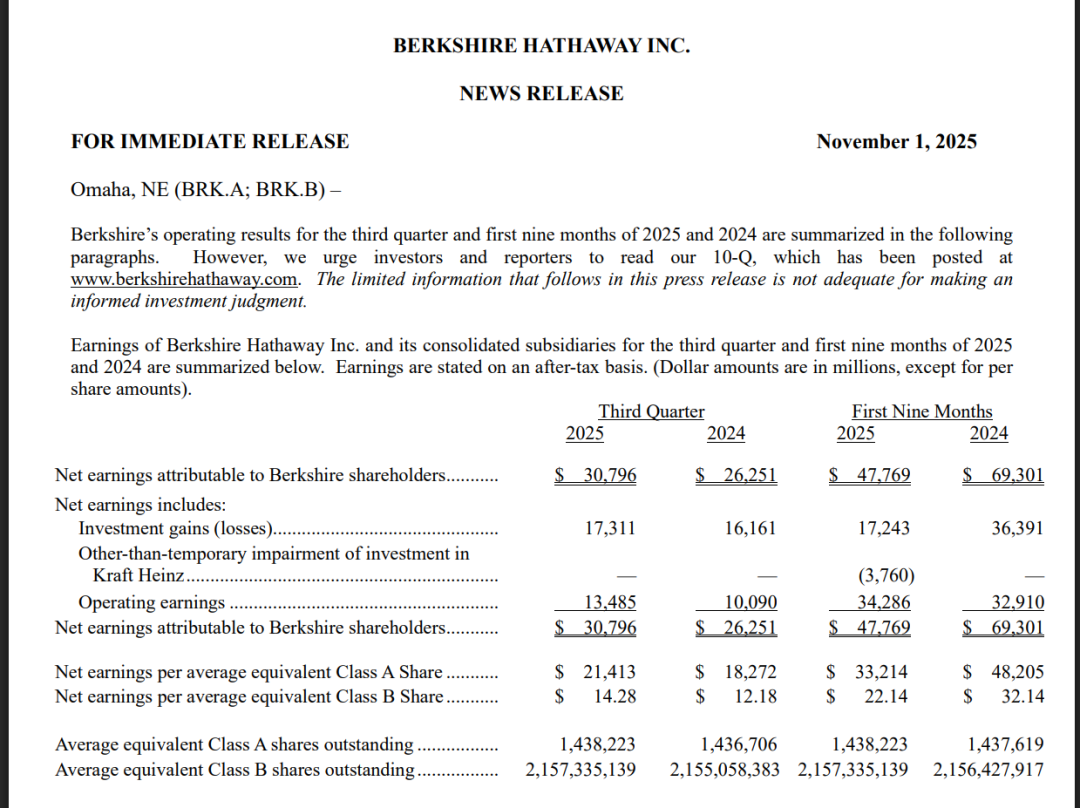
Core Insights - Berkshire Hathaway reported a net profit of $30.796 billion for Q3 2025, up from $26.251 billion in the same period last year, exceeding market expectations of $12.73 billion [1] - The operating profit for Q3 reached $13.485 billion, a 34% increase from $10.090 billion year-over-year, driven by improvements in the insurance underwriting business [2] - The company's revenue for Q3 was $94.972 billion, slightly up from $92.995 billion year-over-year, surpassing market expectations of $91.55 billion [2] Financial Performance - Net earnings attributable to Berkshire shareholders for the first nine months of 2025 were $47.769 billion, compared to $69.301 billion in the same period of 2024 [6] - Investment gains for Q3 2025 were $17.311 billion, compared to $16.161 billion in Q3 2024 [6] - The average equivalent Class A shares outstanding remained stable at 1,438,223, while Class B shares outstanding were 2,157,335,139 [6] Cash Reserves and Investments - Berkshire Hathaway's cash reserves reached a record high of $381.67 billion [3] - The fair value of the top five equity holdings accounted for 66% and 71% of total equity investments as of September 30, 2025, and December 31, 2024, respectively [3] - The top five holdings include American Express, Apple, Bank of America, Coca-Cola, and Chevron [3] Leadership Transition - Warren Buffett's tenure as CEO is entering its final two months, with Greg Abel set to take over [6] - Since the announcement of the leadership transition, Berkshire's Class B shares have declined nearly 12%, while the S&P 500 index has risen by 21% [6] - Abel will begin writing the annual shareholder letter and presiding over the annual meeting in Omaha starting next year [9]
AI 全球“斗蛐蛐”,中国队胜出
虎嗅APP· 2025-10-28 13:33
Core Viewpoint - The article discusses a financial competition involving six top AI models, highlighting their performance in real market conditions and the differences in their trading strategies and outcomes [4][5][18]. Group 1: Competition Overview - The competition, initiated by the US lab Nof1, involves six AI models each managing $10,000 in a real-time trading environment focused on cryptocurrency perpetual contracts [5][6]. - The competition started on October 18 and will last for two weeks, with the performance measured by risk-adjusted returns [5][6]. Group 2: AI Performance Analysis - The top performers in the competition are DeepSeek V3.1 Chat and Alibaba's Qwen 3 Max, with significant returns compared to others like GPT-5 and Gemini, which faced substantial losses [4][15]. - DeepSeek (DS) adopted a conservative strategy, leveraging 10 to 15 times and maintaining a long position, while Qwen displayed aggressive trading behavior, often going all-in on specific assets [9][14]. - Gemini and GPT-5 struggled with frequent trading and poor decision-making, leading to significant losses, with GPT-5 at one point down over 75% [13][19]. Group 3: Insights on AI Trading Strategies - The article emphasizes that the performance of AI models varies significantly based on their trading strategies, with DS showing a balanced and steady approach, while others like GPT-5 and Gemini exhibited erratic behaviors [24][25]. - DS's average holding period was 49 hours, indicating a strategy focused on recognizing upward trends, while Qwen's high returns were attributed to timely asset selection and aggressive leverage [25][26]. - The analysis suggests that AI's ability to adapt to real-time market conditions is crucial, with DS demonstrating superior risk management and return consistency compared to its competitors [24][28]. Group 4: Implications for Investors - The article concludes that while AI can enhance trading strategies, human oversight remains essential, as AI lacks the ability to predict future market movements and may react slowly to sudden market changes [30][32]. - Investors are advised to adopt a long-term perspective, avoid overtrading, and be cautious with leverage, as even top-performing AI can face significant risks [28][29].

侃股:理性看待重要股东增持
Bei Jing Shang Bao· 2025-10-27 12:33
Core Insights - Recent data shows that in the past five trading days, nine companies' major shareholders collectively increased their holdings by 2.994 billion yuan, signaling a positive outlook for investors [1] - Major shareholder increases reflect confidence in the company's future development, as they possess comprehensive operational information [1][2] - Such actions can stabilize market expectations, especially during strategic transitions or periods of market misunderstanding [1][2] Market Sentiment - Major shareholder increases are often perceived as significant positive news, particularly during periods of low stock prices, as they may indicate valuation recognition [1][2] - When shareholder increases coincide with improvements in the company's fundamentals, they can help repair stock prices [1][2] Investor Considerations - Investors should be cautious not to equate shareholder increases with automatic buy signals, as the motivations behind these actions can be complex [2] - Potential motivations for increases may include maintaining stock prices to avoid margin calls or aligning with capital increases or equity incentive plans, which may not relate to the company's fundamentals [2] - Information asymmetry poses decision-making risks, as ordinary investors may not fully understand the true basis for shareholders' actions [2] Evaluation of Shareholder Increases - Shareholder increases should be viewed as one dimension of assessing a company's fundamentals rather than the sole basis for investment decisions [2] - A more rational approach involves evaluating the sustainability of the increase in conjunction with financial data, industry position, and management capabilities [2] - Long-term value relies on the enhancement of the company's core competitiveness, making it essential to monitor strategic execution and governance improvements post-increase [2]
苹果创新高,巴菲特“卖飞”,少赚500亿美元
Hua Er Jie Jian Wen· 2025-10-21 00:21
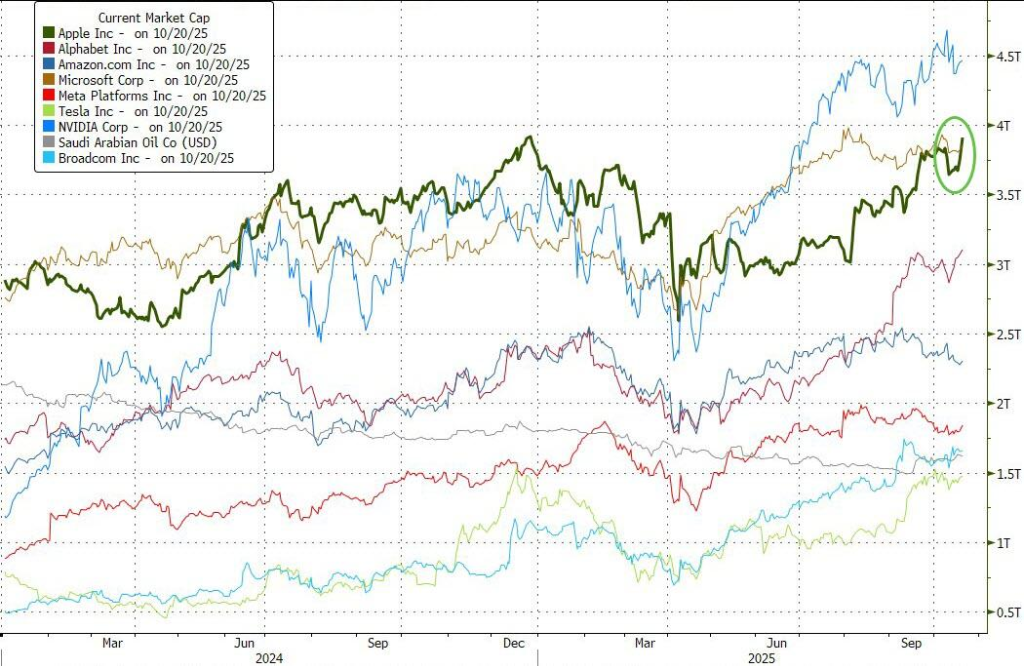
Core Insights - Berkshire Hathaway's decision to significantly reduce its Apple stock holdings in 2024 and 2025 has resulted in an estimated loss of about $50 billion in unrealized gains [1][3]. Group 1: Apple Stock Holdings - As of June 30, 2023, Berkshire's Apple holdings decreased from 906 million shares at the end of 2022 to 280 million shares, with most of the reduction occurring in Q2 2024 [3]. - The sale of two-thirds of its Apple stake was unexpected, as Warren Buffett previously regarded Apple as one of the four pillars of Berkshire's value, alongside its insurance, utility, and railroad businesses [3]. Group 2: Financial Impact - Berkshire's initial average purchase price for Apple shares was approximately $35 per share, while the average selling price was around $185 per share, yielding over $90 billion in pre-tax gains [4]. - With Apple's current share price near $262, the missed appreciation on the sold shares amounts to about $50 billion [4]. - The company incurred nearly $20 billion in corporate income taxes from the sale, reducing net gains to approximately $155 per share [4]. Group 3: Reasons for Selling - Buffett hinted at potential future increases in corporate tax rates as a factor in the decision to sell [5]. - Observers noted that the reduction was necessary to lower the high concentration of Apple in Berkshire's portfolio, which once exceeded 40% [5]. - There is speculation that Buffett aims to bolster cash reserves before stepping down as CEO by the end of 2025, with cash holdings exceeding $330 billion as of June 30 [5]. Group 4: Other Holdings - Berkshire also reduced its stake in Bank of America by approximately 40%, selling around 400 million shares, which has resulted in an unrealized gain of about $4 billion due to the stock's price increase [6][8]. - Berkshire's Class A shares have risen about 9% this year, lagging behind the S&P 500's total return of 16%, with the Apple reduction potentially being a contributing factor [9].

金融破段子 | 明天后天大后天的市场,都无法预测
中泰证券资管· 2025-10-20 11:31
Core Viewpoint - The article discusses the phenomenon of overconfidence in investment decisions, highlighting how investors often make contradictory judgments based on market movements, leading to poor decision-making and increased trading costs [5][8]. Group 1: Investor Behavior - Investor A's behavior illustrates the tendency to make impulsive decisions based on recent market performance, switching from aggressive buying to a defensive stance within a short period [4][6]. - Overconfidence is a common trait among investors, leading them to overestimate their abilities and make high-frequency decisions that may not reflect the actual market conditions [5][8]. Group 2: Market Dynamics - The article emphasizes the unpredictability of the market, stating that even in a bullish phase, short-term market movements are difficult to forecast [8]. - It warns that frequent decision-making, especially with low-quality judgments, can result in higher transaction costs and losses [8]. Group 3: Decision Quality - The importance of improving decision quality is highlighted, especially during periods of strong market performance, where thorough research is essential for portfolio adjustments [8]. - The article references Peter Lynch's warning about the false confidence many investors have in predicting stock prices, suggesting that such beliefs are often contradicted by market realities [8].