
欧洲央行利率政策

Search documents
【财经分析】PMI数据描绘欧元区稳定增长前景 欧洲央行2026年可能维持利率不变
Xin Hua Cai Jing· 2025-11-21 14:25
Core Viewpoint - The Eurozone's business activity shows steady growth in November, indicating economic resilience, with improved business confidence suggesting continued momentum and a balanced inflation outlook, potentially leading the European Central Bank (ECB) to stabilize interest rates by 2026 [1][6]. Economic Indicators - The Eurozone's November composite PMI slightly decreased from October's two-year high of 52.5 to 52.4, remaining above the 50 mark, indicating ongoing economic expansion [2]. - The services sector's PMI rose to 53.1 in November, the fastest growth in 18 months, supported by robust new orders, while employment growth was cautious [2]. - Manufacturing PMI fell to 49.7, indicating a return to contraction, with new orders and employment both declining, suggesting a lack of clear direction in the sector [2]. Country-Specific Insights - Germany's November composite PMI dropped to 52.1, with manufacturing PMI falling to 48.4, reflecting a significant decline in new orders, particularly in exports [3]. - France's November composite PMI improved to 49.9, nearing stability after over a year of decline, with services PMI rising to 50.8, indicating a slight recovery in business activity [4]. ECB Outlook - The ECB is expected to maintain interest rates through December and into next year, supported by resilient economic growth and improved business confidence [6][7]. - ECB officials have indicated that current interest rates are appropriate, with a focus on balancing inflation risks and economic performance [8].
德商银行:拉加德暗示欧洲央行可能长期维持利率不变
Xin Hua Cai Jing· 2025-10-30 23:19
Core Viewpoint - European Central Bank President Christine Lagarde signaled that there will be no reduction in key interest rates in the coming months [1] Group 1: Interest Rate Outlook - Lagarde reiterated that the current interest rate level is in a "comfortable range," reinforcing the rationale for maintaining stable rates [1] - The expectation is that the ECB will keep the deposit rate at 2% at least until the end of next year [1]
每日机构分析:10月30日
Xin Hua Cai Jing· 2025-10-30 14:03
Group 1: Federal Reserve Insights - The potential new Fed chair candidate, Reed, suggests that Powell's stance is more hawkish than expected, increasing the likelihood of skipping a rate cut in December, potentially delaying further easing measures into the new year [1][2] - Nomura Securities has retracted its prediction for a December rate cut after Powell's press conference indicated that a December hike is not guaranteed, with current market expectations for a rate cut by year-end at approximately 72%, down from 91% prior to the Fed's decision [1][2] - CICC estimates that the Fed still has room for three more rate cuts, but the pace of cuts may slow down, influenced by government shutdowns and economic data releases [2] Group 2: European Central Bank (ECB) Outlook - Danske Bank indicates that the ECB is likely to maintain interest rates unchanged in October, with data aligning closely with expectations, although there are growing divergences among members regarding inflation outlooks [3] - ECB President Lagarde is expected to reaffirm a data-dependent approach to decision-making, while the market may be pricing in upward risks for potential rate cuts [3] Group 3: Bank of Japan (BoJ) Policy - Mizuho Bank emphasizes that the BoJ is committed to a gradual normalization of its policy stance, with market participants adjusting their expectations for future policy changes [4] - State Street Global Advisors notes that the likelihood of a BoJ rate hike increases if global trade uncertainties are better assessed, with potential adjustments expected in the coming meetings [4] Group 4: Australian Economic Outlook - HSBC's Australian division reports that unexpected increases in core inflation have fundamentally altered the outlook for official interest rates, with expectations for a rate hike potentially occurring in early 2027 [5]
欧洲央行管委:通胀高于2%的风险更大 不认为需要再降息
智通财经网· 2025-10-15 06:25
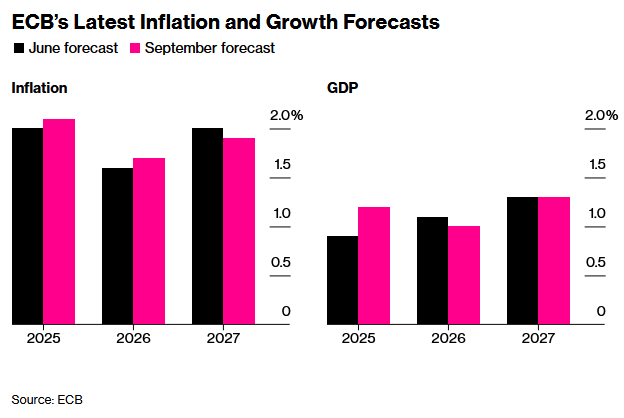
Group 1 - The core viewpoint is that ECB's Gabriel Makhlouf is more concerned about inflation rates exceeding 2% rather than falling below it, despite current inflation being close to the target [1][2] - Makhlouf highlights that food inflation has been rising, currently around 3%, which is an area of particular concern [1] - He emphasizes that as long as medium-term inflation expectations remain anchored around 2%, the temporary dip below this target is not problematic [1] Group 2 - Makhlouf's comments reflect a cautious stance among policymakers regarding economic uncertainties, including tariffs, increased fiscal spending, and the Russia-Ukraine conflict, which could influence inflation in various directions [2] - He believes that inflation risks are "slightly skewed to the upside," contrasting with other ECB officials who see balanced risks [2] - Recent economic data has increased his confidence in the ECB's September forecasts, which predict GDP growth of 1.2% and 1% for 2025 and 2026, respectively [2] Group 3 - The ECB has maintained interest rates since June, with officials stating that the current 2% level appears appropriate, and analysts see little likelihood of further easing in the short term [2] - Makhlouf agrees with the market's assessment that the ECB is likely at a stage of achieving its targets, while acknowledging ongoing uncertainties [2][3] - Some ECB officials still consider the possibility of further rate cuts, with the French central bank governor suggesting that if action is needed, a rate cut is more likely than a hike due to greater downside risks [2]

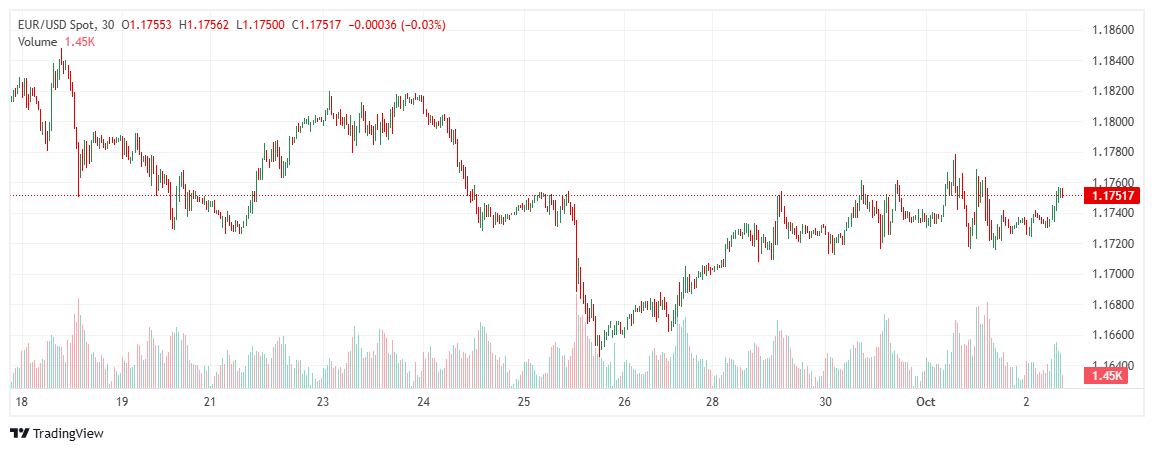
IC外汇平台:欧元兑美元缩减涨幅,回落至1.1730
Sou Hu Cai Jing· 2025-10-02 12:41
Core Viewpoint - The Euro/USD pair is currently facing selling pressure, retreating to the 1.1740-1.1730 range due to a rebound in the US dollar and disappointing ADP employment data, despite a slight improvement in ISM manufacturing PMI data [1][5]. Technical Analysis - The Euro/USD pair struggles to maintain upward momentum, with resistance at 1.1800 [3]. - The next resistance level for bulls is at 1.1918, with a potential test of the psychological level at 1.2000 if this area is breached. Conversely, a drop below the weekly low of 1.1645 could expose the 100-day simple moving average at 1.1605, followed by the weekly low of 1.1574 and the August low of 1.1391 [4]. - Momentum indicators show mixed signals, with the Relative Strength Index (RSI) slightly above the 50 threshold, indicating a loss of control by buyers. The Average Directional Index (ADX) is near 14, suggesting a lack of strength in the current trend [4]. Fundamental Overview - Recent economic data includes a decrease in Eurozone unemployment by 4.846K, against a consensus of 15.400K, while the unemployment rate remains at 6.0% [6]. - The Federal Reserve's recent actions include a 25 basis point rate cut, acknowledging a weak labor market while emphasizing that inflation remains "slightly high." The updated dot plot indicates a dovish stance, with expectations for an additional 50 basis points cut by year-end [8][9]. - The European Central Bank (ECB) has maintained stable interest rates, with officials assessing that inflation is tracking towards a mid-term target of around 2%. The core inflation rate is projected to average 2.4% in 2025, declining to 1.8% by 2027 [11][12]. Trade Tensions - Trade remains a critical risk factor, with a temporary truce between Washington and Beijing easing tensions, although high tariffs persist. The US continues to impose a 30% tariff on Chinese imports, while China maintains a 10% tariff on US goods. Additionally, a recent agreement between the US and EU has led to reduced tariffs on industrial goods, but issues regarding automobile tariffs remain unresolved [13].
铜冠金源期货商品日报-20250912
Tong Guan Jin Yuan Qi Huo· 2025-09-12 02:14
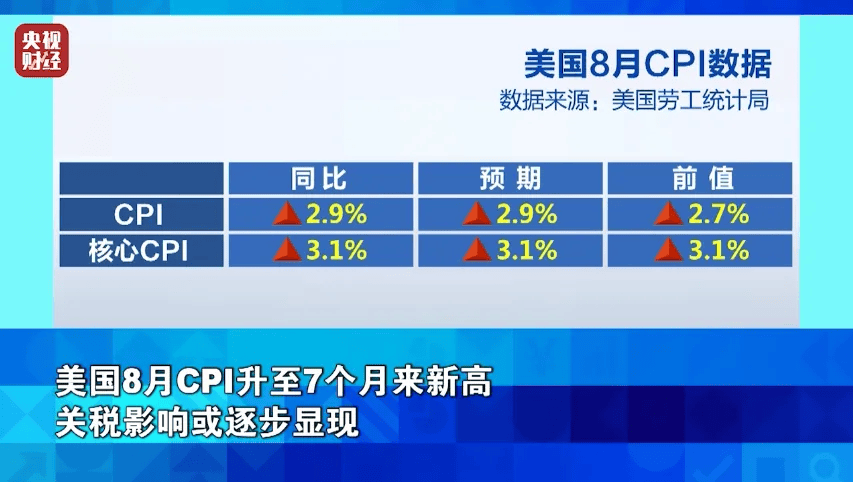
1. Report Industry Investment Rating No relevant content provided. 2. Core Viewpoints of the Report - The expectation of interest rate cuts in the US within the year is further strengthened, with the A - share market rising on heavy volume, and the bond market showing fluctuations. The prices of various commodities are influenced by macro - economic data, industry fundamentals, and geopolitical risks, showing different trends such as high - level oscillations, upward or downward trends [2][3]. 3. Summaries by Related Catalogs 3.1 Macro - Overseas: The non - over - expected CPI and cold initial jobless claims in the US in August strengthened the interest rate cut trading. The US 8 - month CPI was 2.9% year - on - year, core CPI was 3.1%, both in line with expectations and flat compared to July. The initial jobless claims rose to 263,000, hitting a more than two - year high. The market pricing of three interest rate cuts within the year was strengthened, the US dollar index fell to 97.5, the 10Y US Treasury yield dropped to the 4.0% mark, and US stocks reached new highs. The eurozone central bank maintained interest rates unchanged in September and raised growth and inflation expectations [2]. - Domestic: The A - share market rose on heavy volume, with over 4000 stocks rising and the trading volume reaching 2.4 trillion. The ChiNext and STAR Market led the gains. The bond market fluctuated sharply, with the unilateral rise of A - shares suppressing the bond market, but the marginal loosening of the capital side and the discussion of the central bank's restart of bond - buying drove the bond market to stop falling and rebound [3]. 3.2 Precious Metals - International precious metal futures prices closed mixed on Thursday. COMEX gold futures fell 0.23% to $3673.40 per ounce, and COMEX silver futures rose 1.12% to $42.07 per ounce. The market's expectation of the Fed's interest rate cut was strengthened, but the international gold price slightly declined due to long - position closing. It is expected that gold and silver prices will maintain a high - level oscillation before the Fed's interest rate cut on the 18th [4][5]. 3.3 Copper - On Thursday, the main contract of Shanghai copper oscillated upwards, and London copper approached the previous high of the year. The consumption in the domestic peak season is expected to return, and the market continues to bet on 2 - 3 interest rate cuts within the year. It is expected that copper prices will enter an oscillating upward trend in the short term [6][7]. 3.4 Aluminum - On Thursday, the main contract of Shanghai aluminum closed at 20,915 yuan/ton, up 0.63%. The LME closed at $2622/ton, up 0.21%. The social inventories of aluminum ingots and aluminum rods are both in the process of destocking, indicating that the peak - season consumption is gradually being realized. The short - term macro - environment and fundamentals are both positive, and aluminum prices will continue to show a strong performance [8][9]. 3.5 Alumina - On Thursday, the main contract of alumina futures closed at 2945 yuan/ton, up 0.79%. The supply - side pressure of alumina still exists, and the market is dominated by a bearish atmosphere. It continues to be under pressure. Attention should be paid to the cost support [10]. 3.6 Zinc - On Thursday, the main contract of Shanghai zinc oscillated narrowly during the day and shifted slightly upward at night. The social inventory in China continues to increase, which exerts pressure on zinc prices, but the inventory accumulation speed has slowed down. With the gradual recovery of consumption, destocking is still expected. Zinc prices will operate in a low - level oscillation in the short term [11]. 3.7 Lead - On Thursday, the main contract of Shanghai lead oscillated during the day and opened lower and moved higher at night. The high inventory exerts pressure on lead prices. It is expected that lead prices will maintain a weak oscillation before consumption improves [12]. 3.8 Tin - On Thursday, the main contract of Shanghai tin oscillated horizontally during the day and showed a strong oscillation at night. The low - level LME inventory still supports tin prices. It is expected that tin prices will follow the non - ferrous metal sector to repair with a strong oscillation in the short term [13][14]. 3.9 Industrial Silicon - On Thursday, the main contract of industrial silicon rebounded from a low level. The supply side shows a passive contraction trend, and the demand side has different performances in each link. The industrial silicon social inventory continues to decline, and the spot market stabilizes. It is expected that the futures price will maintain an oscillation in the short term [15][16]. 3.10 Lithium Carbonate - On Thursday, the price of lithium carbonate oscillated, and the spot price weakened. The short - term market still focuses on the resource game around the lithium mine event. Although the spot inventory is being destocked, more resources are flowing to the exchange. The lithium price may oscillate around the resource game [17]. 3.11 Nickel - On Thursday, the nickel price oscillated strongly. The US labor market shows signs of weakness, and the inflation pressure slows down. The market's expectation of the Fed's subsequent interest rate cut path is more dovish. The nickel price may oscillate strongly driven by the macro - environment [18][19]. 3.12 Crude Oil - On Thursday, the oil price oscillated. The views of OPEC and IEA are divergent. The market may be more inclined to the IEA's view, and the expectation of supply surplus may put pressure on oil prices in the medium and long term. However, short - term geopolitical risks are rising, and it is expected that the oil price will oscillate [20][21]. 3.13 Steel (Screw and Coil) - On Thursday, steel futures oscillated weakly. The steel production decreased, the inventory continued to accumulate, and the supply - demand relationship was not good. It is expected that the steel price will oscillate at a low level [22][23]. 3.14 Iron Ore - On Thursday, iron ore futures oscillated and declined. The iron ore price is affected by poor terminal demand and weak steel prices. The supply side is shrinking, and there is still a replenishment expectation in mid - to - late September. It is expected that iron ore will oscillate [24]. 3.15 Bean and Rapeseed Meal - On Thursday, the 01 contract of soybean meal rose 0.78%, and the 01 contract of rapeseed meal rose 0.98%. The market expects the NOPA's soybean crushing volume in August to reach a record high for the same period. The net sales of US soybeans for export are slow. It is expected that the domestic continuous meal will oscillate in the short term [25][26]. 3.16 Palm Oil - On Thursday, the 01 contract of palm oil fell 0.11%. High - frequency data shows that the production of Malaysian palm oil in early September decreased month - on - month, providing support for prices. It is expected that palm oil will oscillate and adjust in the short term [27][28]. 3.17 Metal Trading Data - The report provides the closing prices, price changes, price change percentages, trading volumes, and positions of various metal futures contracts on September 11, including SHFE copper, LME copper, SHFE aluminum, etc. [29] 3.18 Industrial Data - The report presents detailed industrial data for various metals such as copper, nickel, zinc, etc., including price changes, inventory changes, and basis changes from September 10 to 11 [30][31][32][33][34][35][36][37]
金价,跌了!油价,大跌!
Sou Hu Cai Jing· 2025-09-12 01:47
Group 1 - The U.S. inflation data for August met expectations, leading to increased bets on interest rate cuts by the Federal Reserve, with traders anticipating at least two cuts by the end of the year, and possibly three [1] - The U.S. Consumer Price Index (CPI) rose to 2.9% year-on-year in August, the highest level in seven months, while the core CPI remained stable at 3.1% [1] - The European Central Bank decided to keep interest rates unchanged for the second consecutive time, while raising the eurozone economic growth forecast to 1.2% [4] Group 2 - The increase in U.S. crude oil inventories by 3.9 million barrels, contrary to expectations of a decrease, raised concerns about weak demand [6] - International oil prices fell, with light crude futures closing at $62.37 per barrel, down 2.04%, and Brent crude at $66.37 per barrel, down 1.66% [7] - Gold prices experienced a slight decline, closing at $3673.6 per ounce, as investors believed the latest inflation data would not alter the Fed's decision on interest rates [9]
美股三大股指创新高,特斯拉涨超6%
Zhong Guo Zheng Quan Bao· 2025-09-11 23:37
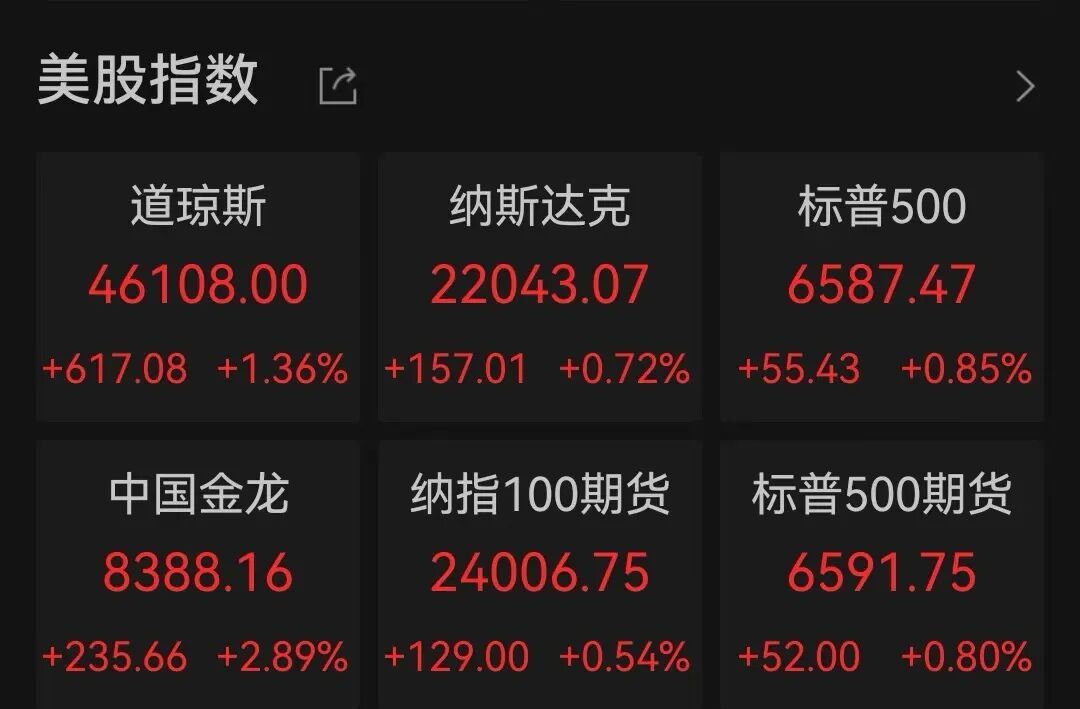
Market Performance - On September 11, US stock indices closed higher, with the Dow Jones Industrial Average rising by 1.36%, the S&P 500 increasing by 0.85%, and the Nasdaq gaining 0.72%, all reaching historical highs [1][2][3] - The Dow Jones Industrial Average peaked at 46,137.2 points during the session, closing at 46,108 points, marking the first time it closed above 46,000 points [3] - The S&P 500 index reached an intraday high of 6,592.89 points, closing at 6,587.47 points, while the Nasdaq index hit a peak of 22,059.71 points, closing at 22,043.07 points, the first close above 22,000 points [3] Technology Sector - The index of the seven major US technology stocks rose by 0.62%, with Tesla surging over 6%, Apple increasing by more than 1%, and Google and Microsoft showing slight gains [5] Chinese Stocks - Chinese stocks listed in the US saw significant gains, with the Nasdaq Golden Dragon China Index rising by 2.89%. Notable individual performances included Century Internet and GDS Holdings, both increasing nearly 15%, and Alibaba rising by nearly 8% [8][10] Precious Metals - International precious metals futures showed mixed results, with COMEX gold futures down by 0.23% to $3,673.4 per ounce, while COMEX silver futures rose by 1.12% to $42.065 per ounce [12][13] Economic Indicators - The US Labor Department reported that initial jobless claims rose to 263,000, an increase of 27,000 from the previous week, marking the highest level since October 2021 [16] - The Consumer Price Index (CPI) for August increased by 2.9% year-on-year, up from 2.7% in July, with the core CPI rising by 3.1% [17]

欧洲央行维持利率不变
Zheng Quan Shi Bao Wang· 2025-09-11 12:27
Core Points - The European Central Bank (ECB) has maintained the deposit facility rate at 2% [1] - The main refinancing rate and marginal lending rate remain unchanged at 2.15% and 2.40% respectively [1]
欧洲央行或按兵不动 欧元走势止跌转涨
Jin Tou Wang· 2025-09-05 03:26
Group 1 - The majority of economists (66 out of 69) expect the European Central Bank (ECB) to maintain the deposit rate at 2.00% during the meeting on September 11, aligning with market expectations [1] - Recent data shows inflation nearing the 2% target and unemployment at historical lows, leading most economists to believe the ECB has completed its rate-cutting cycle [1] - Approximately 60% of economists (40 out of 69) predict that the ECB will keep rates unchanged for the remainder of the year [1] Group 2 - Economists forecast the Eurozone economy to grow by 1.2% this year and 1.1% next year, consistent with the results from the August survey [1] - There are risks identified in the region, including the contraction of the German economy and political instability in some Eurozone countries [1]