现货溢价

Search documents
供应过剩担忧加剧 美国原油期货贴水率降至20个月低点
智通财经网· 2025-10-14 03:52
Group 1 - The core point of the articles highlights a narrowing spread between near-term and future WTI crude oil futures, indicating a potential oversupply in the market due to increased OPEC+ production and seasonal refinery maintenance in the U.S. [1][2] - As of Monday, the WTI crude oil futures for November settled at $59.49 per barrel, while the May 2026 contract was at $59.02, resulting in a 47-cent spot premium, the smallest since January 16 of the previous year [1] - OPEC+ has raised its oil production target by over 2.7 million barrels per day this year, which is approximately 2.5% of global demand, raising concerns about oversupply [1] Group 2 - The WTI crude oil curve is flattening as the market anticipates a less tight supply-demand balance in early 2026 [2] - U.S. refinery utilization rates have declined for four consecutive weeks, averaging 92.5%, reaching the lowest level since the beginning of June [2] - Increased physical inventories and reduced refinery output are leading to decreased demand for spot crude oil, thereby alleviating upward price pressure [2]
全世界都在预测“巨大石油过剩”,为何油价就是不崩?
Jin Shi Shu Ju· 2025-09-19 08:31
Core Viewpoint - Despite predictions of an impending oil surplus, global crude oil prices remain resilient, trading around $67 per barrel, contrary to forecasts suggesting a drop to $50 or lower [1][2]. Group 1: Supply and Demand Dynamics - Major institutions, including the International Energy Agency (IEA) and the U.S. Energy Information Administration (EIA), predict significant oil surpluses, with the IEA forecasting a record surplus of 3.3 million barrels per day by 2026 and the EIA estimating a surplus of 2.1 million barrels per day in the second half of this year [1][2]. - The current market is characterized by a "spot premium," where immediate delivery oil is priced higher than future delivery, indicating market tightness rather than an imminent surplus [2]. Group 2: China's Role in the Oil Market - China is viewed as a stabilizing force in the oil market, actively purchasing crude oil, which traders interpret as a sign of increasing consumption rather than oversupply [2]. - The IEA projects that global oil consumption will rise by only 700,000 barrels per day next year, marking the slowest growth since 2009, excluding the pandemic period [2]. Group 3: OPEC+ Production and Market Reactions - OPEC+ has increased production quotas by 2.5 million barrels per day since April, but actual production increases are expected to be lower due to several member countries reaching maximum capacity [3]. - Analysts suggest that if OPEC+ fails to meet production targets, the anticipated surplus may be smaller than predicted, potentially limiting downward pressure on oil prices [3]. Group 4: Market Sentiment and Future Outlook - Some analysts believe that the anticipated surplus may not significantly impact oil prices, as long as demand from China continues and OPEC+ maintains limited spare capacity [3][4]. - There is a sentiment that when too many traders align on a bearish outlook, it often does not materialize, indicating that unexpected factors could influence market dynamics [4].
租赁利率飙升至近40%!“黄金平替”即将出现史诗级逼空?
Jin Shi Shu Ju· 2025-07-23 09:19
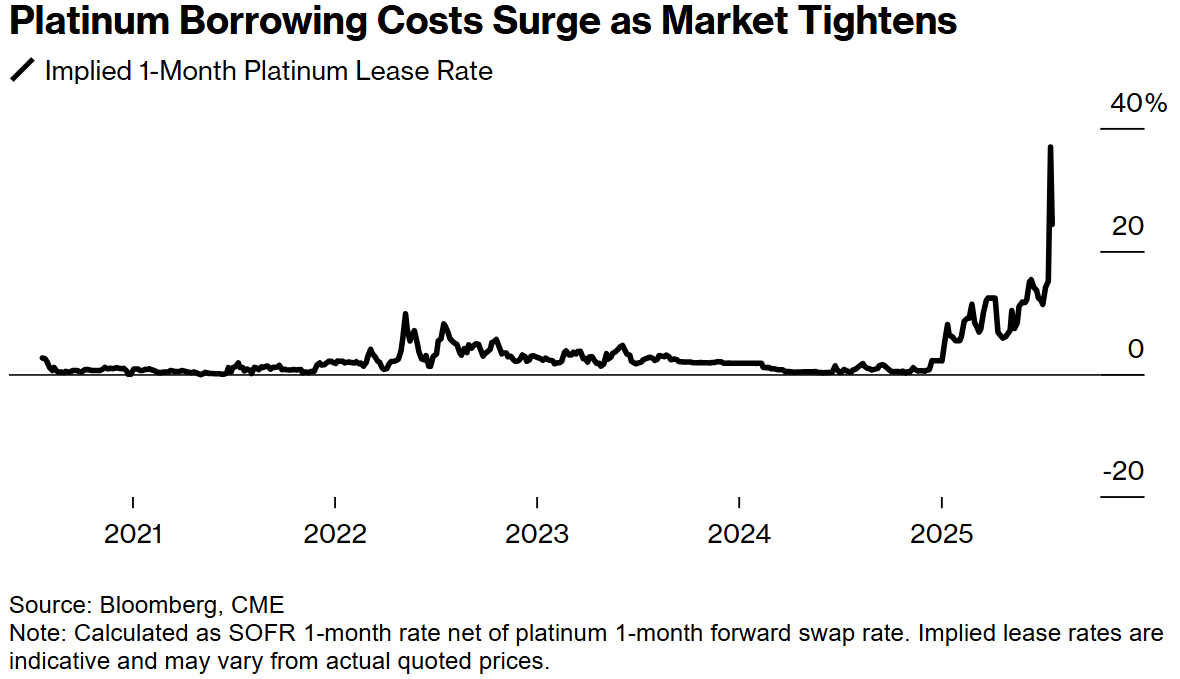
Core Insights - The platinum market has tightened to unprecedented levels due to tariff fears and speculative buying, leading to a surge in prices and borrowing costs [2][3] - Spot platinum prices have increased nearly 60% this year, reaching new historical highs, while the one-month borrowing cost has soared to nearly 40% [2][3] - The influx of over 500,000 ounces of platinum into U.S. warehouses this year was driven by tariff-related premiums, mirroring trends seen in the copper market [2][3] Market Dynamics - The current market conditions are characterized by extreme tightness, with the depth and breadth of spot premiums being more severe than at any time in the past 20 years [3] - The rising leasing rates are partly due to skepticism among platinum users regarding the sustainability of the price increase, as many participants have historically seen prices fluctuate between $950 and $1,100 per ounce [3] - Following the announcement of tariff exemptions in April, U.S. platinum inventories began to decline, but the unexpected imposition of a 50% tariff on copper has led to a resurgence in platinum premiums [3] Supply and Demand - The World Platinum Investment Council estimates that the supply deficit for platinum this year will approach 1 million ounces, further depleting already diminishing above-ground stocks [4]
铂金年内暴涨60%!美中需求激增抽空伦敦苏黎世库存
智通财经网· 2025-07-23 02:31
Group 1 - The platinum market is experiencing unprecedented tightness due to tariff concerns and speculative buying, leading to significant flows of platinum from London and Zurich to U.S. and Chinese warehouses [1] - After a record increase last month, spot prices have reached new highs, with one-month implied borrowing costs for platinum hitting the highest level since data collection began in 2002 [1] - The influx of over 500,000 ounces of platinum into U.S. warehouses earlier this year was driven by tariff-related premiums, mirroring trends seen in the copper market [1] Group 2 - Despite a slight price retreat, market tensions remain unresolved, with spot premium structures strengthening as buyers pay significantly higher prices for immediate supply compared to future contracts [5] - The rise in leasing rates is partly attributed to industry users questioning the sustainability of the recent price surge, which has seen platinum prices soar nearly 60% year-to-date [7] - The World Platinum Investment Council anticipates a supply deficit of nearly 1 million ounces this year, further depleting already limited ground inventories [7]

短期指标失灵?石油市场或比想象中更紧张!
Jin Shi Shu Ju· 2025-07-09 06:39
Group 1 - The global oil market is entering a new period of increased volatility due to unpredictable supply changes, misleading demand signals, geopolitical uncertainties, and deteriorating economic sentiment [1] - Recent abnormal fluctuations in diesel price spreads indicate that traders need a more comprehensive analytical framework to understand the market [1] - The traditional indicators, such as the diesel price spread, are failing to accurately reflect mid-term demand due to extreme weather conditions in Europe and North America [1] Group 2 - The refining industry is facing a capacity crisis, with global refining margins remaining at historically high levels despite concerns over an economic recession [2] - A total of 400,000 barrels per day of refining capacity in Europe is confirmed to be closing, including facilities in Grangemouth and several German refineries [2] - The impact of these closures has not yet fully reflected in current prices, indicating potential future price increases [2] Group 3 - The key observation point is whether the arbitrage trade from the Middle East and India to Europe will restart, serving as an early warning signal for regional supply tightness [3] - The phenomenon of "disappearing barrels" continues to perplex analysts, as the actual tightness in physical inventories far exceeds official supply-demand forecasts [3] - If U.S. sanctions on Iran and Venezuela lead to further reductions in crude oil exports, it could trigger significant market disruptions this year [3]
瑞穗证券:欧佩克+拟大幅增产 反映沙特信心满满而非意图抢夺份额
news flash· 2025-07-07 14:59
Core Viewpoint - The decision by OPEC+ to increase production by 548,000 barrels per day in August reflects Saudi Arabia's confidence in market demand rather than an intention to capture market share [1] Group 1: OPEC+ Production Decision - OPEC+ plans to increase production by 548,000 barrels per day starting in August [1] - This increase is interpreted as a sign of confidence in market demand from Saudi Arabia [1] - The decision indicates that Saudi Arabia does not aim to lower prices or capture market share through increased production [1] Group 2: Market Implications - Saudi Aramco has raised the official selling price of crude oil for August to Asian markets [1] - The current market conditions show that both WTI and Brent crude oil are trading at a premium, indicating tight supply [1] - The overall market sentiment suggests that Saudi Arabia believes the market remains tight despite the increase in production [1]
【期货热点追踪】LME铜价突破1万美元,但现货溢价暴跌85%!市场到底在交易什么逻辑?
news flash· 2025-07-02 23:46
Core Insights - LME copper prices have surpassed $10,000, indicating strong demand in the futures market [1] - However, the spot premium has plummeted by 85%, suggesting a disconnect between futures and spot market dynamics [1] Group 1: Market Dynamics - The surge in LME copper prices reflects bullish sentiment among investors, likely driven by expectations of increased demand [1] - The drastic decline in spot premiums indicates that the current market is trading on different logic, possibly influenced by supply chain issues or inventory levels [1] Group 2: Implications for Investors - The contrasting trends between futures and spot prices may present both opportunities and risks for investors looking to navigate the copper market [1] - Understanding the underlying factors contributing to the price movements is crucial for making informed investment decisions [1]
铂金再度大涨创2014年以来最高,铂金/黄金比值逼近多年阻力位
Hua Er Jie Jian Wen· 2025-06-27 02:44
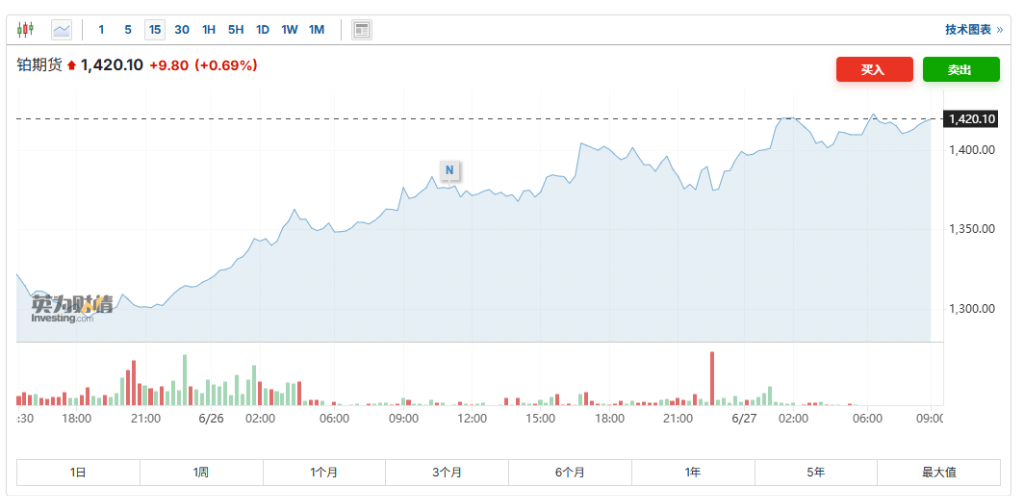
Core Viewpoint - The shift in investment from gold to platinum is driven by "gold fatigue," leading to a surge in platinum prices to over a decade high due to rapid global inventory depletion and supply constraints [1][7]. Group 1: Platinum Price Movement - On June 26, platinum prices surged by up to 4.6%, reaching the highest level since 2014, while palladium saw a rise of over 6%, marking its highest point since November of the previous year [1]. - Platinum futures continued to rise, reaching $1,420 per ounce [1]. Group 2: Market Dynamics - Contrary to expectations that tariff policies would dampen demand, actual market behavior shows increased accumulation in both China and the U.S., leading to a sharp decline in globally tradable platinum inventory [3][5]. - Approximately 500,000 ounces of platinum have flowed into U.S. warehouses, driven by profitable arbitrage opportunities and tariff concerns [5]. Group 3: Supply Constraints - The current market shows extreme supply tightness, indicated by the "spot premium" where platinum futures prices are significantly lower than spot prices [6]. - The implied borrowing cost for one-month platinum leasing remains high at an annualized rate of about 13%, well above the typical near-zero levels [6]. - Major platinum spot markets in London and Zurich have exhibited signs of tightness for several months, confirming the severity of supply shortages [6]. Group 4: Investment Trends - The rise in platinum prices is part of a broader trend of global currency devaluation, with investors seeking hedging tools beyond gold, leading to increased interest in platinum and silver [7]. - Platinum futures have seen a year-to-date increase of over 50% [7].
LME库存迅速下降,铜可能面临历史性逼空?
Hua Er Jie Jian Wen· 2025-06-24 06:41
Group 1 - The core viewpoint of the articles highlights a significant supply shortage in the copper market, leading to a record high spot premium over futures prices, indicating a severe squeeze in the market [1][2] - The spot copper premium reached $280 per ton, the highest level since the record surge in 2021, reflecting a drastic change from six months ago when short-term contracts were trading at a discount [1] - The London Metal Exchange (LME) has seen its available copper inventory drop by approximately 80% this year, now equivalent to less than a day's global usage, primarily due to a rush to ship copper to the U.S. to avoid potential import tariffs [1] Group 2 - Despite a recent slowdown in copper demand, inventory continues to tighten due to tariff impacts, leading to a competitive rush to transport copper to the U.S., causing supply shortages in other regions [2] - The LME has implemented measures to prevent individual traders from holding excessive short-term positions that could lead to spot premiums, but these measures have shown limited effectiveness in the copper market [2] - Recent trading data indicates that the copper market is experiencing deeper pressures, with significant price movements not solely influenced by any single large trader, suggesting a broader market dynamic at play [2]
铜价因美国关税而一枝独秀
日经中文网· 2025-06-20 07:30
Core Viewpoint - The article discusses the rising copper prices in the U.S. driven by increased demand and potential tariffs under Trump's administration, highlighting the implications for the copper market and related industries [1][3]. Group 1: Copper Market Dynamics - The U.S. is the second-largest copper consumer globally, following China, and has seen a surge in domestic prices due to heightened demand amid tariff discussions [1][3]. - As of June 16, LME's three-month copper futures reached $9,703 per ton, marking an 11% increase since the beginning of the year, contrasting with stable prices for aluminum and nickel [1]. - Traders are actively transporting copper from Asia to the U.S. to capitalize on higher prices, with LME inventories down 60% since early 2025 [1][3]. Group 2: Tariff Implications - Although no tariffs on copper have been implemented yet, the potential for increased tariffs has created a speculative environment, with traders anticipating price hikes [3]. - Following the announcement of higher tariffs on steel and aluminum, copper futures on the COMEX rose by 6%, indicating market sensitivity to tariff news [3]. Group 3: Inventory Concerns - A significant reduction in global copper inventories has been noted, with stocks in six countries dropping to approximately 107,000 tons, the lowest in over a year, reflecting a 60% decline since the beginning of the year [4]. - The concentration of copper in the U.S. could lead to shortages elsewhere, raising concerns about supply stability [4]. Group 4: Market Signals - The futures market is showing signs of "backwardation," where spot prices exceed futures prices, indicating a potential shortage of physical copper [5]. - The price difference between spot and three-month futures reached $96 in early June, the highest in nearly three years, suggesting strong demand for immediate delivery [5]. - Market analysts express concerns that insufficient inventory could lead to increased speculative activity, making it difficult for short positions to be maintained [5].