
电动汽车转型

Search documents
需求降温冲击供应链 LG新能源29亿美元向本田(HMC.US)出售电池厂
智通财经网· 2025-12-24 11:17
Core Viewpoint - LG Energy Solution is selling its joint battery plant assets in Ohio to Honda for approximately 4.2 trillion Korean won (29 billion USD) due to declining electric vehicle demand in the U.S. [1] Group 1: Transaction Details - The transaction involves the sale of facilities and other assets at the joint battery plant in Ohio to Honda's U.S. subsidiary [1] - The deal is expected to be finalized by the end of February next year [1] Group 2: Industry Context - The electric vehicle transition outside of China is facing obstacles, negatively impacting the growth prospects of Korean battery manufacturers [1] - Ford has previously reduced its electric vehicle business plans, terminating a battery cooperation agreement worth 9.6 trillion Korean won with LG Energy Solution [1] Group 3: Historical Background - In 2022, Honda and LG Energy Solution announced a total investment plan of 4.4 billion USD to build an electric vehicle battery factory in Ohio, with production originally set to start by the end of 2025 [1] Group 4: Operational Adjustments - In response to ongoing challenges, LG Energy Solution is accelerating its energy storage business layout and is constructing new production lines in Arizona and Michigan to mitigate the impact of declining business [1]

放弃内燃机禁令后,欧洲与美国仍有很大差异
Guan Cha Zhe Wang· 2025-12-19 09:19
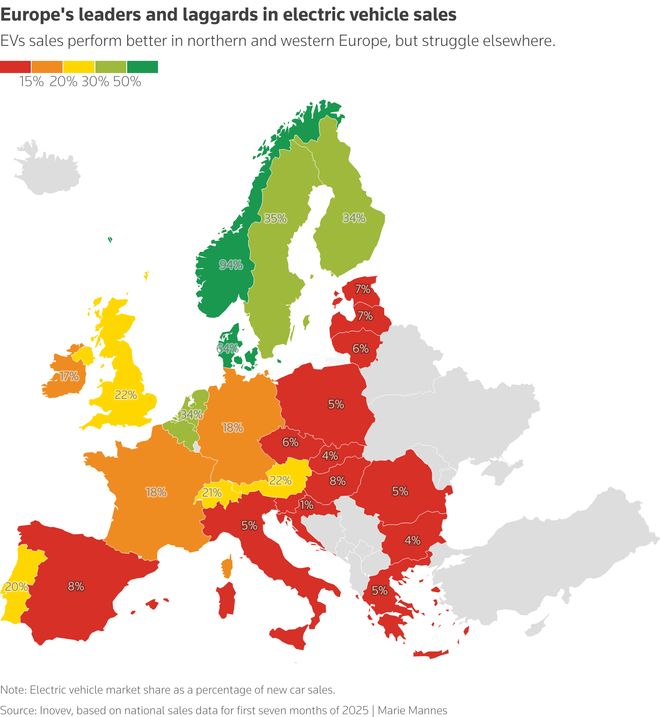
Group 1 - The EU's decision to abandon the 2035 ban on internal combustion engine vehicles provides traditional automakers in Europe with more time to transition, but electric vehicles remain the future, making it difficult for Europe to compete with China's electric vehicle industry in the long run [1] - The new EU rules allow plug-in hybrids, range-extended vehicles, and even fuel vehicles to be sold legally after 2035, and a new category for small electric vehicles has been introduced, providing additional credit for European manufacturers [2][6] - The European Automobile Manufacturers Association (ACEA) reported that electric vehicle sales in the EU increased by 25.7% year-on-year, accounting for 16.4% of total sales, but the market share is still low in Southern and Eastern Europe [2] Group 2 - Analysts predict that by 2035, pure electric vehicles will only account for 62% of sales in Europe, with slow charging infrastructure being a major barrier to higher adoption rates [5] - High-end brands like Porsche, Mercedes, and BMW may benefit the most from the EU's policy shift, as their customer base is more interested in traditional mechanical structures [5] - The EU's decision aims to give European manufacturers time to develop cost-competitive electric vehicles to catch up with Chinese brands, which have been expanding in the European market despite tariffs [6][8] Group 3 - The EU's policy shift has faced criticism from industry stakeholders and environmental organizations, with over 150 CEOs, including those from Volvo and Polestar, supporting the original 2035 ban [12] - The EU's approach contrasts with the U.S. under the Trump administration, which has withdrawn support for electric vehicles [5] - The policy changes have raised concerns among automakers about the impact on their investments, as many have spent billions on electric vehicle development and factory expansions [10]

欧盟:将放弃2035年燃油车禁令
财联社· 2025-12-16 12:07
Core Viewpoint - The European Commission is preparing to abandon the "2035 internal combustion engine ban," which would have completely prohibited the sale of internal combustion engine vehicles in the EU starting in 2035 [1]. Group 1: Policy Changes - The EU will lower the standards for banning the sale of gasoline and diesel new cars starting in 2035, allowing some plug-in hybrid vehicles and electric vehicles with fuel range extenders to be sold [2]. - The new proposal requires a 90% reduction in automotive exhaust emissions by 2035 compared to the current target of 100% reduction [2]. Group 2: Industry Response - European automakers are struggling to compete with Chinese electric vehicle manufacturers like Tesla and BYD, prompting this significant policy shift [3]. - Major manufacturers such as Volkswagen and Stellantis have been advocating for the EU to relax green targets and penalties, marking a critical moment for the automotive industry [3]. Group 3: Electric Vehicle Industry Concerns - The electric vehicle industry argues that this move will weaken investments in electric vehicles and further delay the EU's transition to electric mobility, potentially falling behind China [4]. - Executives from companies like Polestar express that retreating from a clear 100% zero-emission target to 90% could harm both climate goals and European competitiveness [4]. Group 4: Future Initiatives - The EU plans to refine initiatives to promote the share of electric vehicles in corporate fleets, which account for about 60% of new car sales in Europe [4]. - There may be proposals for a new regulatory category for small electric vehicles, which would incur lower taxes and earn additional credits towards carbon emission targets [4].

巴基斯坦汽车市场复苏
Zhong Guo Jing Ji Wang· 2025-12-10 01:21
Group 1 - The Pakistani automotive industry has shown a positive recovery trend since 2025, with total vehicle sales reaching 59,600 units from June to October 2025, a 46% increase year-on-year [1] - In October 2025 alone, sales of cars, vans, pickups, and SUVs reached 17,333 units, reflecting a 32% year-on-year growth [1] - The automotive financing sector has also experienced significant growth, with total financing rising from 236 billion PKR (approximately 949.6 million USD) in October 2024 to 315 billion PKR, marking a year-on-year increase of 33.7% [1] Group 2 - Despite the growth, the industry faces challenges, including the influx of used imported cars, with 4,423 units imported in July 2025, resulting in losses of approximately 6.5 billion PKR for local dealers [2] - Over the past decade, Pakistan has averaged 34,000 used car imports annually, with imports nearing 40,000 units in the 2024-25 fiscal year, accounting for nearly 25% of the market share, leading to an estimated revenue loss of 60 billion PKR for local parts manufacturers [2] - The transition to electric vehicles (EVs) is hindered by inadequate infrastructure, with only 35 public charging stations nationwide, equating to 0.15 stations per million people, and high upfront costs making EVs unaffordable for average consumers [2]
融资利率飙至7% 宝马、大众供应商采埃孚债务大山压顶 为德国汽车行业敲响警钟
Zhi Tong Cai Jing· 2025-12-03 11:53
Core Viewpoint - The rising debt refinancing costs for ZF Friedrichshafen AG highlight the challenges facing the German automotive industry, indicating that the difficulties are spreading throughout the supply chain [1][2]. Group 1: Financial Challenges - ZF Friedrichshafen's recent five-year euro bond interest rate has surged to 7%, compared to just 2% in 2019, reflecting the increased credit costs and financial pressure on the company [1]. - The company faces over €2 billion (approximately $2.3 billion) in debt maturing annually from 2027 to 2030, which will continue to impact its financial performance [1]. - Moody's analyst noted that ZF Friedrichshafen's credit rating is at the lower end of Ba2, indicating higher credit risk, and maintaining this rating may become difficult if conditions do not improve [2]. Group 2: Workforce Reductions - ZF Friedrichshafen plans to cut thousands of jobs, including approximately 7,600 positions in its electric drive division, as part of a broader plan to reduce up to 14,000 jobs in Germany [3][4]. - Bosch, another major supplier, is also planning to lay off about 13,000 employees in its automotive and smart transportation technology division by 2030 [3]. Group 3: Market Dynamics - The company’s debt stems from two significant acquisitions totaling around $20 billion aimed at enhancing its electric vehicle and software-defined vehicle offerings, but the slowdown in the electric vehicle transition and increased competition from Chinese firms pose ongoing challenges [1][3]. - The German automotive industry has seen nearly 50,000 job cuts this year, with suppliers being the fastest shrinking segment of this historically significant industrial sector [6]. Group 4: Investment and Restructuring - ZF Friedrichshafen is restructuring its German operations to enhance competitiveness, but there is a concerning trend of companies cutting investments and relocating production abroad [2][6]. - The lack of a financially strong shareholder to inject new capital complicates ZF Friedrichshafen's restructuring efforts, as it is primarily owned by a foundation and cannot raise funds through equity markets like some competitors [6]. Group 5: Industry Outlook - The German automotive sector is facing a significant downturn, with a record number of bankruptcies reported last year and predictions of a 30% increase in large supplier bankruptcies this year [6]. - The automotive industry is under pressure as banks are hesitant to provide additional credit, making restructuring more challenging for companies like Webasto AG [7].
本田汽车(HMC.US)Q2利润不及预期 大砍财年利润指引
Zhi Tong Cai Jing· 2025-11-07 08:17
Core Viewpoint - Honda Motor Co. has lowered its annual profit forecast by approximately 20%, citing a 25% decline in operating profit for the second fiscal quarter due to U.S. import tariffs and one-time costs associated with electric vehicles [1] Financial Performance - The revised annual operating profit forecast for the fiscal year ending March 2026 is now 550 billion yen (approximately $3.65 billion), down from the previous estimate of 700 billion yen, reflecting a 21% reduction [1] - For the quarter from July to September, Honda reported an operating profit of 194 billion yen (approximately $1.29 billion), which fell short of the average analyst expectation of 212.1 billion yen and decreased from 257.9 billion yen in the same period last year [2] - For the six months ending September 30, 2025, the company experienced a significant decline in comprehensive profit attributable to owners, which dropped 37% to 311.8 billion yen (approximately $2.03 billion) [3] - The diluted earnings per share for the same period were 76.30 yen, down from 103.25 yen year-over-year [3][4] Market Conditions - The company’s revenue for the first half of the fiscal year 2026 was 10.6 trillion yen, reflecting a slight decline of 1.5% year-over-year, indicating challenges in the macroeconomic environment and currency fluctuations [3] - The operating profit for the same period decreased by 41% to 438.1 billion yen, attributed to rising raw material costs and slow recovery in major export markets [3][4]

德国汽车业将迎20万个就业岗位流失 究竟做错了什么?
凤凰网财经· 2025-11-04 12:38
Core Insights - The German automotive industry, once a global leader, is facing significant layoffs due to declining demand, high production costs, and challenges in the transition to electric vehicles [1][2] - An estimated 200,000 jobs may be lost in the coming years, with 51,500 layoffs reported in the past year alone, representing 6.7% of the workforce in the automotive sector [1] - Major automakers like Volkswagen, Mercedes-Benz, and BMW have reported substantial profit declines, with Volkswagen's net profit down 61.5% year-on-year [1][2] Group 1: Industry Challenges - The automotive sector's struggles are attributed to insufficient profitability, with Volkswagen reporting a net profit of only €3.4 billion in the first three quarters of the year [1] - The transition to electric vehicles has been slow, with German manufacturers lagging behind competitors, particularly from China, which have gained market share due to better designs and technology [4][5] - The industry's historical reliance on brand image is becoming less effective against competitors focused on technological innovation [5] Group 2: Policy and Political Factors - Recent political decisions, including the German Chancellor's commitment to delay the EU's ban on new internal combustion engine vehicles, may disrupt the industry's transition to electric vehicles [2][9] - The cancellation of subsidies for electric vehicles has increased consumer costs and suppressed demand, further complicating the industry's recovery [6][10] - The political instability and inconsistent policies have led to a cautious investment climate, with many suppliers planning layoffs and postponing investments [10] Group 3: Future Outlook - The automotive industry is at a crossroads, needing to balance traditional manufacturing with the urgent need for innovation in electric vehicles and autonomous driving technology [8][9] - The competitive landscape is intensifying, with external pressures such as tariffs from the U.S. and the rise of Chinese electric vehicle manufacturers posing significant threats [10] - A unified policy approach is essential for the industry to regain its footing and navigate the challenges ahead [10]


德国汽车业将迎20万个就业岗位流失 究竟做错了什么?
Feng Huang Wang· 2025-11-04 08:14
Core Insights - The German automotive industry is facing significant challenges, including a projected loss of over 200,000 jobs due to declining demand, high production costs, and difficulties in transitioning to electric vehicles [1][4] - Major automakers like Volkswagen, Mercedes-Benz, and BMW have reported substantial declines in net profits, with Volkswagen's profit dropping by 61.5% year-on-year in the first three quarters of the year [1][2] - The German government is attempting to address the crisis by potentially reversing the EU's ban on new internal combustion engine vehicles post-2035, but this move poses risks to the electric vehicle transition and may undermine consumer confidence [2][3] Job Losses and Economic Impact - Since 2019, Germany has lost approximately 245,000 manufacturing jobs, with the automotive sector accounting for 51,500 job losses in the past year, representing 6.7% of the industry's total workforce [1] - The automotive industry's struggles are threatening the overall economic stability of Germany, which relies heavily on this sector [1] Electric Vehicle Transition Challenges - The rise of electric vehicles has been a double-edged sword for German automakers, who have invested billions but are now facing high costs and competition from Chinese manufacturers [4][5] - Despite some achievements in electrification, German automakers are struggling to compete due to high costs and less appealing designs compared to emerging competitors [5] Policy and Political Factors - The political landscape in Germany has contributed to the automotive industry's decline, with fluctuating policies affecting investment and consumer demand [6][8] - The government's indecisiveness and lack of a coherent strategy have led to a negative feedback loop of reduced demand and cautious investment among automakers [6][9] Competitive Landscape - German automakers are at risk of losing their competitive edge as they face increasing pressure from both domestic and international competitors, particularly in the electric vehicle market [5][9] - The industry's historical reliance on brand reputation may not be sufficient to maintain market share against more innovative and cost-effective alternatives [5][9]
离谱!欧美充电桩电缆失窃频发
Zhong Guo Qi Che Bao Wang· 2025-10-29 02:39
Core Insights - The surge in electric vehicle (EV) adoption has led to a significant increase in cable theft from charging stations, driven primarily by the rising copper prices, which have made these cables attractive targets for thieves [2][3][4] - The theft of charging cables not only disrupts the operations of charging network operators but also poses a threat to the overall transition to electric vehicles, as it undermines public confidence in charging infrastructure [6][7][8] Summary by Sections Cable Theft Incidents - In the U.S., cable theft incidents have escalated from one every six months to an average of ten per month for Electrify America [2] - In the UK, over 600 charging cables have been stolen in the past year, while in Germany, up to 70 charging stations can be rendered inoperable in a single day due to cable theft [2] Economic Drivers - The rising international copper prices, which reached nearly $5.2 per pound in May 2024, have been a significant catalyst for the increase in cable theft [3][4] - The demand for copper in electric vehicles is substantial, with each electric vehicle consuming about 60 kg of copper, which is 3-4 times more than traditional gasoline vehicles [3] Impact on Charging Network Operators - The average repair cost for a stolen cable in Germany is around €3,500, and the thefts have led to significant operational disruptions for charging network operators [6] - In the U.S., replacing a stolen cable can cost about $1,000, which is significantly higher than the resale value of the copper [7] Security Challenges - Many charging cables are made of pure copper and lack adequate physical protection, making them easy targets for thieves [5] - The open design of charging stations and the lack of effective monitoring in many areas exacerbate the problem [5] Response Strategies - Charging network operators are exploring various solutions, including the introduction of "anti-cut cables" and smart alarm systems to deter theft [8][9] - Legislative measures are being considered to classify charging cables as critical infrastructure, which would impose stricter penalties for theft [9]

泰汽车销量预计将超过去年水平
Shang Wu Bu Wang Zhan· 2025-10-23 19:23
Core Insights - The Thai automotive industry is expected to achieve domestic car sales of 600,000 units this year, despite overall weak performance, with electric vehicles (EVs) leading the market [1] - In September, sales of battery electric vehicles (BEVs) surged by 99% year-on-year, accounting for 18.8% of total car sales, surpassing internal combustion engine (ICE) vehicles at 18.7%, which saw a 22% decline in sales [1] - The transition to electric vehicles is a key factor in the anticipated increase in domestic car sales, with projections for 2024 set at 572,000 units, although high household debt levels are hindering potential buyers' access to auto loans [1] - Total car sales from January to September increased by 2% year-on-year, reaching 447,969 units compared to 438,659 units in the same period last year [1] - The new government's economic stimulus measures, particularly the "Khon La Khrueng Plus" co-payment scheme, are expected to boost consumer confidence and purchasing power [1] - In September, automotive exports grew by 7.2% year-on-year, totaling 86,056 units, driven primarily by increased sales of pure pickups and pickup-type passenger cars [1] Production Insights - Despite a 10% decline in automotive exports in the first nine months of the year, totaling 689,031 units, September saw a production increase of 4.7%, reaching 128,104 units [2] - The growth in production is largely attributed to manufacturers participating in government EV incentive programs, significantly increasing local production of BEVs to replace imported vehicles [2] - Total automotive production from January to September was 1,075,801 units, a decrease of 4.6% compared to the same period last year [3]