高级驾驶辅助系统

Search documents
汽车近半高管害怕失业
投资界· 2026-02-26 10:05
Core Viewpoint - The automotive industry is experiencing unprecedented levels of disruption, leading to heightened job insecurity among executives, with over 40% expressing concerns about job security, significantly higher than the average across other industries [3][6]. Group 1: Disruption Index and Executive Concerns - The automotive industry has the highest disruption index at 74, marking it as the most impacted sector globally for the second consecutive year [3]. - Over 40% of automotive executives are worried about job security, compared to an average of 28% across other sectors such as retail, aerospace, and healthcare [6]. - The survey included over 3,000 executives from 11 countries and 10 industries, all from companies with annual revenues exceeding $100 million, indicating a high level of representation [6]. Group 2: Sector-Specific Anxiety - Shared mobility and fleet operators have the highest disruption index at approximately 85, with nearly all executives in this segment expressing concerns about keeping pace with changes [9]. - Aftermarket parts, dealership sales and service centers, and automotive-related services follow closely with disruption indices around 78-80, with over two-thirds of executives worried about slow transformation [9]. - Automakers and automotive suppliers have the lowest disruption indices and concerns compared to other segments in the industry [9]. Group 3: Challenges and Competitive Pressures - Nearly half of the executives identified emerging competition and business models as the biggest disruptive challenge, surpassing concerns related to tariffs, geopolitical conflicts, and inflation [10]. - Chinese automotive brands are posing structural challenges to traditional automakers due to their advantages in electrification, intelligence, and rapid product development cycles [10]. - Executives prioritize affordability and alignment with Chinese product development cycles as key concerns [11]. Group 4: Executive Anxiety and Industry Transformation - The nature of product development is changing, requiring new testing, development cycles, and skill sets, which traditional automotive executives may struggle to adapt to [12]. - A significant 59% of automotive executives acknowledge that their companies are lagging in technological transformation, indicating a personal crisis for those in strategic positions [13]. - 81% of executives wish for their companies to pursue vertical integration, reflecting anxiety over supply chain and technological control [13]. Group 5: Opportunities Amidst Anxiety - Despite widespread anxiety, 72% of executives see positive impacts from autonomous vehicles and advanced driver assistance systems [14]. - 69% recognize the potential benefits of AI and machine learning, while 67% see software-defined vehicles as a positive influence [14]. - However, the automotive sector lags in monetizing AI compared to other industries, primarily using it for cost reduction and efficiency rather than revenue generation [15]. Group 6: Operational Efficiency as a Growth Lever - Given the challenges in rapidly achieving technological innovation, automotive companies are focusing on cost-cutting measures [16]. - Improving operational efficiency and capital management has become the preferred growth lever for executives, with only 20% viewing new products and services as key growth drivers [16]. - This reflects the industry's current reality where enhancing efficiency is seen as the most reliable way to maintain stability in the short term [16].


近半高管害怕失业,汽车业挤满焦虑的中年人
汽车商业评论· 2026-02-24 23:06
Core Insights - The automotive industry is currently facing unprecedented disruption, with a Disruption Index score of 74, making it the most impacted sector globally for the second consecutive year [4][6] - Over 40% of automotive executives express concerns about job security, significantly higher than the average of 28% across other industries [6] - The survey indicates that new competition and business models are perceived as the most significant disruptive challenges, surpassing traditional concerns like tariffs and geopolitical conflicts [11] Group 1: Executive Concerns - Executives in the automotive sector are particularly anxious, with shared mobility and fleet operators showing the highest disruption index at approximately 85 [11] - The automotive aftermarket, dealership sales, and related services follow closely with disruption indices around 78-80, indicating a widespread concern about the pace of transformation [11] - Nearly 59% of automotive executives admit their companies are lagging in technological advancements, highlighting a personal and corporate crisis [17] Group 2: Industry Transformation - The shift towards electric and intelligent vehicles is creating structural challenges for traditional automotive giants, with Chinese brands gaining a competitive edge due to faster product development cycles [12] - 81% of executives wish to pursue vertical integration as a response to supply chain and technological uncertainties [17] - Despite the anxiety, 72% of executives see potential in autonomous vehicles and advanced driver-assistance systems, while 69% recognize the positive impact of AI and machine learning [18] Group 3: Operational Strategies - The automotive industry is focusing on improving operational efficiency and capital management as primary growth levers, with only 20% of executives considering new products and services as key growth drivers [20] - The lengthy development cycles in the automotive sector hinder the rapid monetization of AI technologies, which are primarily used for cost reduction rather than revenue generation [18][20] - The industry is currently prioritizing efficiency improvements to maintain stability amid rising costs of raw materials and logistics [20]

黑猫投诉发布12月国内汽车召回数据:日系品牌占近6成 驾驶辅助系统为主要召回原因
Xin Lang Cai Jing· 2026-01-16 07:14
Core Viewpoint - The article provides an overview of the passenger car recall situation in December 2025, highlighting a total of 199,141 vehicles recalled, which represents an 18.55% decrease compared to November 2025 [2][9]. Group 1: Recall Statistics - A total of 18 passenger car recall announcements were made in December 2025, involving 199,141 vehicles [2][9]. - Japanese brands accounted for nearly 60% of the total recalls, with Toyota, Honda, and Lexus recalling 117,014 vehicles, representing 58.76% of the total [3][10]. - American brands, including Ford, Jeep, and Lincoln, recalled 56,089 vehicles, making up 28.17% of the total recalls [3][10]. - German brands, such as Audi and Volkswagen, recalled 25,739 vehicles, which is 12.93% of the total [3][10]. - Korean brand Genesis recalled 299 vehicles, accounting for 0.15% of the total [3][10]. Group 2: Reasons for Recall - The primary reasons for the recalls in December 2025 were identified as issues with advanced driver assistance systems, fuel systems, and specialized devices for new energy vehicles [4][11]. - Toyota and Lexus recalled 93,882 vehicles due to a design flaw in the panoramic monitoring system, which could affect the driver's judgment of the vehicle's surroundings [5][12]. - Ford recalled 38,473 vehicles due to a stress concentration issue at the connection between the fuel hose and the fuel tank, which could lead to fuel leakage under certain conditions [6][13]. - Honda recalled 22,696 vehicles due to a software setting issue in the power control system that could cause a loss of driving power and potential emissions non-compliance [7][14][15].


广州:加快推进国家5G车联网先导区建设 支持在公共交通领域率先探索自动驾驶示范应用
Zheng Quan Shi Bao· 2026-01-08 11:46
Core Viewpoint - The Guangzhou Municipal Government has issued a plan to accelerate the construction of a strong advanced manufacturing city from 2024 to 2035, focusing on smart connected vehicles and intelligent transportation applications [1] Group 1: Smart Connected Vehicles - The plan supports the establishment of demonstration zones for smart connected vehicles based on broadband mobile internet [1] - It emphasizes the acceleration of the national 5G vehicle networking pilot zone construction [1] - The initiative includes the development of intelligent driving cockpit solutions and in-vehicle infotainment systems [1] Group 2: Autonomous Driving Applications - The plan encourages the public transportation sector to explore autonomous driving demonstration applications [1] - It aims to create world-class demonstration application cases in the field of autonomous driving [1] - The establishment of closed testing zones and several semi-open and fully open testing areas for smart connected vehicles is supported [1] Group 3: Road Testing and Advanced Systems - The plan promotes the acceleration of road testing for smart connected vehicles [1] - It supports the development of advanced driver assistance systems and tire pressure monitoring systems [1] - The initiative aims to enhance the overall infrastructure for intelligent transportation solutions [1]
广州:加快推进国家5G车联网先导区建设 支持在公共交通领域率先探索自动驾驶示范应用
Zheng Quan Shi Bao Wang· 2026-01-08 09:27
Core Viewpoint - The Guangzhou Municipal Government has issued a plan to accelerate the construction of a strong advanced manufacturing city from 2024 to 2035, focusing on smart connected vehicles and intelligent transportation applications [1] Group 1: Smart Connected Vehicles - The plan supports the establishment of demonstration zones for smart connected vehicles based on broadband mobile internet [1] - It emphasizes the acceleration of the national 5G vehicle networking pilot zone construction [1] - The initiative includes the development of intelligent cockpit solutions and in-vehicle infotainment systems, as well as advanced driver assistance systems [1] Group 2: Autonomous Driving Applications - The plan encourages the public transportation sector to explore autonomous driving demonstration applications [1] - It aims to create world-class demonstration application cases in the field of autonomous driving [1] - The establishment of closed testing zones and several semi-open and fully open testing areas for smart connected vehicles is supported [1] Group 3: Road Testing and Development - The plan promotes the acceleration of road testing for smart connected vehicles [1] - It includes support for tire pressure monitoring and air conditioning control systems as part of the vehicle technology development [1]
美国自动驾驶或现重大推进
3 6 Ke· 2026-01-07 10:09
Group 1 - The U.S. House Energy and Commerce Committee plans to hold a hearing on January 13 to discuss legislation aimed at simplifying the deployment process for autonomous vehicles [1] - There has been a longstanding division in Congress regarding legislation to address barriers to the deployment of autonomous taxis [2] - The National Highway Traffic Safety Administration (NHTSA) currently maintains existing safety regulations and has not approved exemption requests from major automakers [2] Group 2 - The upcoming hearing will review multiple proposals, including one to increase the annual cap on the number of autonomous vehicles deployed to 90,000 [4] - Automakers have expressed concerns that certain safety standards, such as requiring rearview mirrors or steering wheels, may not be necessary for autonomous taxis [4] - One proposed bill would prohibit states from establishing rules regarding autonomous systems, while another would require NHTSA to develop guidelines for calibrating advanced driver assistance systems [4] Group 3 - The autonomous driving industry has faced increased scrutiny following an incident in October 2023, where a pedestrian was severely injured by a self-driving vehicle from General Motors [5] - Investigations have been launched by NHTSA into autonomous vehicles operated by Waymo and Amazon's Zoox [5] - Since the Trump administration took office, there has been a push to promote the adoption of autonomous driving technology in the U.S. [6] Group 4 - NHTSA has indicated it will expedite the review of automakers' applications to deploy autonomous vehicles without human control [7] - Tesla launched a small autonomous taxi service in Austin, Texas, equipped with a safety monitoring system [7] - Mercedes-Benz announced plans to introduce a new advanced driver assistance system in the U.S. later this year, allowing vehicles to operate autonomously in urban areas under driver supervision [7]
专访:中国的创新生态和产业环境助力企业发展——访法国法雷奥集团首席执行官佩里亚
Xin Hua She· 2025-12-07 07:34
Core Insights - Valeo is leveraging China's robust innovation ecosystem and competitive environment to enhance its capabilities and drive growth [1][2] - The company has established a significant presence in China with 27 production bases and 13 R&D centers, employing over 18,000 people, including more than 4,500 in R&D [1] - In 2024, Valeo's sales in China are projected to approach 30 billion RMB, making it the largest market for the company globally [1] Group 1 - Valeo is focusing on electric vehicle technology and advanced driver assistance systems, increasing investments in R&D and manufacturing in China [2] - The company plans to expand or build multiple factories and R&D facilities by 2025, including a "lighthouse factory" in Shenzhen and a new manufacturing base in Shanghai [2] - Over 65% of Valeo's orders in China by Q3 2025 are expected to come from local OEMs, reflecting a shift in the order structure towards domestic clients [2] Group 2 - Valeo is exploring new opportunities in emerging sectors such as data center cooling and drone component manufacturing, recognizing China's potential in these areas [2] - The company aims to deepen economic and trade cooperation between France and China, contributing to sustainable innovation and high-quality development in the global automotive industry [2]
“去中国化”与“在中国化”共舞
Zhong Guo Qi Che Bao Wang· 2025-12-05 09:39
Group 1: Core Perspectives - The automotive industry is experiencing a dual phenomenon of "localization in China" and "de-Chinaization," driven by geopolitical factors, market dynamics, and industrial upgrades, reflecting a dynamic balance in globalization and regionalization [2][8] - Major automotive companies are increasingly adopting a "China for China" strategy, moving beyond simple localization to deeper integration in response to the rapid transformation towards new energy and intelligent vehicles in the Chinese market [3][6] Group 2: Actions by Automotive Companies - Volkswagen Group has accelerated innovation in China, investing approximately 7.5 billion yuan to establish a major R&D center in Hefei, which has shortened new product development cycles by 30% [6] - Toyota has appointed a Chinese national as the general manager of Toyota China and implemented a "Chief Engineer in China" system, shifting product development leadership to local engineers [6] - Ford has unified its sales channels by establishing a wholly-owned sales service company to enhance brand experience, while General Motors has achieved over 99% localization in its supply chain in China [7] Group 3: De-Chinaization Trends - Some foreign automakers, influenced by geopolitical tensions and supply chain security concerns, are attempting to reduce reliance on Chinese suppliers, with reports of European companies seeking to replace Chinese-made semiconductors [8][9] - The U.S. has imposed tariffs and trade restrictions on China, prompting some companies to consider "de-Chinaization" strategies to maintain competitiveness in the face of rising costs [9][10] Group 4: Resilience of Chinese Supply Chain - Despite external pressures, the attractiveness of the Chinese market continues to drive companies to maintain close ties with Chinese supply chains, particularly in the automotive sector [13][17] - China's supply chain has shown significant resilience and competitiveness, with many companies establishing a robust multinational supply system since 2018 [14][18] - The transition of supply chains may incur initial costs of 30% to 50%, but the efficiency of integrating with existing Chinese supply chains remains advantageous [14][15] Group 5: Future Outlook - The Chinese automotive market is expected to continue its rapid growth, with a shift in how vehicles are perceived, moving from mere transportation to mobile living spaces [17] - The integration of AI and smart technologies is enhancing the potential of vehicles, prompting multinational companies to localize R&D and decision-making processes in China [17][18] - The ongoing transformation from "localization in China" to "de-Chinaization" and ultimately to a new global balance reflects the evolving landscape of the global automotive industry, with China playing an increasingly pivotal role [18]

融资利率飙至7% 宝马、大众供应商采埃孚债务大山压顶 为德国汽车行业敲响警钟
Zhi Tong Cai Jing· 2025-12-03 11:53
Core Viewpoint - The rising debt refinancing costs for ZF Friedrichshafen AG highlight the challenges facing the German automotive industry, indicating that the difficulties are spreading throughout the supply chain [1][2]. Group 1: Financial Challenges - ZF Friedrichshafen's recent five-year euro bond interest rate has surged to 7%, compared to just 2% in 2019, reflecting the increased credit costs and financial pressure on the company [1]. - The company faces over €2 billion (approximately $2.3 billion) in debt maturing annually from 2027 to 2030, which will continue to impact its financial performance [1]. - Moody's analyst noted that ZF Friedrichshafen's credit rating is at the lower end of Ba2, indicating higher credit risk, and maintaining this rating may become difficult if conditions do not improve [2]. Group 2: Workforce Reductions - ZF Friedrichshafen plans to cut thousands of jobs, including approximately 7,600 positions in its electric drive division, as part of a broader plan to reduce up to 14,000 jobs in Germany [3][4]. - Bosch, another major supplier, is also planning to lay off about 13,000 employees in its automotive and smart transportation technology division by 2030 [3]. Group 3: Market Dynamics - The company’s debt stems from two significant acquisitions totaling around $20 billion aimed at enhancing its electric vehicle and software-defined vehicle offerings, but the slowdown in the electric vehicle transition and increased competition from Chinese firms pose ongoing challenges [1][3]. - The German automotive industry has seen nearly 50,000 job cuts this year, with suppliers being the fastest shrinking segment of this historically significant industrial sector [6]. Group 4: Investment and Restructuring - ZF Friedrichshafen is restructuring its German operations to enhance competitiveness, but there is a concerning trend of companies cutting investments and relocating production abroad [2][6]. - The lack of a financially strong shareholder to inject new capital complicates ZF Friedrichshafen's restructuring efforts, as it is primarily owned by a foundation and cannot raise funds through equity markets like some competitors [6]. Group 5: Industry Outlook - The German automotive sector is facing a significant downturn, with a record number of bankruptcies reported last year and predictions of a 30% increase in large supplier bankruptcies this year [6]. - The automotive industry is under pressure as banks are hesitant to provide additional credit, making restructuring more challenging for companies like Webasto AG [7].
推动全球汽车产业电动化、智能化、低碳化转型(国际视点)
Ren Min Ri Bao· 2025-09-14 22:03
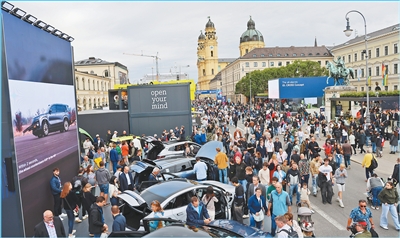
Group 1: Event Overview - The 2025 Munich International Motor Show, themed "'Moving' Everything," took place from September 9 to 14, attracting around 750 exhibitors from over 30 countries, with 116 Chinese exhibitors, marking a historical high in participation [2][3] - The event showcased the global shift towards electric, intelligent, and low-carbon mobility, with significant attention on new products and technologies from Chinese companies [2][5] Group 2: Industry Trends - The International Energy Agency's report indicates that global electric vehicle sales surpassed 4 million units in Q1 2025, with an expected annual total exceeding 20 million units, representing a 25% year-on-year increase and accounting for 25% of global new car sales [2] - By 2030, the number of public charging stations worldwide is projected to increase nearly eightfold to approximately 40 million [2] Group 3: Innovations and Technologies - Major automotive manufacturers like BMW, Mercedes, and Volkswagen are focusing on electric and intelligent development, with BMW showcasing the new iX3 model capable of over 900 km range and rapid charging [3][4] - Bosch and ZF presented advanced driver assistance systems and software-defined vehicle solutions, highlighting the integration of cutting-edge technology in automotive design [4][8] Group 4: Chinese Brands and Contributions - Chinese exhibitors, including BYD and GAC Group, showcased innovative models and technologies, such as BYD's ultra-fast charging technology and GAC's first mass-produced flying car [5][6] - BYD announced plans to establish a factory in Hungary by 2025, emphasizing its commitment to the European market and localizing production and services [5][6] Group 5: International Collaboration - The automotive industry is characterized by high globalization, with German companies relying on global supply chains and partnerships with Chinese firms for technological innovation and product development [7][8] - Companies like CATL and EVE Energy are focusing on localizing production in Europe, with CATL investing in a testing center in Germany to support green transformation efforts [7][8]